超导

Search documents
A股开盘|沪指跌0.17% 智能驾驶题材活跃
Di Yi Cai Jing· 2025-12-16 03:44
Market Overview - The three major stock indices opened lower, with the Shanghai Composite Index down by 0.17%, the Shenzhen Component Index down by 0.21%, and the ChiNext Index down by 0.23% [1] Sector Performance - E-commerce, photolithography, nuclear fusion, superconductors, CPO, and memory concept stocks experienced a pullback [1] - Intelligent driving themes remained active during this trading session [1]
每日资讯晨报-20251215
Jinyuan Securities· 2025-12-15 02:56
Group 1: Market Overview - The Dow Jones Industrial Average closed at 48,458, down 0.51% in the last trading day and up 2.11% over the last 20 trading days [1] - The Nasdaq Composite closed at 23,195, down 1.69% in the last trading day and up 1.42% over the last 20 trading days [1] - The S&P 500 closed at 6,827, down 1.07% in the last trading day and up 1.33% over the last 20 trading days [1] - The Hang Seng Index increased by 1.75% to close at 25,977 [1][4] - The Nikkei 225 index rose by 1.37% to close at 50,837 [1][4] Group 2: Company News - SpaceX is advancing an internal stock transfer transaction, which values the company at approximately $800 billion, paving the way for a potential IPO [15] - Moer Technology has outlined a clear plan for the use of the 7.5 billion yuan raised, focusing on R&D and technology upgrades [15] - Kehua Data has partnered with domestic GPU chip manufacturers to support the development of a self-controlled computing ecosystem [15] - Shunhao Co. indicates that its "Tianshu Tiansuan" business may take 5 years to realize commercial value, facing significant challenges [15] - Yongding Co. does not directly manufacture controllable nuclear fusion devices but provides materials for the magnetic coils of such devices [15] - Longsheng Technology plans to invest approximately 350 million yuan in a new intelligent robotics innovation center in Wuxi [15] Group 3: Economic Indicators - The broad money supply (M2) in China reached 336.99 trillion yuan, growing by 8% year-on-year [13] - The total social financing scale was 440.07 trillion yuan, with a year-on-year increase of 8.5% [13] - The average age of the labor force in China is 39.66 years, reflecting a shift from quantity to quality and structural advantages in the demographic dividend [14]
A股午盘|沪指跌0.04% 银行板块走弱
Di Yi Cai Jing· 2025-12-12 04:05
Core Viewpoint - The stock market showed mixed performance with the Shanghai Composite Index slightly down by 0.04%, while the Shenzhen Component Index and the ChiNext Index increased by 0.57% and 0.6% respectively [1] Group 1: Market Performance - The Shanghai Composite Index decreased by 0.04% [1] - The Shenzhen Component Index increased by 0.57% [1] - The ChiNext Index rose by 0.6% [1] Group 2: Sector Performance - Commercial aerospace concept stocks were notably active [1] - Sectors such as nuclear fusion, CPO, ultra-high voltage, superconductors, charging piles, and photolithography machines saw significant gains [1] - Lithium battery electrolyte, cross-strait integration, and banking sectors experienced weakness [1]
A股收评:三大指数高开低走,北证50逆市涨3.84%,房地产、福建板块领跌!超4300股下跌,成交1.89万亿放量936亿
Sou Hu Cai Jing· 2025-12-11 07:26
Core Viewpoint - The A-share market experienced a decline today, with major indices falling, while the North Exchange 50 index saw an increase, indicating mixed market sentiment [1]. Market Performance - The Shanghai Composite Index closed at 3873.32, down 0.70% [2] - The Shenzhen Component Index fell by 1.27% to 13147.39 [2] - The ChiNext Index decreased by 1.41% to 3163.67 [2] - The North Exchange 50 Index rose by 3.84% to 1443.1 [2] - Total market turnover reached 1.89 trillion yuan, an increase of 936 billion yuan from the previous trading day, with over 4300 stocks declining [1]. Sector Performance - The real estate sector declined, with China Wuyi hitting the daily limit down [5] - The Fujian sector also retreated, with multiple stocks like Huaying Technology and Xiamen Xinda hitting the daily limit down [5] - The duty-free concept saw a drop, with Guangbai shares falling nearly 9% [5] - The aquaculture sector weakened, with Tianma Technology hitting the daily limit down [5] - Other sectors with significant declines included the small red book concept, commercial retail, and prepared dishes [5]. Gaining Sectors - The controllable nuclear fusion sector surged, with Tianli Composite hitting the daily limit up, along with Huazhong Cable and Xue Ren shares [5] - The wind power equipment sector rose, with Goldwind Technology hitting the daily limit up [5] - The superconducting concept also saw gains, with Yongding shares hitting the daily limit up [5] - Other sectors with notable increases included commercial aerospace and instrumentation [5].

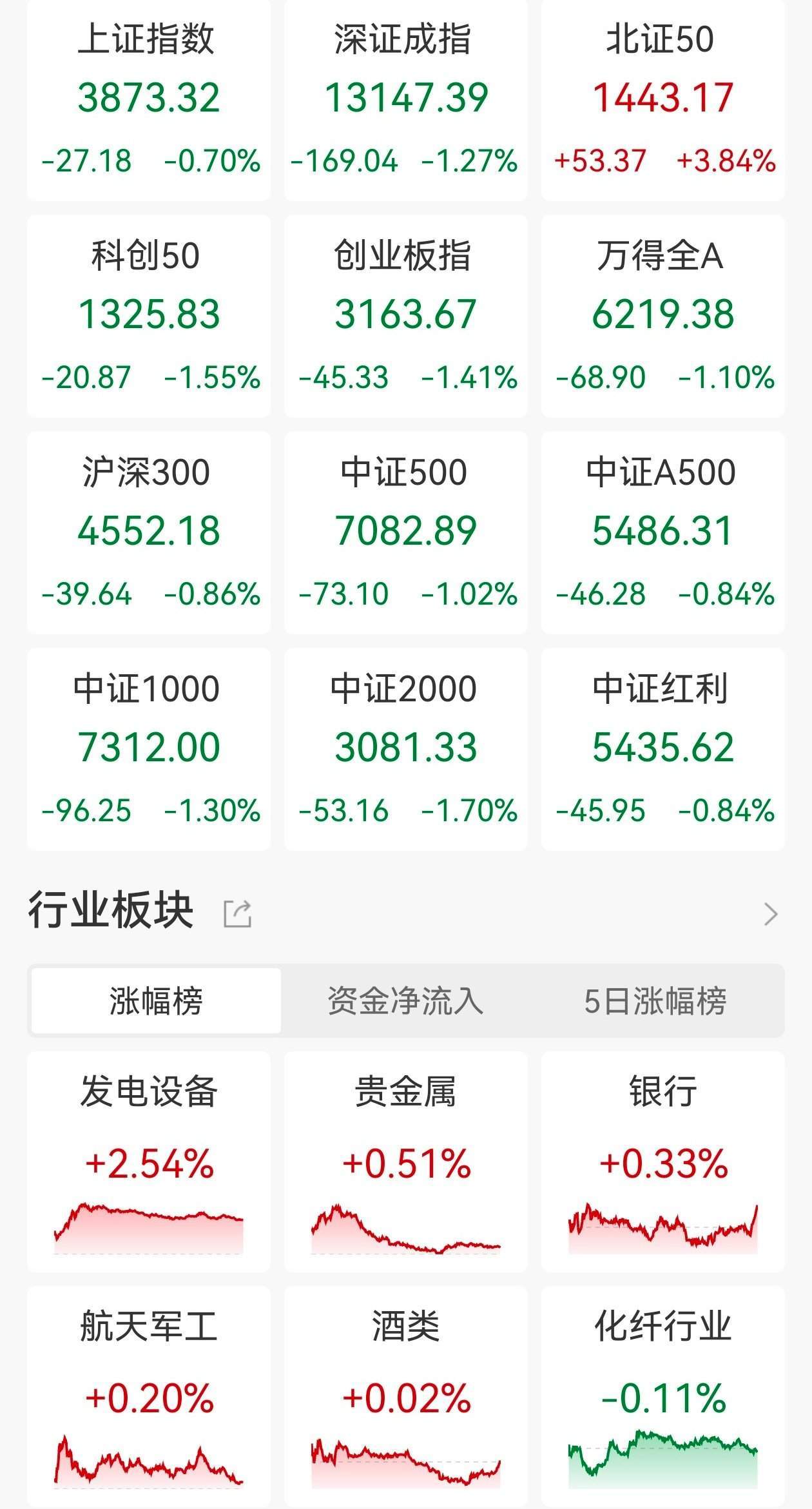
A股收评:三大指数高开低走创业板指跌1.41%,北证50逆市涨3.84%,发电设备强势,房地产、福建板块领跌!超4300股下跌,成交1.89万亿放量936亿
Sou Hu Cai Jing· 2025-12-11 07:21
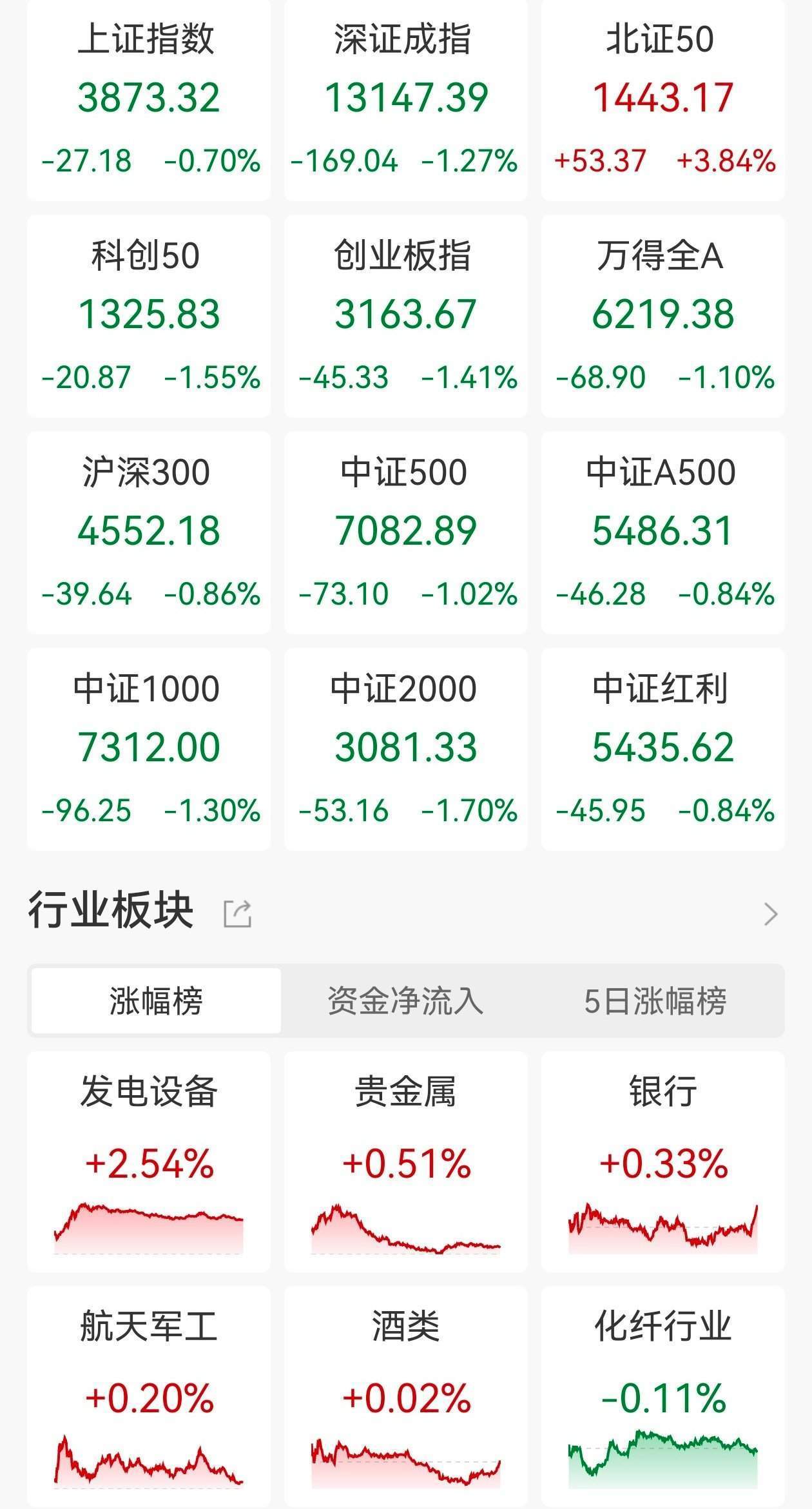
Market Overview - The A-share market experienced a decline today, with the Shanghai Composite Index falling by 0.7% to close at 3873 points, and the Shenzhen Component Index dropping by 1.27% [1][2] - The total market turnover reached 1.89 trillion yuan, an increase of 936 billion yuan compared to the previous trading day, with over 4300 stocks declining [1] Index Performance - Shanghai Composite Index: 3873.32, down 27.18 points (-0.70%) [2] - Shenzhen Component Index: 13147.39, down 169.04 points (-1.27%) [2] - ChiNext Index: 3163.67, down 45.33 points (-1.41%) [2] - North Star 50 Index: 1443.1, up 53.37 points (+3.84%) [2] Sector Performance - The market saw a broad decline across various sectors, with significant drops in the duty-free concept, which fell nearly 9%, and the aquaculture sector, which hit the limit down [4] - The Fujian sector also experienced a pullback, with multiple stocks hitting the limit down [4] - Conversely, the controllable nuclear fusion sector surged, with Tianli Composite hitting the limit up, along with several other stocks [4] - The wind power equipment sector showed gains, and the superconducting concept also saw a rise, with some stocks hitting the limit up [4]

超导指数盘中涨2%,成分股普涨
Mei Ri Jing Ji Xin Wen· 2025-12-11 02:01
Group 1 - The superconducting index rose by 2% during intraday trading, indicating a general upward trend among constituent stocks [1] - Notable performers included Farsens and Yongding Co., which reached the daily limit, while Hancable increased by 8.94%, Western Superconducting by 2.74%, and Baile Electric by 2.72% [1]


开盘:沪指涨0.16%、创业板指涨0.32%,商业航天、券商及超导概念股走高
Jin Rong Jie· 2025-12-08 02:09
Market Overview - On December 8, A-shares opened higher with the Shanghai Composite Index rising by 0.16% to 3909.23 points, the Shenzhen Component Index up by 0.24% to 13178.96 points, and the ChiNext Index increasing by 0.32% to 3119.15 points. The Sci-Tech 50 Index slightly decreased by 0.01% to 1325.97 points [1] Company News - Muxi Co., Ltd. initiated a mechanism that resulted in a final offline issuance of 22.829 million shares, accounting for 70.26% of the total issuance after deducting the strategic placement. The online issuance was 9.6655 million shares, making up 29.74% of the total [2] - A company named Aini Co., Ltd. completed a share transfer, making Shengshi Tianan the controlling shareholder, with the actual controllers changing to Li Ning and Wang Lei. The company's stock will resume trading on December 8 [2] - Tianji Co., Ltd. plans to reduce its holdings by 14.2563 million shares, bringing the total shareholding down to 12.12% [2] - Tian Ci Materials announced that its Vice Chairman Xu Sanshan plans to reduce his holdings by up to 500,000 shares, while other executives also plan to reduce their holdings [3] - Zhongneng Electric plans to acquire 65% of the equity and debt of three companies, including Shandong Dacheng Electric Co., Ltd., for a total cash payment [3] - Bo Hai Chemical is planning to sell its 100% stake in Bo Hai Petrochemical and acquire control of Anhui Taida New Materials Co., Ltd. through a share issuance and cash payment [3] - Baisheng Intelligent intends to acquire 51% of Hefei Zhongke Shengu Technology Development Co., Ltd. for a preliminary price of 100 million yuan [4] Industry Insights - The 2025 National Medical Insurance Drug List has added 114 new drugs, including 50 innovative drugs, with an overall success rate of 88%, significantly higher than the 76% in 2024 [5] - The commercial aerospace sector is seeing growth with a new factory capable of producing 1,000 satellites annually, enhancing the ecosystem for rocket research, satellite manufacturing, and launch control [6] - China and France have issued a joint statement to promote cooperation in the peaceful use of nuclear energy, welcoming ongoing industrial and technological collaborations [7] - The Ministry of Commerce is focusing on expanding consumer goods consumption and enhancing policies to support domestic and international product consumption [9] - The Ministry of Industry and Information Technology held a meeting emphasizing the importance of carbon peak and carbon neutrality management in industrial sectors [10] - Recent reports indicate a significant surge in the spot prices of storage chips, particularly DDR4x, which have increased over four times this year, leading to supply chain challenges for manufacturers [11]
A股大消费板块拉升,超导概念股持续走强
Qi Huo Ri Bao· 2025-12-05 12:21
Group 1: Stock Market Performance - A-shares experienced a rebound with the Shanghai Composite Index rising by 0.7%, Shenzhen Component Index by 1.08%, and ChiNext Index by 1.36% [1] - Over 4,300 stocks in the market increased, with total trading volume reaching 17,390 billion yuan, an increase of 1,773 billion yuan compared to the previous trading day [1] - For the week, the Shanghai Composite Index rose by 0.37%, Shenzhen Component Index by 1.26%, and ChiNext Index by 1.86% [1] Group 2: Sector Performance - The insurance sector showed significant gains, leading the market with a strong performance [1] - China Pacific Insurance (601601) increased by 6.85%, while China Ping An saw substantial gains in both A-shares and H-shares [1] - According to CITIC Securities, the insurance industry is entering a phase of healthy expansion, with expectations of continued upward trends through 2026 [1] Group 3: Superconducting Materials - The superconducting concept continues to strengthen, with companies like Baosheng Co. (600973) and Ningbo Yunsheng (600366) hitting the daily limit [2] - A new nickel-based superconductor developed by Chinese scientists has set a record for the highest superconducting transition temperature, published in the journal Nature [2] Group 4: Consumer Sector - The consumer sector saw a surge, with a wave of stocks hitting the daily limit [2] - The Ministry of Commerce announced plans to enhance supply of essential goods and stimulate consumption through high-level opening-up measures [2]


午后大幅拉升!A股第一名
Zhong Guo Zheng Quan Bao· 2025-12-05 08:40
Market Overview - On December 5, A-shares experienced a rebound with active individual stock performance, as major indices strengthened in the afternoon. The Shanghai Composite Index rose by 0.7%, the Shenzhen Component Index increased by 1.08%, and the ChiNext Index gained 1.36%. Over 4,300 stocks in the market saw an increase, with total trading volume reaching 17,390 billion yuan, an increase of 1,773 billion yuan from the previous trading day [1]. Insurance Sector - The insurance sector saw a significant surge, with China Pacific Insurance (601601) rising by 6.85%, and both A-shares and H-shares of Ping An Insurance experiencing substantial gains [3][4]. - The National Financial Regulatory Administration announced a reduction in risk factors for insurance companies investing in stocks from the CSI 300 index and other ordinary stocks listed on the Sci-Tech Innovation Board. This is expected to support the positive expansion of the insurance industry, with projections indicating a continued upward trend through 2026 [5]. Superconducting Materials - The superconducting concept continued to strengthen, with stocks such as Baosheng Co. (600973), Ningbo Yunsen (600366), and others reaching their daily price limits. This follows recent advancements in nickel-based superconductors, which have achieved record transition temperatures, potentially paving the way for practical applications in various fields, including controlled nuclear fusion [6][9]. Consumer Sector - The consumer sector experienced a surge, with stocks like Dinggu Jichuang (300749) hitting their daily price limits. The Ministry of Commerce announced plans to promote consumption activities, including the "Spring Festival Consumption Season" and online New Year goods festivals, to stimulate consumer spending during the traditional peak season [10][14].





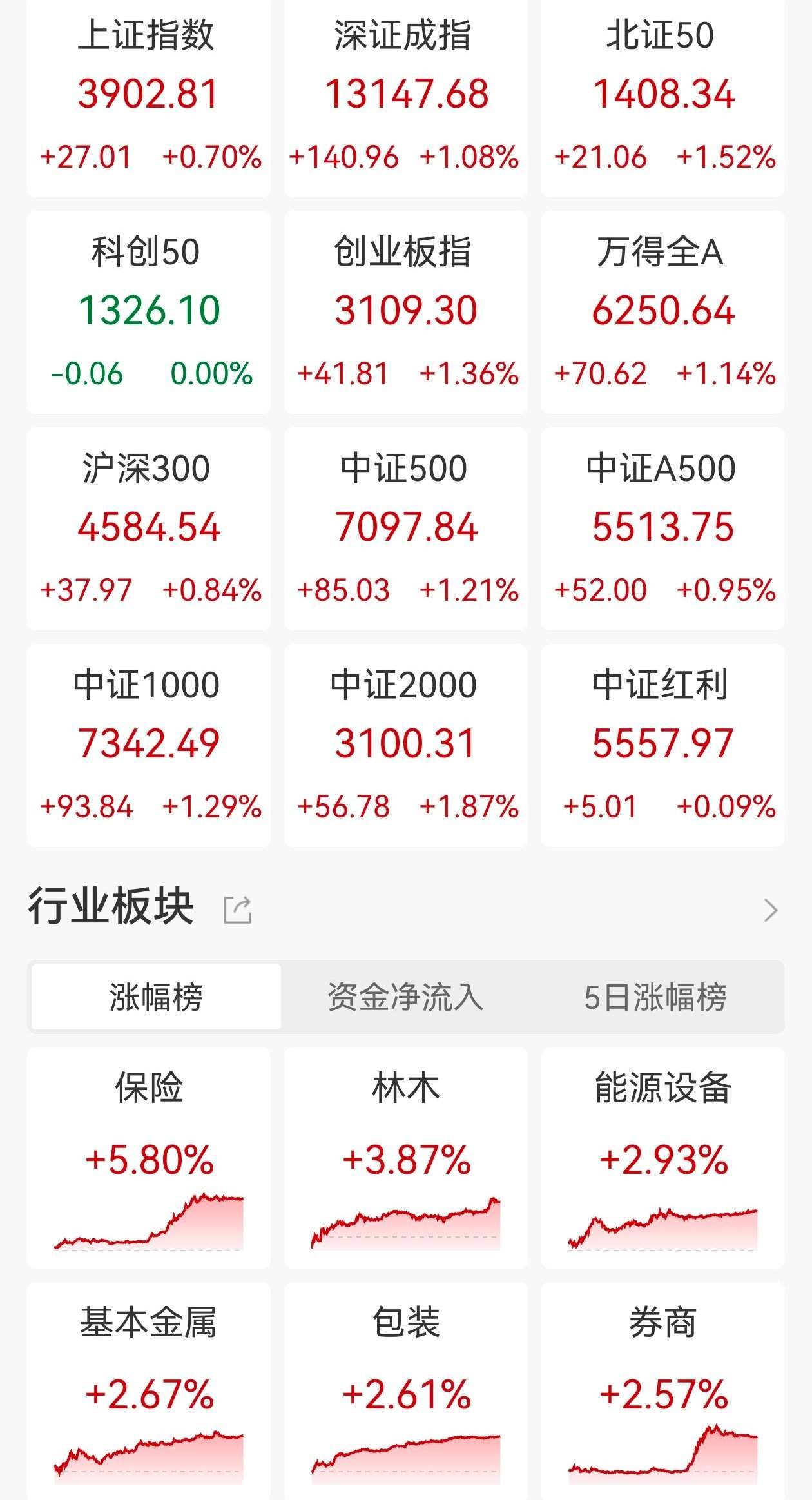
A股收评:午后拉升三大指数集体上涨,沪指涨0.7%创业板指涨超1%北证50涨1.52%,保险、商业航天大涨!近4400股上涨,成交额1.74万亿放量1773亿
Ge Long Hui· 2025-12-05 07:26
Market Performance - The A-share market experienced slight fluctuations in the morning, followed by a collective rise in the afternoon, with the Shanghai Composite Index closing up 0.7% at 3902 points, the Shenzhen Component Index up 1.08%, and the ChiNext Index up 1.36% [1] - The total market turnover reached 1.74 trillion yuan, an increase of 177.3 billion yuan compared to the previous trading day, with nearly 4400 stocks rising [1] Index Summary - Shanghai Composite Index: 3902.81 (+27.01, +0.70%) [2] - Shenzhen Component Index: 13147.68 (+140.96, +1.08%) [2] - ChiNext Index: 3109.30 (+41.81, +1.36%) [2] - CSI 300: 7097.84 (+37.97, +0.84%) [2] - CSI 500: 5513.75 (+85.03, +1.21%) [2] - CSI 1000: 7342.49 (+93.84, +1.29%) [2] Sector Performance - The insurance sector saw significant gains, with China Ping An (601318) being added to a key focus list by Morgan Stanley, leading to a nearly 6% increase in its stock price, while China Pacific Insurance (601601) rose nearly 7% [3] - The commercial aerospace sector also performed well following the successful launch of Blue Arrow Aerospace's Zhuque-3, with stocks like Aerospace Development (000547) and Aerospace Science and Technology hitting the daily limit [3] - The superconducting concept stocks surged, with Yongding Co. (600105) reaching the daily limit [3] - The controllable nuclear fusion sector strengthened, with stocks like Changguang Huaxin also hitting the daily limit [3] - Other sectors that performed well included precious metals, non-ferrous metals, satellite internet, and those related to Fujian [3] - Conversely, bank stocks declined, with Chongqing Bank leading the losses, and the public utilities sector weakened, with Lianmei Holdings (600167) nearing the daily limit down [3] - The tourism, hotel, and traditional Chinese medicine sectors experienced notable declines [3]