
晶圆代工

Search documents
全球晶圆代工TOP10,最新出炉!
Sou Hu Cai Jing· 2025-06-09 14:32
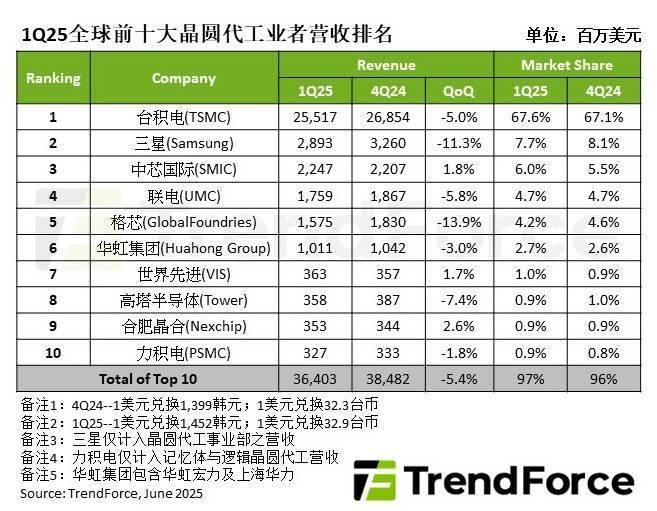
Core Insights - The global wafer foundry industry is expected to see a revenue decline of approximately 5.4% in Q1 2025, totaling $36.4 billion, influenced by international market conditions and seasonal factors [2][3] - The second quarter is anticipated to show revenue growth for the top ten foundries, driven by China's old-for-new subsidy policy, pre-launch inventory for new smartphone models, and stable demand for AI HPC [2] Company Performance - TSMC remains the market leader with a revenue of $25.5 billion in Q1 2025, a decrease of 5% quarter-over-quarter, holding a market share of 67.6% [3][4] - Samsung's foundry revenue fell by 11.3% to $2.89 billion, with a market share of 7.7%, primarily due to weak mobile chip demand and ongoing inventory adjustments [5] - SMIC reported a revenue increase of 1.8% to $2.25 billion, benefiting from customer pre-orders and domestic consumption subsidies, ranking third in the industry [6] - UMC's revenue decreased by 5.8% to $1.76 billion, maintaining its fourth position, with stable wafer shipments offsetting seasonal impacts [6] - GlobalFoundries experienced a revenue decline of 13.9% to $1.58 billion, while HuaHong Group ranked sixth with stable performance [7] - Vanguard's revenue increased by 1.7% to $363 million, moving up to seventh place, while Tower's revenue decreased by 7.4% to $358 million [7] - Nexchip's revenue grew by 2.6% to $353 million, ranking ninth, while PSMC's revenue slightly decreased by 1.8% to $327 million, placing it tenth [8] Market Trends - TSMC's advanced process technologies, particularly in AI and HPC, are driving revenue growth, with 3nm, 5nm, and 7nm processes contributing 73% of wafer sales [4] - AI chip demand is projected to be a significant growth driver for TSMC, with a forecasted 100% increase in AI accelerator chip sales in 2025 [4] - SMIC anticipates a revenue decline of 4% to 6% in Q2 2025, indicating a challenging market environment ahead [6]


2025年Q1全球晶圆代工营收微降,淡季效应与政策调整双重影响
Sou Hu Cai Jing· 2025-06-09 14:32
Core Insights - The global wafer foundry industry experienced a 5.4% quarter-over-quarter decline in total revenue for Q1 2025, amounting to $36.403 billion, but showed a significant year-over-year growth of 24.8% [1] - The traditional seasonal slowdown in the wafer foundry industry was somewhat mitigated this year due to uncertainties in international conditions prompting downstream customers to stock up inventory and China's ongoing trade-in policy [1] Industry Performance - Despite facing seasonal challenges, the wafer foundry industry demonstrated resilience, with expectations for revenue growth in Q2 2025 driven by the launch of new smartphone models and stable demand from AI and HPC sectors [4] - The top ten global wafer foundries accounted for 97% of the market share in Q1 2025, with a total revenue of $36.403 billion [2] Company Rankings - TSMC led the market with a revenue of $25.517 billion in Q1 2025, despite a 5.0% decline from Q4 2024, maintaining a market share of 67.6% [2] - Samsung's revenue fell by 11.3% to $2.893 billion, resulting in a market share of 7.7% [2] - SMIC reported a slight revenue increase of 1.8% to $2.247 billion, raising its market share to 6.0% [2] - Vanguard's capacity utilization was above average due to customer stockpiling, while Tower Semiconductor faced significant seasonal impacts and did not benefit from China's subsidy policies [4]



台积电市占,创历史新高
半导体芯闻· 2025-06-09 10:34
如果您希望可以时常见面,欢迎标星收藏哦~ 来源:内容来自联合报 。 集邦科技今日发布首季晶圆代工市占调查,美国新关税政府引发的提前备货及中国旧换新补贴影 响,急单涌进,抵销淡季效应,首季营收季减5.4%,优于预期,台积电也挟AI及HPC订单需求稳 定,首季全球市占再向上推升,达到67.6%,稳坐全球第一。 集邦调查,第1季主要晶圆代工厂营收合计仅季减约5.4%,为364亿美元,优于预期。展望第2季营 收表现,随着关税引发的提前备货告一段落,整体动能逐步放缓,唯中国旧换新的补贴政策拉货潮 有望延续,加上下半年智慧手机新品上市前备货陆续启动,以及AI HPC需求稳定,将成为带动第 2季产能利用率和出货的关键,预期前十大晶圆代工厂营收将呈现季增。 集邦指出,第1季各晶圆代工业厂仍由台积电以67.6%市占率稳居第一,虽其晶圆出货虽因智慧手 机备货淡季而下滑,但因AI及HPC需求和电视的关税避险急单仍然强劲,抵销手机端需求下滑不 利因素,营收255亿美元,季减5%。 第二名的三星代工部门因美国先进制程禁令限制中国客户投产,以及其客户组成关系,获得中国消 费补贴的红利有限,第1季营收季减11.3%,为28.9亿美元,市占 ...

机构:Q1淡季效应减轻 晶圆代工营收季减至5.4%
news flash· 2025-06-09 07:17
Core Insights - The global wafer foundry industry is experiencing a preemptive inventory buildup due to changes in international circumstances, with some companies receiving urgent orders from clients [1] - China's continuation of the old-for-new subsidy policy introduced in 2024 is helping to mitigate some of the seasonal downturn impacts [1] - Overall industry revenue is projected to decrease by approximately 5.4% quarter-over-quarter, reaching $36.4 billion in the first quarter of 2025 [1]
机构:预期2Q25前十大晶圆代工厂营收呈现季增
news flash· 2025-06-09 07:05
机构:预期2Q25前十大晶圆代工厂营收呈现季增 金十数据6月9日讯,根据TrendForce集邦咨询最新调查,2025年第一季,全球晶圆代工产业受国际形势 变化影响而提前备货,部分业者接获客户急单,加上中国延续2024年推出的旧换新补贴政策,抵消部分 淡季冲击,整体产业营收季减约5.4%,收敛至364亿美元。展望第二季营收表现,整体动能逐步放缓, 唯中国旧换新的补贴政策拉货潮有望延续,加上下半年智能手机新品上市前备货陆续启动,以及AIHPC 需求稳定,将成为带动第二季产能利用率和出货的关键,预期前十大晶圆代工厂营收将呈现季增。 ...
研报 | 1Q25淡季效应减轻,晶圆代工营收季减至5.4%
TrendForce集邦· 2025-06-09 06:53
June 9, 2025 产业洞察 根据TrendForce集邦咨询最新调查,2025年第一季,全球晶圆代工产业受国际形势变化影响而提前备 货,部分业者接获客户急单,加上中国延续2024年推出的旧换新补贴政策,抵消部分淡季冲击, 整 体产业营收季减约5.4%,收敛至364亿美元。 展望第二季营收表现,整体动能逐步放缓,唯中国旧换新的补贴政策拉货潮有望延续,加上下半年智 能手机新品上市前备货陆续启动,以及AI HPC需求稳定,将成为带动第二季产能利用率和出货的关 键,预期前十大晶圆代工厂营收将呈现季增。 | Ranking | Company | | Revenue | | | Market Share | | --- | --- | --- | --- | --- | --- | --- | | | | 1Q25 | 4Q24 | QoQ | 1Q25 | 4Q24 | | 1 | 台积电(TSMC) | 25,517 | 26,854 | -5.0% | 67.6% | 67.1% | | 2 | 三星(Samsung) | 2,893 | 3,260 | -11.3% | 7.7% | 8.1% | | ...
英特尔晶圆厂,抢客户
半导体芯闻· 2025-06-04 10:20
Core Viewpoint - Intel is strategically targeting the South Korean market for its foundry services, particularly aiming to compete with Samsung's wafer foundry business by hosting the Direct Connect Asia event in Seoul [1][2]. Group 1: Event and Strategic Intent - Intel's foundry division will hold the Direct Connect Asia event in Seoul on June 24, marking the first time this event is held outside the U.S. [1] - The event aims to engage with local IC design companies in South Korea that require low-cost advanced process foundry services, indicating Intel's intent to capture market share from Samsung [1][2]. Group 2: Technology and Competitive Landscape - Intel has high hopes for its Intel 18A process technology, which utilizes advanced RibbonFET and PowerVia technologies, and plans to begin mass production in the second half of 2025 [1][2]. - Intel 18A is positioned to compete directly with TSMC's 2nm process technology, showcasing its potential in the foundry market [2]. - Samsung's advanced process technology has lagged behind TSMC, with reports indicating only a 50% yield for its 3nm process and a current 40% yield for its 2nm process, which may hinder its ability to attract large clients [2].

2nm来了,台积电面临四大挑战
半导体行业观察· 2025-05-24 01:43
Core Viewpoint - TSMC's 2nm process is set to begin mass production in the second half of 2025, with a projected monthly capacity of 30,000 wafers by the end of the year, despite facing four significant challenges in the semiconductor supply chain [1][2][4]. Group 1: Production and Capacity - TSMC's 2nm process is expected to exceed the tape-out numbers of the 3nm process in its first two years, potentially driving a global product value of approximately $2.5 trillion within five years of mass production [3]. - The initial production site for the 2nm process will be the Fab 20 in Hsinchu, with an estimated capacity of 3,000 wafers per month by mid-2024, increasing to 22,000 wafers by the end of the year [3][4]. - The 2nm foundry service price is projected to rise to nearly $30,000 per wafer, contributing to TSMC's anticipated 25% growth in annual revenue [4]. Group 2: Challenges Facing TSMC - TSMC faces challenges including the need to expand its Arizona facility in response to U.S. government demands, which may impact future operational performance [1][2]. - Antitrust issues are becoming a concern as TSMC's market share in the global foundry market exceeds 60%, potentially reaching 70% by the end of the year, creating a divide between TSMC and its competitors [1][2]. - The ongoing U.S.-China trade tensions and inflationary pressures pose significant challenges for cost management and pricing strategies within the semiconductor industry [2][4]. - Geopolitical factors are complicating TSMC's capacity planning, requiring a balance between maintaining operations in Taiwan and expanding manufacturing in the U.S. [2][4].
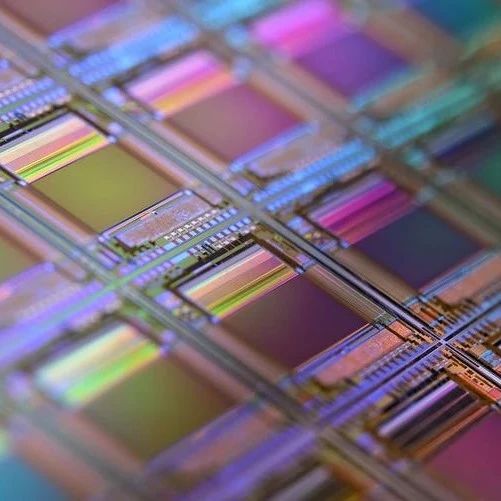
2025一季度全球晶圆代工业务营收连续第五个季度实现增长
势银芯链· 2025-05-19 03:21
Core Insights - The global wafer foundry market is expected to rebound rapidly in 2024, driven by high demand for high-performance computing chips, smartphone chips, and advanced automotive chips [2] - In Q1 2025, the global wafer foundry business revenue increased by 27% year-on-year, marking the fifth consecutive quarter of recovery, although it experienced a 5% quarter-on-quarter decline due to seasonal factors [2] - Chinese domestic company Chipalliance has shown impressive performance, surpassing South Korea's Dongbu HiTek in overall revenue since Q3 2024, ranking 11th globally in wafer foundry business [4] Industry Events - The 2025 TrendBank (5th) Lithography Materials Industry Conference will be held from July 8-10 in Hefei, focusing on in-depth discussions of the lithography materials supply chain and industry development [7] - The conference aims to create an efficient communication platform for government, industry, academia, research, and capital, promoting collaborative innovation in the lithography materials industry [7] Company Overview - TrendBank is a leading industry research and data company in China, providing data, research, consulting, and conference services to support decision-making and business development resources [12]

中芯国际(0981
2025-05-15 15:05
Summary of Conference Call Records Companies and Industries Involved - **Companies**: SMIC (中芯国际, 0981.HK), Hua Hong Semiconductor (华虹半导体, 1347.HK) - **Industry**: Semiconductor Manufacturing Key Points and Arguments SMIC Performance Overview - **Q1 Revenue**: SMIC's Q1 revenue was $2.2 billion, a year-on-year increase of 28%, but the quarter-on-quarter growth was only 1.8%, below expectations [1][2][4] - **Net Profit**: The net profit was $180 million, slightly below the market consensus of $221 million, affected by government subsidies and exchange rate impacts [1][4] - **Gross Margin Guidance**: The gross margin guidance for Q2 is 18%-20%, lower than the market expectation of 21% [1][4] - **ASP Decline**: Average Selling Price (ASP) decreased by 9% due to production issues and equipment stability problems [1][5] Hua Hong Semiconductor Performance Overview - **Q1 Revenue**: Hua Hong's Q1 revenue was approximately $500 million, with a year-on-year growth of less than 18% [1][2][8] - **Net Profit Decline**: Net profit dropped significantly by 88% to $3.75 million, primarily due to depreciation from new production lines and product mix adjustments [1][8] - **Capacity Utilization**: Despite challenges, capacity utilization remained above 100% [1][8] Advanced Process Contribution - **Underperformance**: The advanced process segment's contribution was below expectations due to production issues and delays in product structure [5][9] - **Production Issues**: Two production incidents occurred, one due to equipment maintenance errors and another related to the stability of newly introduced equipment [6][7] Market Dynamics and Future Outlook - **US-China Tariff Negotiations**: The impact of US-China tariff negotiations on SMIC is minimal, with direct tariff risk accounting for about 1% of revenue [3][11] - **Revenue Projections**: SMIC expects revenues of $9.6 billion, $11.9 billion, and $14.6 billion for 2025, 2026, and 2027, respectively, with net profits projected to grow significantly [3][19] - **Hua Hong Expansion Plans**: Hua Hong plans to release 40,000 wafers by the end of 2025 and aims for full capacity release by mid-2027 [3][26] Challenges and Risks - **Production Stability**: Ongoing issues with equipment stability may impact production yields and ASP in the first half of 2024 [7][10] - **Market Sentiment**: Despite short-term challenges, both companies are expected to benefit from the trend of localization and increased domestic demand [10][14] Valuation and Investment Potential - **SMIC Valuation**: Current valuation is at 2x PB, with potential for growth as performance improves and product shipments accelerate [21][25] - **Hua Hong Valuation**: Hua Hong's valuation is expected to remain above 1x PB, with significant improvements anticipated in profitability and ASP in the coming years [39][40] Key Performance Indicators to Monitor - **Capacity Expansion**: Focus on the pace of capacity expansion and technological breakthroughs [41] - **Pricing Power**: Monitoring ASP trends and cost control measures [41] - **Market Demand**: The overall semiconductor market dynamics influenced by AI and macroeconomic factors [41] Conclusion - Both SMIC and Hua Hong Semiconductor face short-term challenges but have strong long-term growth potential driven by domestic demand and technological advancements. Monitoring key performance indicators will be crucial for assessing future investment opportunities.
