
国产化进程

Search documents
热点回应丨内存涨价潮波及手机终端市场
Ke Ji Ri Bao· 2026-02-28 01:12
Core Viewpoint - Meizu has announced the suspension of new domestic smartphone hardware development due to the soaring prices of memory chips, marking it as the first smartphone brand to be significantly impacted by this price surge [1] Group 1: Reasons for Price Increase - The current price surge of memory chips is attributed to a severe imbalance in market supply and demand, driven by increased demand from AI servers and a reduction in inventory of smart terminals [2] - The semiconductor industry has been in a state of destocking and capacity control for the past couple of years, leading to insufficient supply elasticity, compounded by high industry concentration where core capacity is held by a few companies [2] - The shift in demand from traditional consumer electronics and PCs to AI-driven applications has caused resources to be redirected towards more profitable sectors, further straining supply [2] Group 2: Impact of Price Surge - The ongoing increase in memory prices is expected to affect the terminal market, with Counterpoint Research predicting that the average price of new smartphones in China will rise by 15%-25% compared to similar models in 2025 starting from March [3] - The overall cost of components is likely to remain high throughout the year, with terminal prices adjusting dynamically based on cost changes and market competition rather than rigid increases [3] - Companies with supply chain advantages, scale procurement capabilities, operational efficiency, and technological innovation will be better positioned to maintain profitability and growth despite rising costs [3] Group 3: Progress of Domestic Capacity Release - The current price surge is influenced by the varying stages of domestic production capacity development, with some Chinese companies increasing investments in the storage sector, although high-end memory production remains constrained by technology maturity and equipment limitations [4] - The global storage market is still dominated by foreign manufacturers, but domestic companies are making progress in technology and capacity, meeting some demand in local applications [5] - In the medium to long term, advancements in domestic storage technology and gradual capacity release are expected to enhance supply chain autonomy and provide more stable cost expectations for the terminal market [5]
工业母机ETF(159667)涨超2%,盘中净流入超1000万份,制造业景气度有望逐渐回升
Mei Ri Jing Ji Xin Wen· 2026-02-24 03:30
Core Viewpoint - The industrial mother machine ETF (159667) has seen a rise of over 2% with a net inflow of over 10 million units, indicating a potential gradual recovery in manufacturing industry sentiment [1][2]. Group 1: Market Performance - The industrial mother machine ETF (159667) recorded a net inflow of 11 million units during trading, reflecting strong capital interest [2]. - The ETF tracks the China Securities Machine Tool Index (931866), which includes listed companies involved in the manufacturing and servicing of machine tools and key components [2]. Group 2: Industry Outlook - Domestic policies and measures aimed at reducing competition are expected to enhance the profitability of the manufacturing sector, leading to a gradual recovery in manufacturing sentiment [2]. - The global trends in artificial intelligence and data center construction are driving rapid price increases in storage and chips, which is likely to accelerate production expansion in the semiconductor industry [2]. - The upcoming 2026 CCTV Spring Festival Gala is anticipated to showcase humanoid robots from leading companies, potentially boosting product shipment volumes significantly [2]. - The development of Tesla's Optimus V3 is expected to enter mass production, which could lead to explosive growth in the production and sales of humanoid robots globally, thereby increasing demand for upstream core components [2].
C919生产开门红,“今年有望每15天内造一架”
Guan Cha Zhe Wang· 2026-01-26 07:35
Core Viewpoint - The commercial operation of China's C919 aircraft is steadily progressing, with production and delivery accelerating, aiming for a target of at least 28 deliveries in 2026, with a production rate of one aircraft every 10 to 15 days expected [1][4][5]. Production and Delivery - In 2025, COMAC delivered a total of approximately 15 C919 aircraft, including 6 to Air China, 4 to China Eastern Airlines, and 5 to China Southern Airlines, marking an increase from 12 deliveries in 2024 but falling short of the initial target of 75 [2][5]. - The supply chain issues that hindered production in the previous year are gradually improving, with 8 of the 15 aircraft delivered in November and December [2][5]. - The company anticipates that the supply chain situation will continue to improve in the new year, with two C919 aircraft already completed and entering the delivery process at the start of 2026 [4][5]. Engine Supply and Political Factors - The reliance on Western-made LEAP-1C engines poses a challenge for COMAC, as political factors can disrupt the procurement process, although the company is working closely with CFM International to ensure a steady supply [5][6][7]. - Analysts suggest that while the political interference in engine supply is unavoidable, strengthening cooperation with CFM International is the most feasible way for COMAC to increase production in the short term [7]. Market Position and Future Prospects - The C919 has already transported over 4 million passengers since its domestic operation began in May 2023, and the order backlog continues to grow, with major airlines planning to purchase at least 100 aircraft each by 2031 [10]. - The current share of domestically produced aircraft in China's civil aviation fleet has increased from 1.3% in 2019 to 4.7% [10]. - COMAC is actively pursuing international airworthiness certification for the C919, which is crucial for competing with Boeing and Airbus [10][11].


研报掘金丨光大证券:北方华创持续受益于国产化进程,维持“买入”评级
Ge Long Hui A P P· 2026-01-13 07:42
Core Viewpoint - The report from Everbright Securities highlights the strategic transfer of shares in Northern Huachuang, indicating a strengthening of collaboration between Beijing Electric Control and Guoxin Investment, which is expected to enhance resource advantages and promote a "capital cooperation driving industrial empowerment" model [1] Group 1: Share Transfer Details - Beijing Electric Control has received approval from the Beijing State-owned Assets Supervision and Administration Commission to transfer 14,481,773 shares of Northern Huachuang, representing 2% of the total share capital [1] - The share transfer price is set at 426.39 yuan per share, amounting to a total transaction value of 6.174 billion yuan [1] Group 2: Strategic Implications - The share transfer is aimed at strengthening the strategic partnership between Beijing Electric Control and Guoxin Investment, leveraging both parties' resource advantages [1] - The company has announced an equity incentive plan to closely bind its core team, indicating a focus on talent retention and motivation [1] Group 3: Market Position - Northern Huachuang is positioned as a leading platform company in the semiconductor equipment sector, expected to benefit continuously from the domestic production process [1] - The investment rating for the company is maintained at "Buy," reflecting confidence in its growth prospects [1]


价格飙升!内存条何以成“抢手货”?
新华网财经· 2026-01-13 04:58
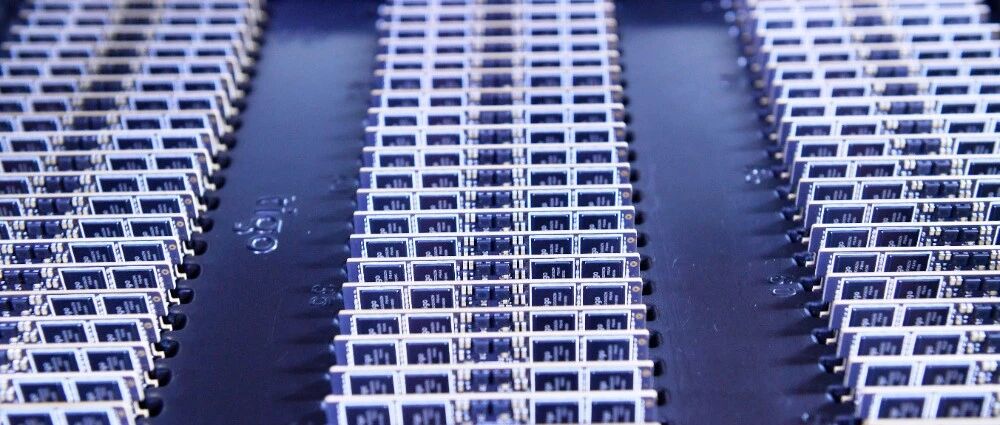
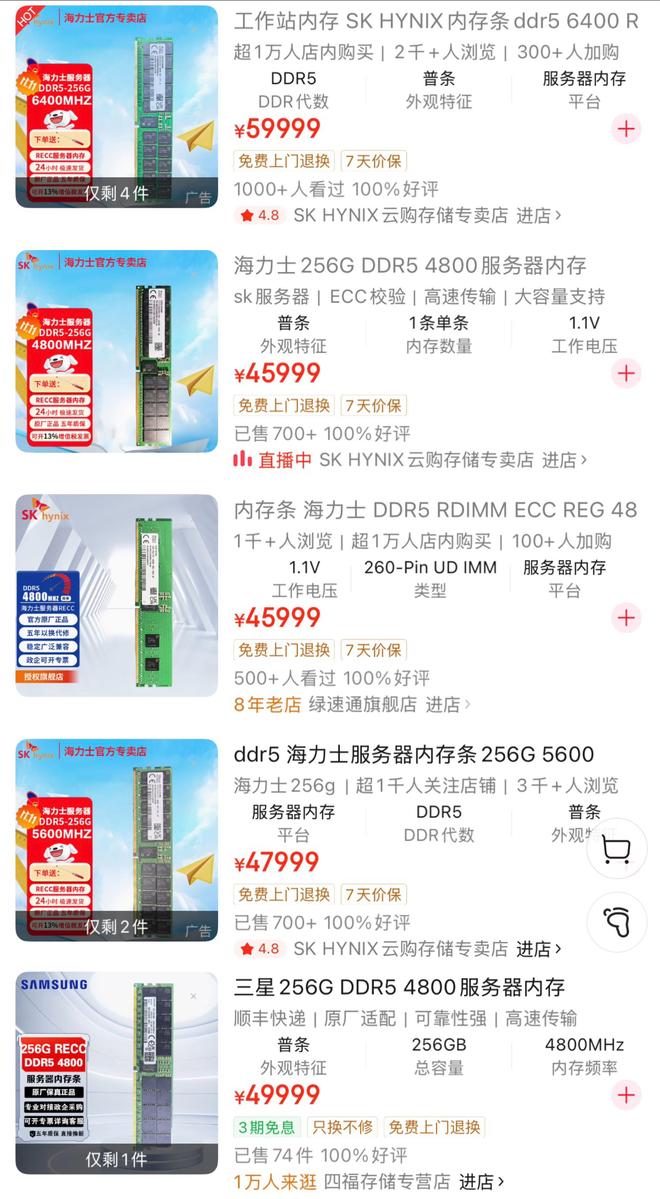
Core Viewpoint - The recent surge in memory prices, particularly for consumer and server-grade memory, has drawn significant attention, with prices more than doubling since mid-2025, exemplified by SK Hynix and Samsung's DDR5 memory prices exceeding 45,000 yuan for 256GB modules [2][4]. Group 1: Price Surge Reasons - The rapid increase in memory prices is attributed to a combination of market supply-demand imbalance, manufacturer strategy adjustments, and varying stages of domestic production capabilities [6]. - The demand side has seen explosive growth driven by AI computing power needs, significantly altering storage demand structures [6]. - On the supply side, manufacturers have been in a "de-inventory and capacity control" phase for the past couple of years, leading to a slow response to the renewed demand, resulting in structural supply-demand imbalances [6]. Group 2: Characteristics of Price Increase - The current price increase is characterized by differentiation rather than a blanket rise, with certain DDR4 and general server memory prices rising first, while high-end memory like DDR5 and HBM shows tight delivery and contract restrictions [8]. - Market expectations are changing faster than actual demand, with price increases driven not only by current order growth but also by anticipatory reactions to future shortages [8]. - Technical factors are more pronounced, as the transition from DDR4 to DDR5 has led to decreased certainty regarding short-term capacity expansion for high-end storage, enhancing price volatility [8]. Group 3: Impact on Industry Chain - The price increase has a differentiated impact on the industry chain, creating both new opportunities and challenges [10]. - For upstream memory chip manufacturers, price recovery aids in restoring profitability and cash flow, supporting ongoing investments in advanced processes and high-end products, while also posing challenges in managing production expansion to avoid new supply-demand imbalances [10]. - Midstream module and server manufacturers face increased cost pressures, necessitating a balance in inventory management, pricing strategies, and customer negotiations, pushing them to optimize product structures and enhance value [10]. - Downstream computing centers, cloud service providers, and AI application companies are adapting by innovating through software-hardware collaboration to alleviate cost and resource constraints, improving the efficiency of existing hardware resources [10]. Group 4: Future Price Trends - The current price fluctuations are not expected to be a short-term phenomenon but are unlikely to spiral out of control, with a gradual easing anticipated over the next 12 months [14]. - The most likely scenario involves prices stabilizing at high levels, with high-end storage products for AI remaining strong, while general and consumer-grade products return to a more moderate cyclical pattern [14].
光大证券晨会速递-20260113
EBSCN· 2026-01-13 02:01
Group 1: Market Overview - The bond market is predicted to see a decline in the ten-year government bond yield by approximately 3 basis points from January to February 2026, and by about 6 basis points from the end of 2025 to the end of 2026 [2] - The internet media sector is expected to experience significant growth in the animated drama market, driven by AI video models, with a recommendation to focus on industry capacity release and specific companies like Reading Group [3] Group 2: Real Estate Sector - As of January 11, 2026, the new housing market in 20 cities recorded a total transaction of 13,000 units, down 50.4% year-on-year, with notable declines in major cities such as Beijing (30%), Shanghai (41%), and Shenzhen (78%) [4] - The second-hand housing market in 10 cities saw a total transaction of 24,000 units, a decrease of 26.2% year-on-year, with significant drops in Beijing (38%), Shanghai (13%), and Shenzhen (37%) [4] Group 3: Company Research - The report on North China Huachuang indicates that state capital cooperation is driving industry empowerment, with projected net profits of 7.628 billion CNY for 2025, 10.030 billion CNY for 2026, and a new forecast of 12.812 billion CNY for 2027 [5] - The report on Shannon Chip Creation highlights the benefits of rising storage prices driven by AI, with a net profit forecast of 605 million CNY for 2025, an increase to 1.043 billion CNY for 2026 (up 48%), and a new forecast of 1.251 billion CNY for 2027 [6]

热点追踪 | 价格飙升!内存条何以成“抢手货”?
Xin Hua She· 2026-01-12 07:01
Core Viewpoint - The recent surge in memory prices, particularly for consumer and server-grade memory, has drawn significant attention, with prices more than doubling since mid-2025, driven by supply-demand imbalances and strategic adjustments by manufacturers [1][5]. Group 1: Price Surge Reasons - The rapid increase in memory prices is attributed to a combination of factors, including a structural imbalance in supply and demand, strategic adjustments by manufacturers, and differences in the pace of domestic production [5]. - On the demand side, the explosive growth in AI computing power has significantly altered storage demand structures [5]. - On the supply side, manufacturers have been in a "de-inventory and capacity control" phase for the past couple of years, leading to a slow response to the renewed demand, exacerbating the supply-demand imbalance [5]. Group 2: Characteristics of the Price Increase - The current price increase exhibits three distinct characteristics: 1. Price fluctuations are "differentiated" rather than a uniform increase across all products, with certain DDR4 and general server memory prices rising first [6]. 2. Market expectations are changing faster than actual demand, with price increases driven not only by current orders but also by anticipatory reactions to potential shortages [6]. 3. Technical factors are more pronounced, particularly during the transition from DDR4 to DDR5, leading to increased uncertainty regarding the expansion of high-end storage capacity [6]. Group 3: Impact on the Industry Chain - The price increase has a differentiated impact on the industry chain, creating both opportunities and challenges: - For upstream memory chip manufacturers, the price recovery aids in restoring profitability and cash flow, but they face challenges in managing production expansion to avoid future supply-demand imbalances [8]. - Midstream module manufacturers and server vendors are experiencing increased cost pressures, necessitating a balance between inventory management, pricing strategies, and customer negotiations [8]. - Downstream AI application companies and cloud service providers are adapting by innovating through software-hardware collaboration to alleviate cost and resource constraints [8]. Group 4: Future Price Trends - The current price fluctuations are not expected to be a short-term phenomenon, but they are unlikely to remain uncontrolled for an extended period, with a gradual easing anticipated over the next 12 months [9]. - It is expected that prices will stabilize at high levels, with high-end storage products for AI remaining strong, while general and consumer-grade products will revert to a more moderate cyclical pattern [9].
智研咨询发布:2026年中国甲基异丁基酮行业市场全景调查及发展趋势预测报告
Sou Hu Cai Jing· 2026-01-07 02:30
Core Insights - The article discusses the growth and development of the methyl isobutyl ketone (MIBK) industry in China, highlighting its increasing domestic production capacity and decreasing reliance on imports due to technological advancements and rising demand [4][7]. Industry Overview - MIBK, also known as 4-methyl-2-pentanone, is a colorless liquid organic compound with a camphor-like odor, soluble in most organic solvents and slightly soluble in water. It is biodegradable, has low volatility, and is chemically stable, making it suitable for applications in organic synthesis, rubber manufacturing, and coatings [6][9]. - The upstream raw materials for MIBK production include acetone, hydrogen, and catalysts, with acetone being the primary raw material that directly impacts production costs and supply [6][9]. Market Dynamics - China's MIBK production capacity is projected to grow from 75,000 tons in 2016 to 150,000 tons by 2024, while production volume is expected to increase from 54,000 tons to 120,000 tons during the same period [7][11]. - The demand for MIBK is significantly driven by its application in the production of anti-aging agents, coatings, electronics, pharmaceuticals, inks, and lubricants, with the anti-aging agent 4020 accounting for 60% of the market share [6][7]. Competitive Landscape - Major global producers of MIBK include Sasol (South Africa), Kumho Petrochemical (South Korea), Shell Chemicals (Netherlands), Mitsui Chemicals (Japan), and Mitsubishi Chemical (Japan). Domestically, companies like Juhua Chemical, Ruibai New Materials, Wanhua Chemical, Hengxing New Materials, Jilin Petrochemical, and Santo Chemical are key players in the MIBK market [7][11]. Future Trends - The MIBK industry is expected to evolve towards greener and more sustainable practices due to stricter environmental regulations. Additionally, the demand for high-purity and low-impurity MIBK will increase with the rapid development of the new energy vehicle sector, high-end electronics, and eco-friendly coatings [7][11].
最高预增超360%!44家A股公司披露2025年度业绩预告,近八成预喜
2 1 Shi Ji Jing Ji Bao Dao· 2026-01-04 12:10
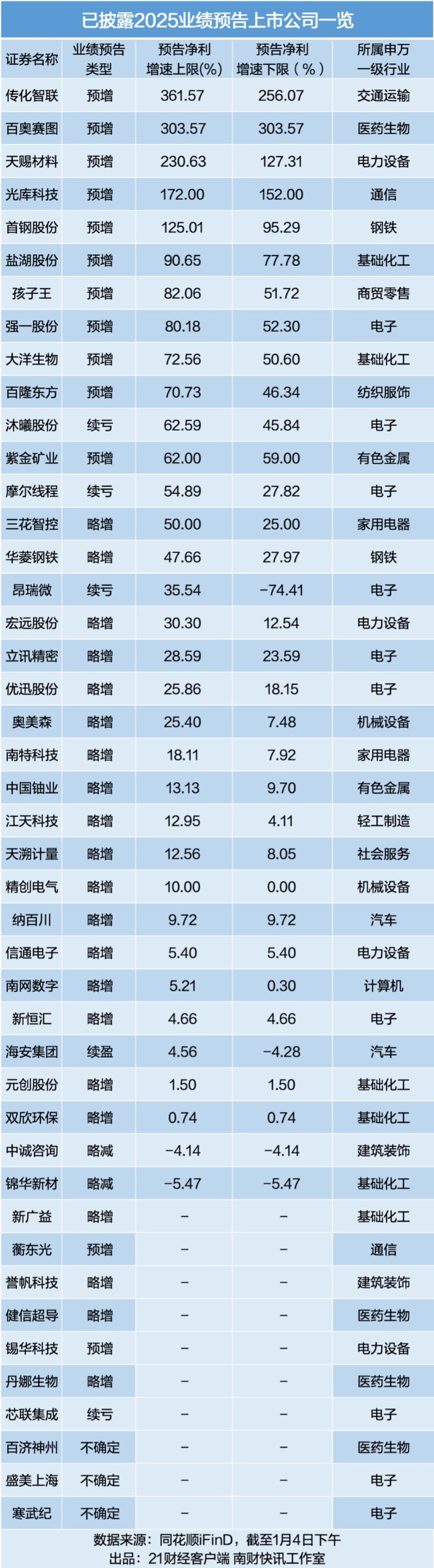
Core Viewpoint - The 2025 earnings forecasts for A-share listed companies are being released, with 44 companies disclosing their predictions, of which 35 are expected to see profit increases, indicating a robust performance across various sectors [1][2]. Group 1: Company Performance - Leading consumer electronics manufacturer Luxshare Precision (002475.SZ) anticipates a net profit of 16.518 billion to 17.186 billion yuan, representing a year-on-year growth of 23.59% to 28.59% [1]. - Automotive parts leader Sanhua Intelligent Control (002050.SZ) expects a net profit increase of 25% to 50%, driven by its strong position in the new energy vehicle thermal management sector [1]. - Mining giant Zijin Mining (601899.SH) forecasts a net profit growth of 59% to 62%, benefiting from increased production and rising sales prices of key mineral products [1]. - Transfar Zhilian (002010.SZ) is projected to have a staggering net profit increase of 256.07% to 361.57%, with expected profits between 540 million to 700 million yuan, attributed to strong core business growth and investment gains [2]. - Steel industry player Shougang Co. (000959.SZ) expects a net profit of 920 million to 1.06 billion yuan, with a growth rate of 95.29% to 125.01%, driven by product optimization and cost management [2]. Group 2: Sector Trends - The electronics and biopharmaceutical sectors are showing strong growth, with Strong One Co. (688809.SH) predicting a net profit increase of 52.30% to 80.18%, and Bai Ao Sai Tu (688796.SH) expecting a remarkable growth of approximately 303.57% due to overseas market expansion [3]. - Despite some companies facing losses, such as Muxi Co. (688802.SH) with a projected loss of 762 million to 527 million yuan, the overall sentiment remains optimistic due to revenue growth driven by AI and domestic demand [3]. - The steel sector is also performing well, with Hualing Steel (000932.SZ) expecting a profit increase of 27.97% to 47.66%, despite facing additional costs from environmental taxes [2][3].




如何应对“电风扇”行情,机构建议这样布局丨每日研选
Shang Hai Zheng Quan Bao· 2025-11-13 01:37
Core Viewpoint - The A-share market is currently experiencing a "tug-of-war" around the 4000-point level, with accelerated sector rotation and intensified capital competition as the year-end approaches and outlook for 2026 is considered [1] Market Overview - The Shanghai Composite Index is in a phase of consolidation, with a lack of strong catalysts leading to a relatively stable market momentum, characterized by oscillation and accumulation [1] - The internal market dynamics show a significant increase in the speed of style and sector rotation, with profit opportunities concentrating in specific sub-sectors [1] - A "wait-and-see" strategy is recommended to avoid risks associated with chasing trends [1] Mid-term Market Outlook - The core support logic for the market is becoming clearer, with similarities drawn to the market conditions of 2020-2021, driven by policy guidance, industrial upgrades, and capital resonance [1] - The market is currently in the early stages of a new policy-driven and industry trend-driven cycle [1] - The fourth quarter is expected to be more stable, with November entering an earnings vacuum period, while the "14th Five-Year Plan" provides new hotspots for the market [1] Strategic Outlook for 2026 - The performance of RMB-denominated equity assets is strategically favored for three reasons: 1. The rise of new economic drivers in China, such as advanced manufacturing and technological innovation, is expected to drive a re-evaluation of China's growth model by overseas capital [1] 2. A marginal easing of Sino-US relations is anticipated to enhance risk appetite [1] 3. Increasing certainty of global liquidity easing is expected to support the RMB and equity markets [1] - Incremental capital sources for the market in 2026 are likely to come from foreign investment and public funds, with a gradual appreciation of the RMB against the USD expected [1] Asset Allocation Strategy - A balanced asset allocation strategy is recommended for the fourth quarter, with an emphasis on defensive and recovery opportunities [2] - High-dividend sectors are highlighted as valuable alternatives to deposits and real estate in a low-interest-rate environment [2] - The mid-term focus remains on technology growth and advanced manufacturing, with an emphasis on domestic production processes and new productive forces [2] - Key sectors for investment include new energy, new materials, aerospace, and strategic emerging industries as outlined in the "14th Five-Year Plan" [2]