
私募股权投资

Search documents
市场化LP会投什么样GP?
FOFWEEKLY· 2025-08-15 10:08
Core Viewpoint - The article discusses the challenges and requirements for General Partners (GPs) in fundraising, emphasizing that the era of simply presenting a PowerPoint to raise funds is over. It outlines the preferences of market-oriented Limited Partners (LPs) and the importance of establishing trust through direct investment projects before considering blind pool funds [3][10]. Fundraising Challenges - GPs often seek assistance in connecting with market-oriented LPs, particularly when they have secured government funding but lack the remaining 10-20% from market sources. The difficulty in fundraising is highlighted, especially for market-oriented funds, which have become scarce [5]. Key Preferences of Market-oriented LPs 1. **Fund Size** - Market-oriented LPs, particularly family offices, generally do not invest in funds larger than 1 billion, with some preferring funds not exceeding 500 million. Larger fund sizes are perceived to negatively impact returns and increase the likelihood of suboptimal project selection due to investment deadlines [6]. 2. **GP Co-investment** - There is a growing expectation for GPs to invest 5-20% of their own capital in the fund. This alignment of interests is crucial for LPs, as it demonstrates the GP's confidence in their own fund. If GPs do not invest, it raises concerns about their commitment and the potential for moral hazard [7]. 3. **Government Funding Proportion** - If a fund has more than 30% of its capital from government sources, many family offices are likely to avoid investing. The perception is that high government involvement may not align with the financial return objectives of market-oriented LPs [8]. 4. **Performance History** - Historical performance, particularly the DPI (Distributions to Paid-In capital) of blind pool funds established before 2018, is a critical factor for LPs. Funds that do not demonstrate strong past performance are unlikely to attract market-oriented capital [9]. 5. **Trust Building through Direct Investments** - Many family offices now require GPs to provide 1-2 direct investment projects as a means to assess the GP's project selection capabilities and the potential for a smooth long-term partnership. This trust-building process can take 1-2 years before considering investments in blind pool funds [10]. Summary of Key Points - Fund size should not exceed 1 billion, ideally between 100-300 million [12] - GP co-investment should be in the range of 5-20% [12] - Government funding should not exceed 30% of the total fund [12] - Historical blind pool funds (pre-2018) should have a DPI above 1 [12] - GPs should provide direct investment projects to establish trust before LP investment [12]


九鼎投资收上交所问询函 亏损仍2.13亿买未盈利标的
Zhong Guo Jing Ji Wang· 2025-08-15 03:27
Core Viewpoint - The company, Kunwu Jiuding Investment, announced plans to acquire a 53.2897% stake in Nanjing Shenyuan Intelligent Technology Co., Ltd. for RMB 21,315.88 million, which will make Nanjing Shenyuan a subsidiary included in the company's consolidated financial statements. The transaction does not constitute a related party transaction or a major asset restructuring and does not require shareholder approval [1][3]. Group 1: Transaction Details - The acquisition is aimed at gaining control over Nanjing Shenyuan, which primarily engages in six-dimensional force sensors and force measurement business. The company reported revenues of RMB 208.80 million in 2024 and RMB 16.38 million in the first four months of 2025, with net losses of RMB 573.49 million and RMB 279.54 million respectively, indicating pressure on profitability [2][4]. - The listed company’s main business includes private equity investment management and real estate development, with reported revenues of RMB 281 million in 2023 and RMB 338 million in 2024, and a net profit of RMB 15 million in 2023, followed by a net loss of RMB 268 million in 2024. The forecast for the first half of 2025 indicates a projected net loss of between RMB 55 million and RMB 44 million [2][4]. Group 2: Regulatory Inquiry - The Shanghai Stock Exchange issued an inquiry letter requesting the company to explain the rationale behind the acquisition of a loss-making entity, considering the company's own financial struggles. The inquiry emphasizes the need to assess whether this move could adversely affect the company's ongoing viability and the interests of minority investors [2][4][5]. - The inquiry also seeks clarification on the valuation of Nanjing Shenyuan, which had a net asset value of RMB 9.881 million as of April 2025, while the transaction values the company at RMB 300 million. The company is required to disclose the rationale behind this valuation and the absence of performance commitments or buyback clauses [5][6]. Group 3: Future Plans and Integration - Following the acquisition, the company is expected to outline its strategic plans for integrating Nanjing Shenyuan, including the management of core technical personnel and financial resources. The inquiry requests details on whether the company has the capability to effectively integrate the acquired entity [6][7]. - The inquiry also raises concerns about the independence of Nanjing Shenyuan's core technologies and potential ownership disputes, as well as the impact of the acquisition on the company's cash flow and liquidity [6][7].

投中统计:7月VC/PE市场持续升温募投数量同比增幅均超四成
投中信息· 2025-08-15 02:49
Fundraising Overview - In July 2025, a total of 569 new funds were established, representing a 27% increase month-on-month and a 44% increase year-on-year[16] - 500 institutions participated in fund establishment, with 91% creating one fund, 5.6% creating two, and 3.4% creating three or more[16] - Zhejiang, Jiangsu, and Shandong provinces led in new fund establishment, with Zhejiang alone contributing 136 funds[17] Investment Market Analysis - In July 2025, there were 823 investment cases, a 1% increase month-on-month and a 44% increase year-on-year, with total investment amounting to 908.76 billion yuan, a 16% year-on-year increase[39] - Jiangsu province led the country with 149 financing cases, while Beijing topped the financing amount with 195.19 billion yuan[39] - The electronic information sector dominated with 265 investment cases and a total of 237.16 billion yuan raised, followed by semiconductor and artificial intelligence projects[48] Key Financing Cases - Notable financing cases included a strategic financing of 365 billion yuan for State Grid New Source and nearly 300 million USD for MiniMax, an AI interaction product developer[57]
穆迪报告:更多美国公司规避贷款方同意程序增加债务
Xin Lang Cai Jing· 2025-08-14 18:37
Core Insights - Moody's report indicates an increasing trend among U.S. companies seeking more flexible terms in credit agreements to raise debt without needing approval from existing lenders [1][2] - Companies with weaker credit profiles are pressuring lenders for greater flexibility to expand their debt capacity due to difficulties in issuing new bonds in the public market [1] - The report highlights that transactions modifying terms to enhance debt financing capabilities could see new debt levels reach 40% to 300% of EBITDA [1] Debt Market Trends - From early 2024 to May 2025, 10% of credit agreements (9 out of 89) have successfully incorporated more flexible terms, all involving private equity-backed borrowers [1] - Recent transactions include financing for SolarWinds by Turn/River Capital and KKR's leveraged buyout of OSTTRA, both reflecting the trend of borrowers seeking to expand debt capacity [1] Competitive Landscape - The trend of borrowers, including financially distressed companies, to "unrestrictedly access debt" is becoming increasingly evident as lenders in the public debt market face fierce competition from the expanding private credit market [2]
知名PE寻求新出路!跨界并购机器人公司
Zheng Quan Shi Bao Wang· 2025-08-14 11:51
Group 1 - The core point of the news is that Jiuding Investment is making a strategic move by acquiring Nanjing Shenyuan Intelligent Technology Co., aiming to diversify its business and seek new growth opportunities in the robotics industry [1][3][4] - Jiuding Investment announced a plan to acquire 53.2897% of Nanjing Shenyuan for a total consideration of 2.13 billion yuan, which includes a cash purchase of 1.13 billion yuan for 37.7196% of the shares and an additional capital increase of 1 billion yuan for 25% [2][3] - The acquisition reflects Jiuding's recognition of the value of the target company and confidence in the robotics industry's prospects, aligning with national policies encouraging mergers and acquisitions for high-quality development [3][4] Group 2 - Jiuding Investment has faced challenges in its private equity business, with a reported net loss of 268 million yuan in the previous year, marking a significant decline of 1848.42% [4][5] - The company manages assets totaling approximately 59.1 billion yuan and has invested in around 367 companies, with a cumulative investment scale of about 33.6 billion yuan [4] - The current market environment has led many private equity firms, including Jiuding, to seek new avenues for growth, with acquisitions through listed companies being a viable strategy to leverage their financial and professional capabilities [5]

九鼎投资商业合理性遭问询,亏损情况下跨界收购未盈利标的
Sou Hu Cai Jing· 2025-08-14 06:26
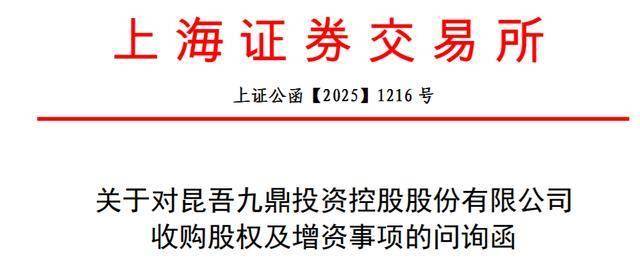
Core Viewpoint - Jiuding Investment plans to acquire a controlling stake in Nanjing Shenyuan Intelligent Technology Co., Ltd. despite operating losses, aiming to enter the robotics industry and create a second growth curve, which has led to a surge in its stock price [1][3]. Group 1: Acquisition Details - Jiuding Investment intends to acquire 53.2897% of Nanjing Shenyuan for a total consideration of 213 million yuan, with 113 million yuan allocated for purchasing 37.7196% of the equity and an additional 100 million yuan for capital increase to obtain 25% post-investment [1][4]. - The acquisition is characterized as a cross-industry move, as Jiuding's existing business differs from Nanjing Shenyuan's operations, which may introduce integration risks [1][3]. Group 2: Financial Performance - Jiuding Investment reported revenues of 281 million yuan and a net profit of 15 million yuan for 2023, with a projected net loss of 268 million yuan for 2024 and an expected loss of 55 to 44 million yuan for the first half of 2025 [3]. - Nanjing Shenyuan's financials show revenues of 2.088 million yuan in 2024 and 0.1638 million yuan in the first four months of 2025, with net losses of 5.7349 million yuan and 2.7954 million yuan respectively, indicating significant pressure on profitability [2][3]. Group 3: Regulatory Inquiry - The Shanghai Stock Exchange has issued an inquiry letter to Jiuding Investment, requesting additional disclosures regarding Nanjing Shenyuan's business model, technology barriers, and competitive positioning in the humanoid robotics sector [4][5]. - The inquiry also seeks clarification on the rationale behind the acquisition of an unprofitable target amid Jiuding's own financial losses, including the absence of performance commitments or share buyback clauses in the transaction [5].
创投月报 | 毅达资本:协助西藏首只政府产业基金落地 独家投资电子浆料公司云荒新材
Xin Lang Zheng Quan· 2025-08-13 04:28
Group 1 - In July 2025, the number of newly registered private equity and venture capital fund managers surged to 16, a 77.8% increase from June, reaching four times the number in July 2024 [1] - The number of newly filed private equity and venture capital funds was 130 and 245 respectively, showing a year-on-year growth of 7.1% but a month-on-month decline of 3.4% [1] - The domestic primary equity investment market recorded 552 financing events, with year-on-year and month-on-month growth of 5.1% and 11.7% respectively, and a total disclosed financing amount of approximately 71.756 billion yuan, a 142.0% increase from July 2024 [1] Group 2 - Yida Capital, managing over 120 billion yuan, has registered four new funds by the end of July 2025, with a total registered capital of 3.62 billion yuan [3] - The Ma'anshan Cihu Venture Capital Partnership Fund, with a total scale of 1 billion yuan, focuses on life health and related industries, with the largest LP holding 69.9% [3] - The Ma'anshan Digital Empowerment Industry Fund also has a total scale of 1 billion yuan, investing in key areas such as artificial intelligence and data elements [4] Group 3 - The Lhasa Strong City Equity Investment Fund, the first government industry fund in Tibet, has a total scale of 1.5 billion yuan, focusing on cultural tourism, digital economy, financial industry, and green industry [4] - Yida Capital disclosed a total of 9 equity investment events during the reporting period, compared to only 1 in July 2024, indicating a significant increase in investment activity [4] - In the first seven months of 2025, Yida Capital completed 50 investments, which is 1.72 times the total number of investment events from July to December 2024 [4] Group 4 - Yida Capital's investments in July 2025 were predominantly in early-stage projects, with angel, Pre-A, and A-round investments accounting for 66.7% of total investments [6] - The manufacturing sector received approximately 42.9% of Yida Capital's investments, covering sub-sectors such as machinery and instrumentation [6] - About one-third of Yida Capital's invested projects are located in Jiangsu Province, with Shanghai and Zhejiang each accounting for 22.2% [9] Group 5 - Cloud Huang New Materials, a developer of high-end electronic paste, completed a Pre-A round financing of 10 million yuan, exclusively invested by Yida Capital [12] - The funds will be used to enhance cash flow and expand customer market reach, aiming to replace foreign suppliers in the high-end electronic materials market [12] - Cloud Huang New Materials has established a large customer base by the end of 2024 and achieved sales of tens of millions in the first half of 2025 [12]

逆势募资超45亿,并购基金新周期下的长期主义样本
投中网· 2025-08-13 04:09
Core Viewpoint - The recent successful fundraising of over 4.5 billion RMB by Xincheng Capital highlights the resilience and recognition of market-oriented private equity funds amidst a challenging fundraising environment, indicating a shift in investor sentiment towards long-term capital cultivation [3][4][24]. Fundraising and Market Trends - Xincheng Capital's new RMB merger fund has raised over 4.5 billion RMB, a significant increase of 50% compared to the previous fund size of 3 billion RMB [3][4]. - Despite a decline in the number of newly established funds and total fundraising in the first half of 2025, Xincheng Capital's success demonstrates strong support from a diverse range of limited partners (LPs), including government-guided funds, insurance capital, and other market-oriented investors [3][4][5]. - The domestic merger market is experiencing a "golden window period" driven by policy incentives and rising demand for industrial consolidation, although most new funds are led by local governments or focus on specific sectors [4][24]. Investment Strategy and Focus - Xincheng Capital continues to focus on controlling mergers as its core investment strategy, targeting privatization of listed companies, business spin-offs, industry consolidation, and cross-border mergers, with a focus on sectors such as commercial services, healthcare, consumer goods, and technology [6][7][24]. - The new fund has seen a significant shift in LP structure, with over 70% of contributions coming from insurance capital, indicating a growing interest from insurance companies in the merger market [5][8][9]. Long-term Value Creation - Xincheng Capital's approach emphasizes long-term value creation through strategic management of acquired companies, as evidenced by successful case studies like the acquisition of Jie Shibang, which has seen an annual compound growth rate of approximately 20% since 2017 [15][17][22]. - The firm has developed a unique "dual curve" exit strategy, allowing for stable cash flow through dividends and refinancing while also seeking timely asset sales in favorable market conditions [17][24]. Industry Dynamics and Future Outlook - The current wave of mergers is characterized by a shift from traditional financial arbitrage to deep participation in industrial integration, requiring participants to possess strong resource integration and empowerment capabilities [19][20]. - Xincheng Capital's established industry expertise and collaborative ecosystem position it well to capitalize on emerging opportunities in the merger market, with plans to accelerate project execution over the next 18 months [24][25].

【活动回顾】S基金系列活动第三期
Sou Hu Cai Jing· 2025-08-13 02:42
活动伊始,毕马威中国资产管理业主管合伙人王国蓓女士和上海股权交易中心基金事业部总监马圆圆女士为活动带来了精彩的开场致辞。 S基金作为私募股权基金和创业投资基金的重要退出通道,一直备受行业关注。在此背景下,毕马威中国、上海股权托管交易中心、上海科创基金、孚腾 资本,在S基金联盟支持下,共同主办本次S基金主题研讨会,本次活动为毕马威中国S基金系列活动第三期。随着国内市场GP主导型交易日益普遍,第三 期活动侧重聚焦于该类交易的法律、交易结构、税务及估值等核心等议题。本次活动吸引了近百位私募管理人及企业代表参与。 中芯聚源董事总经理李刚强先生(左三): 毕马威中国资产管理业主管合伙人王国蓓女士 上海股权交易中心基金事业部总监马圆圆女 随后,植德律师事务所合伙人周峰先生与大家分享了两个GP主导S基金交易的经典案例,并介绍了新设S基金架构及S基金份额交易方案中关注的主要商业 问题与法律问题。 士 毕马威中国金融行业税务合伙人葛乾达先生从GP Led S交易涉税规划和考量的角度,深度剖析了GP Led S交易涉及的税收影响以及税务上对交易定价评判 原则和方法。特别地,葛先生结合税务机关年度发展目标,新税收政策以及征管环境, ...
九鼎投资主业不振一年半亏3.12亿 拟2.13亿控股亏损公司跨界机器人
Chang Jiang Shang Bao· 2025-08-12 23:16
Core Viewpoint - Jiuding Investment (600053.SH), a leading private equity firm in A-shares, is diversifying into the robotics industry by acquiring a 53.2897% stake in Nanjing Shenyuan Intelligent Technology Co., Ltd. for 213 million yuan, aiming to enhance its core competitiveness and create a second growth curve amid declining performance in its main business [1][3]. Group 1: Acquisition Details - The acquisition involves Jiuding Investment purchasing 37.7196% of Nanjing Shenyuan's shares for 113 million yuan, followed by a capital increase of 100 million yuan to obtain an additional 25% stake, resulting in a total investment of 213 million yuan [2][3]. - Nanjing Shenyuan specializes in six-dimensional force sensors, a key component in humanoid robots, and has a strong patent portfolio with 21 invention patents and 23 utility model patents [2][3]. - The transaction is part of Jiuding Investment's strategy to respond to national policies encouraging mergers and acquisitions for high-quality development, aiming to tap into the growing market for humanoid robots [3][4]. Group 2: Financial Performance - Jiuding Investment is facing significant financial challenges, with a projected net loss of 44 to 55 million yuan for the first half of 2025, following a total loss exceeding 312 million yuan over 2024 and the first half of 2025 [1][6][7]. - The company's revenue for 2024 was 338 million yuan, a year-on-year increase of 20.34%, but it reported a net loss of 268 million yuan, marking a dramatic decline in profitability [6][7]. - The private equity management and real estate sectors have seen a decrease in revenue and profits, contributing to the overall financial downturn [6][7]. Group 3: Market Context - Nanjing Shenyuan's valuation has increased to 300 million yuan, reflecting a growing market potential for its six-dimensional force sensors, especially as leading humanoid robot manufacturers begin to incorporate these sensors into their products [4][5]. - The market for six-dimensional force sensors is expanding, with applications moving beyond traditional industrial uses to humanoid robotics, indicating a promising future for Nanjing Shenyuan [4].