
电池制造

Search documents
珠海冠宇:1月20日召开董事会会议
Mei Ri Jing Ji Xin Wen· 2026-01-20 10:47
Group 1 - Zhuhai Gree announced that its 36th meeting of the second board of directors was held on January 20, 2026, combining in-person and communication methods [1] - The meeting reviewed the proposal regarding the adjustment of the grant price for the 2023 restricted stock incentive plan and the cancellation of certain granted but unvested restricted stocks [1]

亿纬锂能斩获全球首个圆柱电池灯塔工厂认证
Zheng Quan Shi Bao Wang· 2026-01-20 10:03
Core Insights - EVE Energy has been recognized as the world's first cylindrical battery lighthouse factory by the World Economic Forum and McKinsey, leveraging advanced technologies such as AIoT, physical simulation, and large language models [1] - The company has established a highly efficient digital system that integrates research, production, and sales, featuring a high-speed production line capable of producing 300 cylindrical battery cells per minute, with an average output of nearly 27 cells per second [1] - EVE Energy's quality control system boasts a product first-pass yield rate of over 97%, with significant improvements in voltage consistency and real-time quality tracking capabilities [2] Production and R&D Achievements - The integration of physical simulation and AI process models has reduced the number of R&D experiments by 75%, significantly shortening the time from R&D to mass production [1] - Automation in key production processes has reached 100%, with an AIoT-driven health prediction system enhancing equipment efficiency to 95% [1] - The company has developed a comprehensive quality control system that utilizes AI for real-time data collection and dynamic optimization across manufacturing processes [2] Financial Performance - For the first three quarters of 2025, EVE Energy reported revenues of 45.002 billion yuan, a year-on-year increase of 32.17%, and a net profit attributable to shareholders of 2.816 billion yuan, with a normalized net profit of 3.675 billion yuan, reflecting an 18.40% increase [2] - The net profit for the third quarter alone reached 1.457 billion yuan, marking a year-on-year growth of 50.70% and a quarter-on-quarter increase of 30.43% [2] Shipment Data - In the first three quarters of 2025, the company shipped 34.59 GWh of power batteries, representing a year-on-year growth of 66.98%, and 48.41 GWh of energy storage batteries, with a year-on-year increase of 35.51% [3]

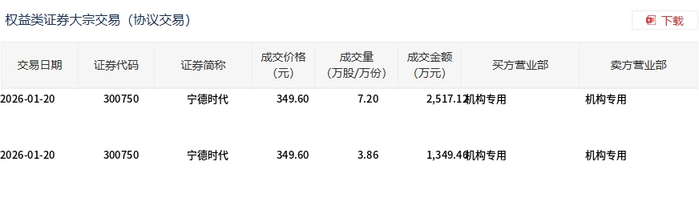
宁德时代今日大宗交易平价成交11.06万股,成交额3866.58万元
Xin Lang Cai Jing· 2026-01-20 09:02
Group 1 - On January 20, 2026, CATL (宁德时代) executed a block trade of 110,600 shares, with a transaction value of 38.6658 million yuan, accounting for 0.31% of the total trading volume for the day [1] - The transaction price was 349.6 yuan, which remained unchanged compared to the market closing price of 349.6 yuan [1] - The block trade included two separate transactions: one for 72,000 shares valued at 25.171 million yuan and another for 38,600 shares valued at 13.494 million yuan, both executed by institutional investors [2]


汇安基金王明路:固态电池“工艺跑通年”或将启幕
Jiang Nan Shi Bao· 2026-01-20 08:31
Core Insights - The solid-state battery industry is poised for significant advancements by 2025, driven by government policies and technological breakthroughs in production and safety standards [1][2][3] Policy and Industry Drivers - The transition from policy expectations to practical implementation is evident, with the Ministry of Industry and Information Technology (MIIT) emphasizing solid-state batteries as a key focus area, aiming to establish 3-5 global leaders by 2027 [2] - New safety standards for electric vehicle batteries will take effect on July 1, 2026, mandating that batteries do not catch fire or explode during thermal runaway [2] - The first national standard for solid-state batteries is set to be publicly solicited by the end of December 2025, marking a foundational step towards industrialization [2] Technological Advancements - The solid-state battery technology is evolving, with sulfide solid-state batteries and oxide/polymer semi-solid batteries becoming the main focus, and semi-solid batteries already in mass production [3] - The industry is shifting its focus from material science to production engineering, with expectations for semi-solid battery equipment to ramp up production in 2026 and full solid-state battery equipment between 2027 and 2030 [3] - 2026 is identified as a critical year for completing the testing and safety assessment processes necessary for large-scale production of solid-state batteries [3] Investment Focus Areas - In the solid-state battery supply chain, the equipment sector is highlighted as having higher profitability and earlier revenue realization, particularly in dry electrode, isostatic pressing, and high-pressure formation processes [4] - On the materials side, lithium sulfide, sulfide electrolytes, and silicon-carbon/lithium metal anodes are recommended for investment focus [4] - For application sectors, while solid-state technology may enhance brand value and market positioning, short-term revenue contributions are expected to be limited [4]
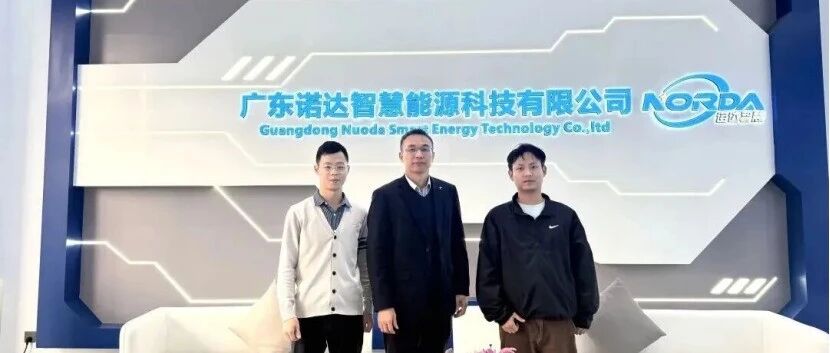
诺达智慧 总经理 江国龙:多极耳圆柱电池牢筑安全底线!2025年预计出货3亿只,满产满销!
起点锂电· 2026-01-20 07:31
巡访标杆企业,洞见产业未来 ——2026起点圆柱电池全国行正式启动! 近两年,得益于技术 突破升级 ,圆柱电池性能进一步提升,高能密、高倍率、长寿命产品高度匹配不同应用场景需求,使得圆柱电池重新起 量,迎来新一轮爆发式增长。尤其是极耳技术的迭代,成为圆柱电池打开市场增量的 "密钥",也成为圆柱电池企业决战新一轮增长周期要面临 的必要"考题"。 起点锂电注意到,在全极耳技术加速量产的过程中,部分企业却给出不同的解题方法,以多极耳技术破局现有竞争格局,其中广东诺达智慧能源 科技有限公司(以下简称:诺达智慧)就是领头的代表企业之一。 诺达智慧是专注于圆柱锂离子电池领域的高新技术企业,集研发技术、生产制造、市场营销和售后服务于一体,致力于为客户提供全方位的解决 方案。 1月12日,起点圆柱电池走访团走进诺达智慧,与公司 总经理江国龙 就圆柱电池发展趋势、市场前景进行深度交流,并针对多极耳技术 优势及应用空间进行详细探讨。 江国龙指出,布局多极耳圆柱电池并非一时兴起,而是经过多年技术经验和市场应用情况确定的发展路线,本质上更具安全、成本优势, 目前 公司多极耳圆柱电池广受客户认可, 2025年满产满销,预计出货3亿只 ...
福特或采购比亚迪电池加码混动市场?官方回应
Mei Ri Jing Ji Xin Wen· 2026-01-20 06:35
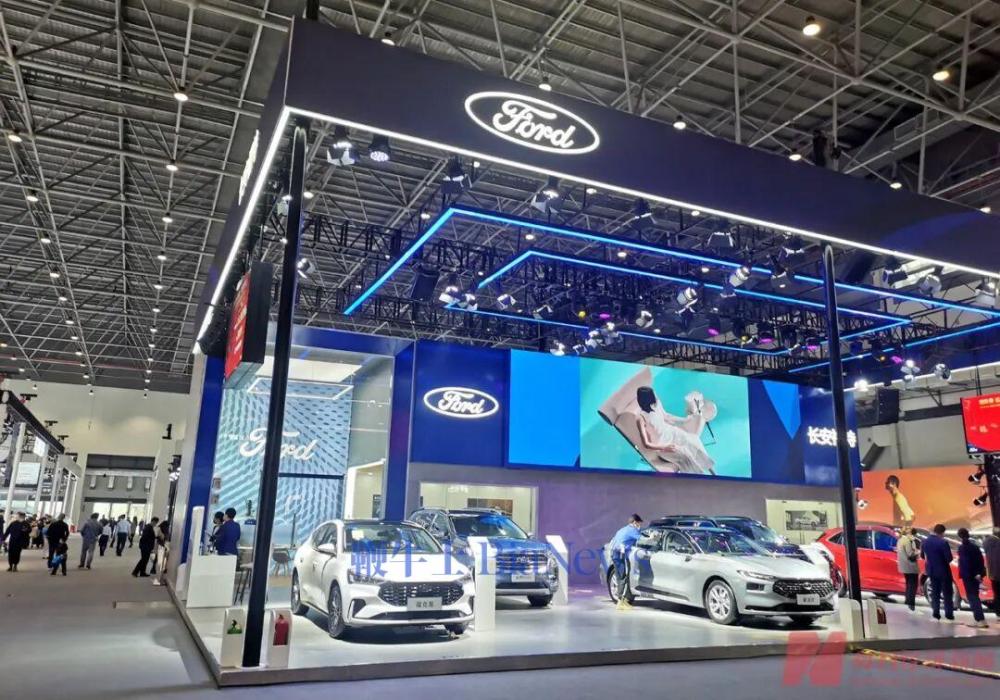
Core Viewpoint - Ford is in discussions with BYD for a battery cooperation plan, focusing on procuring BYD batteries for some of Ford's hybrid models, particularly for use in factories outside the U.S. [1] Group 1: Ford's Strategic Shift - Recently, Ford canceled a significant battery procurement contract with LG Energy Solution worth approximately 459 million RMB, retaining only a portion of the supply for 2026 to 2030 [2] - The cancellation was attributed to changes in policy environment and electric vehicle demand outlook, leading Ford to stop production of certain electric vehicle models [2] - Ford's recent strategic adjustment includes a shift towards high-return businesses, increasing investments in commercial vehicles and battery storage, while reducing focus on large electric vehicle production [4] Group 2: Battery Market Dynamics - The global battery installation volume reached 1,046 GWh in the first 11 months of 2025, marking a 32.6% year-on-year increase, with Chinese companies holding six out of the top ten spots in the global battery market [3] - BYD's lithium iron phosphate (LFP) battery technology is favored for its lower cost (30% cheaper than nickel-cobalt-manganese batteries) and superior safety and lifecycle performance [3] - The demand for LFP batteries is projected to grow by 38% to 420 GWh in 2025, capturing over 54% of the total battery market share [3] Group 3: Historical Context and Future Prospects - Ford and BYD have previously collaborated on battery supply, notably for the launch of the Ford Mustang's first electric SUV in 2021, establishing a foundation for renewed partnership [6] - The current strategic shift towards hybrid vehicles creates a pressing need for reliable and adaptable hybrid batteries, aligning with BYD's expertise in LFP battery production [6]


行业聚焦:全球人形机器人电池组行业头部生产商市场份额及排名调查
QYResearch· 2026-01-20 03:44
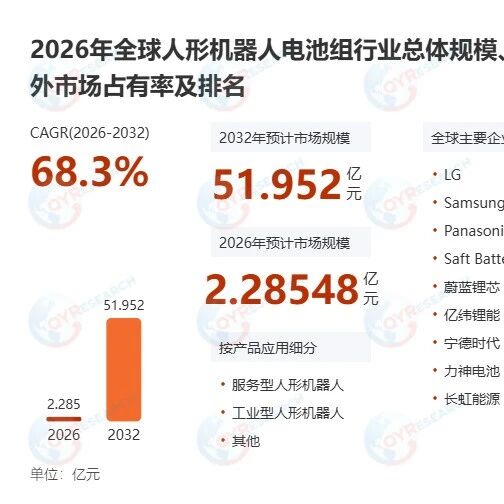
Core Viewpoint - The humanoid robot battery pack market is expected to reach $290 million by 2031, driven by advancements in battery technology and increasing demand for humanoid robots in various sectors [4]. Market Overview - The global humanoid robot battery pack market is projected to grow significantly, with the main drivers being the demand for high energy density lithium-ion cells, modular designs, and smart battery management systems [13]. - The top five manufacturers hold approximately 43.8% of the market share, with major players including CATL, Aulin Lithium, and Yiwei Lithium Energy [6]. Product Segmentation - Service robots account for about 43.6% of the current demand for humanoid robot battery packs [9]. - Liquid lithium batteries represent the largest product segment, capturing around 67.1% of the market share [10]. Industry Drivers - The surge in AI and automation needs is increasing the application of humanoid robots in healthcare, manufacturing, and logistics, thereby driving the demand for high energy density batteries [14]. - Global labor shortages and an aging population are prompting businesses to adopt humanoid robots for assistance in caregiving and daily tasks, further increasing the demand for reliable battery packs [14]. Industry Challenges - Current battery energy density limitations result in short operational times (typically a few hours) and high downtime, restricting the productivity of humanoid robots in industrial settings [15]. - High initial costs and supply chain issues, exacerbated by tariffs (up to 145% on imports from China by 2025), are raising prices and affecting supply chains [15]. Development Opportunities - The adoption of solid-state batteries, such as REPT's 400Wh/kg product, is expected to enhance safety and energy density, with large-scale production anticipated by 2027 for medical and home care applications [16]. - The development of quick-swap battery systems and lithium-sulfur batteries is aimed at supporting continuous operation, particularly in logistics and manufacturing pilot deployments [16].

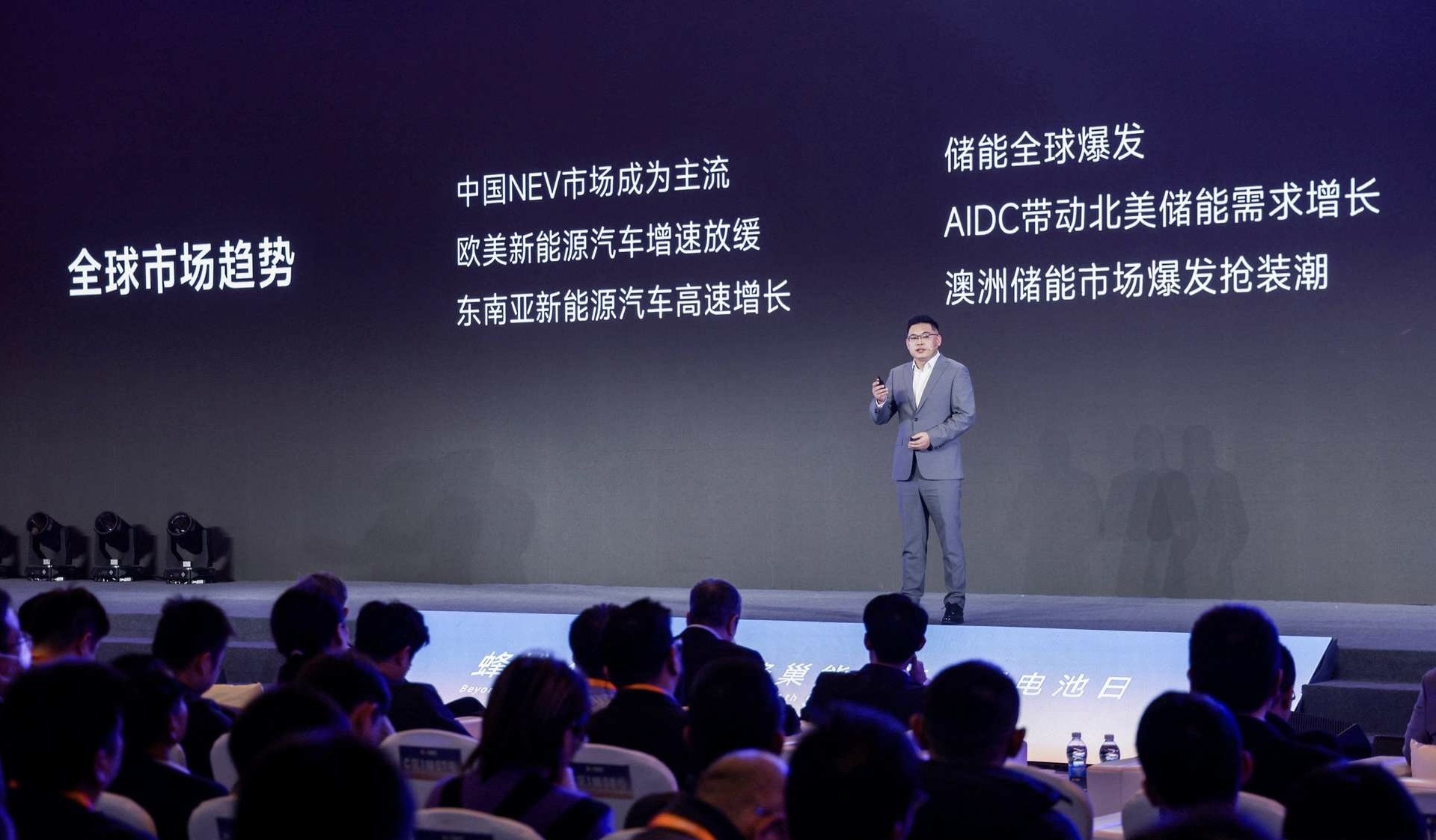
蜂巢能源杨红新:2026,动力电池没有“容易的钱”
Tai Mei Ti A P P· 2026-01-20 01:20
Core Viewpoint - The main uncertainty for achieving profitability in 2026 for battery manufacturers stems from rising upstream raw material costs, which cannot be fully passed on to downstream customers, leading to significant challenges in profit margins [3]. Group 1: Raw Material Price Trends - The price of lithium carbonate has sharply increased from less than 60,000 yuan per ton in mid-2025 to over 130,000 yuan by the end of 2025, continuing to rise into 2026, with a cumulative increase of over 33,000 yuan per ton (over 25%) from early January 2026 [4]. - Phosphate iron lithium prices have experienced a dramatic decline of over 80% from 173,000 yuan per ton at the end of 2022 to 34,000 yuan in August 2025, leading to widespread losses in the industry [4]. Group 2: Cost Transmission Challenges - Battery manufacturers face difficulties in passing on rising costs to customers due to a potential slowdown in demand, with car manufacturers becoming less tolerant of cost increases [5]. - Key raw materials like lithium carbonate, copper, and hexafluorophosphate can be smoothly transmitted to downstream customers due to established price linkage agreements, while costs for non-bulk materials like separators and graphite must be absorbed by battery manufacturers [6]. Group 3: Export Tax Policy Changes - The export tax rebate for battery products will be reduced from 9% to 6% starting April 2026, with a complete cancellation planned for January 2027, significantly impacting profit margins for battery manufacturers relying on cost advantages for exports [7][8]. - Companies must navigate two strategies: negotiating price increases with overseas customers and pursuing localized production to mitigate the impact of reduced export rebates [8]. Group 4: Solid-State Battery Development - Despite being seen as a critical year for solid-state battery commercialization, industry experts express skepticism about the feasibility of large-scale production within the next 5 to 8 years due to significant technical challenges [10][11]. - Current industry focus should prioritize improving existing battery performance and safety rather than chasing the uncertain future of solid-state technology [11]. Group 5: Emerging Market Opportunities - The demand for unmanned delivery logistics vehicles is expected to surge, driven by the need to reduce logistics costs and comply with urban regulations [12]. - Southeast Asia's electric two- and three-wheeler market presents a significant growth opportunity, requiring high-performance batteries tailored to local conditions [12]. - The global electric tool market is projected to grow steadily at around 20% annually, providing a stable supplementary business for battery manufacturers [12]. Group 6: Strategic Industry Outlook - The battery industry in 2026 faces complex challenges, requiring companies to balance cost absorption with finding new revenue streams in international markets [13]. - Future winners in the industry will likely be those who can strategically navigate cost pressures and identify profitable opportunities rather than simply focusing on scale [13].
巴西:研发出3伏特铌电池
财联社· 2026-01-19 16:07
Core Viewpoint - The University of São Paulo in Brazil has announced a patent application for a niobium battery that operates at a voltage of 3 volts and has charging and discharging capabilities, currently in industrial testing phase [1] Summary by Relevant Sections - The battery can function not only under laboratory conditions but also in real environments close to industrial applications, indicating its stability and potential for further industrialization [1] - The 3-volt operating voltage of the battery is comparable to mainstream commercial batteries available in the market, highlighting its competitive edge [1]
安孚科技:目前公司出口的电池产品以碱性电池为主
Zheng Quan Ri Bao Wang· 2026-01-19 13:43
Core Viewpoint - The adjustment of export tax rebate policies for battery products is expected to optimize the industry landscape in the long term, benefiting leading companies with technological, scale, and brand advantages [1] Company Strategy - The company primarily exports alkaline batteries and plans to negotiate pricing with overseas clients and strengthen cost control to stabilize the profitability of its export business in response to policy changes [1] - The company is actively promoting international capacity layout and has established cooperation with key overseas clients to implement capacity construction in relevant regions, while also planning more overseas capacity projects to enhance global supply chain resilience and localized supply capabilities [1]
