石油天然气

Search documents
竞价看龙头:白银有色、招金黄金、豫光金铅等热门股一字跌停
Xin Lang Cai Jing· 2026-01-30 01:45
Group 1 - The core focus of the market is on leading stocks such as Baiyin Nonferrous, Zhaojin Gold, and Yuguang Gold Lead, which experienced significant price drops [1] - Baiyin Nonferrous saw a limit down on its eighth trading day, while Zhaojin Gold and Yuguang Gold Lead also faced limit downs on their respective trading days [1] - China Gold opened lower by 1.85%, indicating a negative trend in the precious metals sector [1] Group 2 - The oil and gas sector showed some resilience, with Zhongjie Oil and China Oil rising by 2.64% and 1.96% respectively [1] - AI application stocks like Tiandi Online and Zhejiang Wenlian experienced positive movements, with increases of 5.20% and a slight decrease of 1.81% respectively [1] - Chemical stocks such as Baichuan Co. and Runtong Co. had mixed performances, with Baichuan Co. rising by 6.19% and Runtong Co. declining by 2.62% [1]


航天国家队谋划“十五五”:旅游、采矿有望向太空进发;白银一度跌超8%,黄金一度大跌5.9%,获利了结压顶贵金属剧烈震荡 ——《投资早参》
Mei Ri Jing Ji Xin Wen· 2026-01-29 23:48
Important Market News - US stock indices closed mixed, with the Nasdaq down 0.72%, S&P 500 down 0.13%, and Dow Jones up 0.11%. Microsoft dropped 10%, losing $357 billion in market value, while Meta rose over 10% [1] - International oil prices continued to rise, with WTI crude up 3.39% at $65.35 per barrel and Brent crude up 3.09% at $69.45 per barrel. Gold reached a historical high of $5598.75 before dropping significantly, closing at $5393.21 per ounce, while silver also saw a decline [2] Industry Insights - China Aerospace Science and Technology Corporation plans to develop space tourism and related infrastructure during the 14th Five-Year Plan period. The company aims to establish a complete operational system for suborbital space tourism and gradually develop orbital space tourism. The space economy is expected to grow significantly, with the satellite communication industry projected to reach between 200 billion to 400 billion yuan by 2030, with a compound annual growth rate of 10%-28% [3] - A research team from the Chinese Academy of Sciences and Peking University has made advancements in quantum computing, demonstrating unique advantages in simulating complex systems. The quantum computing industry is expected to reach a market size of hundreds of billions by 2025-2030, driven by technological breakthroughs and market demand [4][5] - The Beijing Humanoid Robot Innovation Center has launched a testing platform, marking the production of its 1000th humanoid robot. The platform aims to validate technology and meet application needs, with an annual production capacity of 5000 units. The humanoid robot industry is anticipated to see significant growth by 2025, driven by advancements in component performance and cost reduction [6] Stock Reduction Announcements - Kangnibei Group plans to reduce its stake in Kangnibei by up to 25.36 million shares, representing 1% of the total share capital [7] - Chongde Technology's shareholder plans to reduce its stake by up to 870,000 shares, also 1% of the total share capital [7] - Guangpu Co., Ltd. announced that its controlling shareholder intends to reduce its stake by up to 8.47 million shares, accounting for 3% of the total share capital [7] - Other companies, including Shikong Technology and Huafeng Chemical, have also announced plans for share reductions, with varying percentages of total share capital [7][8]
中曼石油天然气集团股份有限公司股东减持股份结果公告
Shang Hai Zheng Quan Bao· 2026-01-29 19:44
中曼石油天然气集团股份有限公司 股东减持股份结果公告 本公司董事会、全体董事及相关股东保证本公告内容不存在任何虚假记载、误导性陈述或者重大遗漏, 并对其内容的真实性、准确性和完整性承担法律责任。 重要内容提示: ● 股东的基本情况 本次减持计划实施前,朱逢学、上海共荣投资中心(有限合伙)(以下简称"共荣投资")、上海共远投 资中心(有限合伙)(以下简称"共远投资")分别持有中曼石油天然气集团股份有限公司(以下简 称"公司")26,163,398股、4,146,811股、2,991,130股(合计持有33,301,339股),分别占公司总股本的 5.66%、0.90%、0.65%(合计占公司总股本的7.21%)上述股份全部来源于公司首次公开发行前已持有 的股份,该部分股份已于2020年11月18日解除限售并上市流通。 ● 股东减持计划的实施结果情况 登录新浪财经APP 搜索【信披】查看更多考评等级 证券代码:603619 证券简称:中曼石油 公告编号:2026-004 (一)股东因以下事项披露减持计划实施结果: 减持计划实施完毕 公司于2025年11月28日披露《中曼石油天然气集团股份有限公司股东减持股份计划公 ...
中石油、国家电网“油电联姻”新进展
Sou Hu Cai Jing· 2026-01-29 15:43
Core Viewpoint - The acquisition of 100% equity of Yingda Futures by Zhongyou Capital for 1.129 billion yuan marks a significant step in the collaboration between China National Petroleum Corporation (CNPC) and State Grid Corporation of China, enhancing Zhongyou Capital's financial capabilities and aligning with the broader energy transition goals of both companies [1][2]. Group 1: Acquisition Details - Zhongyou Capital announced plans to acquire 100% equity of Yingda Futures for 1.129 billion yuan, with the transaction approved by the State-owned Assets Supervision and Administration Commission [1]. - The acquisition price represents an 8.3% premium over Yingda Futures' net asset value of approximately 1.043 billion yuan as of March 2025 [1]. - The transfer of 3.79 million A-shares (3.00% of total shares) from CNPC to State Grid Yingda Group is also part of this transaction, pending regulatory approval [1]. Group 2: Strategic Implications - For State Grid Yingda, divesting the non-core asset Yingda Futures aligns with its strategy to streamline operations [2]. - The acquisition allows Zhongyou Capital to complete its financial license portfolio, enhancing its capabilities in hedging and risk management related to its core oil and gas business [2]. - Zhongyou Capital's diverse financial interests include stakes in various financial institutions, which will be bolstered by this acquisition [2]. Group 3: Industry Context - The collaboration between CNPC and State Grid has intensified since last year, with significant investments aimed at developing a new energy system [3]. - Predictions indicate that China's oil consumption may peak around 2025, prompting CNPC to transition towards a comprehensive energy supplier model that includes oil, gas, and renewable energy [3]. - CNPC aims to achieve a balanced energy portfolio by 2035, with a focus on clean energy generation exceeding 20 billion kilowatt-hours in 2025 [4].

石油板块迎来布局良机,石油ETF鹏华(159697)规模超10亿元
Cai Fu Zai Xian· 2026-01-29 09:05
Group 1: Core Insights - The oil sector is regaining market attention due to cyclical rotation and geopolitical factors, with the Penghua Oil ETF (159697) surpassing 1 billion yuan in scale, reaching 1.032 billion yuan, reflecting significant growth [1] - The Penghua Oil ETF has shown strong capital attraction, with 19 out of the last 20 trading days experiencing net inflows totaling 778 million yuan, indicating high investor recognition and positive market expectations for the current oil cycle [1] - The Penghua Oil ETF is the first in the market to track the National Index of Oil and Natural Gas, covering key companies in the oil and gas industry, with the "Big Three" oil companies accounting for 42.04% of the index [1] Group 2: Market Trends - The global macro environment is witnessing a new cycle rotation for resource assets, with the commodity market currently in the second phase of a supercycle, where industrial metals are rising, but oil prices remain relatively low [2] - Historical analysis shows that during previous commodity cycles, oil prices tend to lag behind other commodities, suggesting that attention should be focused on the oil and gas sector in 2026, especially if geopolitical tensions ease [2] - The strategic oil reserves of the U.S. and OECD have dropped to historical lows, indicating a potential for oil price increases driven by strategic replenishment needs in the future [2] Group 3: Investment Opportunities - The Penghua Oil ETF offers high transparency, low fees, and high liquidity, making it an efficient tool for investors to gain exposure to the oil and gas sector [3] - The ETF is positioned to capitalize on both short-term geopolitical risk premiums and long-term energy cycle reversal opportunities, showcasing its significant allocation value [3]
美伊局势再升温,推升油价,石油ETF鹏华(159697)开盘涨超1.5%
Xin Lang Cai Jing· 2026-01-29 01:52
石油ETF鹏华紧密跟踪国证石油天然气指数,国证石油天然气指数反映沪深北交易所石油天然气产业相 关上市公司的证券价格变化情况。 数据显示,截至2025年12月31日,国证石油天然气指数(399439)前十大权重股分别为中国石油、中国石 化、中国海油、杰瑞股份、广汇能源、招商轮船、新奥股份、九丰能源、中远海能、大众公用,前十大 权重股合计占比67.11%。 石油ETF鹏华(159697),场外联接(A:019827;C:019828;I:022861)。 消息面上,伊朗区域局势升温,特朗普28日在社交媒体上说,一支庞大的舰队正前往伊朗,已准备好迅 速履行其使命。他还称,希望伊朗能够迅速坐到谈判桌前。国际油价升至四个月新高。WTI3月原油期 货收于每桶63.21美元,创去年9月底以来最高,涨幅为1.31%;布伦特3月原油期货收于每桶68.40美 元,涨幅为1.23%。 东方证券指出,近期地区冲突持续发生,此外在供给端,美国严寒天气也影响了炼油产出。由于市场担 忧产油国区域冲突或导致油气供给减少,因此近期布伦特油价出现持续回升。若油价继续上升并保持更 高水平,预计行业资本开支将边际提升,油服的景气度有望边际上升。 截 ...
驻中国海油纪检监察组:发现不法供应商与相关领导干部长期深度绑定
Zhong Yang Ji Wei Guo Jia Jian Wei Wang Zhan· 2026-01-29 01:00
近日,驻中国海油纪检监察组组长钟庆明与8位党组成员一对一、面对面开展约谈。这已经是该组连续 第5年全覆盖约谈党组成员,也是全面派驻改革后的首次约谈。5年来,约谈工作在坚持中不断深入深 化,成为贯通落实"两个责任"的有力抓手和加强党组班子建设的重要载体。 驻中国海油纪检监察组始终把学习贯彻习近平总书记重要指示批示精神和党中央重大决策部署作为约谈 的首要方面,推动党组成员结合分管领域,深入思考贯彻落实的具体思路和方法举措。 在查办某严重违纪违法案件过程中,驻中国海油纪检监察组发现不法供应商与相关领导干部长期深度绑 定。结合约谈,督促分管的党组成员做实查办案件"后半篇文章",对涉案供应商与案发单位业务往来情 况全面起底,针对性开展整改整治。 抓住了"关键少数",就抓住了责任落实的"牛鼻子"。驻中国海油纪检监察组把整改落实情况纳入日常监 督,并在下一年度约谈时,听取党组成员关于上年度通报问题整改情况。 "每次谈话结束后,我们都专门召开会议,专题研究约谈通报的问题。"有的党组成员表示,同时指导推 动其联系单位每季度也定期研究党风廉政建设和反腐败工作。 "上次通报项目廉洁风险情况后,我们迅速采取了措施。"有的党组成员说道 ...

山东新潮能源股份有限公司关于公司股票可能被终止上市的风险提示公告
Shang Hai Zheng Quan Bao· 2026-01-28 18:01
登录新浪财经APP 搜索【信披】查看更多考评等级 证券代码:600777 证券简称:*ST新潮(维权) 公告编号:2026-007 山东新潮能源股份有限公司 关于公司股票可能被终止上市的风险提示公告 本公司第十三届董事会及第十三届董事会董事保证本公告内容不存在任何虚假记载、误导性陈述或者重 大遗漏,并对其内容的真实性、准确性和完整性承担法律责任。 重要内容提示: ● 山东新潮能源股份有限公司(以下简称"公司")于2025年7月5日披露了《关于股票被实施退市风险警 示并继续被实施其他风险警示暨复牌的公告》(公告编号:2025-066),公司股票于2025年7月8日起被 实施退市风险警示,并被继续实施其他风险警示。 三、其他事项 截至本公告披露日,公司生产经营活动正常,日常经营情况未发生重大变化。公司将积极配合会计师开 展年度审计工作,并严格按照《股票上市规则》等相关规定履行信息披露义务,及时做好信息披露工 作。 公司指定信息披露媒体为《上海证券报》《中国证券报》《证券时报》《证券日报》及上海证券交易所 网站(www.sse.com.cn),有关公司信息均以公司在上述指定媒体披露信息为准,敬请广大投资者关注 公司 ...

沪指放量上涨,关注A500ETF易方达(159361)、沪深300ETF易方达(510310)等产品配置价值
Sou Hu Cai Jing· 2026-01-28 10:40
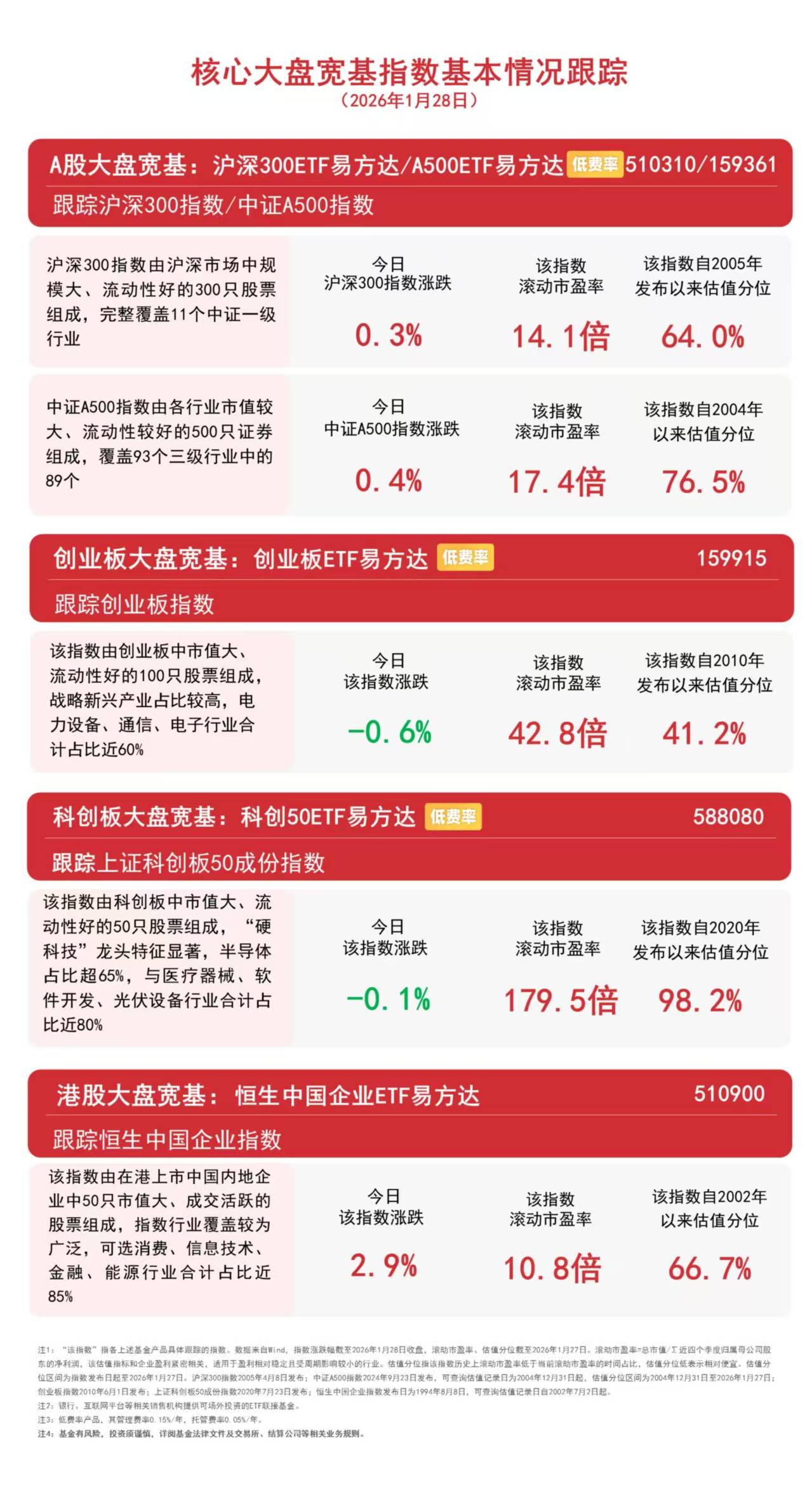
Market Performance - On January 28, A-shares showed mixed performance with the Shanghai Composite Index rising by 0.27% and total market turnover approaching 3 trillion yuan, an increase of over 70 billion yuan compared to the previous day [1] - The CSI 500 Index increased by 0.4%, while the CSI 300 Index rose by 0.3%. In contrast, the ChiNext Index fell by 0.6%, and the STAR Market 50 Index decreased by 0.1% [1][3] - The Hang Seng Index surged, reaching a nearly four-year high, with significant gains in the metals, oil, and semiconductor sectors [1] Sector Performance - Leading sectors included non-ferrous metals, oil and natural gas, coal, chemicals, soybeans, semiconductors, and real estate, which saw notable increases [1] - Conversely, sectors such as photovoltaic equipment, biopharmaceuticals, education, military equipment, beauty care, and PEEK materials experienced declines [1]

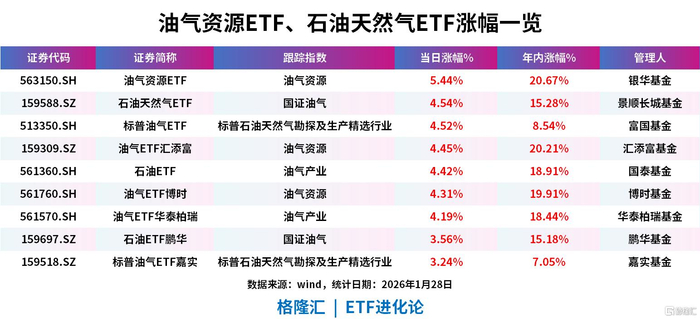
石油股涨势上涨,油气资源ETF、石油天然气ETF涨超5%
Ge Long Hui A P P· 2026-01-28 09:48
Group 1 - Oil and gas stocks are experiencing significant gains, with various ETFs such as the Oil and Gas Resources ETF and the Oil and Gas ETF rising over 5% [1] - The Oil and Gas Resources ETF, managed by Yinhua Fund, has seen a daily increase of 5.44% and a year-to-date increase of 20.67% [3] - The Brent crude oil price forecast for 2026 has been raised to $65 per barrel, reflecting a bullish outlook due to demand recovery and global inventory accumulation [6] Group 2 - The U.S. military's Central Command announced air force readiness exercises amid increasing military pressure on Iran, contributing to a 3% rise in international oil prices [5] - A severe winter storm in the U.S. has led to a production loss of up to 2 million barrels per day, approximately 15% of the country's total production [5] - The geopolitical situation is intensifying the strategic value of deep-sea resources, with domestic energy giants strengthening their leadership positions in resource development [7]