
水泥制造

Search documents
浙江尖峰集团拟斥2000万 - 4000万元回购股份用于员工激励,截至8月末尚未实施
Xin Lang Zheng Quan· 2025-09-01 15:37
Group 1 - The core viewpoint of the announcement is that Zhejiang Jianfeng Group Co., Ltd. has disclosed the progress of its share repurchase plan, which was approved by the board on April 18, 2025 [1][2]. - The company plans to use its own funds and self-raised funds for the share repurchase, with a total estimated amount between 20 million yuan and 40 million yuan [2]. - The repurchase period is set for 12 months from the date of board approval, starting from April 18, 2025, and the initial repurchase price was capped at 15.00 yuan per share, later adjusted to 12.42 yuan per share due to a rights distribution [2]. Group 2 - As of August 31, 2025, the company has not conducted any repurchase transactions, with a total of 0 shares repurchased, representing 0.00% of the total share capital [3]. - The company is required to announce the progress of the share repurchase within the first three trading days of each month, based on the status as of the end of the previous month [3]. - Zhejiang Jianfeng Group will adhere to relevant regulations and make repurchase decisions based on market conditions while fulfilling its information disclosure obligations [3].

金融工程行业景气月报:行业表现大幅分化,浮法玻璃盈利持续改善-20250901
EBSCN· 2025-09-01 11:43
Quantitative Models and Construction Methods 1. Model Name: Coal Industry Profit Forecast Model - **Model Construction Idea**: The model estimates monthly revenue and profit growth rates for the coal industry based on changes in price and capacity factors[10][15] - **Model Construction Process**: 1. The pricing mechanism is determined by the last price index of the previous month, which sets the sales price for the next month[10] 2. The model uses year-on-year changes in price factors and capacity factors to estimate revenue and profit growth rates on a monthly basis[10] - **Model Evaluation**: The model provides a systematic approach to track and predict industry profitability trends, but it is sensitive to price fluctuations and external shocks[15] 2. Model Name: Hog Supply-Demand Gap Estimation Model - **Model Construction Idea**: This model predicts the supply-demand gap for hogs six months in advance based on the relationship between sow inventory and hog slaughter rates[16][17] - **Model Construction Process**: 1. The model assumes a stable proportional relationship between quarterly hog slaughter and sow inventory lagged by six months[16] 2. The formula for the slaughter coefficient is: $ \text{Slaughter Coefficient} = \frac{\text{Quarterly Hog Slaughter}}{\text{Sow Inventory (Lagged 6 Months)}} $[16] 3. The potential supply six months later is calculated as: $ \text{Potential Supply (t+6)} = \text{Sow Inventory (t)} \times \text{Slaughter Coefficient (t+6)} $[17] 4. The potential demand six months later is estimated using historical quarterly slaughter data[17] - **Model Evaluation**: The model effectively identifies hog price cycles but relies heavily on the accuracy of historical slaughter coefficients[17] 3. Model Name: Steel Industry Profit Forecast Model - **Model Construction Idea**: The model predicts monthly profit growth and per-ton profitability for the steel industry by integrating steel prices and raw material costs[19] - **Model Construction Process**: 1. The model incorporates comprehensive steel prices and costs of raw materials such as iron ore, coke, pulverized coal, and scrap steel[19] 2. Monthly profit growth rates and per-ton profitability are calculated based on these inputs[19] - **Model Evaluation**: The model provides a detailed view of profitability trends but may not fully capture external demand-side factors[23] 4. Model Name: Glass and Cement Industry Profitability Tracking Model - **Model Construction Idea**: This model tracks profitability changes in the glass and cement industries using price and cost indicators, and generates allocation signals based on these changes[25] - **Model Construction Process**: 1. The model monitors price and cost indicators to assess profitability trends[25] 2. It incorporates manufacturing PMI and real estate sales data to evaluate macroeconomic impacts on industry expectations[25] - **Model Evaluation**: The model is useful for identifying short-term profitability trends but may be limited by the lag in macroeconomic data updates[26] 5. Model Name: Refining and Oilfield Services Profitability Model - **Model Construction Idea**: This model estimates profit growth and cracking spreads for the refining industry based on changes in fuel prices, crude oil prices, and new drilling activity[27] - **Model Construction Process**: 1. The model calculates profit growth rates using changes in fuel and crude oil prices[27] 2. Cracking spreads are derived from the difference between product prices and raw material costs[27] 3. Allocation signals are generated based on oil price trends and drilling activity[27] - **Model Evaluation**: The model captures key profitability drivers but may not fully account for geopolitical risks affecting oil prices[34][35] --- Backtesting Results of Models 1. Coal Industry Profit Forecast Model - **Excess Return**: The coal industry underperformed the Wind All-A Index by -9.8% in August 2025[10] 2. Hog Supply-Demand Gap Estimation Model - **Supply-Demand Balance**: The potential supply for Q1 2026 is estimated at 19,380 million heads, while the demand is forecasted at 19,476 million heads, indicating a slightly tight balance[18] 3. Steel Industry Profit Forecast Model - **Profit Growth**: The steel industry is predicted to achieve positive year-on-year profit growth in August 2025[23] 4. Glass and Cement Industry Profitability Tracking Model - **Glass Industry**: Profit margins continued to decline year-on-year in August 2025, but the rate of decline narrowed[26] - **Cement Industry**: Profitability slightly declined year-on-year in August 2025[26] 5. Refining and Oilfield Services Profitability Model - **Refining Industry**: Profit growth for August 2025 is predicted to be positive[28] - **Oilfield Services**: Oil prices in August 2025 were lower than the previous year, and drilling activity remained stable, leading to a neutral allocation signal[35]
金隅集团涨2.45%,成交额1.02亿元,主力资金净流出433.35万元
Xin Lang Cai Jing· 2025-09-01 03:19
Group 1 - The stock price of Beijing Jinyu Group increased by 2.45% on September 1, reaching 1.67 CNY per share, with a total market capitalization of 17.832 billion CNY [1] - Year-to-date, the stock price has decreased by 3.47%, with a recent 5-day decline of 1.18%, a 20-day increase of 4.37%, and a 60-day increase of 10.60% [1] - The company has appeared on the trading leaderboard once this year, with the most recent occurrence on July 21, where it recorded a net buy of -22.7325 million CNY [1] Group 2 - Beijing Jinyu Group was established on December 22, 2005, and listed on March 1, 2011, with its main business activities including cement and concrete production, new building materials, real estate development, and property management [2] - The revenue composition of the company includes bulk commodity trading (52.18%), product sales (31.69%), housing sales (7.68%), and other income sources [2] - As of June 30, 2025, the company reported a revenue of 45.566 billion CNY, with a year-on-year growth of 0.01%, and a net profit attributable to shareholders of -1.496 billion CNY, a decrease of 85.40% [2] Group 3 - Since its A-share listing, Beijing Jinyu Group has distributed a total of 7.825 billion CNY in dividends, with 1.516 billion CNY distributed over the past three years [3] - As of June 30, 2025, the top ten circulating shareholders include Hong Kong Central Clearing Limited, which holds 86.9094 million shares, an increase of 5.2339 million shares from the previous period [3]
长江大宗2025年9月金股推荐
Changjiang Securities· 2025-08-31 08:43
Group 1: Metal Sector - Luoyang Molybdenum's net profit forecast for 2025 is 168.65 billion CNY, with a PE ratio of 15.32[12] - The company expects to increase copper production to 70,000 tons in 2025, a 56% year-on-year growth[14] - The strategic partnership with CATL aims to enhance lithium and nickel resource acquisition, contributing over 70% to gross profit[17] Group 2: Cement Sector - Huaxin Cement's domestic sales are projected to decline from 5,004,000 tons in 2023 to 4,078,000 tons in 2025, while overseas sales are expected to grow to 2,017,000 tons[30] - The company aims for a net profit of 19.58 billion CNY from overseas operations by 2026, reflecting a 25% increase from 2025[30] Group 3: Logistics Sector - Eastern Airlines Logistics' revenue from the US market accounts for 20%-30%, with a 5% decline in comprehensive freight rates due to tariff policies[32] - The company is adjusting its route structure to improve performance in the European market, anticipating a recovery in the second half of the year[32] Group 4: Chemical Sector - Wanhua Chemical's net profit is expected to recover as MDI prices stabilize, with a projected increase in demand from the furniture industry[50] - The company is positioned to benefit from a tightening supply of TDI, with prices expected to remain high through 2027[50] Group 5: Power Sector - Changjiang Electric Power's EPS forecast for 2025 is 1.38 CNY, with a PE ratio of 20.26, supported by a commitment to maintain a dividend payout ratio of no less than 70%[74] - The company plans to repurchase shares worth 4-8 billion CNY, reflecting confidence in its future growth[74]



“反内卷”政策预计会继续ING
Sou Hu Cai Jing· 2025-08-30 06:05
Core Viewpoint - The Producer Price Index (PPI) in July showed a month-on-month decline of 0.2%, marking the first narrowing of the decline since March this year, indicating a potential stabilization in industrial prices [2][3]. Group 1: PPI Trends - In July, the prices in coal mining, black metal smelting, photovoltaic equipment manufacturing, cement manufacturing, and lithium-ion battery manufacturing saw a reduced month-on-month decline of 1.9, 1.5, 0.8, 0.3, and 0.1 percentage points respectively, contributing to a reduced downward impact on PPI by 0.14 percentage points compared to the previous month [3]. - The month-on-month decline in PPI was primarily influenced by a series of "anti-involution" policies that have led to a rebound in product prices in cyclical industries, as evidenced by the futures price trends of coal, steel, and cement [3][4]. Group 2: Year-on-Year PPI Analysis - The year-on-year PPI in July decreased by 3.6%, maintaining the same decline as the previous month, with the PPI growth rate remaining in negative territory for 34 consecutive months [4]. - The "anti-involution" policy is seen as a significant factor in the month-on-month improvement of PPI, addressing the core issue of low-price competition driven by supply-demand imbalances [4][5]. Group 3: Future Outlook - The ongoing "anti-involution" policies are expected to continue supporting the month-on-month improvement of PPI, but the extent of this improvement and whether the year-on-year growth can turn positive will require further observation [5]. - To solidify the effects of the "anti-involution" policies, it is crucial to restore domestic demand; otherwise, competitive pressures among enterprises may intensify [6].


韩建河山2025年中报简析:营收净利润同比双双增长,短期债务压力上升
Zheng Quan Zhi Xing· 2025-08-29 22:42
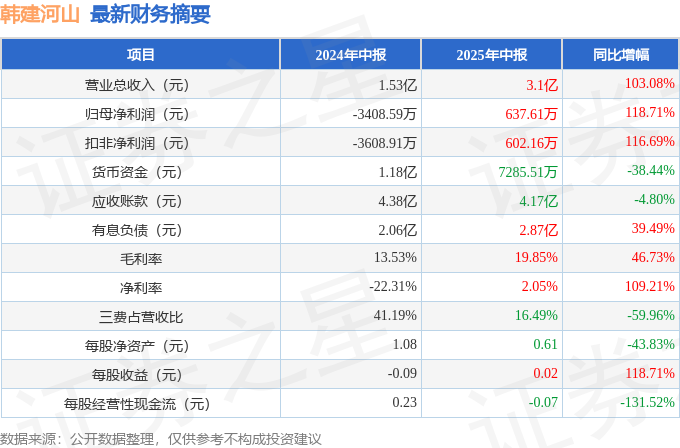
Core Insights - The company Han Jian He Shan (603616) reported a significant increase in revenue and net profit for the first half of 2025, with total revenue reaching 310 million yuan, a year-on-year increase of 103.08%, and a net profit of 6.3761 million yuan, up 118.71% compared to the previous year [1] Financial Performance - Total revenue for Q2 2025 was 193 million yuan, reflecting a year-on-year growth of 71.39% [1] - The gross profit margin improved to 19.85%, an increase of 46.73% year-on-year, while the net profit margin turned positive at 2.05%, up 109.21% from the previous year [1] - The total of selling, administrative, and financial expenses was 51.1751 million yuan, accounting for 16.49% of revenue, a decrease of 59.96% year-on-year [1] - Earnings per share (EPS) rose to 0.02 yuan, a year-on-year increase of 118.71% [1] Debt and Cash Flow - The company experienced increased short-term debt pressure, with a current ratio of 0.89 [1] - Cash flow metrics showed a negative operating cash flow per share of -0.07 yuan, a decline of 131.52% year-on-year [1] - The company’s cash and cash equivalents decreased by 38.44% year-on-year, totaling 72.8551 million yuan [1] Historical Performance - The company has shown a mixed historical performance, with a median Return on Invested Capital (ROIC) of 3.89% since its listing, and a particularly poor ROIC of -35.76% in 2024 [3] - The company has reported losses in five out of nine annual reports since its IPO, indicating a generally weak financial history [3]

金隅集团: 唐山冀东水泥股份有限公司2025年半年度报告
Zheng Quan Zhi Xing· 2025-08-29 17:02
Core Viewpoint - The report highlights the financial performance and operational strategies of Tangshan Jidong Cement Co., Ltd. for the first half of 2025, indicating a recovery in profitability despite ongoing challenges in the cement industry. Financial Performance - The company's revenue for the reporting period reached approximately 11.76 billion yuan, representing a 4.82% increase compared to the same period last year [5][14]. - The net loss attributable to shareholders decreased significantly to approximately 153.62 million yuan, an improvement of 80.94% year-on-year [5][14]. - The gross profit margin improved, with the overall gross margin reaching 20.42%, up by 6.67 percentage points from the previous year [8]. Operational Overview - The company operates with a clinker production capacity of 110 million tons and a cement production capacity of 184 million tons, making it the third-largest cement manufacturer in China [6][8]. - The company has implemented various cost-reduction measures, resulting in a 9.72% decrease in unit sales costs for cement clinker [8][12]. - The company has expanded its product offerings to include special cements and customized products, which have significantly increased their revenue share [13]. Industry Context - The cement industry faced challenges in the first half of 2025, with national cement production declining by 4.3% year-on-year due to reduced demand from the real estate sector and infrastructure investments [6][12]. - Despite the downturn, the industry saw a recovery in profitability, primarily driven by lower coal prices and a temporary increase in cement prices during the first quarter [6][12]. Strategic Initiatives - The company is focusing on enhancing operational efficiency and market positioning through a three-tier operational management model, which includes headquarters, regional, and enterprise levels [7][10]. - The company is actively pursuing digital transformation initiatives, achieving recognition as a leading enterprise in digital supply chain maturity [10][11]. - The company plans to continue expanding its market presence and product offerings, particularly in high-value segments such as special cements and new materials [12][13].

天山股份: 关于召开2025年第四次临时股东会的通知
Zheng Quan Zhi Xing· 2025-08-29 16:52
Meeting Information - The company will hold its fourth extraordinary general meeting of shareholders in 2025 on September 15, 2025 [1] - The meeting will be convened by the company's board of directors and complies with relevant laws and regulations [1] - Voting will be conducted both on-site and via online platforms provided by the Shenzhen Stock Exchange [1][2] Voting Rules - Shareholders must exercise their voting rights seriously, with each share allowed to vote only once through one method: on-site, trading system, or internet voting [2] - The record date for shareholders to attend the meeting is September 8, 2025 [2] Attendance and Registration - All registered ordinary shareholders have the right to attend the meeting and may appoint a proxy to vote on their behalf [2] - Specific documentation is required for both corporate and individual shareholders to attend the meeting [3][4] Proposals for Review - The meeting will review proposals, with details available in prior announcements [2] - Votes from minority investors will be counted separately, and results will be disclosed in the meeting resolution announcement [3] Contact Information - Contact details for inquiries regarding the meeting are provided, including phone numbers and email addresses [4]

华新水泥:关于收购豪瑞尼日利亚资产之关联交易的进展公告
Zheng Quan Ri Bao· 2025-08-29 13:53
Group 1 - The core announcement is that Huaxin Cement has approved the acquisition of assets in Nigeria through its subsidiaries, with a total transaction value of $773.86 million [2] - The company will acquire 100% equity of Caricement B.V. for $56.044 million and 100% equity of Davis Peak Holdings Limited for $27.769 million [2] - The completion of the equity transfer occurred on August 29, 2025, and the acquired companies will be included in Huaxin Cement's consolidated financial statements [2]
尖峰集团: 尖峰集团十二届12次董事会决议公告
Zheng Quan Zhi Xing· 2025-08-29 10:25
Group 1 - The board meeting of Zhejiang Jianfeng Group Co., Ltd. was convened and conducted in accordance with relevant laws, regulations, and the company's articles of association [1][1][1] - The notice for the board meeting was sent out on August 18, 2025, via fax, email, and personal delivery [1][1][1] - The board meeting was held on August 28, 2025, through remote voting, with all nine directors present [1][1][1] Group 2 - The board approved the "2025 Half-Year Report and its Summary" with a unanimous vote of 9 in favor, 0 against, and 0 abstentions [1][1][1] - The announcement includes the resolution of the 12th meeting of the 12th board of directors [1][1][1]