
纺织业

Search documents
众望布艺股份有限公司股票交易异常波动公告
Shang Hai Zheng Quan Bao· 2025-12-26 18:40
证券代码:605003 证券简称:众望布艺 公告编号:2025-030 众望布艺股份有限公司股票交易异常波动公告 本公司董事会及全体董事保证本公告内容不存在任何虚假记载、误导性陈述或者重大遗漏,并对其内容 的真实性、准确性和完整性承担个别及连带责任。 重要内容提示: ●众望布艺股份有限公司(以下简称"公司")股票于2025年12月24日、12月25日、12月26日连续三个交 易日内收盘价格涨幅偏离值累计超过20%。根据《上海证券交易所交易规则》的有关规定,属于股票交 易异常波动的情形。 ●经公司自查并向控股股东杭州众望实业有限公司(以下简称"众望实业")及实际控制人杨林山、马建 芬核实,截至本公告披露日,不存在应披露而未披露的重大信息。 ●鉴于近期公司股票价格波动较大,公司提醒广大投资者注意二级市场交易风险,理性决策,审慎投 资。 一、股票交易异常波动的具体情况 公司股票于2025年12月24日、12月25日、12月26日连续三个交易日内收盘价格涨幅偏离值累计超过 20%。根据《上海证券交易所交易规则》的有关规定,属于股票交易异常波动的情形。 经公司自查,公司目前日常生产经营活动正常,市场环境、行业政策未发生 ...

刚刚!IPO审4过4
梧桐树下V· 2025-12-26 16:04
Group 1 - The article discusses the approval of four companies for IPOs, with one from the Shenzhen Main Board, one from the ChiNext, and two from the Beijing Stock Exchange [1] - The companies approved include: - Fuen Co., Ltd. focusing on eco-friendly fabric research and sales, projected revenue of 181.28 million and net profit of 25.48 million for 2024 [2] - Sanrui Intelligent Technology Co., Ltd. specializing in drone electric power systems, with projected revenue of 83.15 million and net profit of 32.05 million for 2024 [3] - Xinhengtai New Materials Co., Ltd. focusing on functional polymer foam materials, with projected revenue of 77.42 million and net profit of 8.20 million for 2024 [4] - Puang Medical Technology Co., Ltd. engaged in diabetes care and medical devices, with projected revenue of 31.83 million and net profit of 6.69 million for 2024 [4] Group 2 - Fuen Co., Ltd. has a total of 17.5 million shares before the IPO and is controlled by Paiya Holdings with a 36.57% stake, while the actual controllers hold 83.89% of the shares [5][6] - The company reported revenues of 176.38 million, 151.69 million, 181.28 million, and 93.81 million over the past four years, with net profits of 27.57 million, 22.68 million, 25.48 million, and 10.01 million respectively [7] Group 3 - Sanrui Intelligent Technology Co., Ltd. has a total of 36 million shares before the IPO and is controlled by Wu Min with 81.06% voting rights [13][14] - The company reported revenues of 36.16 million, 53.38 million, 83.15 million, and 43.56 million over the past four years, with net profits of 10.09 million, 16.18 million, 32.05 million, and 15.31 million respectively [15] Group 4 - Xinhengtai New Materials Co., Ltd. has a total of 12.33 million shares before the IPO and is controlled by Chen Chunping and Jin Wei with a combined 75.04% voting rights [21][22] - The company reported revenues of 53.00 million, 67.93 million, 77.42 million, and 38.43 million over the past four years, with net profits of 3.97 million, 9.34 million, 8.20 million, and 4.68 million respectively [23] Group 5 - Puang Medical Technology Co., Ltd. has a total of 4.23 million shares before the IPO and is controlled by Tai You Hong and Pu Mao Partnership with a combined 54.67% stake [27][28] - The company reported revenues of 24.18 million, 23.65 million, 31.83 million, and 17.83 million over the past four years, with net profits of 5.16 million, 4.21 million, 6.69 million, and 4.31 million respectively [30]


福恩股份主板IPO过会,业绩稳定性等遭追问
Bei Jing Shang Bao· 2025-12-26 13:48
Core Viewpoint - The core viewpoint of the article is that Hangzhou Fu'en Co., Ltd. has successfully passed the IPO review on the Shenzhen Stock Exchange, aiming to raise approximately 1.25 billion yuan for its sustainable eco-friendly fabric business [1] Company Overview - Fu'en Co., Ltd. is a global supplier of eco-friendly fabrics, focusing on the research, production, and sales of sustainable development materials [1] - The company’s IPO was accepted on June 24, 2025, and it entered the inquiry phase on July 9, 2025 [1] Fundraising Details - The company plans to raise around 1.25 billion yuan through its IPO [1] Market Considerations - The listing committee has requested Fu'en to explain the stability of its performance in relation to industry development trends, concentration of terminal clothing brand merchants, contract signing, pricing power, and comparisons with peer companies [1] - There is a specific focus on whether the company’s performance is at risk of continuous decline [1]
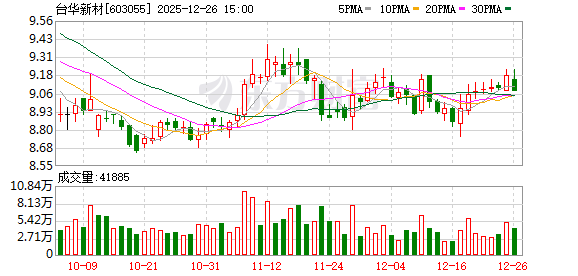
台华新材:2025年第四次临时股东大会决议公告
Zheng Quan Ri Bao· 2025-12-26 12:42
(文章来源:证券日报) 证券日报网讯 12月26日,台华新材发布公告称,公司2025年12月26日召开2025年第四次临时股东大 会,审议通过《关于取消监事会并修订的议案》等多项议案。 ...

南华期货棉花棉纱周报:供给预期持续发酵,棉价加速上行-20251226
Nan Hua Qi Huo· 2025-12-26 12:25
Report Industry Investment Rating No relevant information provided. Core Viewpoints - The supply - demand outlook for domestic cotton in the new year is tight. With the high - yield of Xinjiang cotton this year, the overall supply increase is narrowing due to last year's low inventory and expected low imports. Meanwhile, consumption is supported by expanding spinning capacity, high - load operation of Xinjiang yarn mills, and improved export prospects. Also, expectations of a reduction in next year's cotton planting area in Xinjiang are strengthening, leading to a continuous and accelerating upward shift in cotton prices [1]. - In the short term, there is a risk of cotton price correction. The slowdown in grey fabric sales is affecting the yarn market, squeezing spinning profits and slightly reducing the operating rate. The increasing price difference between domestic and foreign cotton may boost demand for imported yarn, and the uncertainty of the new - season target price subsidy policy also adds to the risk. However, the overall downstream inventory pressure is not large, so the correction range may be limited [7]. - In the long term, the supply - demand of domestic cotton in the new year may remain tight. The rigid consumption of cotton has increased due to the expansion of downstream textile production capacity. Although domestic cotton production has increased significantly, imports are still needed to fill the gap. The probability of further increasing cotton import quotas is low [15]. Summary by Relevant Catalogs Chapter 1: Core Contradictions and Strategy Recommendations 1.1 Core Contradictions - As of December 25, 2025, the cumulative national new - year cotton notarized inspection volume reached 6.0641 million tons, and the average daily notarized inspection volume has dropped to about 55,000 tons. Domestic cotton commercial inventory has significantly increased, but the overall supply increase in the new year is narrowing. The spot price is firm [1]. - Downstream, the expansion of domestic spinning capacity and high - load operation of Xinjiang yarn mills have increased the rigid consumption of cotton. Domestic demand is growing moderately with policy support, and the reduction of Sino - US tariffs is conducive to the recovery of textile and clothing exports [1]. - This year is the last year of the three - year target price subsidy policy. Market expectations of policy adjustment next year are strong due to food supply policies and water resource issues in Xinjiang. A meeting was held to formulate a plan to reduce cotton planting area, further strengthening the expectation of a reduction in Xinjiang cotton area next year [1]. 1.2 Trading - Type Strategy Recommendations - Price range: CF2605 is expected to trade between 13,700 - 14,800. - Strategy: Long - term long positions can be laid out for CF2605 on dips [17]. 1.3 Industrial Customer Operation Recommendations - Price range forecast for cotton in the near future: 13,700 - 14,800, with a current 20 - day rolling volatility of 0.0817 and a 3 - year historical percentile of 0.1968 [17]. - Inventory management: For enterprises with high inventory worried about price drops, they can short Zhengzhou cotton futures (CF2605) to lock in profits, with a hedging ratio of 50% at 14,700 - 14,800. They can also sell call options (CF2605C14800) to collect premiums, with a hedging ratio of 50% at 350 - 400 [17]. - Procurement management: For enterprises with low procurement inventory, they can buy Zhengzhou cotton futures (CF2605) to lock in procurement costs, with a hedging ratio of 75% at 13,700 - 13,800. They can also sell put options (CF2605P13800) to collect premiums, with a hedging ratio of 75% at 300 - 350 [17]. 1.4 Basic Data Overview - Futures data: Zhengzhou cotton 01 closed at 14,565, up 520 (3.7%); Zhengzhou cotton 05 closed at 14,535, up 520 (3.71%); Zhengzhou cotton 09 closed at 14,720, up 545 (3.84%) [18]. - Spot data: CC Index 3128B was at 15,317, up 172 (1.14%); CC Index 2227B was at 13,583, up 275 (2.07%); CC Index 2129B was at 15,559, up 170 (1.1%) [18]. - Spread data: CF1 - 5 spread was 30 (unchanged); CF5 - 9 spread was - 185, down 25; CF9 - 1 spread was 155, up 25 [18]. - Import price: FC Index M was at 12,898, up 129 (1.01%); FCY Index C32s was at 21,173, up 21 (0.1%) [18]. - Yarn data: Futures price was 20,585, up 535 (2.67%); spot price was 21,140, up 210 (1%) [18]. Chapter 2: Core Contradictions and Strategy Recommendations 2.1 This Week's Important Information - **Positive information**: As of December 18, the national new - cotton picking progress was 99.9% (unchanged year - on - year and compared with the four - year average), the delivery rate was 99.3% (up 0.6 percentage points year - on - year and 1.2 percentage points compared with the four - year average), the processing rate was 88.0% (up 2.0 percentage points year - on - year and 7.9 percentage points compared with the four - year average), and the sales rate was 47.3% (up 25.0 percentage points year - on - year and 28.5 percentage points compared with the four - year average). In November, the retail sales of clothing, footwear, and textiles in China were 154.2 billion yuan, up 4.84% month - on - month and 4.19% year - on - year. In November 2025, the export volume of cotton products was 646,400 tons, up 6.32% month - on - month and 9.84% year - on - year; the export value was $5.274 billion, up 12.74% month - on - month and down 10.67% year - on - year; the export unit price was $8.16/kg, up 6.11% month - on - month and down 18.64% year - on - year [19]. - **Negative information**: In November 2025, China's textile and clothing exports were $23.869 billion, down 5.12% year - on - year and up 7.22% month - on - month. Among them, textile exports were $12.276 billion, up 1.03% year - on - year and 9.05% month - on - month; clothing exports were $11.594 billion, down 10.86% year - on - year and up 5.36% month - on - month. As of December 11, 2025, the cumulative net signed export volume of US cotton for the 25/26 season was 1.445 million tons, down 14.40% year - on - year, reaching 54.39% of the annual expected export volume, and the cumulative shipment was 605,000 tons, with a shipment rate of 41.88% [21]. 2.2 Next Week's Important Events to Watch Keep an eye on the subsequent export situation of US cotton as the current US cotton industry data is lagging [22]. Chapter 3: Disk Interpretation 3.1 Price - Volume and Fund Interpretation - **Unilateral trend and fund movement**: Zhengzhou cotton continued to rise this week with an enlarged increase. Funds actively entered the market, and market activity increased. The position of the main contract continuously increased, with bulls in the dominant position. The market's consensus on a bullish outlook was strong. After the accelerated upward movement of cotton prices on Friday, short - position holdings increased, and the long - short ratio weakened slightly, so short - term correction should be guarded against [26]. - **Month - spread structure**: Currently, Zhengzhou cotton 1 - 5 shows a slight back structure supported by industrial - end delivery, while contracts 05 and later maintain a contango structure. The far - month contracts maintain the expectation of tight supply - demand at the end of the year and show a strong trend [29]. - **Basis structure**: This week, the low - end of the cotton basis remained stable, and the high - end slightly decreased. The pick - up price of machine - picked cotton in Xinjiang was 14,960 yuan/ton for grade 3128B and 15,200 yuan/ton for grade 2129B. The sales basis of machine - picked cotton in Shihezi, Xinjiang, with a impurity content of less than 2.7% for the 2605 contract in Xinjiang warehouses was 920 - 1030 yuan/ton, and the pick - up price was 15,080 - 15,250 yuan/ton [32]. Chapter 4: Valuation and Profit Analysis 4.1 Downstream Spinning Profit Tracking - With policy support and technological innovation, Xinjiang yarn mills have a significant cost advantage over those in the inland, maintaining a certain profit. Inland mills were basically in a slight loss in the third quarter. From September, domestic cotton prices declined under the hedging pressure of ginning mills and the supply pressure of new cotton, while yarn spot prices were relatively stable, restoring domestic yarn mills' profits. In December, domestic cotton prices rebounded, squeezing yarn mills' profits again. This week, as cotton prices further increased and yarn prices slightly increased, yarn mills' profits weakened slightly compared with last week [34][35]. 4.2 Import Profit Tracking - Affected by the Xinjiang cotton ban and tariff policies, the price trends of domestic and foreign cotton are relatively independent. This year, China's cotton import profit has been considerable, but the import quota is low, resulting in a low level of cotton imports. In November 2025, China's cotton import volume was 120,000 tons, up 30,000 tons month - on - month and 10,000 tons year - on - year. The cumulative cotton import volume in the 25/26 season was 310,000 tons, down 30,000 tons year - on - year. This week, domestic cotton prices further increased, and foreign cotton prices stabilized and rebounded, slightly expanding the domestic cotton import profit [37]. Chapter 5: Supply and Inventory Deduction 5.1 Supply - Demand Balance Sheet Deduction - The new - year Xinjiang cotton harvest is basically completed, and the output forecast has been slightly revised upwards. In terms of imports, the National Development and Reform Commission has issued an additional 200,000 - ton sliding - scale duty quota, and together with the 894,000 - ton 1% tariff quota for 2026, the new - year cotton import volume is tentatively estimated at 1.1 million tons. The probability of further increasing the sliding - scale duty quota is low. Downstream, domestic demand may maintain a moderate recovery, and the export market is expected to support domestic cotton consumption due to the easing of Sino - US trade relations [42]. - The supply - demand balance sheet shows that in the 25/26 season, cotton production is expected to be 7.6 million tons, imports 1.1 million tons, consumption 8.6 million tons, and the ending inventory 6.26 million tons, with an inventory - to - consumption ratio of 72.79% [43].
众望布艺:股票连续三日涨幅偏离值超20%,提示投资风险
Xin Lang Cai Jing· 2025-12-26 09:28
众望布艺公告称,公司股票于2025年12月24 - 26日连续三个交易日内收盘价格涨幅偏离值累计超20%, 属异常波动。经自查及向控股股东、实控人核实,截至公告披露日,不存在应披露未披露重大信息,生 产经营正常,未涉重大事项、热点概念等,股价异动期间董高监及控股股东无买卖公司股票情况。公司 提醒投资者注意交易风险,2025年1 - 9月营收3.73亿元,同比降3.04%,净利润0.52亿元,同比降 22.47%。 ...
内蒙古将监管与技术帮扶深度融合筑牢产品质量安全底线
Xin Lang Cai Jing· 2025-12-26 06:42
Core Viewpoint - Inner Mongolia focuses on integrating regulatory measures with technical support to enhance product quality safety, addressing public concerns and ensuring a robust safety baseline for products [1] Group 1: Regulatory Measures and Actions - Inner Mongolia's market regulatory authority has conducted over 45,400 inspections of key industrial product production and sales units, implementing more than 15,900 product quality supervision checks, and identifying 225 quality risk issues [1] - The authority has transitioned to a proactive "prevention-first" model for product quality risk management, establishing a risk monitoring system that includes daily monitoring, weekly analysis, and monthly assessments [2] - A total of 45,000 risk information entries have been monitored, with 1,000 batches subjected to risk monitoring checks, leading to 132 risk alerts [2] Group 2: Quality Improvement Initiatives - The authority has achieved a historic breakthrough in quality traceability management, guiding 274 companies to implement source coding for 1,249 products, and assisting 113 companies in establishing traceability systems covering 44,300 cubic meters of products [2] - The "You Point, I Help" service has been launched, providing targeted assistance to nearly 4,000 businesses in understanding new standards and risk management [3] - The authority has conducted 157 quality consultations, assisting 2,296 businesses and resolving 258 quality-related issues, which has directly contributed to an increase in industrial output value of approximately 332 million [3] Group 3: Focus on Children's Products - The authority has organized free inspections of over 8,000 batches of school uniform samples, reducing the non-compliance rate from 10.6% to 7.9% [4] - Specific support has been provided to companies like Inner Mongolia Luwang Cashmere Co., which developed new technologies, resulting in over 15,000 new orders [4] - The authority has facilitated significant growth in online sales for companies, with one reporting a year-on-year increase of over 50% [4] Group 4: Regional Regulatory Practices - Various cities in Inner Mongolia have implemented unique regulatory practices, such as focusing on children's product safety and enhancing oversight of online platforms [5] - Baotou has conducted comprehensive inspections of electric bicycle sales and repair units, effectively eliminating the sale of non-compliant bicycles [5] - Tongliao has improved the compliance rate of agricultural products, achieving a 100% compliance rate for agricultural film products [5]
福恩股份IPO:一家三口表决权超八成,控股股东旗下企业遭股权冻结
Sou Hu Cai Jing· 2025-12-26 06:31
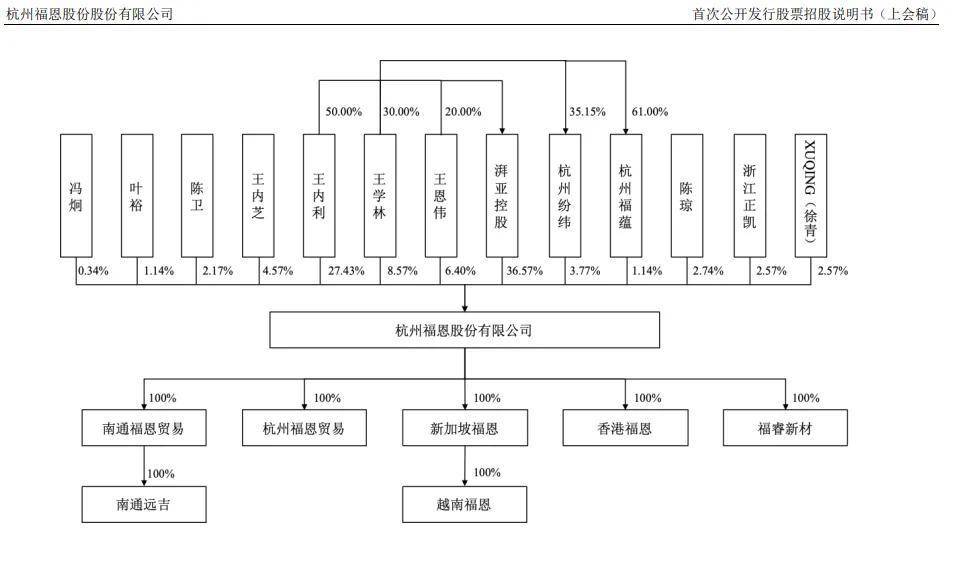
Core Viewpoint - Fuen Co., Ltd. is set to go public on the Shenzhen Stock Exchange, focusing on the research, production, and sales of eco-friendly fabrics, with major clients including well-known global apparel brands [1] Group 1: Company Overview - Fuen Co., Ltd. has evolved from its establishment in January 1997 to a large enterprise integrating fabric design, research, spinning, weaving, dyeing, finishing, and sales [1] - The major shareholders include Paiya Holdings, Wang Neili, Wang Xuelin, and Wang Enwei, with respective ownership stakes of 36.57%, 27.43%, 8.57%, and 6.4% [1] - The controlling shareholders, Wang Neili, Wang Xuelin, and Wang Enwei, collectively control 83.89% of the company [1][2] Group 2: Management Background - Wang Enwei, born in 1955, has held various leadership roles since founding the company and currently serves as a board member [5] - Wang Neili, born in 1981, has been with the company since 2005 and is currently the chairman [5] - Wang Xuelin, also born in 1981, joined the company in 2005 and currently serves as the general manager and board member [5] Group 3: Financial Transactions - Fuen Co., Ltd. has engaged in significant transactions involving large-denomination certificates of deposit, transferring amounts of 20.59 million yuan and 30 million yuan to Paiya Holdings in 2024 and the first half of 2025, respectively [6][7] - The company also plans to acquire 50 million yuan in large-denomination certificates of deposit from Paiya Holdings in October 2024 [6][7] Group 4: Compliance Issues - Fuen Co., Ltd. has faced multiple fines for non-compliance, including a fine of 128,322.84 yuan for unauthorized construction activities in May 2023 [7] - The company’s subsidiary in Vietnam incurred fines for incorrect customs declarations and late tax submissions, highlighting the need for improved compliance management [8] Group 5: Related Party Transactions - The company has been involved in related party transactions with Paiya Holdings, including the transfer and acquisition of large-denomination certificates of deposit, raising questions about the purpose of these transactions given the company's strong cash position [7]
奋勇争先,决战决胜“十四五”|全国统一大市场建设向纵深推进
Ren Min Ri Bao· 2025-12-26 03:17
人民日报记者 林丽鹂 杨文明 姚雪青 破除地方保护和市场分割,鼓励利益共享。 "仅用3个多月,全自动净化车间就落地了。这在过去至少需要9个月。"麦仆科技(上海)有限公司 董事长邓润华介绍了今年在云南大理白族自治州弥渡县项目投产的经历。 上海企业去云南,会不会影响上海的经济发展?"'沪滇协作'不是此消彼长,而是共同做大蛋 糕。"奉贤区援滇干部顾壹壹介绍,云南16个州(市)和上海16个区建立"16+16"重点园区合作共建机 制。今年6月,云南发布《关于建立利益共享机制加快推进园区协作发展的通知》,支持各地发展共建 协作、飞地经济等模式,明确合作双方政府间的财税利益、经济指标可共享。 放眼全国,湖南建立利益分享机制,加快推进"飞地园区"发展;安徽五河县与江苏泗洪县共建省际 毗邻区新型功能区,地理交界处变"合作高地";全国首只跨省域财税分享基金——长三角生态绿色一体 化发展示范区投资基金正式登记设立,其产生的地方级财税收入将由上海青浦区、江苏苏州吴江区、浙 江嘉兴嘉善县"两区一县"按同等比例分享。 习近平总书记指出:"建设全国统一大市场,不仅是构建新发展格局、推动高质量发展的需要,而 且是赢得国际竞争主动权的需要。" ...

从“一根丝”的突破, 看民营企业创新活力
Xin Lang Cai Jing· 2025-12-25 17:23
Core Viewpoint - The transformation of the textile industry, represented by the evolution of a single thread, showcases the acceleration of enterprise upgrades and continuous innovation, with private enterprises becoming a vital force in developing new productive capacities [2][6]. Group 1: Industry Transformation - The textile industry's innovation is not limited to factories but extends to collaborations with research institutions, leading to the development of functional materials such as temperature-regulating cotton fibers [3]. - The Erdos Cashmere Group has transitioned from manual operations to managing 16 fully automated machines, emphasizing that the future of traditional textiles lies in technological empowerment and value reconstruction [2]. Group 2: Technological Advancements - Changfei Fiber Optic Cable Co., Ltd. has achieved significant breakthroughs in optical fiber technology, moving from reliance on imports to mastering all key technologies in the field, positioning itself as a leader in standard-setting [4]. - The company has established joint laboratories to tackle fundamental technologies and facilitate the industrialization of core materials, demonstrating a collaborative approach to innovation [4]. Group 3: Material Performance Breakthroughs - Ningbo Bowei Alloy Precision Wire Co., Ltd. has achieved unprecedented precision in cutting wires, essential for manufacturing high-precision components, pushing diameter limits from 0.33mm to 0.015mm [5]. - Ounait Cable Group has developed cables that maintain flexibility at -40°C and resist harsh environmental conditions, showcasing a commitment to innovation in specialized cable products [5]. Group 4: Contribution of Private Enterprises - Private enterprises contribute 70% of the nation's technological innovations and encompass 80% of specialized "little giant" companies and 90% of high-tech enterprises [6]. - The implementation of the Private Economy Promotion Law is seen as a stabilizing force for private enterprises, enhancing their role in national technological projects and fostering innovation [6].