
私募

Search documents
公私募抢上车摩尔线程,初配名单揭晓,谁抢到了最多筹码?
Feng Huang Wang· 2025-11-26 01:28
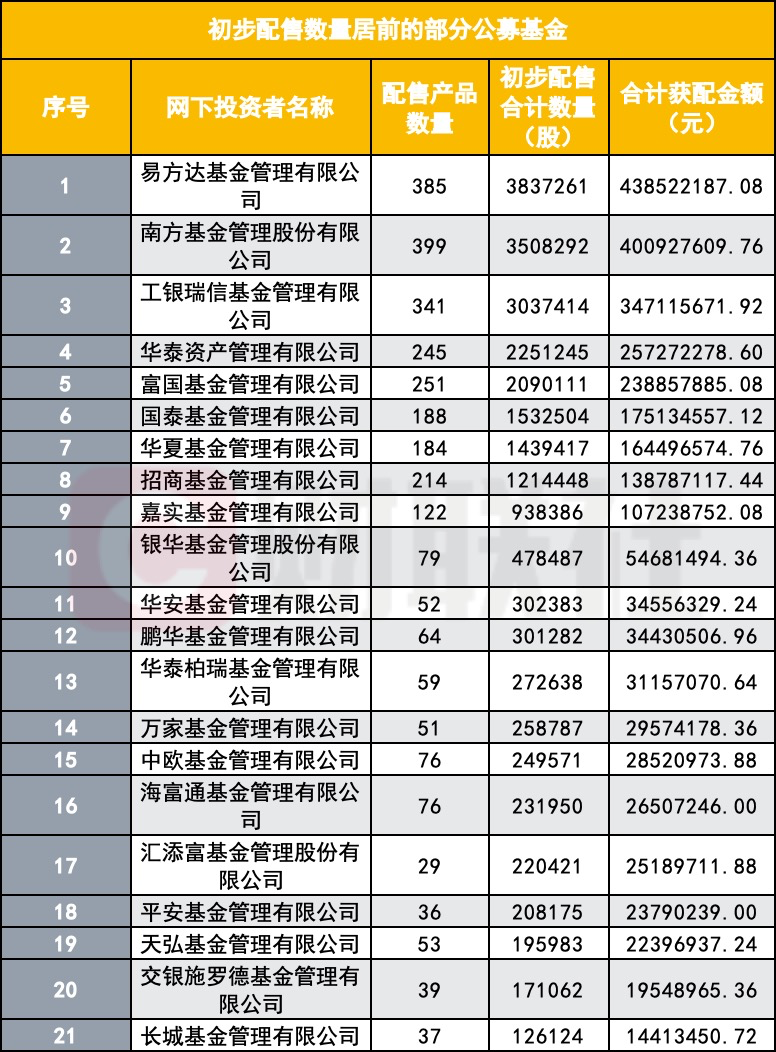
在报价环节就备受关注的摩尔线程,网下初步配售结果终于落地。 在此前初步询价阶段,267家网下投资者管理的7555个配售对象全部参与申购,最终网下有效申购数量达到 704.06亿股,而网下初步配售仅为3920万股,获得初步配售的配售对象比例仅为约0.0557%,意味着整体申购 与获配的倍数接近1:1800。在资金"挤满门口"的背景下,这近4000万股最终落在谁的账户里,成为市场新的关 注点。 在激烈的配售竞争中,一批实力公募基金成为本轮获配大赢家,年金管理机构同样通过数量庞大的计划组合包 揽大量配额。而在非A类的B类投资者中,部分量化私募及券商自营也挤入获配名单,但规模与分布则明显收 紧。 在一位业内人士看来,这种高比例限售安排,一方面提高了打新资金的时间成本,抬高了短线资金的参与门 槛,另一方面也在一定程度上绑定了对公司中长期成长性的看法,"不是简单赌一把上市首日的价格,而是要 考虑九个月甚至更长时间的估值消化"。 公募基金强势揽配,多家头部公司集体押注"国产GPU第一股" 长期资金大量入围 从本次配售规则看,发行人与保荐机构明显将配售资源更多地倾斜给被界定为A类的长期资金。公告披露,A 类投资者包括公募基金 ...

公私募抢上车摩尔线程!初配名单揭晓
财联社· 2025-11-26 01:06
在报价环节就备受关注的摩尔线程,网下初步配售结果终于落地。 在此前初步询价阶段,267家网下投资者管理的7555个配售对象全部参与申购,最终网下有效申购数量达到704.06亿股 ,而网下初步配售 仅为3920万股,获得初步配售的配售对象比例仅为约0.0557%,意味着整体申购与获配的倍数接近1:1800。在资金"挤满门口"的背景下, 这近4000万股最终落在谁的账户里,成为市场新的关注点。 在激烈的配售竞争中,一批实力公募基金成为本轮获配大赢家,年金管理机构同样通过数量庞大的计划组合包揽大量配额。而在非A类的B 类投资者中,部分量化私募及券商自营也挤入获配名单,但规模与分布则明显收紧。 长期资金大量入围 从本次配售规则看,发行人与保荐机构明显将配售资源更多地倾斜给被界定为A类的长期资金。公告披露,A类投资者包括公募基金、社保 基金、养老金、年金基金、银行理财产品、保险资金、保险资产管理产品以及合格境外投资者资金,除A类之外的其他投资机构被划入B 类。 在网下有效申购中,A类投资者申购数量为625.78亿股,占比接近九成,获配股份3858.96万股,占网下初步配售约98.44%。B类投资者 虽然申购数量也达到7 ...

基金公司疯卷实习生:月薪2万起,毕业生50万年薪!
Sou Hu Cai Jing· 2025-11-26 00:49
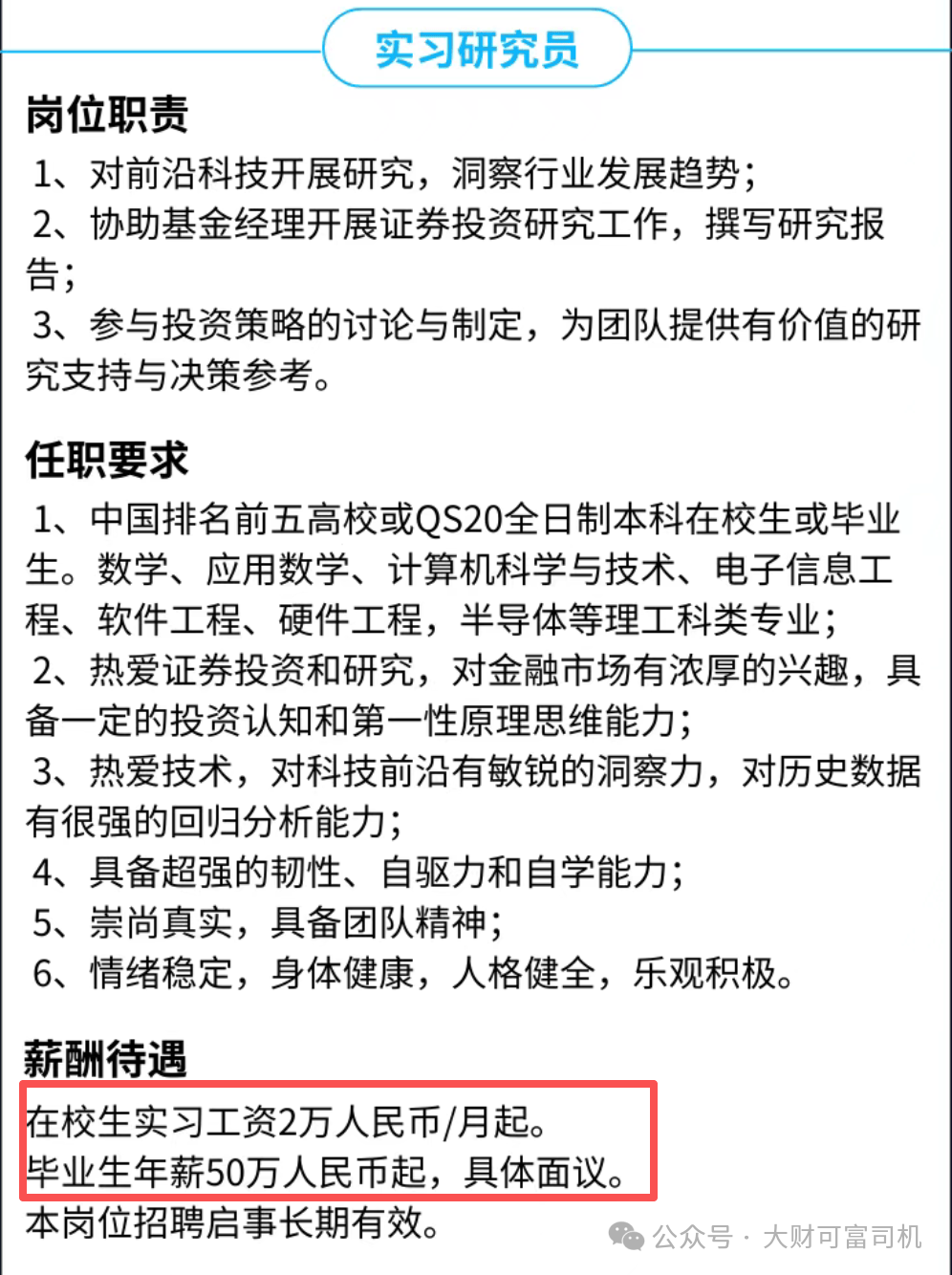
Core Insights - New Sizer Investment has set a new high for salaries in the financial industry, offering internship positions starting at 20,000 yuan per month and annual salaries for fresh graduates starting at 500,000 yuan, with bond researchers starting at 600,000 yuan [1][11][14] - The company is recognized for its strong performance and unique value investment philosophy, which has been developed over more than 20 years by its founder, Han Guangbin [5][6][7] Company Overview - New Sizer Investment was established in Shenzhen in 2009 and is led by Han Guangbin, a pioneer in value investing in China [5][6] - The firm currently manages 12 products with a total asset size between 5 billion to 10 billion yuan, achieving impressive returns of 47.07% and 54.12% for two of its products this year [7][8] Recruitment Strategy - The recruitment strategy emphasizes hiring top talent from leading universities, specifically targeting students from the top five Chinese universities or QS top 20 institutions, with a focus on hard science and engineering majors [11][14] - The company seeks candidates who can quickly assist fund managers in research and investment strategy discussions, rather than typical interns performing menial tasks [11][14] Industry Context - The high salaries offered by New Sizer Investment contrast with the broader trend of salary reductions in banks, brokerages, and public funds, where compensation is more regulated [14][16] - The financial industry remains attractive to many due to its growth potential and the opportunity to accumulate valuable resources and experience, which can lead to diverse career paths [14][16]
均衡配置 寻找确定性 年底私募投资“关键词”出炉
Zhong Guo Zheng Quan Bao· 2025-11-25 20:29
Core Viewpoint - The recent adjustment in the A-share market is attributed to a combination of internal and external factors, leading to a collective risk-averse behavior among investors [1][2]. Group 1: Market Adjustment Factors - The adjustment is seen as a result of multiple factors, including concerns over the economic fundamentals and a complex external environment, alongside fluctuations in liquidity expectations for December [2]. - The tightening of overseas liquidity, particularly following the Federal Reserve's hawkish stance, has led to a net outflow of foreign capital, putting pressure on high-valuation technology stocks in the A-share market [2]. - Defensive behaviors, such as profit-taking by institutional investors as the year-end approaches, have contributed to short-term market volatility [2][4]. Group 2: Private Equity Strategies - Private equity firms are responding to the high market positions with varied strategies, including maintaining high positions, using derivatives for risk hedging, and actively adjusting portfolios for future market conditions [1][4]. - As of November 14, the average stock position of private equity firms reached 81.13%, with large firms holding an even higher average of 87.07%, indicating a high level of market engagement [4]. - Some firms, like Dushuquan, are employing precise risk hedging techniques, such as purchasing out-of-the-money put options to protect against extreme drawdowns [5]. Group 3: Long-term Market Outlook - Despite short-term challenges, private equity firms maintain confidence in the long-term market, actively seeking new investment opportunities during the adjustment [7]. - Dushuquan emphasizes that the current market adjustment is a "healthy correction" within a long-term upward trend, which can help optimize market leverage levels and trading structures [8]. - Firms are focusing on sectors with structural growth potential that do not rely on overall economic recovery, particularly in emerging growth areas like AI technology, semiconductor, and new consumption trends [7].
“尴尬”的通道业务
Shang Hai Zheng Quan Bao· 2025-11-25 18:14
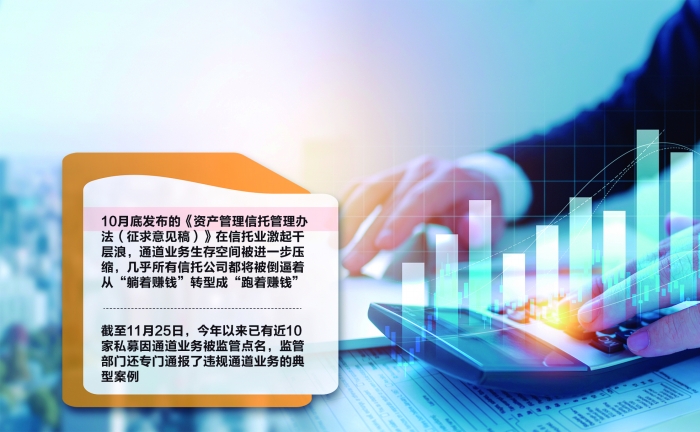
Core Viewpoint - The release of the "Asset Management Trust Management Measures (Draft for Comments)" is significantly impacting the trust and private equity industries, pushing them towards active management and away from passive channel business models [2][3][5]. Group 1: Impact on Trust Industry - The new regulations require trust companies to take on active management responsibilities, limiting their ability to facilitate illegal activities through trust products [3][4]. - Trust companies that heavily rely on channel business will face challenges due to reduced management capabilities and income from these activities [3][4]. - Specific restrictions include limiting the investment amount from a single institutional investor and their affiliates to 80% of the trust product's actual scale, and capping investments in the same asset to 25% of the trust scale [4]. Group 2: Challenges in Private Equity - The private equity sector is also experiencing a contraction in channel business, with several firms being penalized for regulatory violations related to channel activities [6][8]. - Regulatory bodies have issued warnings to multiple private equity firms for improper delegation of investment management responsibilities [6][7]. - The tightening of regulations has led to a significant reduction in the viability of channel business within private equity, with firms now hesitant to engage in such activities [8]. Group 3: Shift Towards Active Management - The industry is witnessing a clear trend towards enhancing active management capabilities, with over 80% of trust companies mentioning active management in their 2024 annual reports [10]. - Recruitment efforts in the trust sector are increasingly focused on specialized talent, reflecting the industry's shift towards professionalization and active management [10][11]. - The competitive landscape is expected to intensify as firms prioritize professional skills and capabilities, marking a departure from the previous "easy profit" model [11].
私募众生相!“每个交易日,都在坚守与调仓间挣扎”
Zhong Guo Zheng Quan Bao· 2025-11-25 08:56
Group 1 - The A-share market experienced a pullback due to intertwined short-term risk factors, leading to cautious capital outflows, despite stock private equity positions reaching a nearly 112-week high [1][5] - Private equity firms are adopting varied strategies in response to the high positions, with some maintaining high exposure, others using derivatives for risk hedging, and some quietly reallocating assets for future market opportunities [1][6] Group 2 - Multiple private equity firms attribute the market adjustment to a combination of internal and external factors, with a focus on changes in external environments and liquidity expectations [3] - The tightening of overseas liquidity, particularly following the Federal Reserve's hawkish stance, has led to short-term net outflows of foreign capital, putting pressure on high-valuation technology sectors in A-shares [3][6] - Defensive behaviors from institutions cashing out profits towards year-end are expected to contribute to market volatility [3] Group 3 - As of November 14, the stock private equity position index reached 81.13%, marking a nearly 112-week high, with large private equity firms' positions nearing 90% [5] - Different private equity firms are employing distinct strategies under high positions, with some maintaining optimism about quality companies' growth despite short-term volatility [6][8] - Strategies include purchasing protective put options to hedge against market downturns and reallocating investments towards cyclical sectors while optimizing technology sector layouts [6] Group 4 - Despite short-term market pressures, leading private equity firms remain confident in the medium to long-term outlook and are actively seeking investment opportunities during the adjustment [8] - Focus areas include emerging growth sectors and cyclical industries, such as AI innovations in power construction and domestic semiconductor trends [8] - The Hang Seng Index is viewed as having reached historical low valuations, with structural opportunities in sectors like food and beverage and social services [8] Group 5 - Optimism about the market's future is reflected in the belief that major indices have returned to reasonable risk premiums after filling previous gaps, with substantial capital waiting on the sidelines [9] - The current adjustment is characterized as healthy, aiding in controlling leverage levels and optimizing trading structures [9] - Private equity firms are continuing to identify undervalued opportunities during this pullback, preparing for the next market cycle [9]
净值回撤20%,希瓦资产CEO梁宏致歉:过度追求宏大叙事,高位贪婪付出代价
Sou Hu Cai Jing· 2025-11-25 05:35
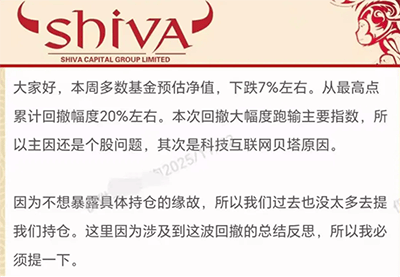
Core Insights - The report from Xiwa Asset indicates a significant decline in the estimated net value of most funds, with an approximate drop of 7% and a cumulative drawdown of about 20% from the peak [1][2] - CEO Liang Hong publicly apologized for the poor performance, attributing the primary reasons to individual stock issues and volatility in the technology and internet sectors [1][2] Group 1: Reasons for Drawdown - The drawdown is primarily attributed to three factors: a decline in the innovation drug sector where the company failed to realize gains at high valuations, a drop of over 37% in a leading hardware company, and significant losses from investments in the stablecoin sector amid a bear market in cryptocurrencies [2][6] - Liang did not disclose the specific hardware company but speculation suggests it could be Xiaomi, which has seen its stock price drop from a high of 61.45 HKD to 38.66 HKD, a decrease of 37% [2][4] Group 2: Company Actions and Future Strategy - Xiaomi's founder and CEO Lei Jun invested over 100 million HKD to purchase 2.6 million shares, increasing his ownership stake to 23.26% [4] - The company has been actively repurchasing its shares, with a total buyback amount exceeding 2.3 billion HKD this year [4] - Liang emphasized the need for a strategic adjustment in response to the significant drawdown, indicating a shift towards absolute return considerations while maintaining value investment principles [7][9]
百亿私募创始人梁宏发文致歉
Xin Lang Cai Jing· 2025-11-25 05:13
Group 1 - The core point of the news is the significant performance decline of Hainan Xiwa Asset Management Co., which has faced a cumulative drawdown of approximately 20% due to several investment missteps [1][2] - The firm reported an estimated net value drop of around 7% in its latest weekly report, which is a stark contrast to the overall positive performance of private equity funds in the A-share market this year [1] - The founder and CIO, Liang Hong, acknowledged three main reasons for the poor performance: heavy investment in innovative drugs that declined, overexposure to hardware leading to a 37% drop, and significant involvement in US stablecoin stocks amidst a cryptocurrency downturn [1][2] Group 2 - Liang Hong has previously apologized to investors for poor performance, indicating a pattern of accountability in response to market challenges [2] - The firm is preparing for potential large-scale redemptions from investors who have experienced prolonged losses, particularly those who invested in 2021 [2] - Despite the setbacks, Liang remains optimistic about the market outlook for the coming year, expressing confidence in a potential recovery and improvement in performance [1][2]
产品净值累计回撤约20%,大幅跑输主要指数,百亿私募大佬致歉
2 1 Shi Ji Jing Ji Bao Dao· 2025-11-25 00:57
Core Insights - The report from Xiwa Asset indicates that most of its funds experienced an estimated net value decline of around 7%, with a cumulative drawdown of approximately 20% from the peak [2] - The founder, Liang Hong, expressed disappointment and apologized for the significant drawdown, attributing it to three main reasons [2] Group 1: Reasons for Drawdown - The decline in net value was primarily due to the drop in heavily weighted innovative pharmaceutical stocks, where the decision to sell at high valuations was not executed decisively [2] - The leading hardware company's stock, which was a major holding, fell over 37%, indicating that maintaining a heavy position during a high valuation phase was inappropriate [2] - There was a significant investment in US stablecoin stocks, which overlooked the risks associated with the bearish trend in cryptocurrencies [2] Group 2: Reflection on Investment Strategy - Liang Hong reflected that the direct cause of the drawdown was the decline of several stocks, but the deeper issue was excessive greed [2] - The excitement at high valuations led to a pursuit of grand narratives while neglecting the risks associated with price increases and the importance of cost-effectiveness [2]
净值回撤20%!百亿私募大佬致歉
Zhong Guo Ji Jin Bao· 2025-11-24 13:02
Core Insights - The founder and CIO of Shiwa Asset, Liang Hong, publicly apologized for a significant decline in fund performance, with an estimated net value drop of around 20% from peak levels [1] - The decline was attributed primarily to issues with individual stocks and the beta exposure to the technology and internet sectors [1] Group 1: Performance Decline - Shiwa Asset reported an estimated net value drop of approximately 7% in its weekly report, with a cumulative decline of about 20% from the highest point [1] - The performance of the funds significantly lagged behind major indices during this period [1] Group 2: Reasons for Decline - The three main reasons for the performance decline were identified as: 1. A drop in heavily weighted innovative pharmaceutical stocks, where high valuations were not realized through timely selling [1] 2. A leading hardware company's stock fell over 37%, with the issue being an excessive position during a period of reasonable high valuation [1] 3. Heavy investment in stablecoin stocks in the U.S. while neglecting the risks associated with the cryptocurrency market turning bearish [1] Group 3: Reflection and Future Strategy - Liang Hong reflected on the decline, acknowledging that greed played a deeper role in the performance issues, emphasizing a lack of attention to risk and cost-effectiveness during high market valuations [1] - He expressed awareness of the disappointment among investors and the potential for significant redemptions, indicating preparedness for such outcomes [1] - Moving forward, the company plans to adapt its strategy by incorporating more absolute return considerations while maintaining a focus on value investing, aiming for improved performance in the coming year [1]