
加密货币

Search documents
印执法局逮捕两名 BitConnect 相关嫌疑人,涉绑架与比特币勒索案
Xin Lang Cai Jing· 2026-01-25 01:47
Core Viewpoint - The Enforcement Directorate (ED) of India has arrested two suspects in connection with a BitConnect cryptocurrency scam involving kidnapping, Bitcoin extortion, and money laundering [1] Group 1: Arrests and Allegations - The arrested individuals, Nikunj Pravinbhai Bhatt and Sanjay Kotadia, are accused of participating in a kidnapping extortion case related to BitConnect [1] - Victims were forced to hand over 2,254 Bitcoins, 11,000 Litecoins, and approximately 1.45 billion Indian Rupees in cash [1] Group 2: Asset Freezing and Investigation - The ED has frozen and seized assets worth approximately 1.9 billion Indian Rupees, including cryptocurrency, stocks, and cash [1] - To date, the total value of assets frozen or seized in this case amounts to around 217 billion Indian Rupees, with the investigation still ongoing [1]
观点:Crypto 必须确保这座大教堂不被赌场吞噬
Xin Lang Cai Jing· 2026-01-25 00:44
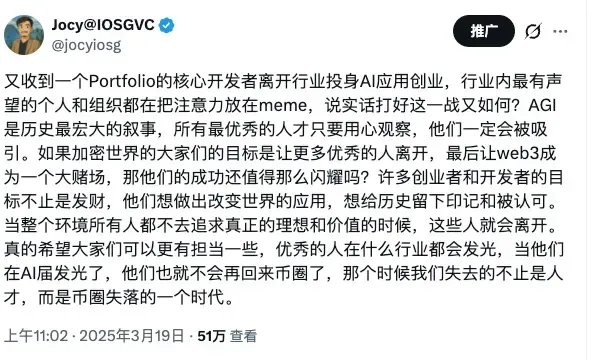
Core Insights - The article discusses the importance of understanding not just who remains in the crypto industry, but why they stay and whether the ecosystem can support a revolution in the sector [2][16] - It highlights the contrasting paths taken by American and Chinese crypto OGs (original gangsters) after achieving financial success, with many in China opting to exit rather than contribute back to the ecosystem [7][8] Group 1: American Crypto OGs - American crypto OGs, after making significant profits, focus on building and supporting the ecosystem rather than exiting, as seen with figures like Brian Armstrong and Naval Ravikant [3][4] - They engage in initiatives that reshape the knowledge production system and promote compliance frameworks for token issuance, contributing to a sustainable ecosystem [3][4] - The emphasis is on attracting talent and creating meaningful applications, rather than merely participating in speculative activities [6][14] Group 2: Chinese Crypto OGs - Chinese crypto OGs face systemic challenges, including a lack of supportive policies and historical narratives that encourage long-term investment in the ecosystem [7][8] - Many choose to exit after achieving financial success, leading to a talent drain and a focus on short-term gains rather than long-term value creation [8][10] - The article argues that this trend results in a vicious cycle where the lack of new value creation reinforces a speculative mindset, further driving away innovators [10][11] Group 3: The Need for Ecosystem Support - The article stresses the necessity of a supportive ecosystem to foster innovation and attract talent, suggesting that small initiatives can lead to significant impacts over time [12][16] - It calls for a redefinition of success in the crypto space, emphasizing the importance of creating real value rather than engaging in zero-sum games [16][17] - The long-term sustainability of the crypto ecosystem depends on establishing mechanisms that encourage contributions back to the community, ensuring that the foundational "cathedral" is not overshadowed by speculative "casinos" [14][15][17]

Ethereum treasury firm buys jet engines amid tokenization push after selling ETH
Yahoo Finance· 2026-01-24 17:24
Company Overview - ETHZilla, a treasury firm focused on Ethereum, has diversified its assets by purchasing two CFM56-7B24 aircraft engines for $12.2 million through a new subsidiary, ETHZilla Aerospace LLC [1][2] - The engines are currently leased to a major airline, with management handled by Aero Engine Solutions for a monthly fee [2] Aerospace Industry Context - The aerospace sector is experiencing a significant supply squeeze for large engines, with IATA estimating that airline members will need to pay approximately $2.6 billion to lease additional spare engines in 2025 [4] - The global aircraft engine leasing market is projected to grow from $11.17 billion in 2025 to $15.56 billion by 2031, reflecting a compound annual growth rate (CAGR) of 5.68% [4] Strategic Moves and Tokenization Plans - The acquisition of aircraft engines is part of ETHZilla's broader strategy to tokenize real-world assets (RWAs) on-chain, amidst pressures in the digital asset treasury space due to declining crypto market values [5][6] - The company has previously sold $40 million in ETH and $74.5 million in December to manage its financial position, indicating a shift towards asset diversification [6] - ETHZilla plans to tokenize assets in collaboration with Liquidity.io and has invested in Zippy and Karus to facilitate the tokenization of loans [7] - The firm aims to establish a scalable tokenization pipeline across various asset classes, expecting to launch its first tokenized asset offerings in the first quarter of the year [8]
快速展望2026年的预期
钱伯斯(Baker McKenzie)· 2026-01-24 05:05
Investment Rating - The report does not explicitly provide an investment rating for the industry Core Insights - 2026 is expected to be a year focused on growth and competitiveness, with UK and EU regulators simplifying rules to alleviate compliance burdens and promote growth agendas [3] - There may be further regulatory divergence as different policy objectives become clearer, particularly in areas like payments and cryptocurrencies [4] - The Financial Conduct Authority (FCA) is emphasizing responsible risk-taking and adapting to managed risks to support growth, with developments expected in consumer duty frameworks and housing affordability rules [7] - The introduction of new regulatory frameworks is anticipated to support consumer activities, including the finalization of "buy now, pay later" (BNPL) rules [8] - Global focus is shifting from strict green finance to transformation and adaptation, with EU regulations aiming to simplify sustainability reporting [10][14] - The EU's anti-money laundering (AML) reforms will drive compliance changes in 2026, with the FCA becoming the unified AML regulator in the UK [12] - The FCA is expected to lead in market innovation, particularly with the development of the new PISCES market and preparations for the T+1 settlement cycle [22] Summary by Sections Regulatory Developments - UK and EU regulators are working on simplifying rules to reduce compliance burdens and promote growth [3] - The FCA is focusing on responsible risk-taking and consumer education, with ongoing simplification of consumer duty frameworks [7] - New regulatory frameworks are expected to support consumer activities, including the introduction of BNPL rules [8] ESG and Sustainability - The global focus is shifting towards transformation and adaptation in ESG, with the EU working on simplifying sustainability reporting [10][14] - The EU's SFDR 2.0 aims to reduce administrative burdens while enhancing consumer clarity [10] Anti-Money Laundering - The EU's AML reforms will significantly impact compliance changes in 2026, with the FCA becoming the unified AML regulator in the UK [12] Market Innovations - The FCA is expected to lead in market innovation, particularly with the development of the new PISCES market and preparations for the T+1 settlement cycle [22] - The UK is awaiting policy positions on payment regulations, with a focus on integrating payment and electronic money systems [21]
OKX CEO Star:以太坊将承载更多金融应用,OKX 计划 2026 年推进股票等资产上链
Xin Lang Cai Jing· 2026-01-24 04:11
Core Viewpoint - The future of many financial applications is expected to be deployed on Ethereum, as recognized by the CEO of OKX, Star [1] Industry Insights - Regulatory bodies are beginning to understand that money laundering is only a small part of blockchain activities and are starting to promote the development of the industry [1] - The attempts by Biden and Gary Gensler to prosecute individuals in the crypto space represent a final backlash against cryptocurrency, which may have played a significant role in the last U.S. election [1] - Industry participants should focus on the development of technology, applications, and regulations while ignoring short-term factors and noise [1] Market Perception - Meme coins like "XX人生、踏马来了" may negatively influence external perceptions and respect for the cryptocurrency sector [1] Company Strategy - OKX plans to bring assets, including stock assets, onto the blockchain by 2026 [1] - OKX will not cease the development of OKB after its listing and intends to build it long-term [1]
币安考虑重启美股代币 全球加密交易所竞逐监管外平行市场
Xin Lang Cai Jing· 2026-01-23 22:32
Core Viewpoint - Major cryptocurrency exchanges are competing to launch tokenized stock trading services that track U.S. stock performance, creating an unregulated parallel market outside U.S. oversight [1][2]. Group 1: Market Dynamics - Binance is considering reintroducing stock tokens on its platform, which were previously suspended in 2021 due to regulatory warnings [1][3]. - Other exchanges like OKX, Kraken, and Bitget are also exploring tokenized stock services, with Kraken's stock token product gaining traction after acquiring Backed Finance [1][8]. - The total value of circulating tokenized stocks has reached $915 million, a 19% increase from the previous month, while the total market capitalization of S&P 500 stocks is approximately $60 trillion [2][8]. Group 2: Trading Characteristics - Tokenized stocks allow trading of shares like Apple and Nvidia through overseas exchanges, even when U.S. markets are closed, and support anonymous transactions [1][9]. - Trading volume for tokenized stocks remains low, with a concentration on a few companies such as Tesla and Nvidia; for instance, Tesla's tokenized stock had a trading volume of $12 million compared to $29 billion on the Nasdaq [2][8]. Group 3: Regulatory Environment - U.S. regulators have not yet clarified how to regulate tokenized stocks, which are issued by third-party entities like xStocks and Ondo Finance, and are not actual shares [3][10]. - The New York Stock Exchange and Nasdaq are planning to allow tokenized stock trading, which could enhance settlement speeds [10]. - Coinbase is advocating for modifications to legislation to expedite the market entry of tokenized stocks by seeking exemptions from certain SEC regulations [4][10]. Group 4: Risks and Challenges - The anonymous nature of tokenized stock trading raises concerns about insider trading and market manipulation, as the low trading volume makes such activities easier [5][11]. - The design of tokenized stocks aims to track specific stock prices, but discrepancies often occur, and investors face risks related to the issuing entities' financial stability [11]. - Companies like Superstate and Securitize are attempting to obtain corporate authorization to convert actual stocks into tokenized versions, but progress has been slow [11].
吴说每日精选加密新闻 - 美国 SEC 主席 Paul Atkins:SEC 与 CFTC 将于下周联合讨论加密监管协调
Xin Lang Cai Jing· 2026-01-23 14:47
Group 1 - The SEC and CFTC will hold a joint event to discuss regulatory coordination in the cryptocurrency sector, aiming to fulfill the commitment to make the U.S. a global crypto hub [1] - Binance has submitted a MiCA license application in Greece and is collaborating with local regulators to ensure compliance, while facing challenges in France where it has not yet obtained the license [1] - UBS is planning to offer cryptocurrency trading services to select private banking clients, with discussions ongoing for several months, although no final decision has been made yet [1] Group 2 - The American Bankers Association (ABA) has identified "prohibiting interest on stablecoin" as a top policy priority for 2026, citing concerns that stablecoins could replace bank deposits and weaken community banks' deposit bases and lending capabilities [2] - The CEO of a major U.S. bank indicated that up to $6 trillion in deposits could potentially flow into interest-bearing stablecoins [2]


CLARITY法案卡壳 Coinbase与华尔街“生死博弈”将触发加密货币黑天鹅?
Zhi Tong Cai Jing· 2026-01-23 13:43
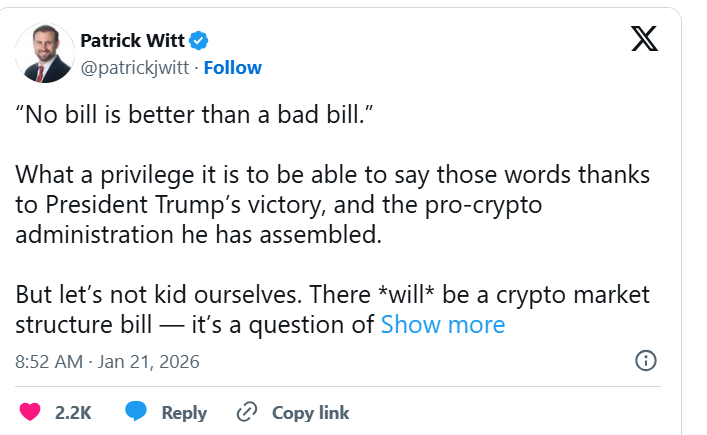
Group 1 - Coinbase's CEO Brian Armstrong's actions have caused significant rifts in the cryptocurrency sector, leading to delays in key regulatory legislation [1][2] - The White House has criticized the cryptocurrency industry, emphasizing that political influence should not be taken for granted [1] - The CLARITY Act aims to establish a comprehensive federal regulatory framework for digital assets, which could reduce compliance uncertainty and promote institutional investment [2][3] Group 2 - The withdrawal of support for the CLARITY Act by Armstrong has raised concerns among industry executives about the overreach of political influence [1][3] - The Senate Banking Committee's review of the CLARITY Act has been indefinitely postponed due to Armstrong's opposition to certain provisions, particularly regarding stablecoin rewards [4][5] - The agricultural committee is also working on its version of the market structure bill, complicating the legislative process amid an election year [5] Group 3 - Concerns have emerged that the delay in the CLARITY Act could lead to a "regulatory black swan" event that may trigger a market crash [3] - The cryptocurrency industry has been a significant donor in the 2023-2024 U.S. presidential election cycle, contributing over $133 million to candidates perceived as supportive of their agenda [6] - The stablecoin market is rapidly expanding, with predictions that its size could reach $2 trillion, highlighting its potential impact on the global financial system [7][8] Group 4 - The debate over stablecoin rewards has become a major point of contention between Wall Street banks and the cryptocurrency industry, with banks fearing deposit outflows [8][11] - Armstrong has framed the conflict as a struggle for consumer interests against banking lobbyists, asserting that the proposed restrictions are harmful [11][12] - The cryptocurrency industry is engaged in a "long game" to embed favorable terms into U.S. financial regulations, anticipating future political shifts [12][13]

Radex Markets瑞德克斯:2026年值得关注的顶级市场
Xin Lang Cai Jing· 2026-01-23 10:26
Group 1: Technology and Infrastructure - The global financial market is transitioning from technological breakthroughs to deepening infrastructure, with a focus on core pillars supporting the digital age [1][4] - In 2025, AI leaders like Palantir and Alphabet saw significant stock increases of 135% and 65% respectively, marking the beginning of a technological revolution [1][4] - The memory and data storage sector, often overlooked, is becoming critical due to the surge in computing power and data processing demands, with companies like Samsung, SK Hynix, and Micron dominating global capacity [1][4] - Micron Technology achieved a remarkable 240% increase in stock price last year, yet its valuation remains attractive compared to the overall high P/E ratios in the tech sector [1][4] - Market sentiment in 2026 is expected to follow a rotation logic similar to that of precious metals, with new investment opportunities emerging in cloud computing, cybersecurity, and high-speed bandwidth [1][4] Group 2: Energy Transition - The energy structure transition is essential for AI development, as the demand for power to train top AI models exceeds the capacity of traditional renewable energy sources [2][5] - The rise of small modular reactors (SMRs) is becoming a key solution, with major tech companies like Meta and Amazon investing in clean nuclear energy [2][5] - The commercialization of SMRs is set to transform the nuclear industry, moving away from large-scale projects to efficient, modular production [2][5] - The entire nuclear supply chain, from uranium mining to reactor component manufacturing, is experiencing a multi-dimensional recovery, presenting opportunities for investors [2][5] Group 3: Digital Assets - Despite a lackluster performance in 2025, the cryptocurrency market is maturing, with institutional investment reducing volatility and enhancing compliance [3][6] - The introduction of regulatory frameworks like the Clarity Act is expected to bring decentralized financial facilities out of the legal gray area, marking a significant shift [3][6] - The speculative trading phase driven by retail investors is nearing its end, paving the way for new financial instruments backed by legal protections and institutional support [3][6] - As global regulatory uncertainties dissipate, cryptocurrencies are anticipated to transition from speculative assets to integral components of the global financial system [3][6]


Bitcoin Price Liquidity Gap Widening: Big Boys Bought $1.2Bn But Retailers Sold
Yahoo Finance· 2026-01-23 07:03
Core Insights - The approval of the first nine spot Bitcoin ETFs by the SEC in January 2024 marks a significant turning point for Bitcoin and the broader cryptocurrency industry [1] - Institutional investors, managing substantial funds, are now able to invest in Bitcoin through regulated ETFs, reducing the influence of retail traders [2] - The immediate market reaction saw Bitcoin prices rise towards the $70,000 level, with institutions rapidly acquiring Bitcoin, contributing billions to the market [3] Market Dynamics - The total cryptocurrency market capitalization has surged to over $3 trillion, with Bitcoin trading at nearly $90,000, significantly above previous highs [4] - Institutional investors have become the primary drivers of Bitcoin price movements, overshadowing retail traders [4][6] - The liquidity in Bitcoin trading has improved, allowing for easier accumulation of Bitcoin without causing significant price volatility [5] Institutional Investment - Spot Bitcoin ETF issuers currently manage over $115 billion in Bitcoin for various institutions, a figure expected to grow as adoption increases [7] - The structure of spot Bitcoin ETFs simplifies the investment process for institutions, eliminating the need for wallets and private key management [7]