银行

Search documents
金融工程日报:沪股指再度调整跌逾1%,保险股领跌、电池产业链走高-20260326
Guoxin Securities· 2026-03-26 15:05
- The report does not contain any specific quantitative models or factors for analysis[1][2][3]
渤海银行2025年实现净利润54.98亿元,较上年增长2.42亿元
Bei Jing Shang Bao· 2026-03-26 14:54
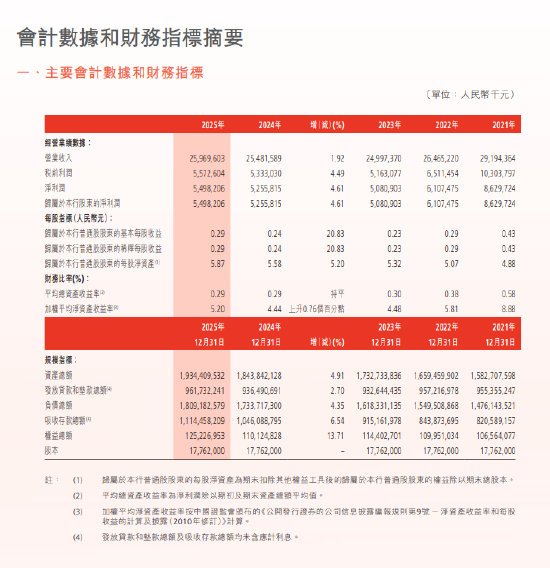
Core Insights - Bohai Bank reported a total operating income of 25.97 billion yuan for 2025, an increase of 488 million yuan, representing a growth rate of 1.92% [1] - The bank achieved a net profit of 5.498 billion yuan, up by 242 million yuan, with a growth rate of 4.61% [1] - The cost-to-income ratio improved to 38.01%, a decrease of 1.00 percentage point compared to the previous year [1] Financial Performance - Total assets reached 1,934.41 billion yuan, an increase of 90.57 billion yuan, reflecting a growth rate of 4.91% [1] - The balance of loans and advances was 949.75 billion yuan, with an increase of 24.39 billion yuan, representing a growth rate of 2.64% [1] - Total liabilities amounted to 1,809.18 billion yuan, an increase of 75.47 billion yuan, with a growth rate of 4.35% [1] - Customer deposits reached 1,138.78 billion yuan, increasing by 71.21 billion yuan, which is a growth rate of 6.67% [1] Asset Quality - The non-performing loan balance was 15.92 billion yuan, a decrease of 559 million yuan [1] - The non-performing loan ratio stood at 1.66%, down by 0.1 percentage points from the previous year [1]
渤海银行:2025年末不良贷款率1.66%,较上年末下降10BP
Xin Lang Cai Jing· 2026-03-26 13:53
Core Viewpoint - Bohai Bank reported a steady growth in both operating income and net profit for 2025, indicating a stable financial performance amidst a challenging economic environment [1][3]. Financial Performance - The bank achieved operating income of 25.97 billion yuan in 2025, representing a year-on-year increase of 1.92% [1][3]. - Net profit reached 5.50 billion yuan, up 4.61% compared to the previous year [1][3]. - The cost-to-income ratio improved, decreasing by 1.00 percentage point year-on-year, reflecting effective cost control measures [1][3]. Asset and Liability Management - Total assets amounted to 1,934.41 billion yuan, a growth of 4.91% from the end of the previous year [1][3]. - Total liabilities were reported at 1,809.18 billion yuan, increasing by 4.35% year-on-year [1][3]. - The bank's deposit base showed steady growth, contributing to its overall financial stability [1][3]. Credit Quality - The non-performing loan (NPL) ratio improved to 1.66%, a decrease of 10 basis points from the previous year, indicating better asset quality [1][3]. - The provision coverage ratio stood at 162.16%, an increase of 6.97 percentage points, demonstrating strong risk mitigation capabilities [1][3].

放松银行监管,有哪些动作?
Huafu Securities· 2026-03-26 13:27
Group 1: Reasons for Regulatory Easing - The Trump administration initiated regulatory easing in the banking sector, aiming to balance safety and growth[3] - The proposed Basel III final rules in July 2023 tightened capital requirements for large banks by 16%, prompting discussions on the need for regulatory relief[20] - The current regulatory framework is perceived as overly strict compared to European counterparts, particularly in capital requirements[4] Group 2: Methods of Regulatory Easing - Four major revisions were proposed to reduce regulatory burdens on banks: adjusting stress test parameters, lowering the Supplementary Leverage Ratio (SLR), revising Basel III capital requirements, and correcting G-SIB surcharge calculations[5] - The SLR requirement for major banks is expected to decrease from 5%-6% to between 3.5%-4.25%, potentially freeing up $200 billion in capital for the top six U.S. banks[5] - The new rules aim to simplify capital calculations and reduce risk weights for real estate loans, potentially releasing $1 trillion in credit space for smaller banks[5] Group 3: Impacts of the Reforms - Overall capital requirements for banks are projected to decrease significantly: small banks' core Tier 1 capital will drop by 7.8%, medium banks by 5.2%, and large banks by 4.8%[41] - The easing of capital requirements is expected to stimulate bank lending and enhance profitability, reversing the trend of credit flowing to non-bank institutions[47] - The reforms may allow $3 trillion to flow into U.S. Treasury and repurchase markets, equating to approximately 9% of the current market for U.S. Treasuries[48]
市场混沌中-科技主线还在吗
2026-03-26 13:20
Summary of Key Points from Conference Call Records Industry Overview - The conference call discusses the Hong Kong stock market, particularly focusing on the technology sector and its performance in 2026 amid various pressures [1][3][4]. Core Insights and Arguments 1. **Market Conditions**: The Hong Kong stock market is expected to face dual pressures from both the numerator and denominator sides, with a challenging valuation logic anticipated for the upcoming quarter due to rising global risk-free rates and stagnant corporate earnings [1][4]. 2. **Liquidity Pressures**: The market is experiencing three main liquidity pressures: reduced inflow of southbound funds, lack of significant foreign investment, and a substantial number of IPOs (around 300 companies) creating a "bloodletting" effect on market liquidity [1][3]. 3. **Technology Sector Outlook**: Despite recent declines, the technology sector remains a key trading theme for 2026, characterized by high beta attributes and strong capital support. The semiconductor equipment segment is particularly highlighted due to expected demand from the construction of 30 new wafer fabs in China from 2024 to 2030 [1][10]. 4. **Valuation Concerns**: The current PE valuation for the technology sector is at the 80th percentile of the past five years, indicating a high valuation environment that may create favorable conditions for large tech IPOs later in the year [1][10]. 5. **Investment Strategies**: Investors are advised to adopt trading strategies such as wave trading or grid trading to capitalize on emotional sell-offs and to take profits after rebounds [1][10][6]. Additional Important Insights 1. **Differentiated Strategies for Investors**: Different strategies are recommended for trading and allocation investors. Trading investors should view market rebounds as technical corrections, while allocation investors should focus on longer-term positions and cost management [6][7]. 2. **Market Sentiment and Behavior**: The technology sector's recent performance indicates that it is still viewed as a mainline investment, with funds shifting towards it during market volatility, despite overall market declines [8][9]. 3. **Global Economic Context**: The macroeconomic environment is shifting from a loose to a moderately tight monetary policy, impacting the valuation of offshore markets like Hong Kong. This shift is evidenced by changes in interest rate expectations from the Federal Reserve [4][5]. 4. **Sector-Specific Challenges**: The technology sector faces challenges such as fierce competition and reliance on consumer spending, which have not shown significant improvement, leading to cautious investor sentiment regarding earnings prospects [5][6]. 5. **Future Market Dynamics**: The market is expected to experience increased differentiation in 2026 compared to 2025, with a more challenging environment for achieving returns due to high asset prices and volatility [12][27]. Conclusion The Hong Kong stock market, particularly the technology sector, is navigating a complex landscape of liquidity pressures, valuation concerns, and macroeconomic shifts. Investors are encouraged to adopt flexible strategies that account for market volatility and sector-specific dynamics while remaining cautious about the overall economic outlook.
大摩闭门会:金融、电力、交运、原材料行业更新
2026-03-26 13:20
Summary of Key Points from the Conference Call Industry and Company Overview - **Industries Discussed**: Financial, Power, Transportation, and Materials - **Companies Mentioned**: Jitu (极兔), Innovation Industry (创新实业), Tianshan Aluminum (天山铝业), Ningbo Bank (宁波银行) Core Insights and Arguments Jitu (极兔) Insights - Jitu is recognized for its strong growth in the express delivery sector, particularly in Southeast Asia, driven by China's e-commerce expansion [3][5] - A recent survey indicated that 87% of investors are bullish on Jitu, with expectations of over 30% growth in delivery volumes in Southeast Asia [5][6] - Concerns from bearish investors include potential pressure on profits in China and risks from geopolitical changes affecting logistics and costs [7][9] - Jitu's expansion into new markets is expected to yield faster growth than in Southeast Asia due to lower market saturation [11] - The company is anticipated to release its 2025 profit report on March 30, which is seen as a significant catalyst for stock performance [15] Power and Grid Equipment Insights - China is advancing a new type of power system, which is expected to drive investment in grid infrastructure [19][20] - Investment in the power grid is projected to grow at a rate of 8-9% annually, with a significant increase expected in 2026 [20] - The shift towards renewable energy sources is leading to a decline in coal and gas power generation, with renewables becoming increasingly dominant [21][29] - Companies like Pinggao and NARI are expected to benefit from the acceleration of grid investments, with strong order growth anticipated [25][28] Aluminum Industry Insights - The ongoing geopolitical conflict in the Middle East is causing supply disruptions in the aluminum market, with a potential reduction of up to 4 million tons in global supply [33][40] - Domestic aluminum production in China is expected to increase slightly, but the overall growth is limited by a production cap set by the government [35][37] - Companies like Innovation Industry and Tianshan Aluminum are positioned well due to their low production costs and integrated operations [41][47] - The aluminum market is expected to remain tight, supporting prices despite geopolitical uncertainties [39][50] Financial Sector Insights - The Chinese financial sector is viewed positively due to stable policies and a resilient banking system, with expectations for continued growth in exports and financial performance [53][55] - Recent surveys in Zhejiang indicate strong export growth, with some areas reporting nearly 40% increases in early 2023 [53] - Ningbo Bank is highlighted for its strong performance metrics, with expectations for profit growth as loan rates stabilize [64][66] Other Important Points - The geopolitical landscape is a significant concern, particularly regarding its impact on logistics and costs in Southeast Asia [9][14] - The transition to a unified national power market in China is expected to enhance inter-provincial grid cooperation and investment [23] - The aluminum industry is facing potential supply shortages due to geopolitical tensions, which could lead to increased prices and demand for aluminum in renewable energy applications [39][50] This summary encapsulates the key discussions and insights from the conference call, providing a comprehensive overview of the current state and future outlook of the relevant industries and companies.

大摩闭门会:金融、电力、交运、原材料行业更新 _纪要
2026-03-26 13:20
Summary of Key Points from Conference Call Records Industry Overview J&T Express (极兔速递) - **Market Sentiment**: 87% of investors are bullish on J&T Express, with expectations for Southeast Asia's parcel volume growth exceeding 30% by 2026 [2][3] - **Regional Expectations**: - Southeast Asia: Nearly 90% of investors expect growth rates above 30%, with 7% anticipating over 50% growth [2] - New Markets: Consensus on growth between 50% to 100% [2] - China: Over 80% expect profits to remain stable or slightly improve [2] Financial Sector - **Bank Lending Trends**: Banks are becoming more rational in lending, with a minimum public loan rate set at 2.41% in Yiwu [1][17] - **Ningbo Bank**: Expected ROE recovery to 14%-15%, with current valuation below 1x PB, indicating significant investment appeal [1][19] Electric Power Industry - **Investment Growth**: Average annual growth rate for grid investment during the 14th Five-Year Plan is expected to rise to 9% from 5% [1][7] - **New Investment Directions**: Focus on smart microgrids and integration of power sources [7] Aluminum Industry - **Supply and Demand**: Global supply-demand tightness expected by 2026, with China's production capacity nearing 45 million tons [1][12] - **Key Players**: - **Innovation Industry**: Low-cost production and high dividend payout (51%) [1][14] - **Tianshan Aluminum**: Integrated operations and capacity growth [1][15] Glass Fiber Industry - **Market Dynamics**: AI-driven demand for high-end electronic fabrics leading to price increases (e.g., 29% rise in certain product prices) [1][20] - **China Jushi**: Expected significant profit growth due to capacity expansion and market positioning [1][21] Core Insights and Arguments J&T Express - **Growth Drivers**: E-commerce penetration and expansion into non-e-commerce segments are key growth factors [3] - **Risks**: Concerns about customer self-built logistics (e.g., TikTok) and geopolitical risks affecting growth and profitability [4][5] Financial Sector - **Stability and Growth**: The Chinese financial system shows resilience with reduced risk levels and improved asset quality [17] - **Ningbo Bank's Strategy**: Differentiated pricing and strong service capabilities expected to drive revenue growth [19] Electric Power Sector - **Transition to New Energy**: Shift from coal to renewable energy sources, impacting traditional power generation [10][11] - **Investment Opportunities**: Companies like XJ Electric and Pinggao Electric are well-positioned to benefit from increased grid investments [8] Aluminum Market - **Price Support Factors**: Anticipated supply constraints and geopolitical risks could bolster aluminum prices [12][13] - **Competitive Advantages**: Companies with low-cost production and strong market positions are expected to thrive [14][15] Glass Fiber Market - **Supply Constraints**: Long delivery cycles for weaving machines may limit supply, benefiting established players like China Jushi [20] - **Profitability Outlook**: Expected significant profit increases due to market dynamics and product diversification [21] Additional Important Insights - **Geopolitical Risks**: Potential energy crises could impact Southeast Asia's economic growth and logistics costs [1][4][5] - **Market Reactions**: Recent stock price adjustments in aluminum companies reflect broader market uncertainties, but long-term demand remains strong [16]
中国平安(02318) - 海外监管公告 - 中国平安保险(集团)股份有限公司2025年年度报告摘要
2026-03-26 13:17
香港交易及結算所有限公司及香港聯合交易所有限公司對本公告的內容概不負責, 對其準確性或完整性亦不發表任何聲明,並明確表示,概不對因本公告全部或任何 部份內容而產生或因倚賴該等內容而引致的任何損失承擔任何責任。 海外監管公告 本公告乃根據《香港聯合交易所有限公司證券上市規則》第13.10B條而作出。 茲載列中國平安保險(集團)股份有限公司在上海證券交易所網站刊登的根 據中國會計準則編制的「中國平安保險(集團)股份有限公司2025年年度報 告摘要」,僅供參閱。 承董事會命 盛瑞生 公司秘書 中國深圳,2026年3月26日 於本公告日期,本公司的執行董事為馬明哲、謝永林、郭曉濤、付欣及蔡方方;非執 行董事為謝吉人、楊小平、何建鋒及蔡潯;獨立非執行董事為吳港平、金李、王廣謙、 洪小源、宋獻中及陳曉峰。 2025年年度报告摘要 (股票代码:601318) 二〇二六年三月二十六日 2025 年年度报告摘要 一、重要提示 1.5 公司简介 | 股票简称 | 中国平安 | | | --- | --- | --- | | 股票代码 | H A 股:601318 | 股:02318(港币柜台) | | | | 82318(人民币 ...

青岛银行(03866) - 海外监管公告 – 青岛银行股份有限公司 (1) 2025年度报告摘要 (...
2026-03-26 12:55
香港交易及結算所有限公司及香港聯合交易所有限公司對本公告的內容概不負責,對其準確性 或完整性亦不發表任何聲明,並明確表示,概不對因本公告全部或任何部份內容而產生或因倚 賴該等內容而引致的任何損失承擔任何責任。 Bank of Qingdao Co., Ltd.* 青 島 銀 行 股 份 有 限 公 司 * ( 於 中 華 人 民 共 和 國 註 冊 成 立 的 股 份 有 限 公 司 ) (H股股份代號:3866) 海外監管公告 本公告乃根據《香港聯合交易所有限公司證券上市規則》第13.10B條作出。 以下文件已於深圳證券交易所網站刊登,僅供參閱: 青島銀行股份有限公司 1. 2025年度報告摘要 2. 2025年度報告 特此公告。 承董事會命 青島銀行股份有限公司* 景在倫 董事長 中國山東省青島市 2026年3月26日 於本公告日期,董事會包括執行董事景在倫先生、吳顯明先生、陳霜女士及 劉鵬先生;非執行董事鄧友成先生、周雲傑先生、Rosario Strano先生、譚麗 霞女士及Giamberto Giraldo先生;獨立非執行董事邢樂成先生、張旭先生、 張文礎先生、杜寧先生及范學軍先生。 * 青島銀行股份 ...
中国平安去年营运利润1344亿元 马明哲:将迎来新的春天
Nan Fang Du Shi Bao· 2026-03-26 12:50
Core Insights - China Ping An reported strong growth in its 2025 annual performance, highlighting a resilient and sustainable business model driven by its "comprehensive finance + healthcare and elderly care" strategy [1][3] Financial Performance - The operating profit attributable to shareholders reached 134.415 billion yuan, a year-on-year increase of 10.3% - The net profit attributable to shareholders after deducting non-recurring items was 143.773 billion yuan, up 22.5% year-on-year - Total revenue amounted to 1,050.506 billion yuan, reflecting a 2.1% year-on-year growth - Shareholder equity surpassed 1 trillion yuan for the first time, reaching 1,000.419 billion yuan, a 7.7% increase from the beginning of the year [3][4] Cash Dividends - Cash dividends totaled 48.891 billion yuan, marking a continuous increase for 14 years - The proposed final dividend for 2025 is 1.75 yuan per share, with an annual dividend of 2.70 yuan per share, representing a 5.9% year-on-year growth - The cash dividend payout ratio based on operating profit is 36.4% [3] Asset Growth - Total assets reached 13.889 trillion yuan, an increase of nearly 1 trillion yuan compared to the previous year - Despite the growth in operating profit, there remains a gap compared to 2022 (146.9 billion yuan) and 2021 (147.9 billion yuan) [4] Business Segment Performance - The life and health insurance segment showed growth, with new business value at 36.897 billion yuan, a 29.3% increase year-on-year - The new business value rate (based on standard premiums) was 28.5%, up 5.8 percentage points year-on-year - The agent channel's new business value grew by 10.4%, while the bank insurance channel saw a significant increase of 138.0% [5] Property Insurance - The property insurance segment reported original insurance premium income of 343.168 billion yuan, a 6.6% increase year-on-year - The overall combined cost ratio improved to 96.8%, a 1.5 percentage point optimization year-on-year [6] Banking Sector Challenges - Ping An Bank's revenue was 131.442 billion yuan, down 10.4% year-on-year, with net profit at 42.633 billion yuan, a decrease of 4.2% - The non-performing loan ratio remained stable at 1.05%, with a provision coverage ratio of 220.88% [6] Healthcare and Elderly Care Strategy - The healthcare and elderly care strategy has shown progress, with partnerships covering 100% of top hospitals and a significant number of clients receiving home care services - The company aims to enhance customer experience through AI-driven service upgrades, creating a unified service entry point for various needs [7][8]