
银行监管

Search documents
美联储理事米兰:重申2026年需降息100个基点,警告过度监管扭曲信贷结构
Sou Hu Cai Jing· 2026-02-26 16:49
Group 1 - The core viewpoint is that Stephen Miran, a Federal Reserve governor, anticipates a need for a 100 basis point interest rate cut by 2026, advocating for early action rather than delay [1] - Miran emphasizes that excessive bank regulation is a structural challenge facing the current monetary policy framework, leading to high compliance costs that inhibit banks' credit creation capabilities [1] - He notes a significant shift in credit activity from traditional banks to non-bank institutions due to overregulation, although he does not currently see systemic risks that would raise macroeconomic concerns [1] Group 2 - Miran's stance on interest rate cuts is supported by weak inflation pressures, which he believes indicate that current interest rates are too high and restrictive [2] - He has previously expressed that there is a lack of strong price pressures in the economy, suggesting that high interest rates are maintained due to the peculiarities of inflation measurement rather than actual price pressures [3] - Miran has a history of advocating for larger rate cuts, having voted against a 25 basis point cut last year, favoring a 50 basis point reduction instead [3]
美联储官员米兰:银行监管过度,这损害了信贷创造,米兰大力支持鲍曼的议程。
Sou Hu Cai Jing· 2026-02-26 13:56
Core Viewpoint - Federal Reserve official Milan argues that excessive bank regulation is harming credit creation and strongly supports Bowman’s agenda [1] Group 1 - Milan emphasizes that overregulation in the banking sector is detrimental to the ability of banks to create credit [1] - The support for Bowman’s agenda indicates a push towards regulatory reform aimed at enhancing credit availability [1]
鲍曼呼吁松绑银行监管 以应对非传统机构竞争
Xin Lang Cai Jing· 2026-02-26 00:05
Core Viewpoint - The Federal Reserve Governor Bowman emphasizes the need to provide traditional lending institutions with effective competition tools and flexibility, despite the stability of the banking system [1] Group 1: Competition in the Lending Market - Non-bank financial institutions are increasingly gaining market share in total loans, creating strong competition for regulated banks that do not face the same capital, liquidity, and other prudential standards [1] - Regulatory changes during the Trump administration have relaxed post-crisis rules, addressing complaints from the banking sector about excessive regulation amid the rapid growth of private credit [1]
美联储将放宽对银行修复缺陷的要求
Sou Hu Cai Jing· 2026-02-12 02:46
Core Viewpoint - The Federal Reserve is signaling a shift in its regulatory approach towards U.S. financial institutions, indicating a potential reduction in oversight and a focus on immediate financial health risks rather than procedural compliance [1] Group 1: Regulatory Changes - The Federal Reserve, under Vice Chair Bowman, is easing regulations on banks by planning to withdraw some confidential warnings previously issued to improve business practices [1] - Regulatory officials have informed banks that existing warnings will be reviewed, and if they do not align with the Fed's recent directives, they may be rescinded [1] - The focus will shift towards assessing immediate financial health risks of banks, reducing the emphasis on processes and procedures [1] Group 2: Implications for Banks - Companies will have the opportunity to engage in developing plans to address any remaining warnings, potentially allowing for more flexibility in operations [1] - The review targets specific categories of warnings, namely "Matters Requiring Attention" (MRA) and "Matters Requiring Immediate Attention" (MRIA) [1]
美联储将重新评估向部分银行发出的监管警示。
Sou Hu Cai Jing· 2026-02-11 18:22
Core Viewpoint - The Federal Reserve will reassess regulatory warnings issued to certain banks [1] Group 1 - The reassessment indicates a potential shift in the regulatory landscape for banks [1] - This move may impact the compliance requirements and operational strategies of the affected banks [1]
Proposed UBS regulation targeted and focused, says Swiss banking supervisor
Reuters· 2026-02-05 15:35
Core Viewpoint - The Swiss government's proposals to strengthen capital rules for UBS are deemed proportionate by Stefan Walter, CEO of Swiss financial market supervisor FINMA, indicating a balanced approach to regulation in Switzerland [1] Group 1 - The proposed capital rules aim to enhance the stability and resilience of UBS, reflecting a proactive regulatory stance [1] - FINMA emphasizes that the regulation in Switzerland is not overly burdensome, suggesting a focus on maintaining competitiveness while ensuring financial safety [1]



The Fed's Michelle Bowman is moving to roll back what she views as regulatory excess pertaining to banks
WSJ· 2026-01-26 01:00
Core Insights - The central bank's vice chair for supervision, Michelle Bowman, is implementing significant staff reductions and regulatory changes, which are contributing to increased tension within the Federal Reserve [1] Group 1 - Michelle Bowman is slashing staff at the Federal Reserve, indicating a shift in operational strategy [1] - Changes in rules are being introduced alongside staff reductions, suggesting a comprehensive overhaul of existing practices [1] - The actions taken by Bowman are adding to the existing tension within the Federal Reserve, highlighting potential internal conflicts [1]

罚没26亿元,超100人被禁业,2025年6565张罚单背后:银行监管转向精准重罚
3 6 Ke· 2026-01-09 05:53
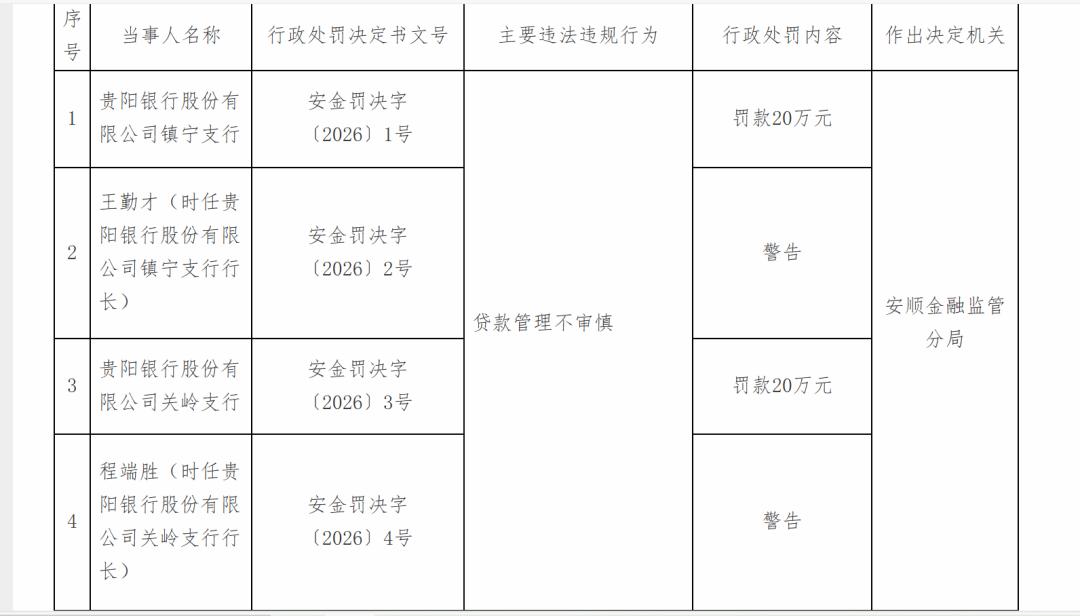
Core Viewpoint - The banking sector is facing intensified regulatory scrutiny in 2026, with multiple banks receiving fines for various violations, reflecting a shift towards more precise and severe penalties aimed at addressing systemic risks [2][3][13]. Regulatory Environment - In early 2026, several banks have already been penalized, indicating a continuation of strict regulatory measures from 2025 [1][4]. - The regulatory actions cover a range of issues, including inadequate loan management and insufficient internal controls [2][7]. Penalty Statistics - In 2025, a total of 6,565 fines were issued to banks, with over 1,000 banks penalized, marking an increase in the number of institutions facing penalties [9][10]. - The total amount of fines in 2025 reached 2.647 billion, a significant increase of 45.28% compared to the previous year, driven by a rise in the number of large fines exceeding one million [10][12]. Specific Cases - Guiyang Bank faced multiple fines in 2025, totaling 19, with the largest fine being 600,000 for inadequate loan management practices [6][7]. - The penalties imposed on Guiyang Bank included fines of 200,000 for two branches due to imprudent loan management, with responsible personnel receiving warnings [5][6]. Trends in Penalties - The trend of issuing large fines is expected to continue, with predictions indicating that the number of fines may remain stable while the amounts could increase, particularly for medium-sized banks [13]. - The focus of regulatory scrutiny is shifting towards high-risk areas, including compliance in financial technology and consumer protection [13]. Employee Accountability - The "double penalty system" has been implemented, linking compliance responsibilities directly to specific individuals, resulting in lifetime bans for over 100 bank employees in 2025 [3][8][12].

36岁银行经理和丈夫自杀,曾大量挪用储户资金!有人140万存款只剩8.8元!警方回应撤案
Xin Lang Cai Jing· 2025-12-27 13:35
Core Viewpoint - The case involves a bank wealth manager, Wang, who manipulated customer accounts leading to significant financial losses for clients, culminating in her suicide and that of her husband, raising questions about bank oversight and customer protection [3][9][10]. Group 1: Incident Overview - Wang, a wealth manager at a state-owned bank, was found dead in April 2023, with subsequent investigations revealing that she had misappropriated over 30 million yuan from clients since 2017 [3][8]. - Following Wang's death, her husband, Meng, also committed suicide, leaving behind two young daughters [3][10]. - The police closed the case due to the suspects' deaths, prompting victims to pursue civil lawsuits to recover their losses [9][10]. Group 2: Victim Accounts - Victims reported significant losses, with one elderly client discovering only 8.8 yuan remaining from 140 million yuan in savings [4][7]. - Another victim, Lili, found that her 780,000 yuan had been reduced to 4,519 yuan after unauthorized transactions [5][6]. - Multiple victims expressed trust in Wang, who had built strong relationships with them, leading to a lack of oversight on their accounts [7][8]. Group 3: Financial Misconduct - Wang's actions included transferring funds to unknown accounts and borrowing approximately 10 million yuan from acquaintances, promising high returns [8][9]. - Reports indicate that at least 12 accounts had over 10 million yuan transferred without the owners' knowledge, with the highest single loss reported at 2.65 million yuan [8][9]. Group 4: Regulatory Response - The local financial regulatory body stated that it could not confirm any violations of banking regulations following the incident [9]. - The police indicated that due to the suspects' deaths, they could not proceed with criminal charges, advising victims to seek civil remedies [10].

传美联储终止花旗(C.US)三项风险管控整改令 监管压力部分解除
智通财经网· 2025-12-18 11:35
Core Viewpoint - The Federal Reserve has informed Citigroup that it has terminated a formal notice requiring the bank to address deficiencies in its trading risk management, marking a significant step in resolving long-standing regulatory and control issues for the third-largest bank in the U.S. [1] Group 1: Regulatory Notifications and Issues - The Federal Reserve had previously issued a notice to Citigroup at the end of 2023, requiring the bank to address three "matters requiring immediate attention" (MRIA) related to the calculation and management of counterparty risk and capital reserves for potential losses [1][2] - One MRIA specifically required Citigroup to improve its data management and governance regarding capital reserves for counterparty credit risk, which is essential for determining the amount of capital needed to mitigate potential losses [2] - Other MRIA issues included the use of proxy indicators for calculating counterparty credit risk when data is unavailable and governance deficiencies related to unclear responsibility among various legal entities within the bank [2] Group 2: Historical Regulatory Challenges - Citigroup has been dealing with significant regulatory penalties over the years, including two penalties stemming from a $9 billion erroneous transfer to a creditor of Revlon in 2020, which necessitated improvements in the bank's control measures [3] - In 2024, the Federal Reserve and the Office of the Comptroller of the Currency imposed a fine of $136 million on Citigroup for failing to improve data governance and quality [4] - The bank's CFO recently stated that significant progress has been made in addressing these issues, aligning with earlier comments from the CEO regarding the transformation efforts [4]
