
电池

Search documents
法国要对中国打贸易战?德国不点头、东欧不买账,欧盟内部吵翻了
Sou Hu Cai Jing· 2026-02-16 02:11
Group 1 - The core issue revolves around France and the EU's proposal to impose high tariffs on Chinese goods, interpreted by some as a potential trade war against China [1][9] - A strategic report from a French government advisory body suggests a uniform tariff of approximately 30% on Chinese imports to protect European industries from the influx of cheaper Chinese products [1][4] - The report highlights concerns from the French and European industrial sectors regarding the competitive pressure from Chinese manufacturing, particularly in sectors like automotive, machinery, chemicals, and batteries [5][10] Group 2 - Chinese official media responded to the tariff proposal, asserting its illegitimacy and indicating potential countermeasures, including investigations into EU products like French wine [3][7] - There are differing opinions within France regarding the proposed tariffs, with the Finance Minister advocating for more targeted trade defense measures rather than blanket tariffs [5][9] - The complexity of the EU's internal decision-making process and the lack of consensus among member states on trade protectionism are highlighted, indicating that the proposal is still in the advisory stage and not yet formal policy [9][10] Group 3 - If the EU were to implement stricter tariffs, China has several potential countermeasures, including anti-dumping investigations and reciprocal tariffs on EU products [7][12] - The ongoing trade discussions reflect deeper global trade tensions, where countries are balancing globalization with domestic industry protection, as seen in the U.S. and EU's approaches to Chinese products [10][12] - The situation emphasizes the need for dialogue and adherence to multilateral trade rules to manage trade disputes effectively, rather than resorting to unilateral actions [10][12]

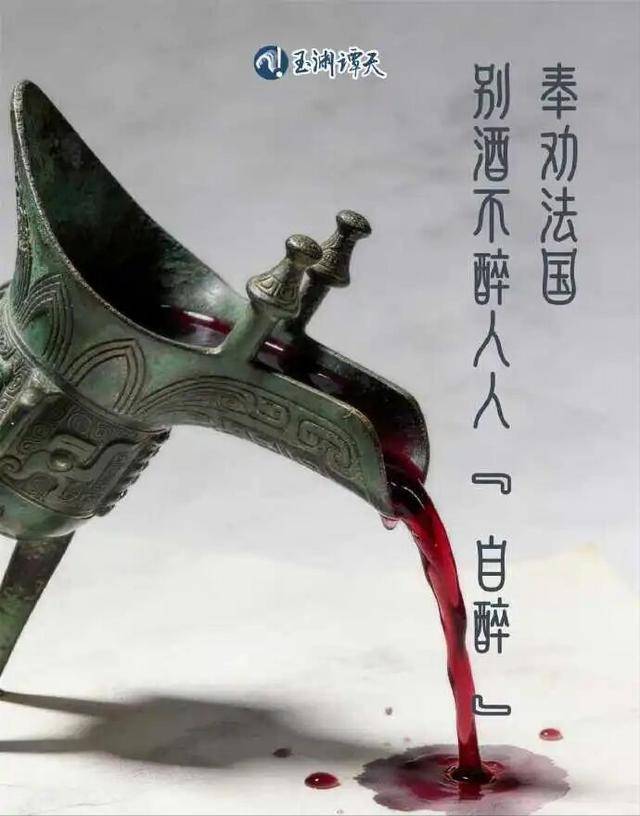
27国外援待命,马克龙向全球发话,对我们出手在先,中方坚决奉陪到底
Sou Hu Cai Jing· 2026-02-15 17:24
Core Viewpoint - A recent report from a French government think tank proposes aggressive measures to curb China's trade expansion, including a 30% import tariff on all goods from China and a plan to force a 30% appreciation of the yuan against the euro, aiming to pressure China into concessions in trade disputes [1][2]. Trade Imbalance - The report highlights a significant trade imbalance, predicting that the EU's trade deficit with China will soar to €304.5 billion by 2024, indicating a substantial one-way flow of funds into China [1]. - France views this imbalance as unfair, particularly in key industries such as automotive, chemicals, batteries, and precision machinery, where Chinese products are rapidly gaining market share due to cost advantages [1]. Economic Impact of Tariffs - Increasing the import tariff by 30% is expected to significantly raise the final prices of Chinese goods in the European market, potentially leading to a decline in sales and providing breathing room for local European businesses [2]. - The proposed yuan appreciation aims to fundamentally weaken the price competitiveness of Chinese products, making them more expensive in euro terms even if domestic prices in China remain unchanged [2]. Internal EU Opposition - Germany and the Netherlands, closely tied to the Chinese economy, have expressed strong opposition to the proposed tariffs, fearing retaliation from China that could severely impact their automotive industries and logistics sectors [4]. - The opposition from these countries represents a pragmatic force within the EU, prioritizing tangible economic interests over abstract concepts of "fair trade" [4]. Internationalization of Pressure - France is attempting to internationalize the issue by seeking support from allies in platforms like the G7, aiming to elevate the pressure on China to a collective Western action [6]. - The U.S. has shown support for France's aggressive stance, aligning with the report's recommendations and providing France with more leverage in pushing its agenda within the EU [6][11]. China's Response - China has firmly rejected external interference in its currency policy, asserting its ability to withstand economic pressure and signaling readiness to initiate anti-dumping and countervailing investigations against EU products, particularly targeting French wine and luxury goods [8][17]. - The report underestimates the strength of China's cost advantages, as Chinese goods are generally priced 30% to 40% lower than European counterparts, suggesting that even with a 30% tariff, Chinese products may still be cheaper [8][16]. Impact on French Companies - French companies, deeply integrated into global supply chains and reliant on Chinese components, may suffer from increased production costs and reduced sales channels due to heightened trade barriers [9]. - The aggressive stance taken by France may inadvertently harm its own businesses, as the pursuit of strategic goals could come at the expense of domestic economic interests [9][19]. Broader Implications - The ongoing tensions are reshaping the previously stable economic relationship between China and Europe, with geopolitical calculations increasingly influencing trade dynamics [9][15]. - The complexity of the EU's internal divisions complicates the formation of a unified trade strategy towards China, as different member states have varying interests and stakes in the relationship [16].
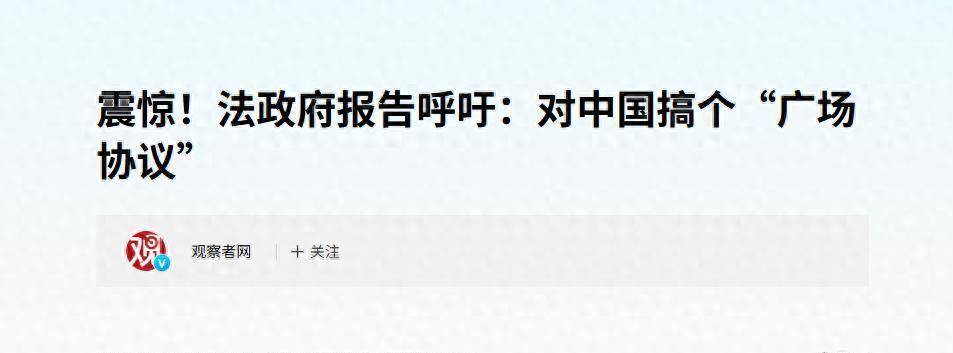
法国有意对中方加征关税,马克龙要出尔反尔了?中欧关系很快转型
Sou Hu Cai Jing· 2026-02-15 03:42
Core Viewpoint - Europe is currently in a complex situation, facing the escalating threat of the Russia-Ukraine conflict and the pressures from the US trade tariff war, making it challenging to manage its stance towards China [1] Group 1: Economic Impact and Competition - A report from France's High Council for Strategic Planning indicates that Chinese products, benefiting from a 30% to 40% cost advantage, are gradually penetrating traditional European industries such as automotive, batteries, machine tools, and chemicals [1] - The report warns that without significant policy adjustments, the industrial sector in France could face a survival crisis, with one-quarter of French exports and two-thirds of German industrial output under strong competitive pressure from China [1] - Germany's trade with China is expected to reach €253 billion by 2025, with a shift from low-end to mid-range products in imports, indicating a pragmatic approach to economic interests rather than ideological constraints [5] Group 2: Policy Recommendations and Internal Debate - The report suggests extreme measures such as imposing a 30% tariff on Chinese goods or devaluing the euro against the yuan by 30%, which has garnered some domestic support but faces significant opposition due to potential inflation and economic growth suppression [3] - French Minister of Economy and Finance, Bruno Le Maire, emphasizes that there is no one-size-fits-all solution and advocates for increasing savings rates and innovation to compete with China [3] - The proposal for large-scale tariffs lacks practical operational basis and is seen as a reaction to current anxieties rather than a well-considered strategy [7] Group 3: Future of China-Europe Relations - Europe is increasingly viewing China as a systemic competitor, while also desiring Chinese investment and technology transfer to boost local industries [7] - The ongoing conflict between the desire for economic cooperation and the need to address ideological concerns, such as human rights and geopolitical issues, complicates the relationship [7] - A stable and coherent policy framework towards China is urgently needed to avoid uncertainty in China-Europe relations, which could burden both parties, especially Europe [12]
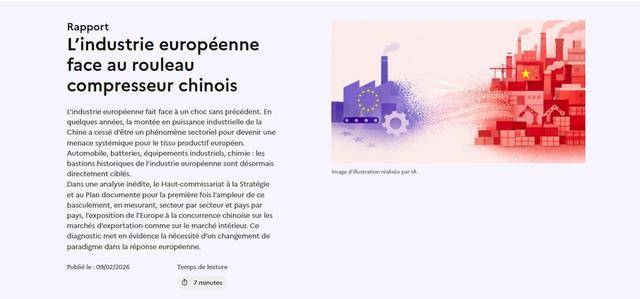
欧盟焦虑爆发,中国工业被盯上?关税威胁下,中方已看准反击方向
Sou Hu Cai Jing· 2026-02-15 03:40
Core Viewpoint - The European Union (EU) is experiencing industrial anxiety, primarily driven by competition from China, leading to calls for a 30% tariff on Chinese goods, particularly from France [1][3]. Group 1: EU's Industrial Concerns - France has raised alarms about the pressure European industries face from Chinese manufacturing, claiming it poses a life-or-death crisis for Europe [1]. - The EU's manufacturing sector is declining, with structural issues such as high energy costs and slow approval processes exacerbating the situation [1][5]. - China's manufacturing output accounts for nearly one-third of global production, while the EU's share is only 15%, intensifying competition within the EU [3]. Group 2: Internal EU Dynamics - The EU's regulatory framework is complex, causing delays in large industrial projects and hindering competitiveness [5]. - There are significant internal disagreements among EU member states regarding trade policies with China, particularly between France and Germany [5]. - Germany's economy is closely tied to China, making it cautious about imposing tariffs that could harm its own industries [5]. Group 3: China's Competitive Edge - China's industrial advantages stem from long-term R&D investments, market competition, and a complete industrial chain, rather than unfair practices [5]. - China has established significant advantages in electric vehicles, batteries, and solar energy, leading to direct competition with European firms [3]. Group 4: Potential Responses and Strategies - If the EU imposes tariffs, China is prepared to retaliate through anti-dumping and countervailing measures, targeting specific products like French wine [5]. - China emphasizes the importance of cooperation and mutual benefit, advocating for a fair and transparent environment for trade [5]. - The EU must focus on improving its own industrial policies and innovation rather than relying solely on tariffs to regain competitiveness [5].
英国媒体人:中国清洁能源改变世界
Xin Lang Cai Jing· 2026-02-14 13:28
Group 1 - The core viewpoint is that China's development of clean energy technology marks the beginning of a significant transformation in how the world uses energy [1] - Approximately 20 years ago, China recognized the severe consequences of climate change, such as unstable water resources and impacts on agriculture, prompting the need for countermeasures [1] - China aims to explore new industrial sectors, viewing clean technology as a promising opportunity that aligns with this direction [1] Group 2 - China has remarkable expertise in efficient manufacturing, which has been applied to the production of clean technologies, yielding impressive results [1] - The costs of solar panels, batteries, and electric vehicles have decreased rapidly, surpassing previous predictions, largely due to China's substantial investments [1] - Other countries in Asia, Africa, South America, and around the world are purchasing these technologies to change their methods of power generation and energy usage [1]
布局固态电池股价飙升,电解液价格大涨后新宙邦利润表现不及天赐材料
Xin Lang Cai Jing· 2026-02-14 11:07
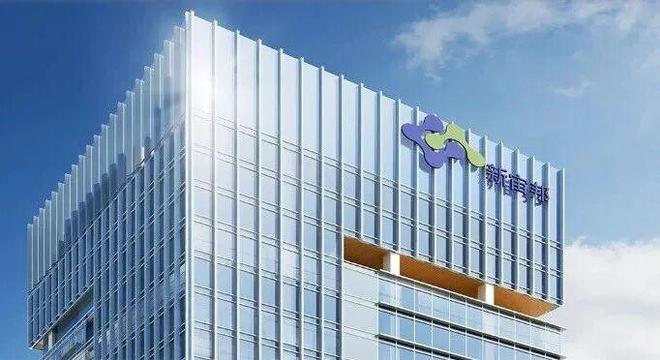
Core Viewpoint - The leading global electrolyte company, Xinzhou Bang, has submitted an IPO application to the Hong Kong Stock Exchange, aiming to raise funds for expanding overseas and domestic production capacity amid a competitive IPO environment with over 400 companies waiting for hearings [3][16]. Group 1: Financial Performance - In the first three quarters of 2025, Xinzhou Bang reported a revenue of 6.616 billion yuan, a year-on-year increase of 16.75%, and a net profit attributable to shareholders of 748 million yuan, up 6.64% [6]. - For the entire year of 2025, Xinzhou Bang achieved total revenue of 9.639 billion yuan, a 22.84% increase, with a net profit of 1.098 billion yuan, growing 16.56% [6]. - In contrast, the leading competitor, Tianqi Materials, projected a net profit of 1.1 billion to 1.6 billion yuan for 2025, reflecting a significant year-on-year growth of 127.31% to 230.63% [6][7]. Group 2: Market Dynamics - The price of lithium hexafluorophosphate, a key material for electrolytes, rose from 49,000 yuan per ton in July 2025 to 180,000 yuan per ton by December 2025, driven by surging demand for energy storage batteries [4][6]. - Global energy storage battery shipments reached 550 GWh in 2025, marking a 79% year-on-year increase, indicating robust demand for electrolytes [4]. Group 3: Production Capacity and Strategy - Xinzhou Bang plans to use the funds raised from the IPO primarily for expanding both overseas and domestic production capacity for electrolytes and raw materials [3][16]. - The company currently has a self-supply ratio of lithium hexafluorophosphate between 50% and 70%, which is significantly lower than Tianqi Materials' over 95%, impacting its profit margins during price surges [7][9]. - Xinzhou Bang's overseas business achieved a gross margin of 45.4% in the first half of 2025, compared to only 19.69% for its domestic operations, highlighting the profitability of its international ventures [17]. Group 4: Competitive Landscape - The competitive landscape is intensifying as other leading electrolyte companies, such as Tianqi Materials, are also expanding their overseas production capabilities, with Tianqi planning a $280 million investment in Morocco [18]. - Xinzhou Bang's ability to quickly expand its overseas production capacity is crucial for capturing market share and avoiding price wars in the future [18][20].

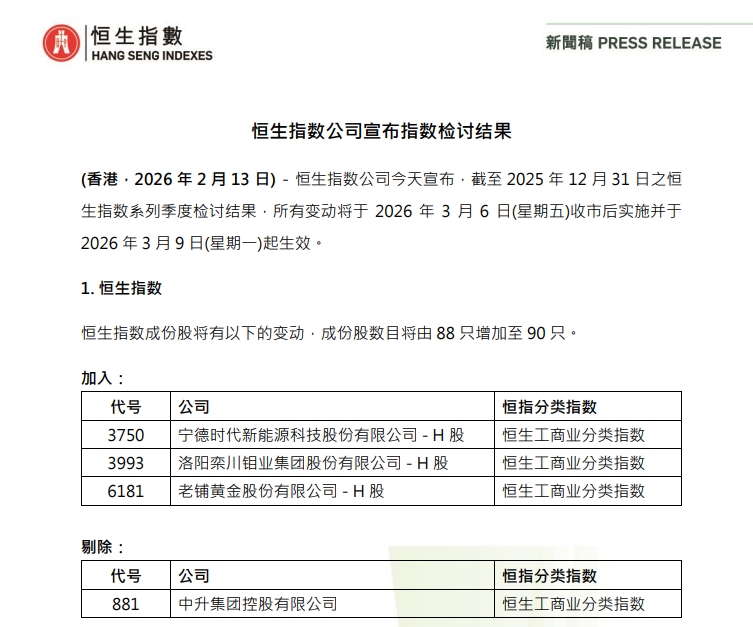
港股重磅调整!恒生指数指数成分股调整,宁德时代上市仅8个月时间被纳入,恒生指数成分股数量将增至90只
Jin Rong Jie· 2026-02-14 08:38
Group 1 - The core point of the article is the inclusion of CATL (宁德时代) in the Hang Seng Index, along with other companies like Luoyang Molybdenum and Laopu Gold, while Zhongsheng Group is removed, increasing the number of constituent stocks from 88 to 90, effective March 9 [1][4]. - CATL was listed on the Hong Kong Stock Exchange on May 20, 2025, and has seen a stock price increase of over 90% within the year, reaching a market capitalization of over HKD 2.7 trillion [3]. - As of February 13, 2025, CATL's H-shares closed at HKD 517.5, while Luoyang Molybdenum and Laopu Gold closed at HKD 21.72 and HKD 738.5 respectively, with respective declines of 6.94% and 3.97% [3]. Group 2 - The adjustment of index constituents is expected to trigger passive fund reallocation, potentially leading to increased trading volumes for the affected stocks as the effective date approaches [4]. - The Hang Seng Index series is gradually incorporating more new economy sectors such as renewable energy, new consumption, and biotechnology, while reducing the weight of traditional industries, enhancing the growth potential and investment attractiveness of the index [4]. - As of December 2025, the total assets under management for products tracking the Hang Seng Index series amounted to approximately USD 117.7 billion [4]. Group 3 - Since the beginning of 2026, there has been a structural divergence in the Hong Kong stock market, with the Hang Seng Index rising by 3.65% while the Hang Seng Tech Index has declined by 2.82% [5]. - In 2025, both the Hang Seng Index and the Hang Seng Tech Index experienced gains of 27.77% and 23.45% respectively [5]. - Analysts suggest that the consumer sector, currently at relatively low valuations, may continue to rise due to increased consumption activity leading up to the Spring Festival, while precious metals and energy sectors are expected to experience upward volatility amid geopolitical uncertainties [5].

邀请函丨2026(第二届)起点锂电圆柱电池技术论坛暨圆柱电池20强排行榜发布会4月10日深圳举办!
起点锂电· 2026-02-14 08:19
Group 1 - The core viewpoint of the article emphasizes the explosive growth of the large cylindrical battery and all-tab technology market by 2025, with a projected increase in China's cylindrical battery shipments exceeding 15%, and large cylindrical batteries growing over 40% [3] - Major companies in the large cylindrical battery sector, such as EVE Energy, Molicel, and others, are expected to face supply shortages due to high demand, indicating a robust market outlook for 2026 [3] - The article highlights the rapid adoption of large cylindrical battery products in various applications, including lightweight power, electric two- and three-wheelers, portable and home energy storage, and automotive power [3] Group 2 - The event organized by Qidian Lithium Battery and Qidian Research Institute (SPIR) aims to discuss cutting-edge technologies, processes, and materials related to cylindrical batteries, showcasing the industry's competitive landscape through a comprehensive ranking of the top 20 companies [3][6] - The agenda includes sessions on high-power cylindrical battery technology, innovations in household and portable energy storage, and the development trends of automotive-grade large cylindrical batteries [7][8] - The forum will also feature discussions on the balance between cost and performance in new materials and processes, as well as the competitive speed of industrialization for new materials in large cylindrical batteries [8]
港股市场,重要调整
Sou Hu Cai Jing· 2026-02-14 00:49
Financial Data - As of the end of January, the social financing scale increased by 8.2% year-on-year, and the broad money supply (M2) grew by 9.0%, significantly higher than the nominal GDP growth rate, creating a favorable monetary environment for economic recovery [3]. Stock Market Adjustments - The Hang Seng Index will increase its constituent stocks from 88 to 90, with the inclusion of CATL, Luoyang Molybdenum, and Laopu Gold, while Zhongsheng Holdings will be removed. These changes will take effect after the market closes on March 6 and will be implemented on March 9 [3]. Regulatory Actions - The China Securities Regulatory Commission (CSRC) announced administrative penalties and market bans against Tianfeng Securities for alleged violations related to financing and information disclosure for Wuhan Contemporary Technology Industry Group [3]. Company News - Southwest Securities plans to issue A-shares to specific investors, raising up to 6 billion yuan to supplement its capital for various business operations [7]. - SAIC Group's subsidiary, SAIC Jin控, will establish a private equity fund with an initial subscription of 2.5 billion yuan, focusing on solid-state batteries and other advanced technologies [8]. - KOTAI Power has decided to terminate its H-share issuance preparations, stating that this decision will not significantly impact its operations [8]. - YG Chip received a notice from the CSRC regarding an investigation for suspected information disclosure violations, while its business activities continue normally [8]. - Meituan expects a loss of 23.3 billion to 24.3 billion yuan for the fiscal year 2025, primarily due to a shift from a profit of approximately 52.4 billion yuan in 2024 to an operational loss in 2025, alongside increased investments in overseas operations [9]. - Zongshen Power plans to swap motorcycle engine-related assets with Longxin General's assets to resolve competition issues and promote clearer business development [9]. Industry Insights - Huatai Securities believes that the advancement of a unified national electricity market will benefit the new power system construction from multiple dimensions, focusing on the accelerated development of energy storage, continuous construction of the main grid, and structural growth in renewable energy demand [11].


绿色债券周度数据跟踪-20260214
Soochow Securities· 2026-02-13 23:47
Group 1: Industry Investment Rating - No information about the industry investment rating is provided in the report. Group 2: Core Viewpoints - In the primary market, from February 9 to February 13, 2026, 7 new green bonds were issued in the inter - bank and exchange markets, with a total issuance scale of about 4.001 billion yuan, a decrease of 5.23 billion yuan compared to the previous week. The issuance tenure is mostly 3 years, and the issuers include central enterprise subsidiaries, local state - owned enterprises, Sino - foreign joint - ventures, and private enterprises, with most having an AAA rating. The issuers are from Jiangsu, Guangdong, Hubei, and Yunnan provinces, and the bond types are enterprise ABS, medium - term notes, and ultra - short - term financing bills [1]. - In the secondary market, from February 9 to February 13, 2026, the weekly trading volume of green bonds totaled 57 billion yuan, a decrease of 3.4 billion yuan compared to the previous week. By bond type, non - financial corporate credit bonds, financial institutional bonds, and interest - rate bonds had the top three trading volumes, at 27.4 billion yuan, 21.5 billion yuan, and 6.4 billion yuan respectively. By issuance tenure, green bonds with a tenure of less than 3 years had the highest trading volume, accounting for about 80.77%. By issuer industry, the top three industries in terms of trading volume were finance, public utilities, and transportation equipment, at 24.5 billion yuan, 11.6 billion yuan, and 2.2 billion yuan respectively. By issuer region, the top three regions in terms of trading volume were Beijing, Guangdong, and Hubei, at 17.1 billion yuan, 6.2 billion yuan, and 4.5 billion yuan respectively [2]. - In the week from February 9 to February 13, 2026, the overall valuation deviation of the weekly average trading price of green bonds was not large, and the discount trading amplitude was greater than the premium trading amplitude, with a higher proportion of discount trading. Among the discount bonds, the top three discount rates were for G21 Yikong 1 (-1.5375%), 25 Shuineng G3 (-0.9945%), and 21 Fengcheng Green Bond 01 (-0.6988%), and the remaining discount rates were within - 0.55%. The issuer industries were mainly finance, transportation equipment, and public utilities, and the Zhongzhai implicit ratings were mainly AA, AA -, and AA +, with issuers mostly from Beijing, Guangdong, and Jiangxi. Among the premium bonds, the top three premium rates were for DD162C (0.6303%), 26 Luhongqiao GN001 (Science and Technology Innovation Bond) (0.5681%), and 20 Yunnan 03 (0.2305%), and the remaining premium rates were within 0.22%. The issuer industries were mainly finance, construction, and transportation, and the Zhongzhai implicit ratings were mainly AAA -, AA +, and AA, with issuers mostly from Shanghai, Tianjin, and Henan [3]. Group 3: Summary by Relevant Catalogs Primary Market Issuance - 7 new green bonds were issued, with a total scale of about 4.001 billion yuan, a decrease of 5.23 billion yuan compared to the previous week [1]. - The issuance tenure is mostly 3 years, and the issuers' natures include central enterprise subsidiaries, local state - owned enterprises, Sino - foreign joint - ventures, and private enterprises [1]. - Most of the issuers have an AAA rating, and they are from Jiangsu, Guangdong, Hubei, and Yunnan provinces [1]. - The bond types are enterprise ABS, medium - term notes, and ultra - short - term financing bills [1]. Secondary Market Trading - The weekly trading volume was 57 billion yuan, a decrease of 3.4 billion yuan compared to the previous week [2]. - By bond type, non - financial corporate credit bonds, financial institutional bonds, and interest - rate bonds had the top three trading volumes [2]. - By issuance tenure, green bonds with a tenure of less than 3 years had the highest trading volume, accounting for about 80.77% [2]. - By issuer industry, the top three industries in terms of trading volume were finance, public utilities, and transportation equipment [2]. - By issuer region, the top three regions in terms of trading volume were Beijing, Guangdong, and Hubei [2]. Valuation Deviation of the Top 30 Individual Bonds - The overall valuation deviation of the weekly average trading price was not large, with a greater discount trading amplitude and proportion [3]. - Among the discount bonds, the top three discount - rate bonds were G21 Yikong 1, 25 Shuineng G3, and 21 Fengcheng Green Bond 01, and the issuer industries were mainly finance, transportation equipment, and public utilities [3]. - Among the premium bonds, the top three premium - rate bonds were DD162C, 26 Luhongqiao GN001 (Science and Technology Innovation Bond), and 20 Yunnan 03, and the issuer industries were mainly finance, construction, and transportation [3].