软件

Search documents
BTIG警告:AI分化已达“不可持续”极端,半导体若倒下大盘将无险可守
智通财经网· 2026-02-13 07:07
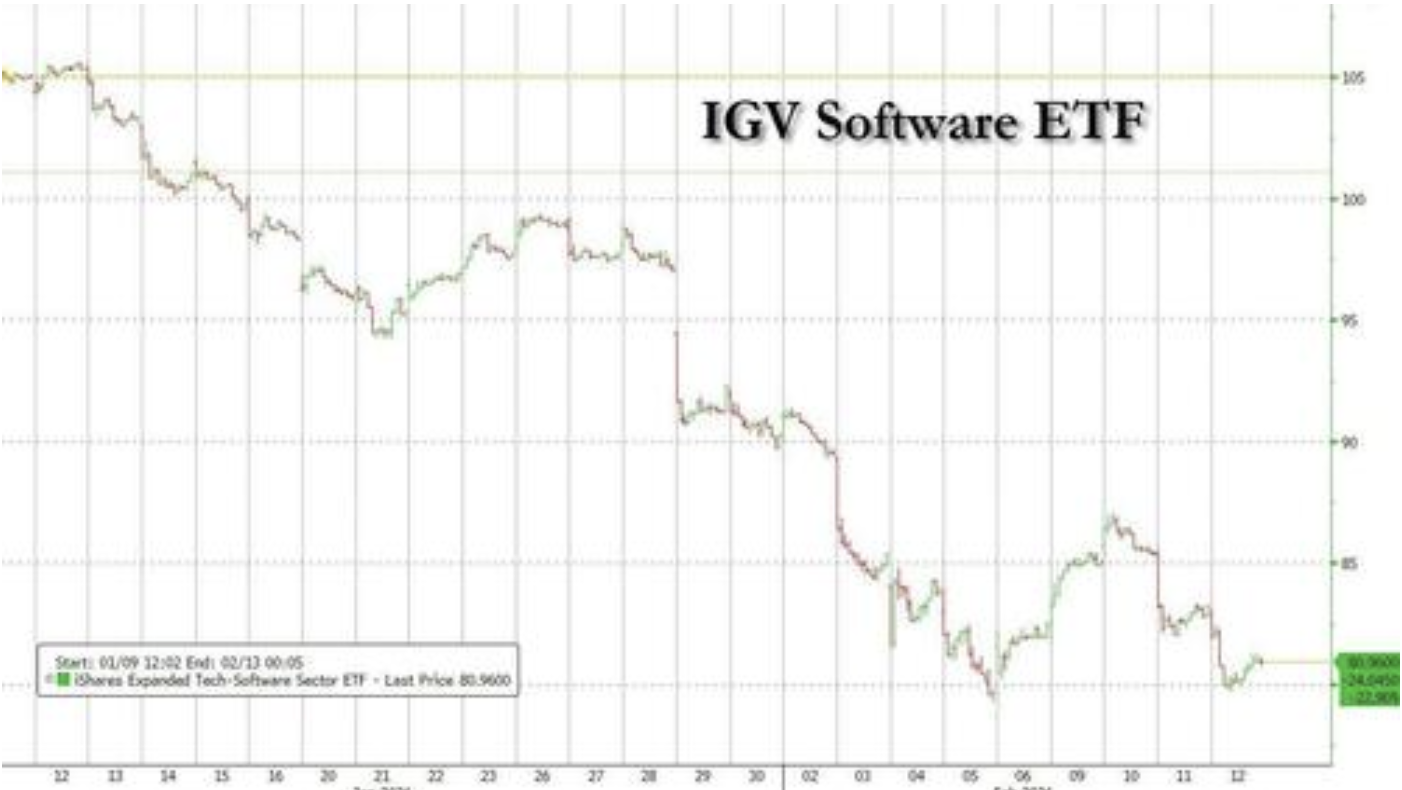
智通财经APP获悉,BTIG 首席市场技术策略师乔纳森·克林斯基(Jonathan Krinsky)表示,人工智能相关 股票的剧烈波动正造成极端的市场分化,这种分化可能正达到不可持续的水平。 软件板块是尤为令人担忧的领域,这位策略师指出。克林斯基进一步解释道:"软件板块确实需要守住 近期低点。"他强调,尽管该板块上周已出现"投降式抛售"特征,但若跌破近期低点,则意味着更深度 的下跌行情正在酝酿。 或许最为关键的是,这位 BTIG 技术分析师警告称,在其他领域动荡不安之际,半导体板块必须继续挑 起大梁。 "鉴于软件股及其他各类个股的大幅下挫,市场确实需要半导体板块继续挑起重担,"他表示。克林斯基 警告称,如果半导体板块也随其他板块一同走软,"指数很可能将无法企稳。" "然而,到了某个时点,我们开始担忧弱势会压倒强势,大盘将变得脆弱,"他表示。 克林斯基指出,标普500指数仍在7000点水平挣扎,而2月下半月通常代表季节性较弱时期,鉴于个股层 面的错位,接下来几周可能颇具挑战。 软件类 ETF: INVESCO AI AND NEXT GEN SOFTWARE ETF (IGPT.US) 在一份报告中,克林斯基着 ...
软件股遭遇2010年来最大做空潮,高盛惊呼:市场“无处可藏”!
Hua Er Jie Jian Wen· 2026-02-13 06:51
Group 1 - The software sector is experiencing the most intense short-selling attack in over a decade, with Morgan Stanley reporting that the short-selling volume in the software and SaaS sectors reached one of the highest levels since 2010 [1][7] - Hedge funds have quickly resumed short-selling strategies after a brief period of covering, with new short positions in the software sector exceeding levels seen at the end of January [2][7] - Concerns about AI replacing human jobs are spreading across more sub-industries, significantly impacting market sentiment, as evidenced by a notable drop in the stock price of CH Robinson [4][8] Group 2 - Defensive sectors are outperforming cyclical stocks, with Goldman Sachs noting the worst two-day performance for cyclical stocks since the "Liberation Day," with a cumulative drop of over 350 basis points [6][8] - The 10-year U.S. Treasury yield has fallen to around a three-month low of 4.08%, indicating increased market risk aversion, while the VIX index closed above 20 [6][8] - The market is becoming increasingly sensitive to the potential disruptive impacts of AI, with major tech companies experiencing valuation declines [9] Group 3 - Goldman Sachs described the current trading environment as one of the most volatile seen, with many tech and growth stocks appearing oversold as the Russell Tech Index falls to its 200-day moving average [6][10] - There is a discussion on whether the valuation adjustments in the market have been excessive, with some companies not returning to pre-earnings release levels despite the rapid pricing in of perceived technological changes [10] - The large tech stocks, referred to as "Mag 7," have underperformed the market by approximately 7.5 percentage points over the past few months, indicating a significant pullback [11]





综述|人工智能技术冲击引发担忧 纽约股市大幅下跌
Xin Hua She· 2026-02-13 06:40
新华社纽约2月12日电 综述|人工智能技术冲击引发担忧 纽约股市大幅下跌 另外,美国住宅销量大幅下降、联邦政府批评苹果手机推送系统偏好左派等因素也冲击相关公司股价。 (完) 今年以来,随着越来越多的人工智能工具投入应用,软件、物流、金融服务、商业地产等行业受到影 响。投资者担心,人工智能可能以更低成本、更高效率重新塑造相关产业的运营方式,冲击这些领域传 统企业的业绩表现。近来,这些担忧逐步开始反映在上市公司股价波动上。 由于投资者担心人工智能将优化物流流程,压缩传统企业利润率,罗宾逊全球物流公司股价12日跌超 14%。投资者担忧人工智能工具使用率提高会削弱办公空间需求,部分商业地产企业股票遭遇抛售。因 为新技术可能颠覆财富管理业务模式,以摩根士丹利公司为代表的金融服务类企业股价也受到冲击。 新华社记者刘亚南 由于投资者担忧人工智能技术大规模应用颠覆相关产业传统运营方式,美国纽约股市12日高开后大幅下 挫,跌幅在尾盘进一步放大。收盘时,纽约股市三大股指均显著下跌,其中物流和商业地产企业股价遭 重挫。 截至当天收盘,道琼斯工业平均指数比前一交易日下跌669.42点,收于49451.98点,跌幅为1.34%;标 准 ...
美股饱受AI焦虑摧残 亚洲赢家受全球资金追捧
Xin Lang Cai Jing· 2026-02-13 06:40
来源:滚动播报 2026年以来,MSCI亚太指数累计上涨逾11%,而美国基准股指则下跌,投资者担心AI模型可能威胁软 件、法律和房地产服务提供商的业务,相关股票被抛售。标普500指数年内下跌0.2%,以科技股为主的 纳斯达克100指数跌幅约为2%。不过周五MSCI亚太指数回落,跌逾1%。 ...
受人工智能相关担忧影响,华尔街股市大幅下挫,随后亚洲股市多数走低
Xin Lang Cai Jing· 2026-02-13 06:26
Core Viewpoint - Asian stock markets mostly declined, following a significant drop in Wall Street tech stocks, as investors are concerned about potential impacts on companies from industry changes driven by artificial intelligence [1][3][9]. Group 1: Market Performance - The Tokyo Nikkei 225 index fell by 0.8% to 57,165.13 points, after previously surpassing 58,000 points [1][7]. - The Hong Kong Hang Seng Index decreased by 1.8% to 26,547.97 points [2][8]. - The Shanghai Composite Index dropped by 0.7% to 4,105.04 points [2][8]. - The Australian S&P/ASX 200 index declined by 1.4% to 8,919.30 points [3][9]. - The South Korean KOSPI index rose by 0.4% to 5,545.49 points, driven by gains in tech stocks, with Samsung Electronics up by 1.2% [1][7]. Group 2: U.S. Market Impact - The S&P 500 index fell by 1.6%, or 108.71 points, to 6,832.76 points, marking the second-largest single-day drop since Thanksgiving, yet remains close to last month's record high [3][9]. - The Dow Jones Industrial Average decreased by 1.3%, or 669.42 points, to 49,451.98 points [3][9]. - The Nasdaq Composite index dropped by 2%, or 469.32 points, to 22,597.15 points [3][9]. - Cisco Systems' stock plummeted by 12.3% despite better-than-expected quarterly results, as investors expressed concerns over its sustained profitability [3][9]. - AppLovin's stock fell by 19.7%, even with quarterly profits exceeding expectations, due to worries about AI's potential impact on its business [3][9]. Group 3: Analyst Perspectives - Some analysts believe that the uncertainty stemming from AI-related transformation risks may persist for some time, affecting investor confidence in related companies, particularly in the software sector [3][9]. - Conversely, some analysts, including those from Capital Economics, remain optimistic about AI-related trends, predicting a "good year" for the S&P 500, led by tech stocks [3][9][10]. - Thomas Matthews from Capital Economics stated that a significant drop in tech stocks is necessary for a sustained reversal in their strong performance, but he expects tech stocks to perform well [10]. Group 4: Other Market Movements - McDonald's reported better-than-expected earnings, leading to a 2.7% increase in its stock price [10]. - Walmart's stock rose by 3.8% following positive earnings results [10]. - Oil prices saw a slight decline, with U.S. benchmark crude down by 0.1% to $62.77 per barrel, and Brent crude down by less than 0.1% to $67.49 per barrel [10]. - Gold prices increased by nearly 1% to $4,995.80 per ounce, while silver rose by 1.4% to $76.72 per ounce [10].
AI资本开支“踩刹车”反成利好?前小摩策略师:市场反弹需巨头表态“止损”
智通财经网· 2026-02-13 06:24
Core Viewpoint - The dramatic reversal in AI trading suggests that if a major tech company tightens its AI infrastructure spending and shifts focus to profits and cash flow, the market may rebound [1] Group 1: Market Dynamics - The software sector has been at the forefront of the tech stock sell-off this year, driven by concerns over the disruptive impact of AI and rising capital expenditures from large firms [1] - There is a notable shift of funds towards value stocks, which is expected to be a key market theme through 2026 [1] Group 2: Corporate Actions - Major companies like Microsoft, Google, Amazon, and Meta Platforms have announced AI investment plans totaling $650 billion for this year [1] - A potential market rebound may require a large-scale firm or software company to publicly announce a halt in AI investments, particularly in high-cost memory procurement, and return to a cash flow-oriented approach [1]


万兴科技春节招聘“不打烊”!100+高薪岗加码引才入湘
Chang Sha Wan Bao· 2026-02-13 06:12
Core Insights - The article highlights the strategic initiative by Wanjing Technology to launch a "Spring Festival Recruitment" plan, aiming to attract global AI talent by offering competitive salaries and a conducive working environment in Changsha [1][3]. Recruitment Strategy - Wanjing Technology is offering over a hundred high-paying positions across various fields including algorithms, product management, research and development, design, marketing, and administrative roles, with 80% of these positions based in Changsha [3]. - The company emphasizes competitive salaries, with algorithm engineers earning up to 1.2 million yuan and product managers earning between 400,000 to 900,000 yuan [3]. Business Growth and Development - The recruitment initiative is driven by the company's rapid business growth, particularly in AI-related sectors, including the launch of the AI-driven platform "Wanjing Drama Factory" and significant investments in AI companies [3]. - Wanjing Technology's creative science park in Changsha has completed its first phase, aiming to become a global creative hub [3]. Employee Development - The company has established a comprehensive employee development system that includes mentorship, AI tool access, and specialized training, with opportunities for outstanding employees to participate in an internal entrepreneurial model [4]. - Wanjing Technology has received several awards for its employer branding, including recognition as an "AI Recruitment Pioneer" and a "Youth-Friendly Employer" [4].

突发,暴跌!全线大跳水!AI恐慌交易,接连引爆!
券商中国· 2026-02-13 06:12
Core Viewpoint - The logistics sector has become the latest victim of "AI panic trading," following significant declines in software and financial sectors, with major logistics stocks experiencing sharp drops in both US and European markets [1][4][6]. Group 1: Market Reactions - On February 12, the Russell 3000 Trucking Index fell by 7.8%, with Robinson Global Logistics (CHRW) dropping over 14% and Expeditors International (EXPD) declining over 13% [1][4]. - In the A-share market, several transportation stocks also saw significant declines, with China Ocean Shipping Energy (中远海能) down over 8% and China Merchants South Oil (招商南油) down nearly 7% [1][3]. - The sell-off in logistics stocks was primarily influenced by the overnight plunge in US and European logistics stocks [4][6]. Group 2: AI Impact - The recent sell-off was triggered by Algorhythm Holdings' announcement that its SemiCab platform could increase freight volume by 300% to 400% without adding operational staff, leading to a surge in its stock price by nearly 79% at one point [4][5]. - Algorhythm's CEO emphasized that the logistics industry has been historically limited by human resources, and their platform aims to break this dependency by embedding intelligence directly into freight operations [5]. Group 3: Broader Market Context - Analysts noted that the current AI "super cycle" is reshaping global industry dynamics, intertwining technological benefits with market anxieties [2][6]. - The panic selling is not limited to technology stocks; any sector associated with AI news is experiencing similar reactions, indicating a broader market trend of fear and uncertainty [7][8]. - The ongoing turmoil in the market has not yet significantly impacted discussions on monetary policy, but prolonged volatility could change this [8].






风险偏好高低切换下,房地产链迎价值机遇,建材ETF(159745)近1周新增规模居同类产品第一
Xin Lang Cai Jing· 2026-02-13 05:12
Group 1 - The core index of the construction materials sector, the CSI All Construction Materials Index, fell by 2.05% as of February 13, 2026, with mixed performance among constituent stocks [1] - The top-performing stocks included Hainan Ruize, which rose by 1.39%, while Jinjing Technology led the decline with a drop of 5.36% [1] - The Construction Materials ETF (159745) decreased by 1.77%, with a latest price of 0.72 yuan, but showed a cumulative increase of 8.24% over the past month [1] Group 2 - The Construction Materials ETF recorded a turnover rate of 2.51% and a transaction volume of 56.7866 million yuan, with an average daily transaction of 183 million yuan over the past week, ranking first among comparable funds [1] - The ETF's scale increased by 12.2 million yuan over the past week, placing it in the top third of comparable funds [1] - The latest net outflow of funds from the ETF was 20.7035 million yuan, but there were net inflows on three out of the last five trading days, totaling 213 million yuan [1] Group 3 - Leverage funds are actively positioning in the market, with the latest margin buying amounting to 3.1003 million yuan and a margin balance of 33.6321 million yuan [1] - According to a report by Guojin Securities, global assets have entered a "Risk-off" mode due to various risk events, leading to a shift from growth to value stocks in the equity market [1] - The report highlights that sectors like industrials, materials, and real estate are gaining favor due to their characteristics that are difficult to replace with AI [1] Group 4 - Zhongyin Securities forecasts two potential turning points in the year: a "policy turning point" around the end of Q1 and a "fundamental turning point" around Q4, focusing on the improvement of demand and narrowing declines in second-hand housing prices [2] - The Construction Materials ETF has seen a net value increase of 28.68% over the past two years, ranking first among comparable funds [2] - The ETF's highest single-month return since inception was 24.25%, with an average monthly return of 6.65% during rising months [2] Group 5 - As of February 6, 2026, the Construction Materials ETF had a Sharpe ratio of 1.29, indicating a favorable risk-adjusted return [3] - The maximum drawdown for the ETF this year was 5.48%, with a relative benchmark drawdown of 0.24%, and it recovered the fastest among comparable funds [3] Group 6 - The management fee for the Construction Materials ETF is 0.50%, and the custody fee is 0.10%, with a tracking error of 0.065% over the past six months, the highest among comparable funds [4] - The ETF closely tracks the CSI All Construction Materials Index, which reflects the overall performance of listed companies in the construction materials sector [4] Group 7 - As of January 30, 2026, the top ten weighted stocks in the CSI All Construction Materials Index accounted for 61.6% of the index, including companies like Conch Cement and Dongfang Yuhong [5]


高盛:全球市场“巨变”:“实体”回归,“科技”分化
美股IPO· 2026-02-13 03:27
Core Viewpoint - Goldman Sachs indicates that the global bull market is not over, but the driving forces have shifted from crowded US tech stocks to emerging markets, commodities, and value stocks [1][3] Group 1: Market Dynamics - Funds are moving from over-congested US tech stocks to emerging markets (EM), commodities, and "old economy" value stocks [3] - The MSCI Emerging Markets Index has risen from 100 to nearly 120 relative to developed markets since the beginning of 2025, indicating a significant revaluation [7] - Despite geopolitical uncertainties, the stock market shows resilience, largely due to strong fundamentals and improved macro and micro drivers [9][8] Group 2: AI and Technology Sector - AI capital expenditure is projected to reach $659 billion, but concerns over return on investment (ROI) are rising, leading to significant differentiation among the "Magnificent Seven" tech stocks [4][14] - The software sector is experiencing a crisis as AI innovations threaten traditional SaaS models, resulting in a sharp decline in software valuations [5][16] - The correlation among the "Magnificent Seven" has sharply decreased, with varying returns; for instance, Google's return is around 66%, while others like Apple and Amazon lag behind [14][16] Group 3: Value Stocks and Old Economy - There is a revival of interest in value stocks, which were previously seen as "value traps," as some are successfully transforming into "value creators" by generating higher cash flows [18][19] - Capital expenditures in traditional sectors like utilities and telecommunications are increasing, driven by the need for infrastructure to support tech growth [17] - The performance of financial assets has reversed, with gold, emerging markets, and value stocks outperforming tech stocks, marking a significant shift in market dynamics [20] Group 4: Diversification and Future Outlook - The era of diversification is emerging, as the sources of growth are expanding beyond large tech stocks, with strong earnings growth across various sectors [22][23] - Analysts have raised earnings forecasts for 2026 unusually early, particularly for emerging markets, indicating a shift in investment opportunities [12][23] - Investors are encouraged to reassess long-standing allocation habits and diversify across regions, sectors, and styles to capitalize on the changing market landscape [23]