
AI颠覆

Search documents
A股策略周报20260301:中国即HALO,实物即方舟-20260301
SINOLINK SECURITIES· 2026-03-01 08:54
Group 1 - The report highlights ongoing concerns regarding AI disruption, as evidenced by Nvidia's recent earnings report, which exceeded expectations but resulted in a significant stock price decline, indicating market apprehension about AI's impact on profitability [3][14][20] - There is a notable divergence between Nvidia's earnings per share (EPS) and stock price trends, with EPS rising while stock prices have weakened, reflecting investor skepticism about sustainable growth in AI-related revenues [3][14][24] - The report draws parallels between the current situation in the US tech sector and the decline of renewable energy assets in China in 2022, where rising capital expenditures did not translate into improved market valuations due to deteriorating fundamentals [3][20] Group 2 - The report emphasizes that Chinese assets are more resilient to AI disruption compared to US assets, as A-share companies are more concentrated in mining and manufacturing sectors, which are less susceptible to AI replacement [4][41] - Chinese companies generally have a higher proportion of tangible assets relative to total assets compared to their US counterparts, enhancing their ability to withstand potential AI-related shocks [4][41][47] - The manufacturing and materials sectors in China contribute a larger share of value-added compared to other major developed economies, positioning Chinese assets as valuable in the context of global investment [4][50] Group 3 - The report notes an increasing focus from overseas governments on strategic resource commodities, with initiatives like the US Treasury's "Treasury Plan" and Zimbabwe's suspension of lithium exports highlighting the geopolitical importance of these resources [5][51] - The demand for key minerals is rising at the government level, particularly in the US, where securing supply chains for critical minerals has become a strategic priority [5][51][56] - Supply-side dynamics are also shifting, as resource-rich countries are implementing policies that could disrupt supply and drive up prices, reflecting a trend towards resource nationalism [5][56][59] Group 4 - The report discusses the potential impact of geopolitical tensions in the Middle East on oil prices, suggesting that if oil prices rise to $90 per barrel, it could reverse the downward trend in US inflation [6][63] - The relationship between oil price fluctuations and US Consumer Price Index (CPI) growth has weakened over the past three years, indicating a complex interaction between energy prices and inflation metrics [6][63]

Reddit五周暴跌42%,AI颠覆恐慌席卷美股,传统互联网正遭遇一场估值重估
Jin Rong Jie· 2026-02-24 03:40
Group 1 - Reddit has experienced a significant valuation adjustment, with its stock price dropping approximately 42% over five weeks, attracting widespread attention [1] - The decline in Reddit's stock is closely related to the "AI disruption panic" affecting the entire US software and internet sector, as new tools from AI companies like Anthropic and OpenAI raise concerns about the growth prospects of traditional software and internet firms [1] - Anthropic's announcement of its Claude Code tool for modernizing COBOL systems led to IBM's stock plummeting over 13% in a single day, marking its largest single-day drop since 2000 [1] Group 2 - A report from Citrini Research outlines a hypothetical scenario for 2028, suggesting that AI disruption could lead to significant white-collar job losses, decreased consumer spending, and economic contraction, particularly impacting delivery platforms and payment processing companies [1] - Companies such as DoorDash, American Express, and KKR, which were specifically mentioned in the report, saw their stock prices drop over 6% in response to the outlined risks [1] - On February 23, the three major US stock indices fell by over 1% due to dual pressures from tariff uncertainties and AI disruption concerns, with Reddit's decline serving as a microcosm of the broader "AI panic trading" phenomenon [2]
关税恐慌再现!道指大跌超800点 金融软件板块重挫 白银逼近90美元
Di Yi Cai Jing· 2026-02-24 00:29
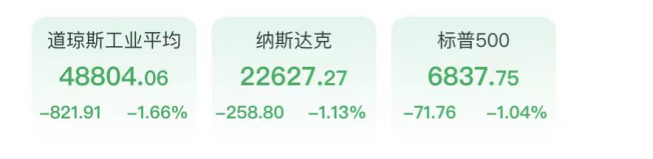
Market Overview - The three major U.S. stock indices experienced significant declines, with the Dow Jones falling by 821.91 points (1.66%), the Nasdaq down by 258.80 points (1.13%), and the S&P 500 decreasing by 71.76 points (1.04%) [1][2] - The VIX, a measure of market volatility, surged by 11.05% to 21.20, indicating increased market anxiety [1] Sector Performance - The financial sector dropped by 3.3%, with major banks like Wells Fargo, Citigroup, and JPMorgan falling over 4% [4] - Software companies faced a 4.0% decline, with DoorDash and ServiceNow dropping over 5%, and Oracle down by 4.59% [4] - The airline and travel sectors plummeted by 3.7% and 4.0%, respectively, due to severe winter storms affecting transportation [4] Key Stock Movements - Notable tech stocks showed mixed results, with Nvidia rising by 0.91% and Apple by 0.60%, while Google fell by 1.02%, and Amazon, Meta, Tesla, and Microsoft all dropped over 2% [2][3] Economic and Policy Context - The U.S. Supreme Court ruled that the Trump administration's tariffs on imports were unconstitutional, leading to new trade threats from the White House [5] - Trump announced a new 10% tariff on all U.S. imports, which was later raised to 15%, creating uncertainty in the market [5] - The average effective tariff rate is expected to decrease from 16% to 13.7% following the Supreme Court's decision [5] Investor Sentiment - Investors reacted negatively to the uncertainty surrounding trade policies, leading to a sell-off in U.S. assets [6] - Concerns about the potential for other countries to respond negatively to U.S. policies have heightened market anxiety [6] - The market is currently characterized by a preference for selling first and asking questions later, reflecting a strong aversion to uncertainty [6] Bond Market Reaction - In response to the latest tariff announcements, investors shifted towards U.S. Treasury bonds for safety, with the 10-year Treasury yield falling to 4.03% [7] - The two-year Treasury yield decreased by 3.6 basis points to 3.44%, indicating a flight to safety amid rising inflation concerns [7] Upcoming Events - Nvidia's earnings report is anticipated to impact market volatility, as it holds a significant weight in the S&P 500 index [8]

关税恐慌再现!道指大跌超800点,金融软件板块重挫,白银逼近90美元
Di Yi Cai Jing· 2026-02-24 00:25
Market Overview - The U.S. stock market experienced significant declines, with the Dow Jones falling by 821.91 points (1.66%) to 48,804.06, the Nasdaq dropping 1.13% to 22,627.27, and the S&P 500 decreasing by 1.04% to 6,837.75 [2][3] - The VIX, a measure of market volatility, surged by 11.05% to 21.20, indicating increased investor anxiety [2] Sector Performance - The financial sector saw a decline of 3.3%, with major banks like Wells Fargo, Citigroup, and JPMorgan falling over 4% [6] - Software companies faced a significant drop of 4.0%, with DoorDash and ServiceNow declining over 5% and Oracle down 4.59% [6] - The healthcare index rose nearly 1%, driven by a 4.86% increase in Eli Lilly's stock, outperforming its competitor Novo Nordisk [6] Trade Policy Impact - Following a Supreme Court ruling against the Trump administration's tariff policy, new tariffs of 10% on all U.S. imports were announced, later increased to 15% [7] - The average actual tariff rate is expected to decrease from 16% to 13.7% due to these changes, with a potential further drop to 9.1% after 150 days [7] Investor Sentiment - Investor reactions to the uncertainty surrounding trade policies have led to a sell-off in U.S. assets, with concerns about global investor sentiment towards U.S. policies [8] - The market is currently characterized by a preference for safe-haven assets, with gold prices rising significantly as a hedge against dollar assets [8] Economic Indicators - The New York Fed reported an increase in core trend inflation from 2.4% to 2.8%, attributed to rising costs in services and goods, influenced by tariff policies [9] - Despite a cooling job market, inflationary pressures are causing some Federal Reserve officials to oppose interest rate cuts [9] Commodity Performance - Gold prices surged over 3%, trading around $5,250 per ounce, while silver futures rose by 7.3% to $89.05 per ounce, reflecting heightened risk aversion among investors [10]
本周,“AI颠覆一切”的狼终于来了
Hua Er Jie Jian Wen· 2026-02-14 09:07
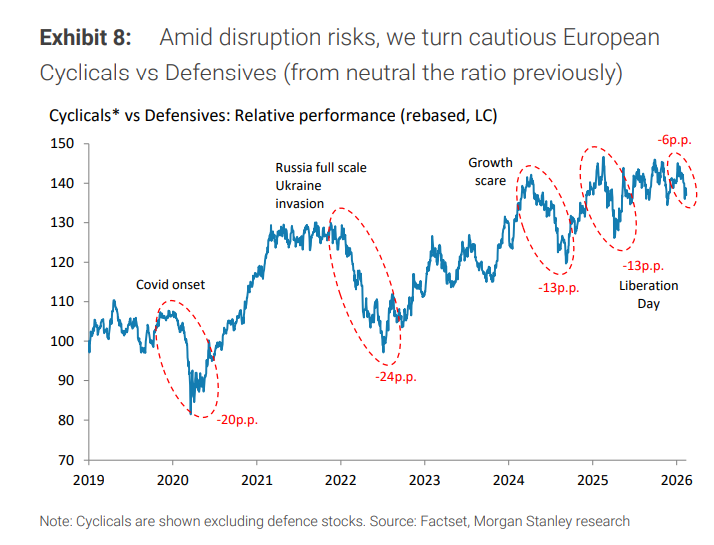
Core Insights - The market is increasingly recognizing the imminent threat of AI disruption, with the perceived risk in the MSCI Europe index rising from 4% to 24% in just over a month, including the banking sector [1][9] - Morgan Stanley has shifted its stance from neutral to cautious regarding cyclical stocks versus defensive stocks, highlighting opportunities in the European credit market for downside protection [1][15] AI Capability Advancements - The latest AI model, GPT-5.2, has achieved human expert-level performance in 71% of professional tasks, marking a significant leap in AI capabilities [5][8] - The speed of AI advancements is accelerating, with predictions that upcoming models in 2026 will far exceed current capabilities due to increased computational power [8] Market Disruption Dynamics - Initial concerns about AI's impact on the software industry have rapidly expanded to broader economic disruption risks, reminiscent of market reactions during the early COVID-19 pandemic [9][10] - Approximately 10% of the MSCI Europe index (excluding banks) is now viewed as facing substantial AI disruption risks, with this figure rising to 24% when including banks [9][10] Valuation Trends - The valuation of "disruption stocks" has decreased from a peak P/E ratio of 24x to 16.4x, with further downward potential indicated by comparisons to "uncontested disruption stocks" [10] Resilience Assessment Framework - Morgan Stanley proposes a framework to evaluate sectors and stocks based on five dimensions of risk exposure, identifying utilities, semiconductors, defense, and tobacco as the most resilient sectors [11] - Sectors such as software, commercial services, and banking are identified as facing the highest disruption risk [11] Non-AI Replicable Assets - The report emphasizes the rising value of assets that cannot be replicated by AI, including physical assets, regulatory barriers, and unique human experiences [4][12][14] Credit Market Insights - Despite AI disruption concerns affecting some credit markets, European investment-grade spreads remain low, presenting opportunities for investors to hedge against potential downturns [15] Computing Power Demand - There is a significant and growing demand for computing power, with projections indicating that the growth rate of demand will outpace current supply forecasts [16][21] - The intensity of computing requirements for AI queries is increasing rapidly, with predictions that companies may need to double their computing power every six months [19][21]


能源、必选消费和美债领涨2026!华尔街的“AI交易”被“AI颠覆”了
美股IPO· 2026-02-14 04:12
Group 1 - The core viewpoint of the article is that the initial optimism surrounding AI as a strong investment theme has shifted to concerns about its disruptive potential, particularly for asset-light companies that may be replaced by AI technologies [3][7][22] - The S&P 500 index experienced significant volatility, with its performance deteriorating to the worst levels since November, exacerbated by fears of AI disruption spreading across various markets [4][5] - The financial sector has been notably affected, with a marked decline in performance, while utility stocks have emerged as a safe haven amid AI-related concerns [5][6] Group 2 - Investor sentiment has shifted dramatically, with many now questioning the return timelines on large capital expenditures by tech giants and the sustainability of stock buybacks [8][10] - The market is undergoing a revaluation, particularly in the software sector, raising fears of contagion effects that could impact other industries [9][10] - Extreme positioning and leverage in the market are amplifying volatility, with a significant drop in cash allocations and a lack of downside protection among fund managers [11][12] Group 3 - There has been a notable increase in hedging activities, as evidenced by rising volumes of put options, indicating a growing concern for downside risks [19][20] - The Chicago Board Options Exchange's put-call ratio has surged since January, reflecting heightened investor caution [20] - Despite current volatility, the S&P 500 remains near historical highs, and credit spreads are at ten-year lows, suggesting that a market collapse has not yet materialized [18][22]

AI淘金热变成AI恐慌潮!华尔街新共识:躲开一切可能被颠覆的公司
华尔街见闻· 2026-02-11 09:15
Core Viewpoint - The investment logic on Wall Street is undergoing a significant transformation, with investors rapidly selling stocks of companies that may be disrupted by AI, rather than focusing on identifying AI winners [3][4]. Group 1: Market Reactions - A recent sell-off was triggered by the launch of Altruist Corp.'s tax strategy tool, Hazel, which caused major wealth management companies like Charles Schwab and Raymond James Financial to see stock declines of over 7%, marking the largest drop since the market crash in April [4]. - The panic began when Anthropic introduced a new tool, leading to a deep correction across software, financial services, asset management, and legal services sectors [5][7]. - The insurance brokerage industry was also affected, with stocks plummeting after Insurify launched a ChatGPT-based application for comparing auto insurance rates [7]. Group 2: Industry Impact - Altruist's Hazel tool highlights the market's deep anxiety regarding AI's potential to disrupt traditional financial services, as it can perform tasks that typically require an entire team for just $100 a month [6][7]. - The fear of AI disruption has spread from the software industry to broader sectors, indicating a significant shift in market sentiment [5][7]. Group 3: Diverging Opinions - Despite the prevailing panic, some market participants question the speed and extent of AI disruption, suggesting that technological upheaval often takes longer than anticipated [10][11]. - Concerns about AI's impact on various industries may be premature, as the market is still in the early stages of understanding AI's long-term implications [12]. Group 4: Market Sensitivity - The current sell-off reflects a general anxiety over high valuations in the market, which have been driven by a surge in AI spending and unexpected economic resilience [13]. - In a highly sensitive market environment, even minor negative signals can lead to significant stock declines, as investors prefer to err on the side of caution regarding potential AI disruptions [13].



AI淘金热变成AI恐慌潮!华尔街新共识:躲开一切可能被颠覆的公司
Hua Er Jie Jian Wen· 2026-02-11 05:58
Core Viewpoint - Wall Street is experiencing a significant shift in investment logic, with investors rapidly selling stocks of companies that may be disrupted by AI, leading to widespread panic and sell-offs across various sectors [1][2]. Group 1: Impact on Wealth Management - The recent sell-off was triggered by Altruist Corp.'s launch of the AI tax strategy tool Hazel, which caused major wealth management firms like Charles Schwab and Raymond James to see stock declines of over 7%, marking the largest drop since April [1][2]. - Altruist's CEO Jason Wenk noted that the market reaction was surprising, erasing billions in market value for several investment firms, and emphasized that the architecture used to build Hazel could replace many roles in wealth management that typically require entire teams [2][3]. Group 2: Broader Industry Concerns - The fear of AI disruption has expanded from the software industry to financial services, asset management, and legal services, particularly after new tools from companies like Anthropic and Insurify were introduced [1][3]. - Insurify's launch of a ChatGPT-based application for comparing auto insurance rates led to significant stock declines among U.S. insurance brokers, reflecting investor concerns about the survival of intermediary services that could be replaced by AI [3]. Group 3: Market Sentiment and Valuation Sensitivity - Despite the prevailing panic, some market participants question the speed and extent of AI disruption, suggesting that technological upheaval often takes longer to materialize than anticipated [4]. - The current sell-off also highlights a general anxiety regarding high valuations in the market, where even minor negative signals can lead to significant stock price declines, indicating a highly sensitive investment environment [5].
美股盘前要点 | 特朗普拟豁免科技巨头芯片关税,台积电1月销售额创新高
Ge Long Hui· 2026-02-10 12:32
Group 1 - US stock index futures showed slight increases, with Nasdaq futures up 0.22%, S&P 500 futures up 0.15%, and Dow futures up 0.01% [1] - European stock indices had mixed results, with Germany's DAX up 0.03%, UK's FTSE 100 down 0.34%, France's CAC up 0.25%, and the Euro Stoxx 50 up 0.19% [1] - Citigroup warned that "AI disruption" could lead software stocks to retest their 2023 lows, with a potential long-term terminal value evaporation of about one-third [1] - AI startup Anthropic plans to secure 10 gigawatts of data center computing power, surpassing OpenAI [1] - The US plans to exempt companies like Amazon, Google, and Microsoft from upcoming chip tariffs, potentially linked to TSMC's investment commitments [1] - TSMC reported a 36.8% year-on-year increase in January sales to a record high of NT$401.26 billion, with a board-approved capital budget of $44.962 billion [1] - Amazon plans to launch a content trading platform allowing publishers to sell content to AI companies [1] - Alphabet's Waymo achieved fully autonomous driving operations in Nashville, Tennessee [1] - Tesla's North American sales head Raj Jegannathan has left the company amid challenges of declining global demand [1] - Salesforce reportedly laid off fewer than 1,000 employees earlier this month, affecting marketing and product management roles [1] Group 2 - Eli Lilly will acquire Orna Therapeutics for $2.4 billion to strengthen its position in the autoimmune sector [2] - Baidu is reportedly secretly launching the "O Plan," which insiders say is related to the Baidu app [2] - Qianwen APP is testing integration with Damai, covering the entire process from film recommendations to payment and ticket issuance [2] - AstraZeneca expects a 9% increase in product sales to over $55.5 billion by 2025, anticipating continued growth this year [2] - Coca-Cola's Q4 net revenue of $11.8 billion fell short of expectations, with an anticipated adjusted organic revenue growth of 4-5% this year [2] - BP's Q4 underlying replacement cost profit increased by 32% year-on-year to $1.54 billion, with stock buybacks paused [2] - Barclays reported a pre-tax profit of £1.9 billion in Q4, exceeding expectations, and committed to returning at least £15 billion to shareholders by 2028 [2] - ON Semiconductor's Q4 revenue declined by 11% year-on-year to approximately $1.53 billion, with first-quarter guidance falling short of expectations [2] - Ferrari's Q4 net profit of €381 million exceeded expectations, with orders already booked through the end of 2027 [2]



花旗警告:“AI颠覆”恐导致软件股回测2023年低点,长期终端价值蒸发约1/3
Ge Long Hui A P P· 2026-02-10 01:56
Core Viewpoint - The decline in the software and services sector is primarily due to market reassessment of terminal value driven by "AI disruption," rather than a deterioration in short-term fundamentals [1] Group 1: Market Dynamics - The market has already reflected a compression of terminal price-to-earnings ratios by approximately 10%-20% [1] - If the compression extends to 30%, stock prices in the sector could fall back to mid-2023 lows or even lower, indicating a potential long-term evaporation of terminal value by about one-third [1] - Major software ETFs are experiencing a surge in trading volume and implied volatility, indicating a phase of panic selling [1] Group 2: Future Outlook - Extreme trading behaviors typically signify a climax in selling, suggesting a potential for a technical rebound in the short term, but this does not imply that long-term risks have been mitigated [1] - The reassessment of terminal value due to AI will persist, shifting the software industry from broad-based gains to a phase of significant individual stock differentiation [1] - The market will increasingly focus on companies' ability to integrate AI, with those enhancing efficiency through AI likely to continue growing, while those with business models easily replaceable by AI may face long-term pressures [1] - The current market is entering a more volatile bull market phase, with software stocks undergoing the most intense adjustments within this context [1]