公募基金

Search documents
银华基金: 以长期主义夯实根基 服务金融强国建设
Zhong Guo Zheng Quan Bao· 2026-02-03 20:25
Core Viewpoint - The 20th Central Committee's Fourth Plenary Session is a significant event that outlines how the financial industry can better serve the national agenda during a new development phase, emphasizing the importance of high-quality development in finance [1] Group 1: Understanding the Historical and Theoretical Context - The session summarizes the achievements of the new era and provides a top-level design for economic and social development during the "14th Five-Year Plan" period, highlighting its far-reaching significance for advancing Chinese-style modernization [2] - The company recognizes the need to align its strategy with national strategy, taking on the responsibility of supporting high-quality development and contributing to the construction of a financial powerhouse [2] Group 2: Commitment to People-Centric Financial Work - The session emphasizes a people-centered development approach, which is crucial for the financial sector, as it must serve the public and manage the wealth of millions [3] - The company aims to create value for investors and enhance the investment experience by focusing on long-term, sustainable practices and reducing volatility [3] Group 3: Strategic Development and Long-Term Focus - The session indicates that achieving socialist modernization is a gradual process requiring continuous effort, which informs the company's approach to asset management and brand building [3] - The company prioritizes quality and sustainability over short-term gains, focusing on building core capabilities in research, risk control, and service [3] Group 4: Professional Strength in Service of the National Agenda - The financial market is undergoing significant restructuring, with new policies promoting long-term investment and enhancing market stability and transparency [4] - The company plans to actively engage in technology and green finance, directing capital towards key sectors and supporting the development of specialized enterprises [4] Group 5: Focus on Inclusive and Pension Finance - The company is committed to providing a diverse range of financial products to meet the needs of various investors, particularly in the area of personal pension services [5] - It emphasizes the importance of investor education and enhancing financial literacy to improve the overall investment experience [6] Group 6: Long-Term and Value Investment Commitment - The company adheres to a deep fundamental research framework for investment, focusing on long-term value and optimizing incentive mechanisms [6] - It is expanding its range of equity funds and developing a comprehensive asset allocation toolbox to cater to different market conditions [6] Group 7: Internal Reform and Innovation - The company is committed to deepening internal reforms and enhancing its investment framework to align with high-quality development standards [7] - It emphasizes talent development and a robust risk management system to ensure sustainable growth and prevent major risks [7] Group 8: Implementation of the Session's Spirit - The construction of a financial powerhouse is a systematic project that requires continuous improvement in capabilities [8] - The company aims to integrate the session's spirit into its governance structure and investment practices, focusing on serving the real economy and enhancing investor experience [8]
海外创新产品周报20260202:Simplify发行中国商品ETF,白银ETF流出靠前-20260203
Shenwan Hongyuan Securities· 2026-02-03 07:53
1. Report Industry Investment Rating The document does not provide the industry investment rating. 2. Core Viewpoints of the Report - Simplify issued a China Commodity ETF, which mainly invests in futures listed on Chinese commodity exchanges, using a quantitative long - short model for variety selection [1][4]. - In the past week, US equity products had an inflow of over $30 billion, while silver ETFs had an outflow of over $2 billion, and gold ETFs had a relatively stable inflow [1][8]. - Since the beginning of this year, in addition to the precious metals sector, US industrial ETFs have seen significant gains, especially aerospace and defense ETFs, with some products rising nearly 18% [1][10]. - In December 2025, the total non - money mutual funds in the US decreased by $0.09 trillion compared to November. From January 14th to 21st, the outflow of domestic equity funds narrowed, international equity products had an outflow, and bond products had an increased inflow [1][14]. 3. Summary by Directory 3.1 US ETF Innovation Products: Simplify Issues China Commodity ETF - Last week, there were 15 new ETFs issued in the US, including Simplify's China Commodity ETF, which invests in Chinese commodity exchange futures and uses a quantitative model for variety selection [1][4]. - First Eagle issued two active US equity ETFs, T. Rowe Price issued an innovation ETF, Harrison Street issued an infrastructure active ETF, and TrueShares issued a stock hedge ETF [5]. 3.2 US ETF Dynamics 3.2.1 US ETF Funds: Silver ETFs Lead Outflows - In the past week, US equity products had an inflow of over $30 billion, with significant inflows into Nasdaq ETFs and emerging market ETFs. Commodity and alternative products had a slight outflow after increased volatility, and silver ETFs had an outflow of over $2 billion [1][8]. - Vanguard's S&P 500 ETF's two - week inflow was close to zero, Nasdaq ETFs had the largest two - week inflow, and gold ETFs had a relatively stable inflow last week [9]. 3.2.2 US ETF Performance: Aerospace and Defense ETFs Show Significant Gains - Since the beginning of this year, in addition to the precious metals sector, US industrial ETFs have had significant gains. State Street's industrial ETF rose nearly 7%, and aerospace and defense ETFs generally rose over 10%, with Global X's product rising nearly 18% [10][11]. 3.3 Recent Capital Flows of US Ordinary Mutual Funds - In December 2025, the total non - money mutual funds in the US were $23.64 trillion, a decrease of $0.09 trillion from November. The S&P 500 declined by 0.05% in December, and the scale of domestic equity products decreased by 1.03% [14]. - From January 14th to 21st, the outflow of domestic equity funds further narrowed to $1.11 billion, international equity products had an outflow of $2.69 billion, and bond products had an inflow that expanded to $8.47 billion [14].
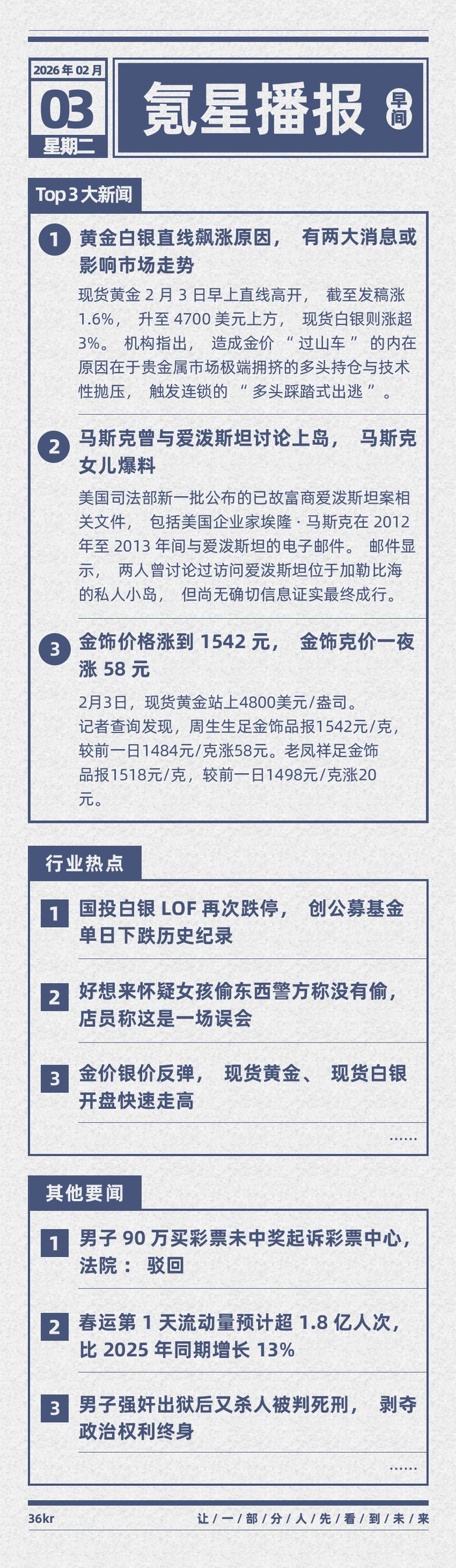
黄金白银飙涨金饰克价涨58元,马斯克女儿爆料与爱泼斯坦往来
3 6 Ke· 2026-02-03 07:23
Group 1 - Gold and silver prices surged, with spot gold rising 1.6% to over $4,700 and spot silver increasing by over 3% due to extreme long positions and technical selling pressure in the precious metals market [5][6] - The price of gold jewelry reached 1,542 yuan per gram, an increase of 58 yuan from the previous day, while another brand reported a price of 1,518 yuan per gram, up 20 yuan [5][6] - The National Investment Silver LOF experienced a trading halt, marking a record single-day decline for public funds [6] Group 2 - The first day of the Spring Festival travel rush is expected to see over 180 million people, a 13% increase compared to the same period in 2025 [6]

投资者微观行为洞察手册·1月第4期:融资资金开始回流
GUOTAI HAITONG SECURITIES· 2026-02-03 05:08
Market Pricing Status - The market transaction activity has slightly increased, but the profit effect has decreased. The average daily trading volume for the entire A-share market rose to 3.1 trillion yuan, while the proportion of stocks that increased in value dropped to 23.6% [6][8][15] - The median weekly return for all A-shares decreased to -3.4%, indicating a decline in profitability [6][8][15] A-Share Liquidity Tracking - Financing funds have seen a slight inflow, while ETF funds experienced a significant outflow. The new issuance scale of equity funds decreased to 35.09 billion yuan, and the overall stock position of public funds has declined [6][20][29] - Private equity confidence index increased by 0.5% compared to December, but the positions have marginally decreased [6][20][41] - Foreign capital inflow into A-shares was 4.13 million USD, with the northbound capital transaction proportion dropping to 0.1% [6][20][42][44] - The IPO fundraising was 5.55 billion yuan, and the scale of private placements was 4.55 billion yuan [6][20] - ETF funds saw a massive outflow of 319.37 billion yuan, with the passive trading proportion decreasing to 9.1% [6][20][28] A-Share Industry Allocation - Financing and ETF funds have both seen outflows from the electronics sector. In terms of foreign capital, net inflows were highest in non-ferrous metals (+119.5 million USD) and automobiles (+38.1 million USD), while transportation (-1.3 million USD) and public utilities (-1.1 million USD) saw net outflows [6][20][3.1] - Financing funds showed net inflows in non-ferrous metals (+13.45 billion yuan) and basic chemicals (+2.05 billion yuan), while defense and electronics sectors experienced net outflows of 2.82 billion yuan and 5.95 billion yuan, respectively [6][20][3.3] - The top sectors for net inflows in the ETF market included non-ferrous metals and chemical ETFs, while electronics, non-bank financials, and banks saw significant outflows [6][20][3.2] Hong Kong and Global Fund Flow - Southbound capital inflow has slowed down, while global foreign capital has marginally flowed into the US and Asian markets. The Hang Seng Index rose by 2.4% during this period [6][20][4.1] - The net buying amount of southbound capital decreased to 2.71 billion yuan, which is at the 15% percentile since 2022 [6][20][4.2] - In the global context, foreign capital inflows were highest in the US (+6.27 billion USD), South Korea (+2.83 billion USD), and China (+2.64 billion USD) [6][20][4.3]
富国基金的灵魂人物
Xin Lang Cai Jing· 2026-01-30 00:38
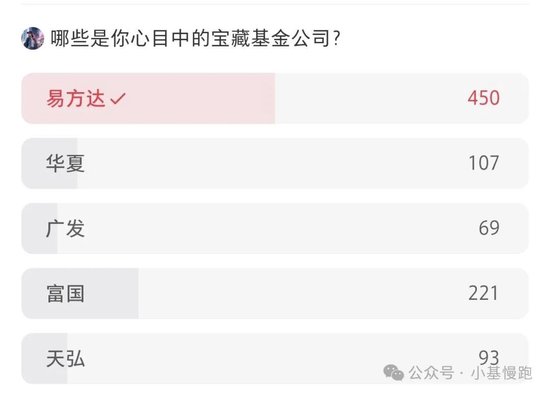
来源:城商行研究 在资产管理行业,一个优秀的领航员能够带领机构穿越市场波动,创造持续回报;而一个不合适的掌舵 人,则可能让巨轮偏离航道甚至触礁沉没。 而富国基金的灵魂人物就是陈戈。 还记得之前搞过一个投票,"哪些是你心目中的宝藏基金公司",投票的还是挺多的,除了易方达作为基 金一哥,遥遥领先之外,大家选择最多的就是富国基金。 而富国,也是我心目中最喜欢的基金公司之一。 尊重文化:富国基金的灵魂 陈戈的管理哲学核心是"尊重"与"平等"。在富国基金,每一位员工都是平等的,一视同仁。只有在平等 的基础上,才能真正做到发自内心的"尊重"。 在陈戈的领导下,富国基金的行政部门、财务部门、人力部门不是权力中心,而是服务中心。他们通过 各种方式满足员工的工作需求,解决他们的后顾之忧,让业务部门能将更多的时间和精力分配到更有效 的工作上。 在公募基金行业,富国基金总经理陈戈也是一个独特的存在。他不是频繁亮相的公众人物,却在其担任 基金经理期间,让富国天益价值基金创造了18.52%的年化回报,成为行业标杆。 自2014年担任总经理以来,陈戈带领富国基金实现跨越式发展。公司公募管理规模从2014年的662亿元 增长至2025年末 ...
多团队投研骨干齐出,景顺长城联合景顺集团举办2026年投资策略会
Sou Hu Cai Jing· 2026-01-27 03:10
同时,康乐指出,在贝塔收益比较显著的当下,阿尔法的获取越发依赖超前的认知、深入的研究和严格 的投资纪律,景顺长城始终坚信从基本面出发的主动管理,依然是公募基金行业不可撼动的核心竞争 力,在A股市场的投资实践中,通过自上而下的资产配置、自下而上的公司挖掘以及严谨的风险管理, 仍然能够为客户创造长期稳健的超额回报。 这一理念的践行,离不开对宏观经济和产业的深刻洞悉、以及市场脉动的敏锐把握。回看市场,今年以 来,上证指数时隔10年再次站上4100点大关,点燃了市场热情,全A日均成交额已经突破3万亿元。站 在当前时点,随着"十五五规划"正式启动,新一轮科技革命重塑全球经济与产业格局,宏观环境的节奏 如何把握?科技变革的机遇在哪里?如何在复杂多变的市场环境中精准布局、挖掘超额收益?针对这些 问题,景顺长城资产配置、权益、固收以及混合资产管理团队的投研骨干在策略会上,进行了深入拆 解,并带来他们的最新研究和思考。同时,本次策略会还请来了外方股东景顺集团的投资专家,分享全 球视野下的资产配置策略,干货满满。 宏观环境:国内政策环境有利,美元走弱利好新兴市场 对于2026年的宏观环境,景顺长城首席资产配置官王勇持相对乐观的态 ...
如何在复杂多变的市场中发掘超额收益?景顺长城这场硬核投资策略会值得关注
Zhong Guo Zheng Quan Bao· 2026-01-26 12:07
Core Insights - The investment outlook for 2026 emphasizes "stability while seeking progress and improving quality and efficiency," supported by proactive macro policies and robust counter-cyclical adjustments, indicating a promising start for the 14th Five-Year Plan [1] - The ongoing technological revolution is reshaping the global economic and industrial landscape, presenting significant investment opportunities in technology, overseas expansion, and domestic demand [1][2] Macroeconomic Environment - The macroeconomic environment for 2026 is viewed positively, with favorable domestic policies and a supportive capital market [3] - Fiscal policies are expected to focus on social welfare, while monetary policy remains "moderately loose," allowing for potential rate cuts [3] - The shift towards equity assets is anticipated as risk-free rates decline, with structural opportunities in AI, energy, and innovative pharmaceuticals [3] Global Investment Strategies - The investment strategy includes a focus on resilience and rebalancing, with an optimistic view on risk assets due to stabilizing economic conditions [4] - The U.S. Federal Reserve's interest rate cuts and a weaker dollar are expected to benefit emerging market assets [4] AI Industry Insights - The AI sector is highlighted as a key investment focus, with significant growth potential in computing power demand [5] - OpenAI's computing power investments and revenue growth have created a positive feedback loop, indicating a strong future for AI-related investments [5][6] - The AI competition is fundamentally different from the 2000 internet bubble, as it revolves around the control of critical production resources [6] Investment Strategy Focus - The strategy emphasizes growth sectors and the gradual overseas expansion of Chinese manufacturing, which is seen as a structural opportunity [7] - High-dividend assets and technology giants in the Hong Kong market are considered attractive, though caution is advised [8] Fixed Income and Asset Allocation - The "fixed income plus" strategy is gaining importance in the context of declining interest rates, with expectations for stable returns from bonds [9] - The overall outlook for the equity market remains positive, with a focus on corporate earnings support [9] - The potential for volatility in the fixed income market is acknowledged, with a focus on systematic asset allocation to achieve stable returns [10] Conclusion - The investment strategy conference reflects the company's expertise in multi-asset management, emphasizing a long-term, fundamental approach to investment [11] - The company aims to enhance its investment and service capabilities to deliver better returns and experiences for investors [11]
四大证券报头版头条内容精华摘要_2026年1月26日_财经新闻
Xin Lang Cai Jing· 2026-01-25 23:05
Group 1 - Tencent and Baidu announced their Spring Festival red envelope distribution plans, with Tencent distributing 1 billion yuan and Baidu 500 million yuan [1] - The performance of gold mining companies is expected to increase significantly due to rising gold prices, with companies like Zhaojin Mining and Hunan Gold announcing substantial earnings growth for 2025 [3][18] - The stock price of Pop Mart rebounded nearly 23% from January 19 to 23, recovering its market value to 294.6 billion HKD after a four-month decline [4][19] Group 2 - The People's Bank of China is shifting its focus on short-term interest rates, with the overnight rate potentially becoming a new benchmark, indicating a clearer approach to monetary policy [5][21] - Beijing's GDP is projected to grow around 5% in 2026, with a focus on expanding domestic demand and developing high-tech industries [6][22] - The IPO signals from three companies in the embodied intelligence sector suggest a potential boom in listings for this industry in 2026 [7][23] Group 3 - The global stock market ended 2025 strongly, with major indices rising over 20%, driven by technology and resource sectors [8][24] - The US dollar index fell nearly 2%, while gold prices surged, nearing 5,000 USD per ounce, marking a significant shift in investor sentiment towards safe-haven assets [9][25] - The new regulations on mutual fund performance benchmarks have been officially implemented, providing a practical reference for investors [10][26] Group 4 - The Beijing Stock Exchange saw its new stock subscription funds exceed 1 trillion yuan for the first time, indicating growing investor interest [11][27] - Insurance companies have begun cautiously investing in gold, but overall allocation remains limited due to high prices and the need for careful exploration [12][28] - The international silver price reached a historic high, with a significant increase of 44.38% since the beginning of 2026 [15][31]
财信证券宏观策略周报(1.26-1.30):市场上行斜率放缓,重视业绩基本面-20260125
Caixin Securities· 2026-01-25 13:32
Group 1 - The report suggests a strategic bullish outlook with tactical flexibility, emphasizing the importance of performance fundamentals in investment decisions [4][7][13] - It identifies a favorable investment window from mid-December 2025 to early March 2026, while cautioning against rapid upward trends in indices [4][7] - Key sectors to watch include commercial aerospace, satellite industries, AI applications, and sectors driven by price increases such as non-ferrous metals and chemicals [4][13] Group 2 - Economic growth is projected at 5.0% for 2025, with a focus on high-quality development and a potential GDP growth target of around 5% for 2026 [7][10] - The real estate market is still in a deep adjustment phase, with new housing sales expected to decline by 8.7% in 2025, indicating a need for careful observation of stabilization points [8][9] - Fiscal policy is expected to maintain a "only increase, not decrease" approach, with significant spending in key areas to support economic growth [10] Group 3 - The public fund industry is anticipated to solidify its high-quality development framework, with new guidelines enhancing the accountability of performance benchmarks for funds [11] - Precious metals are expected to retain investment value due to increasing global instability and ongoing central bank gold purchases, with gold prices nearing $5,000 per ounce [12][13] - The report highlights the importance of monitoring industry-specific data, such as cement price indices and industrial production growth rates, to gauge market trends [19][20]
业绩比较基准新规出炉,直击“风格漂移”等痛点,公募如何推进
Bei Jing Shang Bao· 2026-01-25 11:42
Core Viewpoint - The China Securities Regulatory Commission (CSRC) has released guidelines to standardize the selection and use of performance benchmarks for publicly offered funds, addressing long-standing industry issues such as "style drift" and "fund blind boxes" to enhance investor experience and satisfaction [1][3][5]. Group 1: Regulatory Framework - The guidelines, titled "Guidelines for the Selection and Use of Performance Benchmarks for Publicly Offered Securities Investment Funds," consist of six chapters and twenty-one articles, establishing a comprehensive regulatory framework covering benchmark selection, changes, disclosure, internal controls, external constraints, and self-regulation [3][4]. - The accompanying "Operational Guidelines" further detail the operational processes related to the performance benchmarks [3][4]. Group 2: Industry Challenges - The CSRC noted that the public fund industry has long faced a lack of specialized and systematic regulations, with many fund managers failing to establish comprehensive internal control mechanisms regarding performance benchmarks [3][4]. - As of January 23, among 21,850 funds with nearly one year of performance data, 4,878 funds underperformed their benchmarks, accounting for over 20% of the total, with some funds lagging by more than 40 percentage points [4]. Group 3: Impact on Investor Experience - The new regulations aim to enhance the clarity and comparability of fund performance, guiding fund managers to focus on investment discipline and style stability, ultimately creating sustainable long-term returns for investors [5][6]. - Fund management companies, such as Huaxia Fund and E Fund, have expressed commitment to aligning their operations with the new guidelines, emphasizing investor education and communication to improve service quality and investor satisfaction [7][8]. Group 4: Implementation Timeline - The new regulations will take effect on March 1, with a one-year transition period for existing products to adjust their performance benchmarks to comply with the new requirements [4]. - Fund custodians will have a six-month transition period to implement necessary supervisory responsibilities and system modifications [4].