
打印机

Search documents
上海今年已有十余款人形机器人新品发布,下月举办具身智能技能大赛;中山佳能打印机工厂停产丨智能制造日报
创业邦· 2025-11-30 03:18
Group 1 - The Shanghai AI industry is focusing on humanoid robot development, with over ten new products launched this year, and significant breakthroughs in key technologies such as edge chips and intelligent modules [2] - The upcoming Global Developer Pioneer Conference and International Embodied Intelligence Skills Competition will take place from December 12 to 14, featuring six major themes and 19 sub-events related to robotics in various life scenarios [2][3] - The Canon printer factory in Zhongshan has ceased operations as of November 21, with factors such as intensified competition and strategic adjustments contributing to this decision [2] Group 2 - The first batch of 15 "leading smart factories" was announced at the World Intelligent Manufacturing Conference, emphasizing collaboration and innovation to build a globally influential smart manufacturing model [2]


中山佳能打印机工厂停产 中国打印机市场竞争加剧
Di Yi Cai Jing· 2025-11-29 04:17
Core Viewpoint - Canon's printer factory in Zhongshan has ceased operations as of November 21 due to intensified market competition, the rise of domestic brands, the trend towards paperless offices, and strategic adjustments by Canon [1][2][5] Company Summary - Canon (Zhongshan) Office Equipment Co., Ltd. was established in June 2001 and is a major producer of laser printers, having produced a cumulative total of 110 million units by April 2022, with an industrial output value of nearly 3.2 billion yuan in 2022 [3] - The factory's workforce has been declining, with employee numbers dropping from 3,372 in 2022 to approximately 1,400 by September 2025, indicating ongoing operational challenges [3] - Canon's 2024 financial outlook suggests a continued slowdown in the Chinese and European markets, with expectations of slight sales contractions in both inkjet and laser printer segments [3] Industry Summary - The laser printer market in China is experiencing significant changes, particularly in the low-end segment where domestic brands like Bentu and Lenovo are gaining market share, with domestic A4 laser printer market share rising from 16% in 2010 to 42% in 2024 [2][5] - IDC forecasts a decline in shipments of A4 laser printing devices by 5% and A3 devices by 10% in the first half of 2025, reflecting the shrinking market [2] - The shift towards paperless offices, driven by the adoption of digital platforms like WeChat Work and DingTalk, is contributing to the decline in printing demand, posing challenges for traditional printer manufacturers [6][7]

中山佳能打印机工厂停产,中国打印机市场竞争加剧
Di Yi Cai Jing· 2025-11-29 03:29
Core Viewpoint - The Canon printer factory in Zhongshan has ceased operations due to intensified competition in the Chinese printer market, the rise of domestic brands, the trend towards paperless offices, and strategic adjustments by Canon [2][4][7]. Group 1: Factory Closure Details - The Zhongshan Canon printer factory officially stopped production on November 21, with employees temporarily on leave until November 28 [3][6]. - The factory is currently settling accounts with employees and suppliers, and a compensation plan for employees is expected to be announced soon [3][6]. - The factory has been facing operational difficulties due to a shrinking market for laser printers and increased competition from domestic brands [4][5]. Group 2: Market Dynamics - According to IDC, the shipment volume of A4 laser printing devices in China is projected to decline by 5% year-on-year in the first half of 2025, while A3 laser printing devices are expected to drop by 10% [4]. - The market share of domestic brands in A4 laser printers has surged from 16% in 2010 to 42% in 2024, while Canon's market share in China is only 6.4% despite holding 22.9% globally [4][7]. - The competitive pressure in the laser printer market has increased significantly, particularly in the low-end segment, where Canon faces stiff competition from brands like Pantum and Lenovo [7][8]. Group 3: Strategic Shifts - Canon has been shifting its strategic focus towards higher-margin businesses such as medical imaging and semiconductor equipment, leading to a reduction in its printer production capacity in China [7][8]. - The company has already begun transferring some of its printer production capacity to its factories in Vietnam [7][8]. - The trend towards paperless offices, driven by the adoption of various digital platforms, is contributing to the decline in demand for printers [8][9].

惠普(HPQ.US)新财年盈利指引不及预期 宣布裁员高达6000人
Zhi Tong Cai Jing· 2025-11-25 23:48
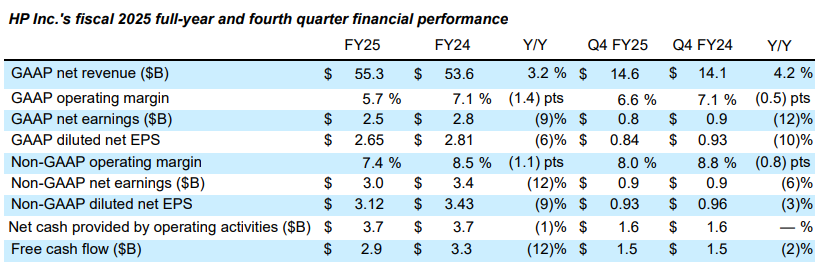
Core Viewpoint - HP Inc. reported a 4.2% increase in revenue for Q4 FY25, reaching $14.6 billion, slightly above analyst expectations of $14.5 billion. However, the company's earnings guidance for FY26 fell below market expectations, indicating challenges ahead due to rising costs and workforce reductions aimed at enhancing efficiency through AI tools [1][4]. Financial Performance - For FY25, HP's total revenue was $55.3 billion, a 3.2% increase from $53.6 billion in FY24. The Q4 revenue was $14.6 billion, up from $14.1 billion in Q4 FY24, reflecting a 4.2% year-over-year growth [2]. - The GAAP diluted net EPS for Q4 FY25 was $0.84, down 10% from $0.93 in Q4 FY24. The non-GAAP diluted net EPS for the same period was $0.93, a decrease of 3% from $0.96 [2]. - The operating margin for Q4 FY25 was 6.6%, down from 7.1% in Q4 FY24, indicating a decline in profitability [2]. Business Segments - The personal computer segment saw an 8% revenue increase to $10.35 billion, driven by customer upgrades to Windows 11 and interest in AI-enabled computers. Conversely, the printer segment's revenue declined by 4% to $4.27 billion, aligning with expectations [2]. Future Outlook - For FY26, HP expects adjusted earnings per share to be between $2.90 and $3.20, below the analyst consensus of $3.32. For Q1 FY26, the expected adjusted EPS is between $0.73 and $0.81, slightly below the analyst average of $0.78 [4]. - The company plans to implement cost-cutting measures that will result in annual savings of $1 billion by 2028, with a restructuring cost of approximately $650 million, of which $250 million will be incurred in FY26 [4]. Market Response - Following the earnings announcement, HP's stock fell approximately 5% in after-hours trading, contributing to a 25% decline in stock value for the year [7].

他靠巴掌大的打印机,征服欧美,年入18亿
创业家· 2025-11-11 10:15
Core Viewpoint - The article highlights the success story of 趣印科技 (Phomemo Technology), which transformed from a small startup into a leading player in the portable printer market, achieving significant revenue growth through innovative product development and strategic market positioning [8][42]. Group 1: Company Background and Initial Challenges - 趣印科技 was founded by 郭晋鹏 in 2013, initially focusing on the niche market of label ribbons, which was dominated by established companies like Brother and DYMO [19][18]. - The company faced significant challenges in its early years, including a lack of industry experience and financial difficulties, leading 郭晋鹏 to sell personal assets to sustain operations [22][44]. - By 2015, the company began to see revenue growth, surpassing 4 million RMB, as it navigated a competitive landscape marked by price wars [22][23]. Group 2: Strategic Decisions and Market Expansion - In 2015, the introduction of cross-border e-commerce policies allowed 趣印科技 to expand internationally, leveraging platforms like Amazon to reach global customers [26][25]. - The company transitioned from solely producing consumables to developing its own line of lightweight, portable printers, launching the "印先森M02" in 2018, which catered to specific user needs [32][28]. - By 2022, 趣印科技 became the global leader in the portable printer market, with a revenue increase from 4 million RMB to 1.8 billion RMB over a decade [44][42]. Group 3: Product Innovation and User Engagement - The company emphasized user feedback to drive product innovation, leading to the development of various applications for its printers, including DIY printing solutions [34][35]. - 趣印科技's app has attracted 5 million users globally, showcasing the importance of content in enhancing product value and user engagement [38][40]. - The strategic focus on content and user experience has allowed 趣印科技 to differentiate itself in a crowded market, creating a robust ecosystem of products and services [46][48]. Group 4: Future Outlook and Industry Impact - The company plans to continue its growth trajectory by investing in high-end printing technology and expanding its product offerings [51][52]. - 趣印科技's journey serves as a model for other Chinese enterprises, demonstrating the potential for innovation and market leadership through strategic focus and product excellence [53][54].

大湾区超级城市群加速崛起
2 1 Shi Ji Jing Ji Bao Dao· 2025-11-09 02:30
Core Insights - The article highlights the rapid development and integration of the Guangdong-Hong Kong-Macao Greater Bay Area (GBA) as a world-class city cluster, driven by significant infrastructure improvements and enhanced connectivity [1][5][10] Infrastructure Development - The opening of major infrastructure projects like the Shenzhen-Zhongshan Link and the Hong Kong-Zhuhai-Macao Bridge has drastically reduced travel times, enabling a "half-hour traffic circle" and a "one-hour living circle" within the GBA [1][5][7] - Daily cross-city commuting in the GBA exceeds 6 million trips, with highway traffic surpassing 8 million vehicle trips [1][5] Economic Growth - The GBA's economic output has surpassed 14 trillion yuan, with the "Shenzhen-Hong Kong-Guangzhou" innovation cluster ranking first globally [1][7] - The GBA is home to over 87 million people and boasts an economic scale of 14.79 trillion yuan, positioning it as a significant global urban agglomeration [7][10] Collaborative Innovation - The GBA is evolving towards a collaborative innovation model, integrating research, technology transfer, and industrial application, exemplified by companies like Nasda [10][14] - The region is fostering a network of innovation that leverages the unique strengths of Hong Kong, Shenzhen, and Guangzhou, particularly in emerging fields like AI and robotics [14][15] Soft Connectivity - Initiatives such as the "smart customs" measures at the Hengqin Port reflect the ongoing efforts to enhance "soft connectivity" among the GBA cities, facilitating smoother cross-border interactions [10][12] - The successful hosting of the 15th National Games across multiple cities demonstrates the GBA's ability to coordinate large-scale events and promote regional integration [10][12]


大湾区超级城市群加速崛起
21世纪经济报道· 2025-11-09 02:22
Core Viewpoint - The article highlights the rapid development and integration of the Guangdong-Hong Kong-Macau Greater Bay Area (GBA), emphasizing the transformation of transportation infrastructure and its impact on urban connectivity and economic collaboration [1][5][7]. Group 1: Infrastructure Development - The opening of the Shenzhen-Zhongshan Link has significantly reduced commuting time from two hours to thirty minutes, facilitating daily cross-city work and life for many residents [1]. - The GBA has seen a surge in traffic, with over 8 million vehicle trips on highways and more than 6 million daily cross-city commutes, reflecting the area's deepening integration [1][5]. - Major infrastructure projects, including the Hong Kong-Zhuhai-Macao Bridge and the Guangzhou-Shenzhen-Hong Kong Express Rail Link, have established a "half-hour traffic circle" and an "hour-long living circle," enhancing connectivity among the 11 cities in the GBA [5][7]. Group 2: Economic Collaboration - The GBA's economic output has surpassed 14 trillion yuan, with the "Shenzhen-Hong Kong-Guangzhou" innovation cluster ranking first globally, positioning the GBA as a key player in international urban competitiveness [1][7]. - The integration of transportation infrastructure has transformed Zhongshan into a "super interface" for the west bank of the Pearl River, enhancing its role in regional economic collaboration [7]. - The GBA is evolving into a world-class super city cluster, with over 87 million residents and an economic scale of 14.79 trillion yuan, fostering collaborative development among major metropolitan areas [7]. Group 3: Innovation and Talent Exchange - The GBA is witnessing a shift towards an innovation-driven economy, with a focus on creating a full chain from basic research to industrial application, exemplified by companies like Nasda [9][12]. - The region's collaborative innovation network allows for efficient problem-solving in research and development, with over 70% of Nasda's supply chain sourced from the GBA [12]. - The GBA's unique characteristics and complementary advantages among its cities are expected to enhance its overall competitive edge, particularly in emerging fields like AI and robotics [12].

【机构调研记录】睿远基金调研中际旭创、纳思达
Sou Hu Cai Jing· 2025-11-03 00:19
Group 1: Company Research - Ruifeng Fund's Investigation - Ruifeng Fund recently conducted research on two listed companies, Zhongji Xuchuang and Nasda, highlighting their performance and strategic developments [1][2] - Zhongji Xuchuang reported a significant revenue of 10.216 billion yuan for Q3 2025, with a gross margin of 43% and a net profit of 3.137 billion yuan, indicating substantial growth [1] - The company is experiencing increased shipments of 800G products and has begun deploying 1.6T products, with expectations for large-scale production in 2026-2027 [1] - Nasda is responding to new regulations emphasizing the importance of printer security, which may affect user purchasing decisions due to concerns over data leakage [2] Group 2: Financial Performance and Market Position - Ruifeng Fund's total asset management scale is 73.335 billion yuan, ranking 75th out of 211 in the public fund category [2] - The fund's best-performing product in the past year is Ruifeng Growth Value Mixed A, with a net value of 1.9 and a growth rate of 57.52% [2] - The fund manages a total of 10 public funds, ranking 153rd out of 211 [2]
纳思达20251030
2025-10-30 15:21
Summary of Conference Call Notes Company and Industry Overview - The company discussed its performance in the printing and integrated circuit sectors, particularly focusing on the impact of recent regulatory changes and market conditions on its operations and future strategies [2][16]. Key Points and Arguments 1. **Financial Performance**: - In the first three quarters of 2025, the company reported a net profit loss of approximately 516 million yuan due to the sale of Lexmark, resulting in a negative net profit of 356 million yuan [2][3]. - The asset-liability ratio significantly decreased from 72% to 44% post-sale, indicating an optimization of the financial structure [2][3]. 2. **Bentu Business Decline**: - The Bentu business experienced a substantial decline in Q3 2025, with net profit dropping to 62 million yuan, primarily due to the new security assessment requirements that reduced shipment volumes from 230,000 units in Q2 to 60,000 units in Q3 [2][4][5]. - The new security assessment results are expected to be announced in early 2026, which may create new market opportunities for domestic printers [2][6]. 3. **Market Opportunities**: - The "Electronic Information Manufacturing Industry Stabilization Action Plan" supports the use of domestic printers and copiers, which is favorable for the company's growth [2][6]. - The company aims to increase its overseas market share, targeting nearly half of its total revenue from international operations [2][8][10]. 4. **Jihae Company Performance**: - Jihae's performance in 2025 did not meet expectations due to challenges in the printer-related chip business and unfavorable pricing for non-consumable chips [2][12]. - New products in the MCU, industrial motor, and DSP sectors have been launched but have made limited contributions [2][12][13]. 5. **Strategic Focus**: - The company is strategically positioned in the high-end industrial control and automotive electronics markets, which are seen as blue ocean markets with significant growth potential [2][16]. - The domestic printer market has a low penetration rate, with only 10% market share in China and 1.7% globally, indicating substantial room for growth [2][17]. 6. **Challenges and Adjustments**: - The company is undergoing significant reforms to improve net profit and cash flow, particularly in the general consumables business, which has not yet achieved profitability despite annual revenues of 5-6 billion yuan [2][15]. - Jihae has restructured its divisions and sales management team to enhance inventory management and sales efficiency, with expected improvements in Q1 2026 [2][14]. 7. **Regulatory Impact**: - The addition of GPU and printer main control chips to the security assessment list reflects increased governmental focus on information security, which may intensify competition among manufacturers [2][19]. 8. **Future Outlook**: - The company remains optimistic about the recovery of the information technology application innovation (ITAI) sector, with recent sales data indicating positive trends [2][20]. - The company plans to continue focusing on its core business areas and believes it has the foundation and capital to recover from current challenges [2][21]. 9. **Investor Communication**: - The company is committed to transparency with investors and will disclose relevant information as conditions allow, emphasizing the importance of team adjustments to meet business objectives [2][22].
2025年1-8月中国复印和胶版印制设备产量为122万台 累计下降10.9%
Chan Ye Xin Xi Wang· 2025-10-24 03:22
Core Insights - The production of photocopying and offset printing equipment in China has seen a significant decline in 2025, with August figures showing a year-on-year decrease of 10.5% [1] - Cumulatively, from January to August 2025, the total production of such equipment reached 1.22 million units, marking a 10.9% decline compared to the previous year [1] Group 1 - In August 2025, the production of photocopying and offset printing equipment in China was recorded at 145,000 units [1] - The cumulative production from January to August 2025 was 1.22 million units [1] - The decline in production rates indicates a potential downturn in the industry [1]
