外贸

Search documents
政治局会议再提“帮助外贸企业”,还有这些举措
Di Yi Cai Jing· 2025-07-30 07:59
供应链"出口转内销"的另一端,须进一步激活内需市场 中共中央政治局7月30日召开会议,分析研究当前经济形势,部署下半年经济工作。面对激烈的国际竞 争,会议强调,要扩大高水平对外开放,稳住外贸外资基本盘。帮助受冲击较大的外贸企业,强化融资 支持,促进内外贸一体化发展。优化出口退税政策,高水平建设自贸试验区等开放平台。 这是3个月前中央政治局召开会议特别提出"加快推动内外贸一体化"以来,再次部署"促进内外贸一体化 发展",也明确要"帮助受冲击较大的外贸企业"。 中国国际经济交流中心资深专家委员朱民此前提出,在贸易战的情况下,外贸企业必然会受到影响,企 业平均的边际利润约15%,要消化高关税并不容易。这意味着外贸企业要有很大的调整,削减成本、多 元化出口方向、改进技术,相应的结构调整不仅面临困难而且还需要时间。 近年来多地都在为外贸企业"出口转内销"提供便利和服务,并帮助开拓多元化市场。此次会议同时指 出,用好各项结构性货币政策工具,加力支持科技创新、提振消费、小微企业、稳定外贸等。 供应链"出口转内销"的另一端,须进一步激活内需市场。此次会议强调,要有效释放内需潜力。深入实 施提振消费专项行动,在扩大商品消费的同 ...
中共中央政治局:增强国内资本市场吸引力和包容性,巩固资本市场回稳向好势头
Feng Huang Wang· 2025-07-30 06:16
中共中央政治局7月30日召开会议,会议指出,要持续防范化解重点领域风险。落实好中央城市工作会 议精神,高质量开展城市更新。积极稳妥化解地方政府债务风险,严禁新增隐性债务,有力有序有效推 进地方融资平台出清。增强国内资本市场的吸引力和包容性,巩固资本市场回稳向好势头。 要扩大高水平对外开放 稳住外贸外资基本盘 宏观政策要持续发力、适时加力 会议指出,宏观政策要持续发力、适时加力。要落实落细更加积极的财政政策和适度宽松的货币政策, 充分释放政策效应。加快政府债券发行使用,提高资金使用效率。兜牢基层"三保"底线。货币政策要保 持流动性充裕,促进社会综合融资成本下行。用好各项结构性货币政策工具,加力支持科技创新、提振 消费、小微企业、稳定外贸等。支持经济大省发挥挑大梁作用。强化宏观政策取向一致性。 依法依规治理企业无序竞争 推进重点行业产能治理 会议指出,要持续防范化解重点领域风险。落实好中央城市工作会议精神,高质量开展城市更新。积极 稳妥化解地方政府债务风险,严禁新增隐性债务,有力有序有效推进地方融资平台出清。增强国内资本 市场的吸引力和包容性,巩固资本市场回稳向好势头。 会议强调,要扩大高水平对外开放,稳住外贸外 ...
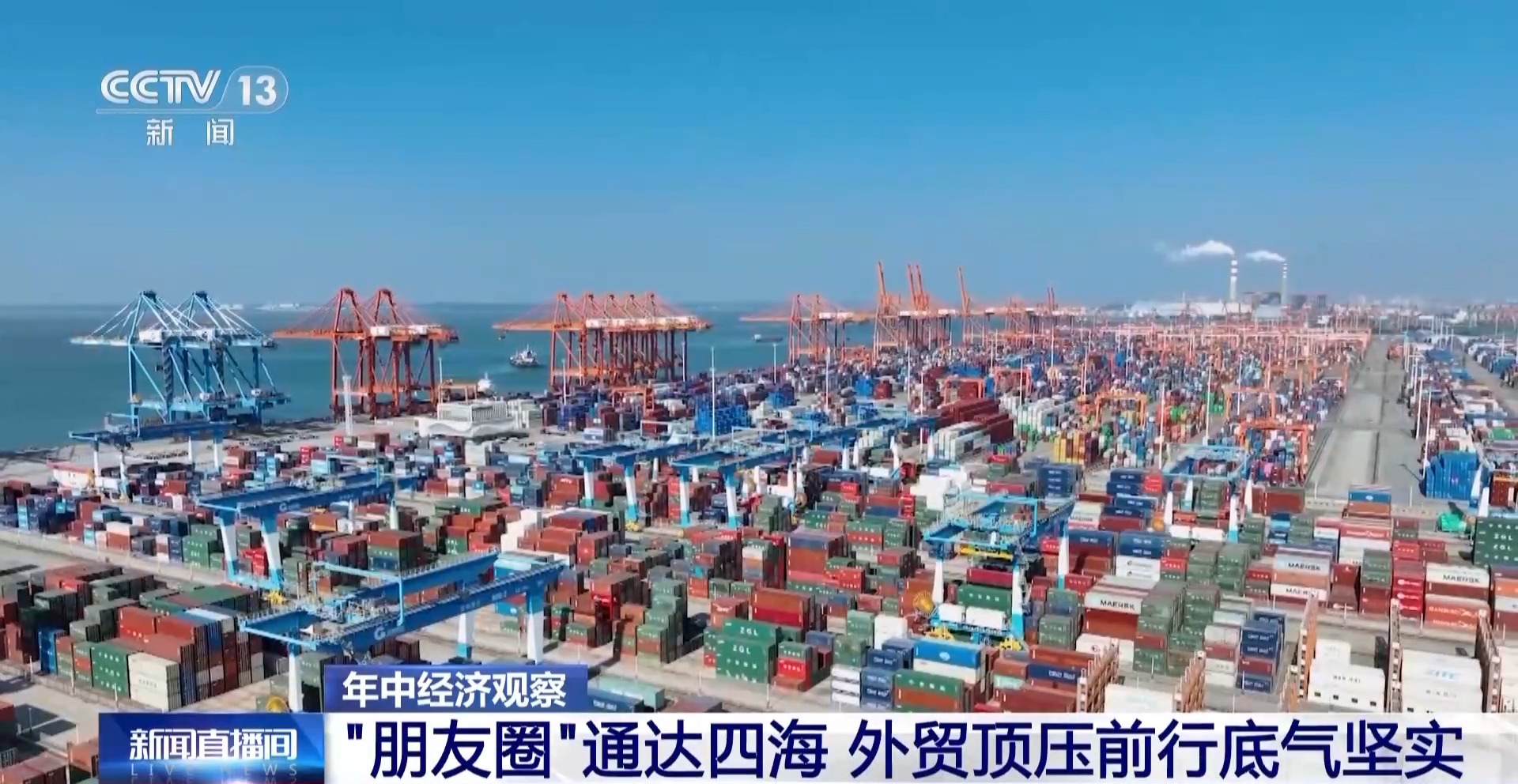
我国外贸交出亮眼答卷,实现“三个首次”背后有哪些因素在支撑?
Yang Shi Wang· 2025-07-30 03:33
Core Insights - China's foreign trade achieved remarkable results in the first half of the year, with three historical milestones: exports exceeding 13 trillion yuan, over 600,000 enterprises engaged in import and export activities, and private enterprises' import and export scale surpassing 12 trillion yuan for the first time [1][6]. Group 1: Trade Growth and Infrastructure - Major ports in China, including Shanghai, Ningbo-Zhoushan, and Qingdao, added over 72 new shipping routes and more than 19 new destination ports in the first half of the year [3]. - The Western Land-Sea New Corridor has seen significant developments, including the successful operation of "railway container connections to roll-on/roll-off ships" and the regular operation of freight trains between China, Laos, and Thailand [5]. Group 2: Contribution of Private Enterprises - Private enterprises accounted for 57.3% of China's foreign trade in the first half of the year, with their import and export scale surpassing 12 trillion yuan, growing at a rate 4.4 percentage points higher than the national average [6][8]. - High-tech products from private enterprises have seen a 12.5% increase in exports, showcasing their adaptability and resilience in the international market [8]. Group 3: Policy and Innovation - Institutional innovations have played a crucial role in expanding market opportunities for foreign trade enterprises, including the establishment of cross-border e-commerce pilot zones and optimized port layouts [9]. - The successful export of bio-jet fuel, derived from previously undesirable waste oil, highlights the potential for green products in international markets, supported by new regulatory frameworks [9][11].

上半年出口增23%,非洲成今年我国外贸“最热”市场之一
第一财经· 2025-07-27 09:56
Core Viewpoint - The article highlights the increasing focus of Chinese small and medium-sized foreign trade enterprises on the African market as a response to declining orders from the U.S. market, with a goal to increase sales in Africa to 20% by the end of 2025 [1][3]. Group 1: Market Trends - In the first half of the year, China's imports and exports to Africa grew by 14.4%, with exports increasing by 23.0% and imports by 2.3% [1]. - Africa has become one of the fastest-growing regions for Chinese exports, surpassing growth rates in the EU, Southeast Asia, Latin America, and other regions [1]. - Yiwu's total import and export value increased by 25.0% in the first half of the year, with exports growing by 24.6% and imports by 28.3% [5]. Group 2: Business Strategies - Companies are adapting their products to meet local demands in Africa, such as modifying a 20-liter water bucket to suit West African consumers, resulting in a 10% price increase and a 30% rise in sales [4]. - There is a push for deeper collaboration with local distributors in countries like Nigeria, South Africa, and Kenya to develop products that cater to African consumer needs [4]. Group 3: Digital Transformation - The B2B foreign trade financial platform XTransfer has seen exponential growth in its services for African markets, indicating a shift towards digital payment solutions [7]. - Local payment services provided by XTransfer have helped mitigate risks associated with currency shortages and payment delays in countries with strict foreign exchange controls [8]. Group 4: Company Performance - Yiwu Small Commodity City (60041) expects a net profit of 1.63 billion to 1.7 billion yuan for the first half of 2025, reflecting a year-on-year increase of 12.57% to 17.4% [9].

上半年出口增23%,非洲成今年我国外贸“最热”市场之一
Di Yi Cai Jing· 2025-07-27 04:45
Group 1 - Africa has become the fastest-growing regional market for Chinese exports, surpassing the EU, Southeast Asia, and Latin America in growth rates [1][2] - In the first half of the year, China's imports and exports to Africa increased by 14.4%, with exports growing by 23.0% and imports by 2.3% [1][5] - The goal is to increase the sales proportion in the African market to 20% by the end of 2025, providing a viable alternative to the declining U.S. market [1][2] Group 2 - Chinese small and medium-sized foreign trade enterprises are increasingly focusing on the African market due to its population dividend, consumption upgrades, and digital opportunities [2][3] - The demand for affordable Chinese products in Africa is rising, particularly in sectors like electric vehicles, engineering machinery, clothing, cosmetics, and daily necessities [2][3] - Companies are adapting their products to meet local preferences, such as modifying a 20-liter water bucket to suit West African consumers, resulting in a 30% increase in sales despite a 3% cost increase [3][4] Group 3 - The total import and export value of Yiwu in the first half of the year increased by 25.0%, with exports growing by 24.6% and imports by 28.3% [4][5] - Yiwu's trade with Africa reached 71.95 billion yuan, making it the largest market, followed by Latin America, ASEAN, and the EU [4][5] Group 4 - Digital payment platforms like XTransfer are experiencing exponential growth in business volume due to the increasing demand for local payment services in Africa [6][7] - The platform's local payment services cover several African countries, facilitating transactions and mitigating risks associated with currency shortages [6][7] - The shift from traditional markets to emerging African markets is accompanied by a transition from cash transactions to digital payments, enhancing resilience against external risks [7] Group 5 - Yiwu Small Commodity City expects a net profit of 1.63 billion to 1.7 billion yuan for the first half of 2025, representing an increase of 12.57% to 17.4% compared to the previous year [7] - The growth in profit is attributed to the continued increase in main business revenue and the enhancement of trade fulfillment services [7]
金十图示:2025年07月26日(周六)新闻联播今日要点
news flash· 2025-07-26 12:32
Group 1 - The western region of China achieved a record high in import and export scale, with a total value of 2.12 trillion yuan in the first half of the year, representing a year-on-year growth of 10.4% [4] - The civil aviation industry in China reached new heights in the first half of the year, completing a total transportation turnover of 783.5 billion ton-kilometers, with passenger transport volume at 370 million and cargo mail transport volume at 4.784 million tons, showing year-on-year growth of 11.4%, 6%, and 14.6% respectively [5] - The third batch of 690 billion yuan in special long-term bonds has been allocated to support the old-for-new consumption policy, with plans for a fourth batch of the same amount to be issued in October [6] Group 2 - China's largest coalbed methane production capacity has surpassed 2.5 billion cubic meters annually, with the Daqi gas field having newly drilled 37 wells this year and a proven geological reserve of 300 billion cubic meters [8]

省商务厅解读《海南自由贸易港执行例外措施进口货物的监管办法(试行)》
Hai Nan Ri Bao· 2025-07-26 02:14
Core Viewpoint - The implementation of the "Regulatory Measures for Import Goods under Exception Measures in Hainan Free Trade Port" aims to enhance regulatory requirements and leverage policy advantages to promote the development of new foreign trade formats [1] Group 1: Regulatory Framework - The "Prohibited and Restricted Import and Export Goods List" has been officially released and will take effect from the date of the Hainan Free Trade Port's closure operation [1] - The "Regulatory Measures" clarify the regulatory requirements and procedures for two categories of goods that are relaxed under the "Prohibited and Restricted List" [1][2] Group 2: Management of Import Goods - The import goods under exception measures are categorized into those exempt from import license management and those allowed for "two-way" bonded maintenance [2] - Goods exempt from import license management are limited to final users for self-use in Hainan Free Trade Port and cannot be circulated or resold within the island [2] - Current import license management includes 119 items, with 45 being ozone-depleting substances and 74 being old electromechanical products [2] Group 3: Bonded Maintenance Business - The "Regulatory Measures" outline the requirements for bonded maintenance business, including applicable subjects, project declaration processes, and conditions for suspension and termination [3] - The state has increased support for bonded maintenance business in Hainan, making its policies more favorable than those in other regions [3] - Eligible enterprises can conduct bonded maintenance for both the comprehensive bonded zone product catalog and the exception measures of the "Prohibited and Restricted List," which is expected to significantly promote the development of new foreign trade formats [3]
上海12.85万亿贷款余额创新高!个人住房贷款需求明显回升,外资净流入境内股票
Sou Hu Cai Jing· 2025-07-25 01:20
Core Insights - The Shanghai financial market shows positive changes with a significant rebound in personal housing loan demand and a warming trend in foreign investment in domestic stocks [1][4]. Group 1: Personal Housing Loans - The balance of household loans increased by 13.7% year-on-year, with the growth rate improving by 8.1 percentage points compared to the same period last year, indicating a recovery in the real estate market [3]. - By the end of June, the total balance of loans in Shanghai reached 12.85 trillion yuan, growing by 8.4% year-on-year, surpassing the national average growth rate by 1.6 percentage points [1][3]. - The weighted average interest rate for newly issued corporate loans in June was 2.74%, down 49 basis points from the previous year, while the rate for small and micro enterprises was 3%, down 56 basis points, effectively reducing financing burdens [3]. Group 2: Foreign Investment - Foreign investment in domestic stocks has notably rebounded, shifting from net outflows in the same period last year to net inflows this year, with increased buying activity since May [4]. - The total foreign exchange income and expenditure reached 2.77 trillion USD in the first half of the year, with a year-on-year growth of 19% [4]. - The cross-border RMB settlement volume grew to 16.2 trillion yuan, a 15% increase year-on-year, maintaining a 46.5% share of the national total, the highest in the country [4].

外贸大市 “半年报”:深圳领跑,东莞、金华成“增速黑马”
2 1 Shi Ji Jing Ji Bao Dao· 2025-07-24 10:47
Core Viewpoint - The foreign trade performance of major cities in China showed significant growth in the first half of the year, driven by effective export strategies and an optimized product structure, particularly in high-tech exports [1][2][9]. Group 1: Import and Export Data - Shenzhen's total import and export value reached 2.17 trillion yuan, accounting for 9.9% of the national total, maintaining its position as the "foreign trade capital" [2]. - Guangzhou's total import and export value was 605.05 billion yuan, marking a 15.5% year-on-year increase and the first time surpassing 600 billion yuan [3]. - Dongguan's import and export value reached 749.28 billion yuan, with a year-on-year growth of 16.5%, reclaiming its position as the "fifth largest foreign trade city" [3][4]. Group 2: Growth Drivers - The growth in foreign trade is attributed to two main factors: the "export grabbing" strategy adopted by companies and the resilience of diverse international markets [1][2]. - High-value-added products are driving export growth, with high-tech product exports showing rapid increases across various cities [8][9]. Group 3: Market Diversification - Cities like Dongguan have seen significant growth in exports to emerging markets, with increases of 43.5% to ASEAN and 21.5% to India [10]. - Kinhua's diversified market strategy led to a 20.1% year-on-year growth in total trade, with exports to the US, EU, and ASEAN markets increasing significantly [5][11]. Group 4: Structural Changes in Exports - The export structure is shifting from traditional low-value products to high-tech and high-value products, indicating a transformation in China's manufacturing capabilities [9]. - Notable increases in exports of high-tech products were reported, such as a 3.9-fold increase in surgical robot exports from Shanghai [8].
出口增长7.2%≠你的增长?小渔夫研判品牌出海两大发力点
Zhong Guo Chan Ye Jing Ji Xin Xi Wang· 2025-07-24 09:03
Core Viewpoint - Global trade is experiencing a duality of challenges and opportunities, with the World Trade Organization warning of deteriorating economic prospects due to tariff increases and trade policy uncertainties. However, there are reverse opportunities for Chinese foreign trade enterprises, particularly in the context of the Belt and Road Initiative, where demand for high-end manufacturing and green technology is surging despite fluctuations in the European and American markets [1]. Group 1: Export Growth - In the first half of 2025, China's total goods trade reached 21.79 trillion yuan, a year-on-year increase of 2.9%, with exports hitting 13 trillion yuan, up 7.2%, marking a historical high for the same period [4]. - The resilience of China's foreign trade is attributed to two key transformations: structural transformation of exports and diversification of export markets [5]. Group 2: Structural Transformation - The first transformation involves a shift from "manufacturing" to "intelligent manufacturing." In the first half of the year, exports of electromechanical products reached 7.8 trillion yuan, growing by 9.5% and accounting for 60% of total exports, indicating a significant transition from labor-intensive industries to high-tech manufacturing [6]. - The second transformation is the diversification of export destinations. The share of exports to the U.S. has decreased by 2.8% compared to the end of 2024, while trade with Belt and Road countries reached 11.29 trillion yuan, making up 51.8% of total trade. This reflects China's proactive adjustment to global geopolitical changes and a trend towards a resilient structure supported by multiple markets [7]. Group 3: Challenges and Opportunities - The path forward for foreign trade is fraught with challenges, including increased tariff barriers, heightened geopolitical risks affecting shipping costs, and an evolving competitive landscape shifting from price wars to brand and technology battles [10]. - Conversely, there are emerging opportunities driven by the Belt and Road Initiative, which is creating demand in infrastructure, energy, and digital economy sectors, providing a "blue ocean market" for Chinese enterprises. Additionally, the global recognition of "Chinese intelligent manufacturing" is rising, facilitating easier market entry for companies leveraging technology and branding [11]. Group 4: Strategic Transformation Leaders - Companies like Xiaoyufisher are positioned as leaders in strategic transformation for foreign trade enterprises. They offer comprehensive solutions that align with the needs of "intelligent manufacturing upgrades" and "diversified markets." Their dual approach of AI-driven SaaS marketing platforms and strategic positioning has proven effective, helping numerous foreign trade companies secure orders and establish their brands overseas [12]. - Successful case studies include assisting a partition company in securing a million-dollar project in Uganda and facilitating over 2 million yuan in orders for a mechanical parts company in Russia, showcasing the effectiveness of their "technology + strategy" dual-driven model [14].