Securities

Search documents
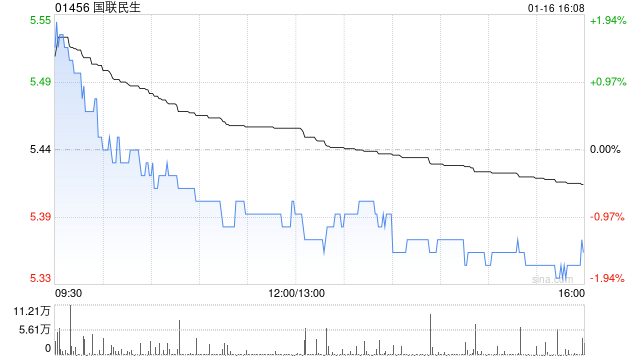
国联民生发盈喜 预期2025年度实现归母净利润20.08亿元同比增加406%左右
Xin Lang Cai Jing· 2026-01-18 23:47
Core Viewpoint - Guolian Minsheng (01456) expects a significant increase in net profit for the fiscal year 2025, projecting a net profit of RMB 2.008 billion, which represents a year-on-year increase of RMB 1.611 billion, or approximately 406% [1][5]. Financial Performance - The company anticipates a net profit attributable to the parent company, excluding non-recurring gains and losses, of RMB 1.944 billion for 2025, reflecting an increase of RMB 1.563 billion compared to the previous year, or about 410% [1][5]. Business Developments - During the reporting period, the company successfully acquired control of Minsheng Securities through the issuance of A-shares, and is efficiently integrating its existing business with that of Minsheng Securities, which has been included in the consolidated financial statements [1][5]. - The company is actively seizing market opportunities and exploring deep integration of technology, finance, and industry, focusing on "synergistic empowerment" and "internal growth" to enhance its comprehensive financial service capabilities [1][5]. - Significant growth has been observed in the business lines of securities investment, brokerage, and wealth management, largely due to a low comparative base from the previous year [1][5].


平安基金管理有限公司关于旗下基金新增东方证券股份有限公司为销售机构的公告
Shang Hai Zheng Quan Bao· 2026-01-18 18:45
Core Viewpoint - The announcement details the addition of several sales institutions for various funds managed by Ping An Fund Management Co., Ltd., effective from January 19, 2026, allowing investors to perform various transactions through these institutions [1][8][16][23][26]. Group 1: Sales Institutions - Ping An Fund Management Co., Ltd. has signed sales agreements with Dongfang Securities Co., Ltd., Xibu Securities Co., Ltd., Founder Securities Co., Ltd., Guojin Securities Co., Ltd., and Huaxi Securities Co., Ltd. to act as sales agents for its funds starting January 19, 2026 [1][8][16][23][26]. - Investors will be able to open accounts, subscribe, redeem, invest regularly, and convert funds through these institutions from the specified date [2][9][17][27]. Group 2: Fee Discounts - Investors who subscribe or regularly invest through these sales institutions will enjoy fee discounts, with the specifics of the discount determined by the sales institutions [4][11][18][28]. - The company does not impose restrictions on the discount limits for subscription fees, regular investment fees, and conversion fees, which will be managed based on the sales institutions' provided discount rates [4][11][18][28]. Group 3: Important Notes - Regular investment is a method of fund subscription where investors can set up automatic deductions for fund purchases, with minimum deduction amounts specified in the fund's prospectus [5][12][19][29]. - Fund conversion allows investors to exchange their holdings in one fund for shares in another fund managed by the same management company, subject to the rules outlined in the fund contract [5][12][19][29]. Group 4: Contact Information - Investors can consult details through the respective sales institutions, including customer service numbers and websites for Dongfang Securities, Xibu Securities, Founder Securities, Guojin Securities, and Huaxi Securities [7][14][21][24][31].



研选 | 光大研究每周重点报告 20260103-20260109
光大证券研究· 2026-01-18 12:03
Group 1: Macro Research - The optimal model predicts that the ten-year government bond yield will decrease by approximately 3 basis points from the end of January 2026 to the end of February 2026, and by about 6 basis points from the end of 2025 to the end of 2026 [4]. Group 2: Wealth Management Outlook - In 2025, the total market wealth management scale is estimated to grow by around 3.5 trillion to approximately 33-34 trillion, driven by factors such as deposit disintermediation, valuation adjustments, and enhanced returns from rights expansion [6]. - The report analyzes potential changes in the operational logic of wealth management businesses for 2026 through nine key questions across five dimensions [6].

信用债市场周度回顾260117:摊余债基再迎集中开放期,把握3-5Y配置良机-20260118
GUOTAI HAITONG SECURITIES· 2026-01-18 07:26
Group 1 - The report emphasizes the importance of focusing on coupon rates and suggests taking advantage of the 3-5 year credit bond allocation opportunities during the concentrated opening period of amortized cost method bond funds [6][7] - The credit bond market is characterized by strong buying power despite a short-term contraction in liquidity, with a notable shift in demand from short-term to medium and long-term bonds [6][9] - The report indicates that the market will benefit from multiple supportive factors, including accelerated credit issuance by banks and the upcoming concentrated opening period for amortized cost method bond funds, which is expected to provide sustained buying support for medium to long-term credit bonds [7][9] Group 2 - In the primary market, net financing decreased to 49.04 billion yuan, with a total issuance of 278.6 billion yuan and maturities of 229.57 billion yuan during the week of January 12-16, 2026 [9][10] - The secondary market saw an increase in trading volume, with total transactions reaching 861.775 billion yuan, up by 65.925 billion yuan from the previous week, and a general decline in medium-term note yields [9][12] - The report highlights that AAA-rated issuers accounted for the largest share of new issuances, with construction sector issuers being the most prominent [9][10]

Some Budgets that became blueprints for institutional change
The Times Of India· 2026-01-17 16:00
Core Insights - The article discusses the evolution of India's Union Budgets over the decades, highlighting key reforms and their impacts on the economy and governance [21][20]. Group 1: Historical Budget Reforms - Pranab Mukherjee's 1983-84 budget introduced performance-based grants to states, allocating Rs 300 crore based on program implementation rather than population [3][21]. - V.P. Singh's 1985-86 budget raised the personal income tax exemption limit from Rs 15,000 to Rs 18,000, removing around 1 million taxpayers from the tax net [5][21]. - Rajiv Gandhi's 1987-88 budget significantly increased education spending from Rs 352 crore to Rs 800 crore, leading to the establishment of the Securities and Exchange Board of India [6][21]. Group 2: Liberalization and Structural Changes - Manmohan Singh's 1991-92 budget marked a shift towards Liberalization, Privatization, and Globalization (LPG) in response to a balance of payments crisis, with fiscal deficit exceeding 8% of GDP [7][21]. - P. Chidambaram's 1996-97 budget focused on long-term infrastructure financing, establishing the IDFC to support infrastructure projects [10][21]. - The 1997-98 budget, known as the "dream budget," introduced significant tax reforms, lowering personal income tax rates and recognizing the importance of information technology [11][21]. Group 3: Recent Developments and Future Directions - Arun Jaitley's 2017-18 budget introduced the Goods and Services Tax (GST), unifying 17 central and state indirect taxes under a federal framework [16][17]. - Nirmala Sitharaman's 2020-21 budget emphasized infrastructure development through the National Infrastructure Pipeline and proposed a restructuring of the personal income tax regime [18][21]. - The 2025-26 budget proposed the Jan Vishwas Bill 2.0 to decriminalize certain provisions, aiming to reduce compliance burdens and improve the ease of doing business [19][21].
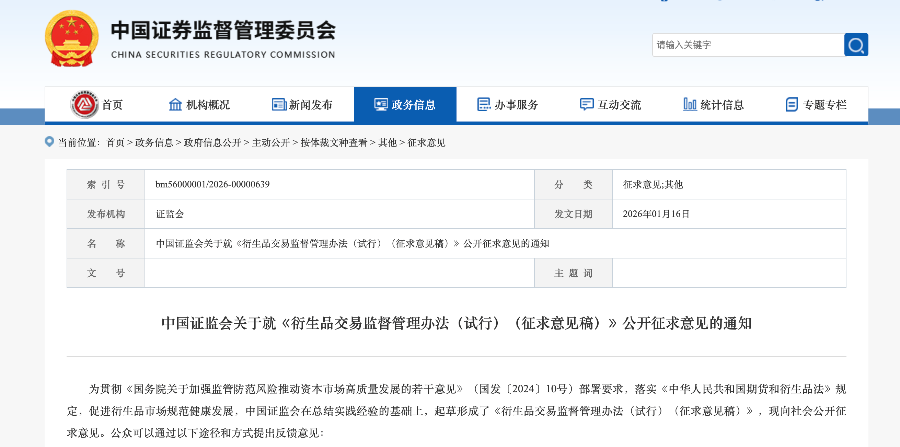
证监会就衍生品新规征求意见 穿透监管、隔离风险、明晰边界
2 1 Shi Ji Jing Ji Bao Dao· 2026-01-17 14:21
Core Viewpoint - The China Securities Regulatory Commission (CSRC) has released a draft for public consultation on the "Supervision and Administration Measures for Derivative Trading (Trial) (Draft for Comments)", aiming to establish a more comprehensive and operable regulatory framework for the rapidly developing derivatives market [1] Group 1: Key Regulatory Changes - The revised regulations address core concerns in the derivatives business, emphasizing effective separation of derivative trading from proprietary and other business operations to prevent conflicts of interest [3] - The new rules prohibit the lending or disguised lending of derivative trading qualifications, closing loopholes in "channel business" [4] Group 2: Risk Management and Compliance - A new cross-market position aggregation and penetration supervision mechanism has been established, allowing futures exchanges to aggregate positions held directly and indirectly by traders in similar derivative contracts [6] - The regulations encourage the use of derivatives for risk management by the real economy while setting clear boundaries, particularly regarding the complexity of products [8] Group 3: Implications for Market Participants - The new rules require companies to establish robust internal control and risk management systems, ensuring compliance with strict internal decision-making processes and information disclosure [8] - The draft aims to create a more standardized, transparent, and resilient derivatives market, responding to market expectations while reinforcing systemic risk prevention [9]
去年经济总量预计突破6000亿元,深圳福田发展动力何来?
Nan Fang Du Shi Bao· 2026-01-17 01:49
Core Insights - The economic output of Futian District in Shenzhen is expected to exceed 600 billion yuan by 2025, leading the city's growth rate [1] - The district is advancing a "CBD + Innovation Zone" strategic transformation, supported by "hard technology + hard finance" to drive high-quality development [1] Financial Sector Developments - Futian District is implementing eight major actions to strengthen its financial sector, aiming for the highest total value and growth rate in the city by 2025 [3] - In the past year, 12 new licensed financial institutions were introduced, bringing the total to over 300, with 132 new financial institutions established, marking a six-year high [3] - The district has seen five national firsts and three national innovations in financial services, including projects in AI + finance and mergers and acquisitions [3] Technology Sector Advancements - The "hard technology" sector is rapidly emerging, with industrial output surpassing 300 billion yuan and a doubling of the artificial intelligence industry cluster's output [6] - Over 13,000 new technology service and software information service companies were registered, reaching a ten-year high, with a doubling of new robotics companies and three new unicorns [6] - The density of concept verification centers and small trial bases is the highest in the city, with two companies selected for the Ministry of Industry and Information Technology's first batch of key cultivation platforms [6] Strategic Planning and Future Outlook - The district is set to enhance its licensed financial institution aggregation plan and strengthen three "trillion-level" financial headquarters clusters by 2026 [5] - During the 14th Five-Year Plan, Futian has implemented the first district-level long-term development plan for a modern industrial system, focusing on strategic adjustments in industrial structure [8] - New industrial clusters in new energy, smart terminals, and software information services have emerged, with significant growth in biomedicine and semiconductors [8]

浙商证券股份有限公司第四届董事会第四十次会议决议公告
Shang Hai Zheng Quan Bao· 2026-01-16 20:58
Core Points - The board of directors of Zheshang Securities held its 40th meeting on January 16, 2026, to discuss and approve several key resolutions [1][2][4]. Group 1: Board Decisions - The board elected Qian Wenhai as the representative director to execute company affairs, with a term lasting until the end of the current board's tenure [2]. - The election received unanimous approval with 9 votes in favor, and no votes against or abstentions [3]. - The board confirmed the members and convener of the fourth audit committee, consisting of Zeng Aimin, Shen Si, and Wang Jun, with Zeng Aimin serving as the convener [5]. Group 2: Meeting Details - The meeting was convened in compliance with the Company Law and the company's articles of association, with 9 directors present, including 5 in person and 4 via communication [1][11]. - The meeting was chaired by Qian Wenhai and utilized a combination of in-person and online voting methods, adhering to legal and regulatory requirements [11][12]. - The meeting's proceedings were witnessed by legal representatives from Beijing Jiayuan Law Firm, confirming the legality and validity of the voting process [15].

50万亿天量存款即将到期
21世纪经济报道· 2026-01-16 14:01
Core Viewpoint - The upcoming maturity of approximately 50 trillion yuan in fixed deposits by 2026 poses significant challenges for the banking sector in managing liabilities and may lead to a reallocation of household assets [3][4][5]. Group 1: Scale of Maturing Deposits - The maturity of fixed deposits is expected to reach around 50 trillion yuan in 2026, with a notable increase of about 10 trillion yuan from 2025 [4]. - The majority of this maturity will come from two- and three-year deposits, each exceeding 20 trillion yuan, while five-year deposits will be around 5-6 trillion yuan [4]. - Different research institutions estimate the total maturity of fixed deposits to be between 59 trillion and 75 trillion yuan, indicating a significant impact on the banking sector [5][6]. Group 2: Potential Directions for Maturing Funds - A substantial portion of the maturing funds is likely to remain within the banking system, as the deposit retention rate is high, around 96% [7]. - Consumers are expected to optimize their deposits by moving funds to banks offering higher interest rates, as seen in the case of a consumer moving funds from a state-owned bank to a city commercial bank [7]. - Consumer spending is projected to be a major outlet for these funds, with anticipated household consumption reaching 53 trillion yuan in 2025 [8]. Group 3: Investment Trends and Preferences - There is a growing trend towards reallocating funds into bank wealth management products, which are expected to see a net increase of approximately 3.7 trillion yuan in 2025 [8]. - Insurance products are also gaining popularity, particularly among high-net-worth individuals seeking long-term investment options [9]. - Some investors are diversifying their portfolios by allocating funds into bonds and stock-enhanced funds, indicating a shift in investment strategies [9]. Group 4: Market Dynamics and Bank Strategies - The banking sector is likely to face a re-pricing of a large volume of funds, with interest rates on large deposits declining significantly [16][17]. - The People's Bank of China has indicated potential for further interest rate cuts, which could help banks reduce their interest expenses and stabilize net interest margins [16]. - Banks are actively trying to optimize their liability structures by encouraging shorter-term deposits and promoting wealth management and insurance products [17][18].

6家企业集体遭警示
21世纪经济报道· 2026-01-16 13:56
Core Viewpoint - The article highlights the increasing regulatory scrutiny and penalties faced by companies in Dongguan, particularly ST Huilun, for financial misconduct and inadequate internal controls, indicating a broader trend of compliance issues among listed companies in the region [1][5]. Group 1: Regulatory Actions and Penalties - ST Huilun was fined 11.4 million due to concealing related party fund occupation and committing financial fraud for two consecutive years [1][4]. - ST Quanwei received a regulatory letter for related party fund occupation and internal control deficiencies, with a loan of 1.3 million from a related party identified as a significant issue [2][3]. - Guangdong TuoStar was issued a warning for inaccurate revenue recognition, including prematurely recognizing 7.9686 million in revenue, leading to inflated profits [3][5]. Group 2: Internal Control Issues - ST Huilun failed to disclose fund occupation matters, with a total fund occupation of 28.33 million, representing 5.12% of net assets, and inflated revenues by 25.49 million and 62.33 million in 2021 and 2022 respectively [4][5]. - Entropy Technology was warned for multiple financial disclosure violations, including inaccurate revenue recognition and insufficient bad debt provisions [3][5]. - Guangbo Laser faced regulatory measures for internal control deficiencies, including improper revenue recognition and failure to disclose related party transactions accurately [5][6]. Group 3: Broader Implications - The regulatory actions reflect a growing emphasis on compliance and the need for companies to enhance their governance and internal controls to protect investor interests [5][6]. - The penalties serve as a warning to other companies about the consequences of non-compliance, emphasizing the importance of accurate and reliable information disclosure [6].