
贵金属

Search documents
黄金直线拉升,美元急跌,白银飙升5%,美联储降息概率有变
21世纪经济报道· 2026-02-13 14:09
Group 1 - The core consumer price index (CPI) in the U.S. fell from 2.7% to 2.4% in January, marking the lowest level since May 2025, while the core CPI decreased from 2.6% to 2.5%, the lowest since March 2021, aligning with market expectations [1] - Following the CPI data release, the U.S. dollar index dropped below 97, and U.S. stock index futures experienced a mild rebound, with spot gold rising over 1% and silver increasing nearly 5% [1] - The two-year U.S. Treasury yield fell to around 3.4%, the lowest since October of the previous year, indicating a shift in market sentiment towards potential interest rate cuts by the Federal Reserve [1] Group 2 - Gold and silver have experienced significant fluctuations in the current precious metals market, with gold's year-to-date increase shrinking from 25% to 15%, while silver's rise has decreased from over 50% to around 7% [4] - The divergence in performance between gold and silver is attributed to their differing investment attributes, with gold being a prominent safe-haven asset and silver having a higher industrial demand component, leading to greater price volatility during market adjustments [4][5] - The gold-silver ratio, an important indicator of the relative strength of precious metals, has risen from below 50 at the beginning of the year to 65, suggesting increased market risk aversion and a preference for gold over silver [5]


2026年大宗商品展望
Guolian Minsheng Securities· 2026-02-13 08:59
Report Information - Report Title: 2026 Commodity Outlook - Research Team: Guolian Minsheng Securities Forward-looking Research Team - Report Date: February 13, 2026 [1] Investment Recommendations - Industrial metals: Due to the demand from the electric vehicle, energy storage, wind power, and photovoltaic sectors, and the long - term insufficient capital expenditure in copper mines and China's electrolytic aluminum production capacity approaching the limit, copper and aluminum are recommended for their potentially positive fundamentals [3]. - Minor metals: Benefiting from China's macro - regulation and supervision of strategic minerals and the supply being restricted by mining quotas, rare earths, antimony, and tungsten are recommended [3]. - Precious metals: With their defensive properties, the prices of silver and platinum are expected to enter an upward cycle, so they are recommended [3]. Core Views - The factors influencing commodity prices are divided into short - to - medium - term disturbances, cyclical factors, and trend/structural forces. Capital expenditure in the next 3 - 5 years will affect commodity supply and pricing [3]. Summary by Section 1. Commodity Price Drivers 1.1 Medium - to - Long - Term Influencing Factors: Capital Expenditure Cycle - Copper prices follow the marginal cost pricing principle, while oil prices do not fully conform. The oil price center may have a 5 - year cycle [12][14][15]. 1.2 Short - to - Medium - Term Disturbing Factors: Geopolitics and Supply - Side Restrictions - Commodity price fluctuations caused by geopolitics and supply - side restrictions usually correct within half a year to a year. The flexibility of US shale oil production can offset the impact of OPEC's production changes on oil prices to some extent, and OPEC+ production agreements affect oil prices within 6 months [23]. 1.3 Impact of Technological Progress - The impact of electric vehicle technology on oil demand is slower than on lithium carbonate demand. The new nickel production process has led to a large release of nickel ore capacity, and nickel prices have not outperformed inflation. US natural gas prices have underperformed inflation due to technological progress, and agricultural technological progress has significantly affected agricultural product prices [24][29][34][38]. 2. Traditional Energy: "Stable with Changes", Reshaping the Supply - Demand Structure 2.1 Oil Market - Global oil and gas upstream investment has been increasing since 2020, but it may not return to the high level of 2014 - 2015. OPEC's production recovery may be limited by remaining capacity. Trump's impact on US oil production may be limited. Global oil consumption is increasing, with China and India being the main contributors. The oil market may be in an oversupply situation in 2025 - 2026 [45][51][63][82][87]. 2.2 Natural Gas Market - Asian natural gas demand is stable, and China's dependence on imported LNG has weakened in 2025. US LNG project capacity is expected to grow rapidly, while Europe faces greater LNG import demand [91][98][104][112]. 2.3 Coal Market - Coal remains an important "ballast stone" in the power system. Global coal consumption growth is slowing, and supply is relatively stable. China's coal market is expected to operate stably under the policy of increasing supply and ensuring stable prices [120][126][132]. 3. Steel Industry: Weak Demand, Excess Capacity - Construction steel demand is in a low - growth state, and China's steel exports may be restricted by trade policies. Iron ore supply is expected to be loose, and the coking coal market supply - demand gap is narrowing, with prices fluctuating [134][139][149][159]. 4. Industrial Metals: Improving Supply - Demand Structure, Positive Fundamentals 4.1 Copper - Copper demand is facing a shift in growth drivers, with new energy sectors such as electric vehicles, wind power, and photovoltaics becoming important demand sources. However, copper exploration investment has been low, and the growth of ore - end resources has been suppressed. The slowdown of recycled copper smelting and the decline of processing fees may support copper prices [165][172][178][192]. 4.2 Aluminum - China's bauxite supply is tight, and imports account for a large proportion, with potential overseas supply disruptions. Global electrolytic aluminum production growth is slowing, and China's production is restricted by the capacity ceiling, which may support aluminum prices [199][208][219]. 4.3 Rare Earths - China's rare earth mining and smelting quota growth has slowed down, and the increase in overseas supply is limited [224]. 4.4 Antimony - The demand for antimony in the photovoltaic glass industry is expected to increase, but domestic antimony mine production growth is limited, and global supply is tightening [230][235]. 4.5 Tungsten - The downstream demand for tungsten is expected to improve with the recovery of the manufacturing industry. However, domestic tungsten mine production growth may slow down, while overseas supply may increase [240][246]. 5. Precious Metals: Entering an Upward Cycle - Silver and platinum - group metals may continue to be in a shortage situation. The industrial demand for silver, especially in the photovoltaic sector, is strong, while the demand for platinum and palladium in the automotive industry may decline due to the increase in electric vehicle penetration [252][257]. 6. Agricultural Products: Climate Change Challenges, Regional Market Differentiation 6.1 Soybeans - The global soybean supply - demand structure is expected to remain loose. China's soybean consumption may decline, the US renewable fuel production has decreased, and trade policies may affect the soybean trade pattern. North American and South American soybean production has different trends, and China's soybean import volume may decrease [264][269][273][278][294]. 6.2 Corn - Global corn supply is tightening, with inventory decreasing. China's corn consumption is growing steadily, the US corn production has decreased but exports have increased significantly, Brazil's corn production has different trends, and its domestic ethanol production restricts exports [299][300][309][315][320]. 6.3 Wheat - The global wheat market is in a tight - balance state. China and India's imports may increase, Russia and the EU's supply has decreased due to bad weather, while North America and Australia's wheat production has been positively affected by the weather. The supply of major exporting countries is tight, and prices are stabilizing [321][331][332][339][340].
山金国际股价下跌3.28%,弱于大盘及行业表现
Jing Ji Guan Cha Wang· 2026-02-13 08:30
Industry Policy and Environment - As of February 12, the spot gold price in New York fell by 3.26%, while silver experienced a decline of 10.89%. Analysts suggest that the drop in U.S. tech stocks prompted some investors to sell precious metals to cover liquidity, exacerbated by algorithmic trading, which collectively pressured international precious metal prices and negatively impacted the A-share gold sector [2]. Company Fundamentals - According to the Q3 2025 report, the gold production of Shanjin International decreased by 11% year-on-year in the first three quarters, with a quarter-on-quarter decline of 4% in Q3. Some institutions indicate that the drop in production has a marginal impact on profits. Despite the company's excellent cost control, the production shortfall may weaken investor confidence in short-term performance [3]. Capital and Technical Aspects - On February 13, Shanjin International experienced a net outflow of 291 million yuan in main funds, continuing a trend of net outflows over several days. Technical indicators show that the stock price is below the 20-day moving average, and the MACD histogram is in negative territory, indicating significant short-term pressure [4].

沪银库存告急且高位博弈持续
Jin Tou Wang· 2026-02-13 08:25
Group 1 - The core viewpoint of the article highlights the significant demand for silver in the market, driven by both physical investment and industrial needs, leading to a historical premium in silver contracts on the Shanghai Futures Exchange [3] - The recent surge in silver premiums is attributed to a supply crisis and depletion of deliverable materials, with analysts indicating that unless smelters increase production significantly during the upcoming holiday, the tightness in supply is likely to persist [3] - The current silver futures trading shows a slight upward trend, with prices fluctuating around 20,600.00 yuan per kilogram, indicating a bullish short-term outlook [1] Group 2 - The silver inventory at the Shanghai Futures Exchange has dropped to its lowest level in over a decade, exacerbating the scarcity of physical silver and leading to increased costs for industrial procurement [3] - There is a dual engine of demand: strong physical investment demand, particularly from the Shenzhen market, and concentrated industrial purchases for solar panel production, as manufacturers rush to complete orders before the April 1 export tax rebate deadline [3] - The trading volume on the Shanghai Futures Exchange has decreased to a four-year low, suggesting that investors are reducing positions ahead of the holiday, which may lead to lower volatility in the short term [3][4]
A股蛇年收官!创业板指大涨近60%强势领跑!这股5天暴涨140%!“春节AI竞赛”提前开幕!
雪球· 2026-02-13 08:07
Market Overview - The three major indices collectively declined on the last trading day of the lunar year, with the Shanghai Composite Index falling by 1.26% to below 4100 points, the Shenzhen Component Index down by 1.28%, and the ChiNext Index down by 1.57% [3] - However, for the entire year, major indices saw significant gains, with the Shanghai Composite Index up by 25.28%, the Shenzhen Component Index up by 38.84%, and the ChiNext Index up by 58.73% [4] Industry Highlights Military Equipment Sector - The military equipment sector showed resilience, with stocks like Andavere hitting a 20% limit up, and other companies such as Aviation Power and Yaxing Anchor Chain also reaching their limit up [6] - Recent developments include the successful first flight of China's first electric vertical takeoff and landing aircraft, led by the China Aerospace Science and Technology Corporation [8] - Analysts suggest that the increasing complexity of the international environment necessitates advanced military equipment, indicating a long-term positive outlook for the military industry [9] AI Sector - Despite a downturn in the Hong Kong market, several AI concept stocks surged, with Zhizhu rising over 140% this week [10][11] - The launch of new AI models coinciding with the Lunar New Year is expected to attract significant consumer interest, marking a competitive "Spring Festival release season" [13] - The global AI agent market is rapidly expanding, with notable projects like OpenClaw gaining traction, indicating a shift towards more capable execution-type AI [13] Precious Metals Sector - The precious metals sector experienced a sharp decline, with significant drops in gold and silver prices, attributed to geopolitical factors and market volatility [15][16] - Recent reports indicate that algorithmic trading may have exacerbated the sell-off in precious metals, with profit-taking and margin calls contributing to the downturn [18]






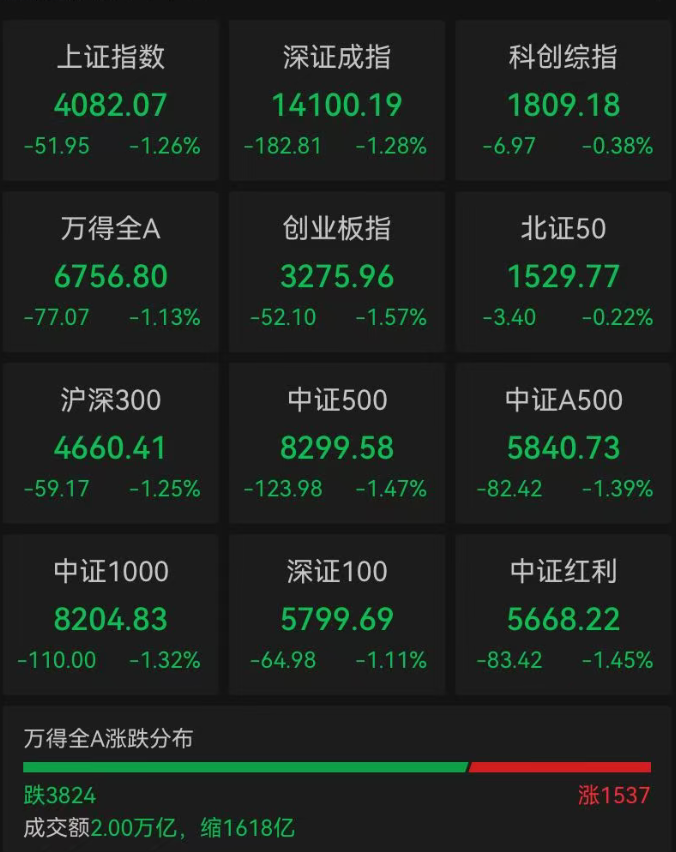
蛇年收官日,1537只个股上涨,3824只个股下跌,航天军工板块大涨!沪指蛇年累计上涨25.58%,市场近4700只个股收涨|A股收盘
Mei Ri Jing Ji Xin Wen· 2026-02-13 07:35
Market Overview - On the last trading day of the Year of the Snake, all three major A-share indices fell, with the Shanghai Composite Index down 1.26%, Shenzhen Component Index down 1.28%, and ChiNext Index down 1.57% [1][2] - The total trading volume in the Shanghai, Shenzhen, and Beijing markets was 19,989 billion yuan, a decrease of 1,618 billion yuan from the previous day, with 1,537 stocks rising and 3,824 stocks falling [1][2] Index Performance - The Shanghai Composite Index closed at 4,082.07, down 51.95 points [2] - The Shenzhen Component Index closed at 14,100.19, down 182.81 points [2] - The ChiNext Index closed at 1,809.18, down 6.97 points [2] - The total A-share market saw a decline of 1.13% in the Wande All A Index, with the ChiNext Index down 1.57% [2] Sector Performance - Aerospace and military industry, film and television, and semiconductor equipment sectors saw the largest gains, while precious metals and shipping sectors experienced significant declines [1][3] - The semiconductor equipment index rose by 1.65%, with stocks like Fuchuang Precision surging by 11% [4] - The aerospace and military index increased by 1.3%, with stocks such as Andavil and Aviation Power hitting the daily limit [5] - The precious metals index fell over 4%, with Zijin Mining dropping nearly 5% [6] Annual Performance Summary - The A-share market concluded the Year of the Snake with all major indices showing positive performance, with the Shanghai Composite Index up 25.58%, Shenzhen Component Index up 38.84%, and ChiNext Index leading with a 58.73% increase [6][7] - Nearly 4,700 stocks rose throughout the year, with 779 stocks doubling in price and over 100 stocks increasing by more than 200% [7] - The average daily trading volume surged to 1.89 trillion yuan, a nearly 70% increase compared to the previous year, with days exceeding 2 trillion yuan accounting for 35% of trading days [6][7]


How China's 'unruly' speculators might be fueling the frenzy in gold market
CNBC· 2026-02-13 06:51
Group 1 - Gold and silver prices increased as U.S. Treasury bond yields decreased, indicating a potential softening economy ahead of important jobs data [1] - Gold prices reached a record high of $5,594 per ounce on January 29, but experienced a nearly 10% drop the following day, marking one of the sharpest declines in decades [2] - Analysts suggest that Chinese retail and institutional investors are significantly influencing gold price volatility, with U.S. Treasury Secretary attributing this to "unruly" trading activities in China [2][3] Group 2 - U.S. Treasury Secretary Scott Bessent noted that the recent gold price movements are indicative of speculative trading, leading to increased margin requirements in China [3] - The surge in gold futures and exchange-traded funds, along with rising leverage usage despite margin hikes, is contributing to the erratic trading patterns of gold [3] - China is identified as the "dominant driver" affecting precious metal prices during this period, according to Nicky Shiels, head of research and metals strategy at MKS Pamp [4]
美股、黄金、白银、原油集体大跌!
Xin Lang Cai Jing· 2026-02-13 04:57
Market Performance - The three major U.S. stock indices collectively declined, with the Dow Jones falling by 1.34%, the Nasdaq by 2.03%, and the S&P 500 by 1.57%. Large-cap tech stocks experienced widespread losses, with Apple dropping by 5% [1][1][1] - The LiFeng index for Chinese concept stocks fell by 2.64%, indicating a general downturn in popular Chinese stocks [1] Commodity Prices - WTI crude oil futures decreased by 2.77%, closing at $62.84 per barrel, while Brent crude oil futures fell by 2.71%, ending at $67.52 per barrel [1][1] - Precious metals saw significant declines, with COMEX gold futures dropping by 3.08% to $4941.4 per ounce and COMEX silver futures plunging by 10.62% to $75.01 per ounce [1][1] Employment Data - The number of initial jobless claims in the U.S. for the previous week was reported at 227,000, slightly above the forecast of 224,000 and down from the previous value of 231,000 [1][1] AI Sector Developments - AI startup Anthropic completed a $30 billion financing round, resulting in a post-money valuation of $380 billion [1][1] - OpenAI launched its first AI model, GPT-5.3-Codex-Spark, based on chips from semiconductor startup Cerebras Systems [1][1]
暴跌是对杠杆的清洗,而非牛市的终结
对冲研投· 2026-02-13 03:36
Core Viewpoint - Precious metals are currently the focus of market trading, but increased volatility has made trading more challenging. The article aims to analyze the significant fluctuations in precious metals and the potential logical developments that may follow [3]. Group 1: Market Dynamics - The surge in prices began in early December, driven by factors such as the physical currency logic, the continuous weakening of the US dollar index, and heightened market expectations leading to a "short squeeze" logic [4]. - The decline in prices started on January 29, primarily triggered by the "Walsh trade," with the equity market's downturn exacerbating liquidity feedback, leading to a chain reaction of sell-offs across various asset classes [4][21]. - The current precious metals market is in a period of adjustment following significant volatility, with January's surge reflecting a prelude to the collapse of the US dollar's credit, while February's drop serves as a stress test for tightening liquidity expectations [5][43]. Group 2: Key Drivers of Price Movements - The price surge from December to January was fundamentally linked to the deterioration of US dollar credit, physical currency dynamics, and expectations of liquidity easing. The US dollar index fell from 100 to a low of 95.6 during this period [6]. - The logic of physical currency was driven by the decline in sovereign credit, with rising global bond yields due to inflation and default risks prompting a shift of funds into physical precious metals [7]. - The US federal government debt exceeded $38 trillion by the end of 2025, with a fiscal deficit rate expanding to 5.85%, indicating significant risks in the fiscal situation and leading to a depreciation of dollar credit [10]. Group 3: Market Sentiment and Positioning - Following the volatility in early February, the precious metals market has shifted from speculative frenzy to a more rational state, with implied volatility significantly decreasing from historical highs [28]. - Non-commercial long positions have been significantly reduced, indicating a cleansing of speculative leverage that had accumulated above $100, leading to a healthier market structure [29]. - Silver prices found strong support at the 60-day moving average, indicating robust buying interest from industrial capital, while the US dollar index faced resistance at the 98 level, confirming its role as a mid-term top [32]. Group 4: Future Core Drivers - The future direction of the precious metals market will depend on whether the core logic of physical currency and dollar credit remains unchanged, with three main drivers to watch: the interplay between physical currency and dollar credit, liquidity logic and policy support, and the potential for a silver squeeze [33]. - Observing the 10-year US Treasury yield against the dollar index will be crucial, as a divergence could signal a re-evaluation of dollar credit risk [34]. - The liquidity logic is critical, with the reserve ratio of the Federal Reserve falling to around 11%, indicating potential liquidity risks that could prompt a shift in policy from tightening to easing [39].

招商期货-期货研究报告:商品期货早班车-20260213
Zhao Shang Qi Huo· 2026-02-13 03:24
Report Industry Investment Rating - Not provided in the report Core Viewpoints of the Report - The precious metals market is highly volatile. Gold is recommended to hold long - term positions, while silver requires cautious participation [1]. - For base metals, copper and tin suggest waiting for stable buying opportunities. Aluminum is expected to be range - bound, and alumina has upward potential [2][4]. - In the industrial silicon market, the fundamentals show a situation of both weak supply and demand, and the price is expected to fluctuate within a certain range [4]. - In the black industry, it is recommended to close positions in rebar, iron ore, and coking coal [6]. - In the agricultural products market, soybeans and corn futures are expected to show different trends, and corresponding trading strategies are provided for each [7]. - In the energy and chemical market, different products have different supply - demand situations and trading suggestions, such as short - term weak fluctuations and medium - term improvement opportunities [9][10] Summary by Relevant Catalogs Precious Metals - **Market Performance**: Last night, precious metals fell rapidly. The Shanghai Gold 2604 contract barely held the 1100 - yuan mark, and the Shanghai Silver 2604 contract fell below the 20000 - yuan mark [1]. - **Fundamentals**: The U.S. Treasury Secretary's decision and concerns about AI investment led to drops in U.S. technology stocks and precious metals. There were changes in gold and silver inventories in various places [1]. - **Trading Strategy**: Hold long positions in gold and be cautious with silver [1] Base Metals Copper - **Market Performance**: Copper prices weakened significantly yesterday [2]. - **Fundamentals**: U.S. stock market decline, concerns about AI, dollar strengthening, tight copper ore supply, and the Spring Festival off - peak season affecting demand [2]. - **Trading Strategy**: Wait for stable buying opportunities [2] Aluminum - **Market Performance**: The closing price of the electrolytic aluminum main contract decreased by 0.21% compared with the previous trading day, and the 0 - 3 month spread was - 400 yuan/ton [2]. - **Fundamentals**: High - load production in electrolytic aluminum plants and a slight increase in the weekly aluminum product start - up rate [2]. - **Trading Strategy**: The price is expected to be range - bound in the short term [2] Alumina - **Market Performance**: The closing price of the alumina main contract decreased by 1.20% compared with the previous trading day, and the 0 - 3 month spread was - 206 yuan/ton [2]. - **Fundamentals**: Some alumina plants entered the production - reduction and rotation maintenance stage, while electrolytic aluminum plants maintained high - load production [2]. - **Trading Strategy**: Pay attention to subsequent maintenance and shutdown situations as the price has upward potential [2] Industrial Silicon - **Market Performance**: The main 05 contract closed at 8335 yuan/ton, a decrease of 35 yuan/ton from the previous trading day, with a closing price decrease of 0.42% [4]. - **Fundamentals**: Stable furnace - opening quantity and an overall start - up rate of 22.36%. Both the polysilicon and organic silicon industries are promoting anti - involution, with expected production declines [4]. - **Trading Strategy**: The price is expected to fluctuate between 8200 - 8800 yuan. Consider short - selling at high prices if the large - scale production reduction is short - term [4] Carbonate Lithium - **Market Performance**: LC2605 was 149,420 yuan/ton (- 840), a closing price decrease of 0.56% [4]. - **Fundamentals**: Changes in the prices of lithium - related products, production and inventory changes in the lithium salt industry, and expected production declines in downstream materials [4]. - **Trading Strategy**: The price is expected to fluctuate [4] Polysilicon - **Market Performance**: The main 05 contract closed at 49015 yuan/ton, a decrease of 165 yuan/ton from the previous trading day, with a closing price decrease of 0.43% [4]. - **Fundamentals**: Stable weekly production and inventory, changes in the production schedules of downstream products, and positive factors in the demand side [4]. - **Trading Strategy**: The main contract is expected to weakly fluctuate between 45000 - 53000 yuan [4] Tin - **Market Performance**: Tin prices weakened significantly yesterday [4]. - **Fundamentals**: Similar to copper, including U.S. stock market decline, dollar strengthening, and tight tin ore supply, along with a significant increase in domestic warehouse receipts [4]. - **Trading Strategy**: Wait for stable buying opportunities [4] Black Industry Rebar - **Market Performance**: The rebar main 2605 contract closed at 3056 yuan/ton, an increase of 11 yuan/ton from the previous night - session closing price [6]. - **Fundamentals**: Decrease in building material apparent demand and production, weak demand expectations but limited supply, and certain technical support for prices [6]. - **Trading Strategy**: Close positions. The reference range for RB05 is 3040 - 3100 yuan [6] Iron Ore - **Market Performance**: The iron ore main 2605 contract closed at 759.5 yuan/ton, a decrease of 2.5 yuan/ton from the previous night - session closing price [6]. - **Fundamentals**: Changes in iron ore inventory and molten iron production, neutral supply - demand situation, and certain technical support for prices [6]. - **Trading Strategy**: Close positions. The reference range for I05 is 750 - 780 yuan [6] Coking Coal - **Market Performance**: The coking coal main 2605 contract closed at 1121 yuan/ton, an increase of 1 yuan/ton from the previous night - session closing price [6]. - **Fundamentals**: Changes in molten iron production, weak supply - demand situation, and certain technical support for prices [6]. - **Trading Strategy**: Close positions. The reference range for JM05 is 1090 - 1140 yuan [6] Agricultural Products Soybean Meal - **Market Performance**: CBOT soybeans are short - term strong, reflecting the expectation of good U.S. soybean exports [7]. - **Fundamentals**: South American bumper harvest expectation, strong U.S. soybean crushing and increasing export expectations, and an overall improving U.S. soybean supply - demand but a globally loosening supply - demand [7]. - **Trading Strategy**: Pay attention to China's purchase of U.S. soybeans and South American production realization; the domestic market is weaker and range - bound [7] Corn - **Market Performance**: Corn futures prices are strong, and spot prices are stable [7]. - **Fundamentals**: More than 60% of grain sales are completed, with limited sales pressure. However, the selling mentality in the Northeast has changed, and downstream enterprises are replenishing inventory at low prices [7]. - **Trading Strategy**: The futures price is expected to be range - bound and slightly strong due to policy disturbances [7] Oils and Fats - **Market Performance**: The Malaysian market is short - term weak [8]. - **Fundamentals**: A 14% month - on - month decrease in Malaysian palm oil production in January, a 11% month - on - month increase in exports, and a 7.7% month - on - month decrease in inventory at the end of January [8]. - **Trading Strategy**: Oils and fats are weak. Consider an anti - spread strategy and pay attention to future production and biodiesel policies [8] Cotton - **Market Performance**: ICE U.S. cotton futures prices continued to rebound, while international crude oil futures prices fell sharply [8]. - **Fundamentals**: A 3.2% year - on - year decrease in the expected U.S. cotton planting area in the 26/27 season, and changes in U.S. cotton export sales and domestic cotton supply - demand [8]. - **Trading Strategy**: Buy at low prices. The price range is 14600 - 15000 yuan/ton [8] Eggs - **Market Performance**: Egg futures prices rebounded, and spot prices stopped quoting [8]. - **Fundamentals**: A decrease in the number of laying hens in production, active chick replenishment, and expected seasonal decline in egg prices due to weakening demand [8]. - **Trading Strategy**: The futures price is expected to be range - bound and weak [8] Pigs - **Market Performance**: Pig futures prices are weak, and spot prices have a slight increase [8]. - **Fundamentals**: Expected rapid decline in slaughter volume after the minor New Year, large daily slaughter pressure this month, and a situation of strong supply and weak demand [8]. - **Trading Strategy**: The futures price is expected to be range - bound and weak [8] Energy and Chemicals LLDPE - **Market Performance**: The LLDPE main contract continued to fluctuate slightly. The low - price spot in North China was 6530 yuan/ton, and the 05 - contract basis was 200 points lower than the futures price [9]. - **Fundamentals**: Easing domestic supply pressure and weakening downstream demand [9]. - **Trading Strategy**: Short - term weak fluctuations, and consider long - positions at low prices in the medium - term [9] PTA - **Market Performance**: PX CFR China price was 917 dollars/ton, and PTA East China spot price was 5180 yuan/ton, with a spot basis of - 73 yuan/ton [10]. - **Fundamentals**: High - level supply of PX and PTA, and a situation of inventory accumulation [10]. - **Trading Strategy**: Maintain a long - position view on PX in the medium - term, and consider taking profits on PTA [10] PP - **Market Performance**: The PP main contract continued to fluctuate slightly. The PP spot price in East China was 6550 yuan/ton, and the 01 - contract basis was 130 points lower than the futures price [10]. - **Fundamentals**: Increasing supply pressure and weakening downstream demand [10]. - **Trading Strategy**: Short - term weak fluctuations, and consider short - positions at high prices in the medium - term [10] MEG - **Market Performance**: The East China spot price was 3675 yuan/ton, with a spot basis of - 105 yuan/ton [10]. - **Fundamentals**: Increasing supply, inventory accumulation, and weakening downstream demand [10]. - **Trading Strategy**: Consider long - positions at appropriate times as the market may start to destock in March [10] Styrene - **Market Performance**: The styrene main contract fluctuated slightly. The East China spot market price was 7570 yuan/ton [10]. - **Fundamentals**: High - level pure benzene inventory, low - level styrene inventory, and weak supply - demand on both sides [10]. - **Trading Strategy**: Short - term wide - range fluctuations, and consider long - positions on styrene or related spread strategies in the medium - to - long - term [10]