
传媒

Search documents
国泰海通|传媒:AI大战一触即发,互联网普及率突破80%
国泰海通证券研究· 2026-02-08 14:56
Core Viewpoint - The article highlights the ongoing competition for AI traffic entry points, suggesting that companies benefiting from new scenarios and ecosystems should be closely monitored [1]. Group 1: AI Competition and Market Dynamics - The SW Media Index fell by 3.30% from February 2 to February 6, 2026, ranking 26th among 31 industries, underperforming compared to the Shanghai Composite Index (down 1.27%), Shenzhen Component Index (down 2.11%), CSI 300 (down 1.33%), and ChiNext Index (down 3.28%) [1]. - During the 2026 Spring Festival, three AI applications—Yuanbao, Qianwen, and Doubao—launched various promotional activities to capture AI traffic, with Yuanbao initiating a cash red envelope campaign worth 1 billion yuan [1]. - Qianwen started a 3 billion yuan promotional event on February 6, focusing on free food delivery, while Doubao, as the title sponsor of the 2026 CCTV Spring Festival Gala, is expected to launch its activities on New Year's Eve [1]. Group 2: Beneficiaries of AI Development - The essence of the AI competition is the battle for traffic entry points and the enhancement of new scenarios and ecosystems, with multiple sectors poised to benefit from the scene dividends and the evolution of new content forms [2]. - Recommended sectors include: 1. **Gaming**: AI applications serve as effective distribution channels, and the integration of AI with gaming can explore new gameplay [2]. 2. **Film and Television**: Various forms of media, including movies and series, are expected to benefit from AI-driven transformations [2]. 3. **Marketing**: The new ecosystem is anticipated to generate increased demand for advertising [2]. - As of February 5, 2026, China's internet penetration rate surpassed 80%, with the number of internet users reaching 1.125 billion [2]. - The user base for generative AI has grown to 602 million, with a penetration rate of 42.8% [2]. - From July 2025, advertising expenditure has shown significant year-on-year growth, with double-digit increases in monthly growth rates from September to November, peaking at 16.6% during the November shopping festival [2].


【十大券商策略】持股过节,兼具胜率与赔率!眼下是加仓良机
券商中国· 2026-02-08 14:39
Group 1 - The core viewpoint is that there is no need to worry about short-term market fluctuations, as the underlying trends indicate a shift from virtual to real economies in Europe and the US, alongside the disruptive innovation brought by AI [2] - The urgency for strategic security investments and new infrastructure in the US reflects a growing competition, balancing short-term shareholder interests with long-term strategic value [2] - China's capital market has already completed the pricing adjustment from virtual to real, currently undergoing a verification and pricing process for quality and efficiency improvements [2] Group 2 - A potential "favorable timing and conditions" for a new upward cycle in the A-share market is anticipated in the coming months, particularly around the Spring Festival [3] - Historical data shows that February, especially around the Spring Festival, is a period of strong market activity, with small-cap stocks likely to outperform [3] - The recent market pullback is seen as an opportunity to regain confidence and prepare for the upcoming upward cycle, especially around the 4000-point level [3] Group 3 - The global market is quickly pricing in the potential hawkish stance of the Federal Reserve, while the Chinese government is shifting its focus towards domestic demand, which is expected to boost economic prospects [5] - The recent emphasis from the China Securities Regulatory Commission on stabilizing the capital market is expected to support a gradual recovery in the A-share market [5] - Recommendations include focusing on emerging technologies and sectors such as consumer services, food and beverage, and traditional manufacturing [5] Group 4 - The recent global asset adjustment is more about digesting emotions rather than fundamental changes, with a favorable environment for market recovery expected post-Spring Festival [6] - Key sectors to focus on include technology manufacturing, resource products, and infrastructure chains, with a particular emphasis on AI hardware and high-end manufacturing [6] - The upcoming period is expected to see increased industry catalysts and a rise in risk appetite, creating opportunities for thematic investments [6] Group 5 - The Hang Seng Technology Index is seen as having value for investment, with expectations of a rebound once the liquidity shock subsides [7] - The market is expected to experience a stronger performance post-Spring Festival, with a focus on sectors benefiting from the "14th Five-Year Plan" [7] - The rotation of investment focus is anticipated to accelerate in February, particularly towards sectors like oil, food and beverage, and construction materials [7] Group 6 - The global risk-off mode has led to a reevaluation of assets, with a focus on physical assets and a recovery in manufacturing trends [8] - Recommendations include investing in commodities like oil, copper, and lithium, as well as sectors with confirmed bottoming out in the Chinese manufacturing industry [8] - The return of capital and easing of pressure from quantitative tightening are expected to support a recovery in consumer sectors [8] Group 7 - The recent adjustments in the A-share market are primarily driven by internal factors, with external shocks having limited impact on the fundamental industry landscape [9][10] - The market sentiment has been sufficiently released, and a continuation of the spring market rally is anticipated post-Spring Festival [10] - Key sectors to watch include AI computing, chemical industries, and power equipment, with potential catalysts from local policy signals [10] Group 8 - The market is expected to maintain a range-bound oscillation, with a shift towards value and consumer sectors as high-valuation tech stocks face selling pressure [12] - Defensive sectors like banking and food and beverage are likely to attract investment, while growth sectors may regain focus post-Spring Festival [12] - The upcoming policy window and recovery in risk appetite are expected to shift market attention back to growth sectors with clear performance catalysts [12]
迎接春季行情第二段
East Money Securities· 2026-02-08 14:05
Group 1 - The market is currently pricing in hawkish expectations from Kevin Walsh, which may be overestimated, and further validation is needed from his actions and statements [2][24] - The domestic AI investment is still in its early stages, with significant differences in cycles compared to overseas investments, which are experiencing a surge in capital expenditure [2][22] - The micro liquidity environment in the domestic market remains favorable, and there are expectations for policy support, indicating a potential for a spring market rally [2][27] Group 2 - The long-term growth trend remains dominant, with expectations for continued outperformance in growth sectors, particularly in electronics, insurance, media, machinery, communication, chemicals, and real estate chains [3][30] - The current style switch is characterized as a small cycle level relative return convergence, with historical data indicating that such convergence typically lasts around 40 trading days [3][43] - The emotional cycle is currently in an upward phase, which supports a risk-on sentiment and a preference for growth investments [3][38] Group 3 - The recent global risk asset adjustments have shown resilience in the A-share market, despite pressures from tightening dollar liquidity and renewed concerns over AI narratives [10][22] - The anticipated spring market rally is expected to be supported by policy expectations and capital inflows, particularly in the period leading up to the National People's Congress [27][29] - The growth style is expected to outperform in the medium term, while the recent style switch is viewed as a tactical adjustment rather than a fundamental shift [24][30]
港股互联网ETF(513770)下探近7个月新低,资金溢价狂涌,信心来自哪里?
Xin Lang Cai Jing· 2026-02-08 12:10
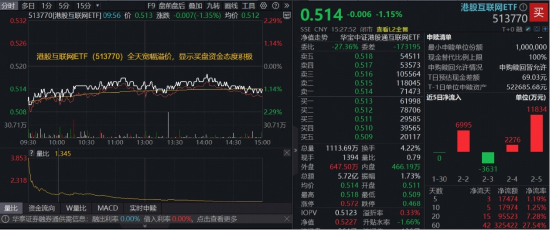
Core Viewpoint - The Hong Kong stock market experienced a significant decline influenced by the drop in US tech stocks, with major internet companies facing deep corrections, particularly Alibaba and Meituan [1][10]. Group 1: Market Performance - On February 6, the three major indices in Hong Kong opened sharply lower, with Alibaba-W dropping nearly 3% and Meituan-W and Kuaishou-W falling over 2% [1][10]. - The Hong Kong Internet ETF (513770) opened lower and saw a price drop of up to 2%, eventually closing down 1.15%, despite showing signs of strong buying interest with a net inflow of 175 million yuan over the past five days [11][13]. Group 2: Valuation and Investment Sentiment - The Hong Kong internet sector has seen a continuous decline for six days, with the market price hitting an eight-month low on February 5. The current price-to-earnings ratio (PE) for the China Securities Hong Kong Internet Index is 24.25, which is at a historical low compared to the past five years [3][13]. - Southbound capital has shown a clear bottom-fishing trend, with a cumulative net purchase exceeding 56 billion HKD this week, including a record 24.977 billion HKD on February 5, focusing on Tencent, Alibaba, and Xiaomi [5][15]. Group 3: Future Outlook - Analysts from Guohai Securities highlight that leading internet companies are generally undervalued, with a new round of competition centered around AI models improving commercial ROI. The internet sector is expected to see a valuation reset, driven by stable user traffic and the emergence of generative AI as a new growth driver [16]. - GF Securities notes that the current global dollar cycle is peaking and transitioning, with the RMB entering a mild appreciation phase. This, combined with foreign capital inflows and valuation recovery, presents a favorable re-pricing window for Chinese equity assets [16]. Group 4: ETF and Investment Strategy - The Hong Kong Internet ETF (513770) and its linked funds passively track the China Securities Hong Kong Internet Index, with the top ten weighted stocks including Alibaba-W, Tencent, and Xiaomi, accounting for nearly 77% of the ETF [6][16]. - For investors looking to reduce volatility while still focusing on technology, the Hong Kong Large Cap 30 ETF (520560) is recommended, which combines high-growth tech stocks with stable dividend-paying companies [17].
2月8日周末公告汇总 | 晶合集成拟20亿取得晶奕集成100%股权;沪硅产业拟签订逾30亿电子级多晶硅框架合同
Xuan Gu Bao· 2026-02-08 12:01
Group 1: Resumption and Suspension of Trading - Longyun Co., Ltd. plans to acquire 58% equity of Yuheng Film Industry through share issuance, leading to stock resumption [1] - Ruili Kemi intends to issue shares to purchase 16% equity of Wuhan Kedes, resulting in stock suspension [2] - Yongtai Technology aims to acquire 25% equity of Yongtai High-tech, with Ningde Times becoming a shareholder, leading to stock suspension [3] Group 2: Mergers and Acquisitions - Jinghe Integration plans to acquire 100% equity of Jingyi Integration for 2 billion yuan; Jingyi is the construction entity for Jinghe's Phase IV project [4] - Shahe Co., Ltd. intends to purchase 70% equity of Jinghua Electronics for 274 million yuan; the target company focuses on IoT smart display controllers and LCD devices [4] - Yiwan Yichuang plans to issue shares and pay cash to acquire 100% equity of Lianshi Legend; the target company specializes in AI algorithm-based intelligent marketing services [4] - Shanshan Co., Ltd. has signed a restructuring investment agreement with its controlling shareholder and subsidiaries; if successful, the actual controller will change to the Anhui State-owned Assets Supervision and Administration Commission [4] Group 3: Equity Transfers and Increases - Dongwang Times' controlling shareholder plans to publicly solicit the transfer of 6% equity [5] - Kangtai Biological's shareholder Yuan Liping intends to transfer 2% equity to Huabao Wanying Private Fund [6] - Linyang Energy's controlling shareholder Huahong Electronics plans to increase holdings by 50 million to 100 million yuan [7] Group 4: External Investments and Daily Operations - Hu Silicon Industry plans to sign a framework contract for the procurement of 3.045 billion yuan of electronic-grade polysilicon [8] - Dongtian Micro plans to invest 400 million yuan to establish a global R&D center and manufacturing headquarters in South China, focusing on precision optical components for optical communication [8] - Zhenyu Technology intends to invest in Thailand to establish a production base with an annual output of 15 million precision transmission components [9] - Lvtong Technology's investment fund plans to invest 10 million yuan in Shenghao Optoelectronics, which specializes in optical communication chip testing equipment [10] - Xinwangda's subsidiary has reached a settlement with Weir Electric, expected to impact the net profit attributable to the parent company by 500 million to 800 million yuan in 2025 [11] - Heng Rui Pharmaceutical's HRS-4642 injection has been included in the list of breakthrough therapeutic varieties, with no similar drugs approved for sale domestically or internationally [12] - Zhixin Co., Ltd. plans to invest 1.1 billion yuan to establish an automotive welding parts project [13] - Aisheng Co., Ltd. has received patent authorization for Maxeon BC batteries and components, with total licensing fees amounting to 1.65 billion yuan [14] - Sanfu Co., Ltd. is investing in a new project with an annual output of 200 tons (Phase I: 40 tons) of SOD and supporting solvents, with a total investment of 154 million yuan, including 125 million yuan for Phase I [14] - Gongxiao Daji is participating in the auction for 60% equity of Guotou Agricultural Products Supply Chain (Beijing), with a transfer base price of 99.7776 million yuan [15]

同样打生肖噱头,茅台为什么不如马年农夫山泉?
Sou Hu Cai Jing· 2026-02-08 11:47
Core Viewpoint - The strong rebound of Moutai has ignited the entire liquor sector, with significant price movements and market reactions indicating a potential recovery in the industry after a prolonged adjustment period [1][2][4]. Group 1: Moutai's Market Performance - Moutai's stock price surged by 8.61% on January 29, marking the highest single-day increase since February 2025, and its market capitalization returned to 1.8 trillion yuan with a trading volume exceeding 26.3 billion yuan [2]. - The stock price of Moutai has rebounded over 18% from its low, approaching a critical technical bull market position, which could influence the extent of its price increase and the nature of the rebound [4]. - The price of Moutai's 53-degree 500ml flying Moutai is psychologically anchored at 1499 yuan, and if the market price falls below this level, Moutai may implement strategies to stabilize prices [4]. Group 2: Industry Trends and Consumer Behavior - The upcoming Spring Festival is traditionally a peak consumption period for liquor, and the introduction of iMoutai has helped stabilize prices after a previous decline [1][4]. - There is a notable increase in demand for flying Moutai during the Spring Festival, but post-holiday, consumer purchasing behavior may revert to more rational levels, potentially affecting prices [4]. - The overall liquor industry is showing signs of recovery, with first-tier brands like Moutai indicating a gradual exit from the adjustment phase, which could positively impact the pricing structure across the sector [7]. Group 3: Collectible Liquor Market - The collectible value of Moutai's zodiac-themed products is under scrutiny, with some experts advising caution regarding their investment potential, as past releases have shown significant price fluctuations [5]. - The market for zodiac-themed Moutai has seen substantial price adjustments, with the latest batch experiencing a drop from 2750 yuan to 2280 yuan per bottle [4][5]. - Comparatively, other collectible products, such as the zodiac water from Nongfu Spring, have demonstrated even higher premium rates, raising questions about Moutai's relative value in the collectible market [1]. Group 4: Economic Context and Future Outlook - The liquor industry has experienced multiple adjustment cycles since 1999, with the current cycle, which began in 2022, being notably prolonged, reflecting broader economic challenges and shifts in consumer demand [8][9]. - The recovery of the liquor sector is closely tied to macroeconomic indicators, with expectations for a turning point in the industry by the second half of 2026 as inventory levels normalize [9].



调整或已到位,把握配置区间。风格之辩:成长优于价值,大盘优于小盘,科技+顺周期仍是主线。:风格之辩——策略周聚焦
Huachuang Securities· 2026-02-08 09:41
Group 1 - The report highlights three main market concerns: the nearing end of industry rotation, significant suppression of risk appetite, and the transition to stock game before the Spring Festival [1][9][21] - The current market is entering a mid-to-long-term capital allocation phase, with the A-share bull market exhibiting high Sharpe characteristics, driven by improving fundamentals and stable free cash flow generation [2][21] - The report emphasizes that quality growth is superior to pure high-dividend value, with a focus on cyclical and real estate sectors, while large-cap stocks are favored over small-cap stocks due to tightening liquidity [3][35][41] Group 2 - The technology and cyclical sectors remain the main investment themes, with expectations of PPI turning positive, which will enhance EPS pricing and support growth in sectors like computing hardware, energy storage, AI applications, and smart driving [4][36] - The report categorizes growth into two types: high-growth sectors such as electronics and media, and sectors with performance elasticity under low bases, including steel, construction materials, and high-end manufacturing [33][38] - The report notes that the remaining liquidity is tightening, which may put pressure on high-valuation factors, indicating that the influence of valuation factors will diminish in the coming year [35][41]
华金证券:春季行情未完 持股过节
Xin Lang Cai Jing· 2026-02-08 07:05
Group 1 - The short-term performance of A-shares before the Spring Festival may influence the market after the holiday, with historical data showing that in 16 years since 2010, there were 9 instances where the Shanghai Composite Index rose or fell in the first five trading days before the festival and then moved in the opposite direction on the first trading day after the festival [8][2] - Economic and profit expectations during the Spring Festival may improve, with anticipated favorable data for travel and consumption, as well as a potential rebound in real estate sales due to low base effects and strong policy support [9][2] - Liquidity is expected to remain loose during the Spring Festival, with the central bank likely to increase net injections to counter seasonal tightening, and stock market funds may maintain a certain level before accelerating back after the holiday [9][2] Group 2 - After a short-term adjustment, technology growth and cyclical sectors are expected to outperform, supported by policy and industry trends, with historical patterns indicating that leading sectors may regain strength post-adjustment [10][3] - Current observations suggest that technology growth and certain cyclical industries are likely to remain dominant, driven by supportive policies and ongoing industry trends, particularly in commercial aerospace and AI [10][3] - The consumption sector's short-term rebound may be a result of valuation recovery, but its sustainability is uncertain due to weak consumer confidence and the absence of a profit turning point [11][3] Group 3 - Industry allocation recommendations suggest a balanced approach towards technology growth, certain cyclical sectors, and consumption, with specific industries like automotive, military, beauty care, machinery, and communication expected to perform well in 2025 [11][3] - The current sentiment towards growth sectors such as pharmaceuticals, automotive, and computing is relatively low, indicating potential for future gains [11][3] - Suggested low-entry allocations include sectors with upward policy and industry trends, such as electronics (semiconductors, AI hardware), media (AI applications, gaming), and healthcare [11][3]
行业景气度跟踪报告(2026年2月):涨价品种出现分化,券商景气度高增
ZHESHANG SECURITIES· 2026-02-08 04:25
Upstream Sector - In the upstream cyclical products, there is a price divergence, with only gold prices rising while silver and other industrial metals have declined[1] - The PPI for coal mining and washing has improved, with a year-on-year growth of -8.9% in December, up from -11.80% in November[41] - Brent crude oil prices have decreased by 6.2% to $66.30 per barrel, while WTI crude oil prices fell by 4.7% to $62.14 per barrel[15] Midstream Sector - In the steel sector, iron ore and rebar prices have increased week-on-week, with rebar prices at 3,002 RMB per ton, up 1.6%[16] - The chemical products price index has decreased by 0.9% week-on-week, indicating a downward trend in major chemical product prices[16] - The shipping industry is experiencing a decline, with the Baltic Dry Index down by 5.6%[16] TMT Sector - The semiconductor sales cycle is on the rise, with a year-on-year growth of 22.9% in China[17] - The software industry has seen a cumulative profit growth of 7.3% year-on-year[17] - The film box office revenue in China has decreased by 69.11% year-on-year, indicating a significant drop in the media sector[17] Downstream Consumption - The price of Feitian Moutai has increased, supporting the strength of the liquor market[19] - The number of breeding sows in China has decreased by 2.9% year-on-year, indicating a decline in the agricultural sector[19] - The retail sales of consumer goods in December have shown a year-on-year decline of 0.9%[19] Financial and Real Estate Sector - The cumulative year-on-year decline in China's commercial housing sales area is 8.7%[20] - The cumulative year-on-year decline in real estate development investment is 17.2%[20] - The total trading volume in the two markets has increased, with the margin financing balance remaining high, indicating a robust brokerage environment[20]
陆家嘴财经早餐2026年2月8日星期日
Sou Hu Cai Jing· 2026-02-07 22:50
Group 1 - China's foreign exchange reserves have increased for six consecutive months, reaching $339.91 billion as of January 2026, up by $41.2 billion or 1.23% from December 2025. Gold reserves have also risen for 15 months, totaling 7.419 million ounces, with a month-on-month increase of 40,000 ounces [1] - The logistics costs in China have been steadily decreasing for several years, with the ratio of total logistics costs to GDP dropping to 13.9% in 2025, the lowest level on record [3] - Shanghai aims to establish a modern industrial system with a focus on advanced manufacturing, targeting six emerging pillar industries, and plans to attract 6,300 new foreign-funded enterprises in 2025, a year-on-year increase of 6.8% [3] Group 2 - Nvidia's CEO Jensen Huang expressed optimism about AI development, stating that the infrastructure for AI is still in its early stages and will require another seven to eight years to fully develop, with demand for computing power being extraordinarily high [2] - A strategic partnership has been formed between Pony.ai and Moore Threads, marking the application of domestic AI computing power in key training and simulation areas for autonomous driving [4] - The Chinese government has issued guidelines to cultivate data circulation service institutions, including data exchanges and service platforms, to support the development of high-quality datasets for AI [5] Group 3 - The Chinese futures market saw a significant increase in total funds, exceeding 400 billion yuan in January, reaching a historical high of 2.57 trillion yuan, with a 19% growth in client equity compared to the end of 2025 [10] - The number of new futures clients in 2025 reached 940,000, showing significant growth compared to the previous year [10] - The Chinese central bank has increased its gold holdings for 15 consecutive months, signaling a strategy to optimize international reserves amid fluctuating global gold prices [10]
