工业机器人

Search documents
数启新程向未来 ——写在2025天府数字经济大会开幕之际
Si Chuan Ri Bao· 2025-11-18 00:09
Core Insights - The digital economy is a strategic focus for the "14th Five-Year Plan" and is a key driver for high-quality development in Sichuan, with the core industry value expected to exceed 530 billion yuan in 2024, accounting for 16.7% of revenue from large-scale enterprises, ranking among the top in the country [1][11] - The establishment of digital economy innovation development pilot zones, including Sichuan, has created new opportunities for deepening reforms and innovations in the digital economy [1][11] Infrastructure Development - Sichuan has achieved full 5G coverage in all 26,000 administrative villages, with a total of 207,000 5G base stations built, ranking 6th in the country [3] - The province's total optical cable length has reached 5.869 million kilometers, equivalent to 15 times the distance from Earth to the Moon, with industrial parks achieving 10G optical network coverage [3] - The total computing power in Sichuan has reached 16.8 exaFLOPS, with plans to double this to 40 exaFLOPS by 2027 [4] Industrial Transformation - The digital transformation coverage rate among large-scale industrial enterprises in Sichuan has increased to 45.5%, with over 800 smart factories cultivated [6][7] - Sichuan has established 47 cross-industry industrial internet platforms, ranking 8th in the national development index, with a digital transformation action plan aiming for full coverage by 2027 [7][8] - The province is addressing the challenges faced by small and medium-sized enterprises in digital transformation by providing support and establishing digital transformation promotion centers [7][8] Economic Impact - The digital economy is driving modernization in agriculture, with new business models like smart agriculture emerging, leading to significant growth in rural e-commerce [9][10] - The online transaction volume in Sichuan exceeded 3 trillion yuan in the first seven months of the year, with over 5.5 million people employed in the sector [10] - Sichuan has built 437 internet hospitals, serving over 23.46 million patients, and achieved 100% internet access in primary and secondary schools [10]
卡诺普机器人递表港交所 公司在所有中国焊接机器人制造商中排名第一
Zhi Tong Cai Jing· 2025-11-17 14:22
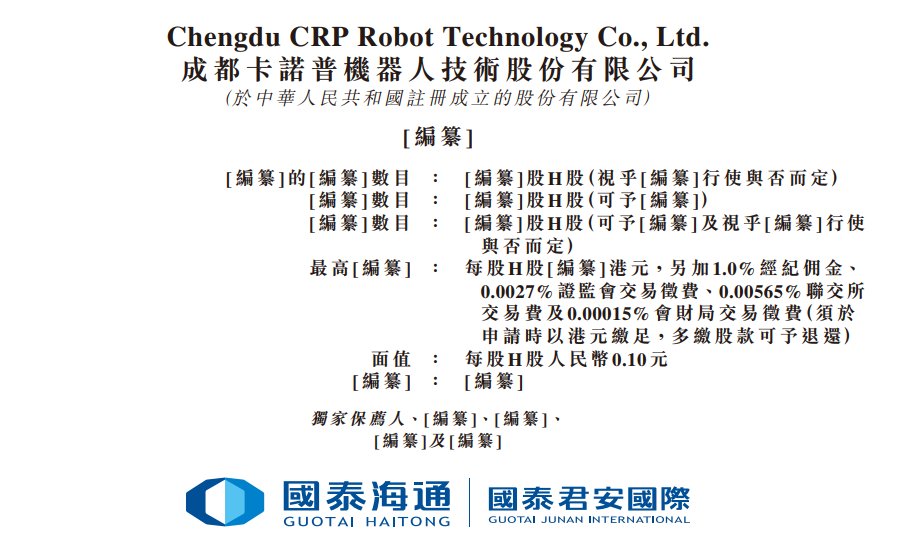
据港交所11月17日披露,成都卡诺普机器人技术股份有限公司(以下简称:卡诺普机器人)递表港交所主板,国泰君安融资有限公司为其 独家保荐人。招股书提到,根据弗若斯特沙利文的资料,以2024年的收入计算,卡诺普机器人在所有中国焊接机器人制造商中排名第 一。 | 编纂]的[编纂]數目 : [编纂]股田股(視乎[编纂]行使與否而定) | | --- | | [编纂]數目 .. [编纂]股H股(可予[编纂]) | | [编纂]數目 : 「編纂]股H股(可予[編纂]及視乎[編纂]行使 | | 與否而定) | | 最高[编纂] : 每股H股[編纂]港元,另加1.0%經紀佣金、 | | 0.0027% 證監會交易徵費、0.00565% 聯交所 | | 交易費及0.00015% 會財局交易徵費(須於 | | 申請時以港元繳足,多繳股款可予退還) | | 面值: 每股H股人民幣0.10元 | | [编纂] : 【编纂】 | 据招股书,卡诺普机器人是中国先进的工业机器人公司,也是具身智能机器人的先锋。依托全栈自主核心技术与多场景智能应用能力, 成功构建了主要涵盖工业机器人、协作机器人、具身智能机器人的三大类全自主研发产品矩阵。 卡 ...


新股消息 | 卡诺普机器人递表港交所 公司在所有中国焊接机器人制造商中排名第一
智通财经网· 2025-11-17 12:54
智通财经APP获悉,据港交所11月17日披露,成都卡诺普机器人技术股份有限公司(以下简称:卡诺普机器人)递表港交所主板,国泰君 安融资有限公司为其独家保荐人。招股书提到,根据弗若斯特沙利文的资料,以2024年的收入计算,卡诺普机器人在所有中国焊接机器 人制造商中排名第一。 据招股书,卡诺普机器人是中国先进的工业机器人公司,也是具身智能机器人的先锋。依托全栈自主核心技术与多场景智能应用能力, 成功构建了主要涵盖工业机器人、协作机器人、具身智能机器人的三大类全自主研发产品矩阵。 卡诺普机器人在中国工业机器人产品的焊接功能以及金属及机械加工应用领域均居于领先地位。根据弗若斯特沙利文的资料,以2024年 的收入计算,(i)公司在所有中国焊接机器人制造商中排名第一;(ii)公司在关键焊接机器人细分领域(包括激光焊接及切割机器人)中的所 有中国制造商中排名第一;及(iii)在金属及机械加工行业机器人应用方面,该公司在中国企业中居于领先地位。根据弗若斯特沙利文的 数据,在实现工业机器人规模化的中国企业中,卡诺普机器人在盈利能力方面是领导者之一。 顺应市场趋势,卡诺普机器人构建了"双引擎驱动"的增长模式,在巩固国内基础的同时 ...
10月经济数据解读:全年目标逼近 稳增长促转型
Yang Guang Wang· 2025-11-17 11:11
Core Insights - China's economy continues to show resilience and potential, maintaining a stable growth trajectory despite global economic challenges [1][2] - Key economic indicators remain within a reasonable range, supporting the achievement of annual economic development goals [1] Production Sector - Industrial production remains stable, with a year-on-year increase of 4.9% in the added value of industrial enterprises above designated size [1] - High-tech manufacturing and equipment manufacturing sectors outperformed overall industrial growth, with increases of 7.2% and 8.0% respectively [1] - New product output is experiencing rapid growth, with significant increases in production of new energy vehicles (19.3%), industrial robots (17.9%), and 3D printing equipment (30.8%) [1] Consumption Sector - In October, the total retail sales of consumer goods increased by 2.9% year-on-year, indicating a steady recovery in the consumer market [1] - Notably, consumption upgrade products are growing rapidly, with retail sales of communication equipment and cultural office supplies increasing by 23.2% and 13.5% respectively [1] - Service retail sales accelerated, with a year-on-year growth of 5.3% from January to October, reflecting a 0.1 percentage point increase compared to the first three quarters [1] Investment Structure - Investment structure is showing positive changes, with high-tech industry investment maintaining rapid growth, particularly in information services (32.7%) and aerospace manufacturing (19.7%) [2] - These trends indicate a solid move towards high-quality development and a more pronounced innovation-driven growth characteristic [2] Policy Support - The Chinese government has introduced new policy tools worth 500 billion yuan to enhance local government financial capacity and stimulate effective investment [2] - Measures have been implemented to further invigorate private investment, contributing to improving corporate performance and supporting favorable economic conditions [2] Future Outlook - The 20th National Congress has outlined a development blueprint for the next five years, presenting numerous opportunities for high-quality economic growth [2] - As consumer potential is gradually released and industrial upgrades accelerate, the economy is expected to gain sustained momentum [2]
埃斯顿(002747) - 2025年10月31日-11月14日投资者关系活动记录表
2025-11-17 09:18
2025 年 10 月 31 日-11 月 14 日投资者关系活动记录表 编号:2025007 | 投资者关系活动类别 | □特定对象调研 □分析师会议 | | --- | --- | | | □媒体采访 □业绩说明会 | | | □新闻发布会 □路演活动 | | | □现场参观 | | | ■其他(电话会议) | | 参与单位名称及人员姓名 | 2025年10月31日 15:30-16:30 电话会议 | | | 广发基金管理有限公司、天治基金管理有限公 | | | 司、美林国际、摩根士丹利亚洲有限公司、美 | | | 林(亞太)有限公司、花旗环球金融亚洲有限公 | | | 司、凯基证券亚洲有限公司、法国巴黎银行、 | | | 香港上海汇丰银行有限公司、高盛(中国)证 | | 券 | 有 限 责 任 公 司 、 北 京 明 远 投 资 管 理 有 限 公 | | | 司、深圳市尚诚资产管理有限责任公司、富瑞 | | | 金融集团香港有限公司、中信建投证券股份有 | | | 限公司、信达证券股份有限公司、中国国际金 | | | 融股份有限公司、德银投资管理有限公司、瑞 | | | 银证券有限责任公司、汇丰前海 ...

中国工业机器人上演“升职记”
Ren Min Ri Bao Hai Wai Ban· 2025-11-17 07:02
Core Insights - The evolution of industrial robots in China is transforming them from auxiliary tools to primary labor forces in manufacturing, significantly impacting global smart manufacturing dynamics [1][2][3] Group 1: Industrial Robot Development - China has become the world's largest industrial robot market, with an expected 2.027 million units by 2024, accounting for over 50% of global installations since the 14th Five-Year Plan [2][4] - In 2022, China installed nearly 300,000 new robots, surpassing the total installations in all other regions combined [3] - The density of industrial robots in China reached 470 units per 10,000 people, significantly exceeding the global average, indicating rapid advancements in smart manufacturing capabilities [3][4] Group 2: Application and Integration - Industrial robots are increasingly integrated into various sectors, with applications in 71 major industries and 241 sub-industries, enhancing productivity and efficiency [4][5] - The rise of "dark factories" in China, where automation is prevalent, is exemplified by companies like Midea, Xiaomi, and Gree adopting advanced robotic technologies in their manufacturing processes [4][5] - The integration of AI with robotics is enabling real-time monitoring and optimization of equipment performance, a practice that is not yet widespread in other regions [5][6] Group 3: Future Prospects and Innovations - The Chinese government is promoting the "Robot+" initiative to expand the depth and breadth of robot applications, focusing on areas like welding, assembly, and material handling [6][7] - Despite the early-stage application of humanoid robots in industrial settings, there is a growing ecosystem supported by government initiatives and a surge in startups focusing on specialized components [6][7] - The development of robots is seen as a solution to labor shortages and is expected to create new job opportunities in various sectors, including education, healthcare, and elder care [7]
中国工业机器人上演“升职记”(国际论道)
Ren Min Ri Bao Hai Wai Ban· 2025-11-16 23:10
Core Insights - The article highlights the transformation of industrial robots in China from auxiliary tools to primary labor forces, significantly impacting global smart manufacturing dynamics [3][4][6]. Group 1: Industrial Robot Development - China's industrial robot market is projected to reach 2.027 million units by 2024, making it the largest in the world [3][4]. - In 2022, China installed nearly 300,000 new robots, surpassing the total installations in other regions combined [4]. - The density of industrial robots in China has reached 470 units per 10,000 people, significantly above the global average [4]. Group 2: Application and Integration - Industrial robots are now utilized across 71 major sectors and 241 sub-sectors of the national economy, accounting for over 50% of global new installations since the 14th Five-Year Plan [5][6]. - Major Chinese companies like Midea, Xiaomi, and Gree have adopted "dark factories" that leverage advanced robotics for production [5][6]. - The integration of AI with robotics is enhancing operational efficiency, with real-time monitoring and data analysis optimizing equipment performance [6][8]. Group 3: Future Prospects and Innovations - The Chinese government is promoting the "Robot+" initiative to expand the application of robots in various manufacturing processes, particularly in welding, assembly, and material handling [7]. - There is a growing ecosystem for humanoid robots in China, supported by government initiatives and a surge in startups focusing on specialized components [7][8]. - The development of humanoid robots is still in early stages, but they are expected to play a significant role in industrial and service sectors in the future [7][8].

海尔集团董事局主席周云杰:未来通过构建AI能力 形成智慧家庭、大健康、工业机器人三大产业生态
Ge Long Hui· 2025-11-15 00:56
Core Insights - The dialogue at the 17th Entrepreneur Conference in Wuhan focused on embracing a new world dominated by AI, featuring discussions among industry leaders on cutting-edge AI topics [1] Company Strategy - Haier Group's Chairman, Zhou Yunjie, outlined the company's future strategy, which includes three main sectors: smart home, big health, and industrial robotics [1] - The smart home sector encompasses smart appliances, smart living solutions, and home robots [1] - The big health sector involves biomedicine and medical equipment [1] - Haier aims to build an industrial ecosystem by developing AI computing capabilities around these three sectors [1]

河南前10个月出口“向新、向智、向绿”趋势明显 工业机器人出口同比增长超200%
Zhong Guo Xin Wen Wang· 2025-11-14 06:40
河南前10个月出口"向新、向智、向绿"趋势明显 工业机器人出口同比增长超200% 中新网郑州11月14日电 (阚力 王佳宁)郑州海关13日消息称,今年前10个月,河南省进出口7411.2亿元 (人民币,下同),同比(下同)增长14.5%,出口商品"向新、向智、向绿"趋势明显,其中,工业机器人出 口增长超200%。 据郑州海关统计,前10个月河南出口4881.7亿元,增长21.8%;进口2529.5亿元,增长2.6%。10月份, 河南进出口978.1亿元,为该省年内月度进出口最高值。 数据显示,河南出口"向新、向智、向绿"动力更加强劲。前10个月,河南出口机电产品3172.3亿元,占 全省出口总值的65%;其中,农业机械、机床、工业机器人出口分别增长31.8%、34.7%、200.3%。同 期,出口电动汽车213.5亿元,增长超254%。 外贸经营主体活力更足。前10个月,河南有进出口实绩的外贸企业数量达1.37万家,其中,进出口值 5000万元以上的企业923家。同期,河南民营企业进出口逾5083亿元,占全省外贸总值的68.6%。 据统计,前10个月,河南对东盟、欧盟两大市场进出口仍保持快速增长。东盟依然为河 ...
中国上市公司产业升级高峰会组委会主任陈慕鸿:科技赋能、价值回馈双轮驱动,推动耐心资本共享时代机遇
Zheng Quan Ri Bao· 2025-11-14 03:17
Group 1 - The conference aims to promote the integration of Shanxi's capital market with national industrial upgrading, having grown from a regional event to a nationally influential platform since its inception in 2018 [1] - China's GDP grew by 5.2% year-on-year in the first three quarters of 2025, with notable performance in sectors like new energy vehicles, information technology, and industrial robotics, reflecting a deep integration of technological innovation and industrial transformation [1] - The theme of the conference is "Technology Empowering Listed Companies to Return Value to Patient Capital," focusing on how to effectively convert technological innovation into industrial competitiveness and ultimately share development results with investors and society [2] Group 2 - The 20th Central Committee of the Communist Party of China emphasizes the need for technological innovation to lead the construction of a modern industrial system, indicating a strategic direction for listed companies' industrial upgrades [2] - Three major challenges are identified: the contradiction between accelerated technological iteration and long R&D cycles, the conflict between short-term profit pressures and long-term investment needs, and the urgent requirement for independent control of the industrial chain amid global technological competition [2] - The conference features two specialized sub-forums aimed at sharing insights from institutions and listed company chairpersons, focusing on practical experiences and market expectations to inspire various market participants [3]