通讯器材

Search documents
兼评2月经济数据:经济开门红好于预期
KAIYUAN SECURITIES· 2026-03-17 01:12
Group 1: Economic Performance - Industrial added value for January-February increased by 6.3% year-on-year, surpassing expectations by 1.1 percentage points[3] - Fixed asset investment (FAI) showed a cumulative year-on-year increase of 1.8%, against an expected decline of 2.7%[14] - Service sector production rose to 5.2% year-on-year, up 0.2 percentage points from the previous value[3] Group 2: Investment Trends - Infrastructure investment rebounded significantly, with broad infrastructure up 25.8% year-on-year and narrow infrastructure up 23.6%[4] - Manufacturing investment growth improved by 2.5 percentage points to 3.1%, with notable increases in electrical machinery and textiles[4] - Real estate investment saw a reduction in decline, improving by 6.1 percentage points to -11.1%[5] Group 3: Consumer Behavior - Retail sales (social retail) increased by 1.9 percentage points to 2.8% year-on-year, although cumulative growth declined by 0.9 percentage points[6] - Service retail continued to outperform goods retail, with a widening growth gap of 3.1 percentage points[6] - Key contributors to retail growth included home appliances and food, while automotive sales lagged[6] Group 4: Market Outlook - Economic performance in early 2026 exceeded expectations, suggesting a potential moderate recovery in equity markets[7] - The need for additional policies to support domestic recovery remains, particularly in light of geopolitical uncertainties and consumer demand fluctuations[7] - Risks include potential policy changes and unexpected economic downturns in the U.S.[8]
开年经济的温度
HUAXI Securities· 2026-03-16 12:25
Economic Performance - Industrial added value increased by 6.3% year-on-year in January-February, exceeding the expected 5.0%[1] - Fixed asset investment rose by 1.8% year-on-year, against an expected decline of 4.2%[1] - Retail sales of consumer goods grew by 2.8% year-on-year, surpassing the expected 2.1%[1] Supply and Demand Dynamics - The weighted year-on-year growth of industrial and service production indicators was 5.6%, rebounding by 0.5 percentage points from December[1] - The gap between supply and demand narrowed from 9.6 percentage points to 2.5 percentage points[1] External Demand and Exports - Industrial export delivery value surged by 6.3%, the highest growth rate since April of the previous year, contributing 0.7 percentage points to industrial added value[2] - The expected annual export growth rate has been revised upward from 3-5% to around 6%[2] Consumer Spending Trends - Retail sales growth for services reached 5.6%, significantly higher than the 2.5% growth for goods[2] - Automobile sales negatively impacted retail performance, contributing a drag effect of 2.2 percentage points on retail sales[3] Infrastructure and Investment - Fixed asset investment increased by 1.8%, with infrastructure investment growing at 11.4%, outperforming manufacturing and real estate investments[4] - State-owned investment rose by 7.7% year-on-year, significantly higher than the previous year's decline of 2.5%[4] Real Estate Market Insights - Real estate sales area and sales value showed better-than-seasonal performance, with sales area declining by only 1.1% month-on-month[5] - New home prices in first-tier cities saw a reduced decline of 0.1% month-on-month, indicating a stabilization trend[5] Overall Economic Outlook - The economic data indicates improvements in consumption and investment, particularly in infrastructure, driven by state-owned enterprises[6] - The real estate sector shows signs of recovery, although challenges remain due to previous weak sales and limited land acquisition by developers[6]
财政部:2025年全国科学技术支出12062亿元
Ke Ji Ri Bao· 2026-02-04 02:23
Group 1 - The Ministry of Finance reported a decrease of 1.7% in national general public budget revenue for 2025, amounting to 21,604.5 billion yuan compared to 2024 [1] - National general public budget expenditure is projected to increase by 1% to 28,739.5 billion yuan in 2025, with significant allocations for education, science and technology, and social security [1] - Key expenditures include education spending of 43,417 billion yuan (up 3.2%), science and technology spending of 12,062 billion yuan (up 4.8%), and social security and employment spending of 44,416 billion yuan (up 6.7%) [1] Group 2 - The sales revenue from the consumption upgrade policy is expected to exceed 2.6 trillion yuan in 2025, benefiting over 360 million people [2] - The automotive sector saw over 11.5 million vehicles replaced under the old-for-new policy, with nearly 60% being new energy vehicles [2] - The Ministry of Finance and the Ministry of Commerce initiated pilot projects for new consumption formats, allocating 9.6 billion yuan to support 65 selected cities [2]
消费品以旧换新政策释放消费潜力 相关产品年销售额超2.6万亿
Chang Jiang Shang Bao· 2026-02-02 00:45
Core Insights - In 2025, the central government implemented a series of financial policies to support the expansion of commodity consumption and optimize service consumption supply, including the issuance of 300 billion yuan in long-term special bonds to support the replacement of consumer goods [1][4] - The retail sales of consumer goods exceeded 50 trillion yuan, reaching 50,120.2 billion yuan, with a year-on-year growth of 3.7%, accelerating by 0.2 percentage points compared to the previous year [1][2] Group 1: Policy Implementation and Impact - The "old for new" policy expanded from 8 categories of home appliances to 12, including digital products and electric bicycles, with increased subsidy intensity [2] - In 2025, over 11.5 million vehicles were replaced under the "old for new" policy, with nearly 60% being new energy vehicles [2][4] - The sales of related products under the "old for new" policy exceeded 2.6 trillion yuan, benefiting over 360 million people [4] Group 2: Market Performance - Retail sales of limited above units grew by 3.4%, with significant increases in categories such as communication equipment (20.9%) and cultural office supplies (17.3%) [3] - The retail sales of new energy passenger vehicles reached 12.8 million units, a year-on-year increase of 17.6%, with a penetration rate of 53.9% [3][4] - Upgraded product categories saw accelerated demand, with sports and entertainment goods growing by 15.7% and jewelry and cosmetics reversing previous declines [3] Group 3: Industry Upgrades and Environmental Impact - The "old for new" policy not only boosted consumption but also promoted industrial upgrades and green transformation, with over 90% of replaced home appliances being high-efficiency products [4] - The recycling of scrapped vehicles increased by 24.5%, leading to significant reductions in carbon emissions [4] - The Ministry of Finance, in collaboration with the Ministry of Commerce, initiated pilot projects to foster new consumption models and international consumption environments, allocating 9.6 billion yuan for the first batch of funding [4][5]
财政部:2025年消费品以旧换新相关产品销售额超过2.6万亿元
智通财经网· 2026-01-30 11:13
Core Insights - The Ministry of Finance announced that in 2025, the sales of products related to the consumption upgrade policy exceeded 2.6 trillion yuan, benefiting over 360 million people [1][24] - The 2025 fiscal budget showed a slight decrease in overall revenue but a stable performance in key tax categories, with a focus on social welfare and economic support measures [4][10] Group 1: Consumption Upgrade Policy - The consumption upgrade policy led to the sale of over 11.5 million vehicles through trade-in programs, with nearly 60% being new energy vehicles [1][24] - The trade-in program for home appliances saw nearly 130 million units sold, with over 90% being first-level energy-efficient products [1][24] - The sales of digital products, including mobile phones, reached over 91 million units, with mid-to-high-end models accounting for 72.5% of sales [1][24] Group 2: Fiscal Revenue and Expenditure - In 2025, the total public budget revenue was 21.6 trillion yuan, a decrease of 1.7% from 2024, with tax revenue growing by 0.8% [4][8] - Major tax categories showed varied performance, with personal income tax increasing by 11.5% and corporate income tax growing by 1% [4][9] - Total public budget expenditure was 28.74 trillion yuan, an increase of 1% from 2024, with significant growth in social security and employment spending by 6.7% [5][10] Group 3: Social Welfare Initiatives - The introduction of a universal childcare subsidy program marked a significant step in social welfare, with over 30 million infants receiving support [11][14] - Approximately 100 billion yuan was allocated for the childcare subsidy, with 90.4 billion yuan coming from central finances [12][14] - The program aims to ensure equitable access to subsidies regardless of urban or rural status, with a focus on efficient distribution and management [13][14] Group 4: Agricultural Support Measures - The Ministry of Finance emphasized food security, with a focus on increasing agricultural productivity through various support measures [15][18] - Significant funding was allocated for high-standard farmland construction, with 1,766 billion yuan dedicated to this initiative [15][18] - The total grain production reached 1.43 trillion jin in 2025, marking an increase of 168 billion jin from the previous year [19][20]
北京市统计局:京津冀协同发展动能持续提升
Xin Lang Cai Jing· 2026-01-29 17:44
Economic Growth - In 2025, the GDP growth rates for Beijing, Tianjin, and Hebei are projected to be 5.4%, 4.8%, and 5.6% respectively, indicating a steady improvement in development quality and accelerated collaborative development momentum [1] - The industrial added value for large-scale industries in the three regions is expected to grow by 6.5%, 4.2%, and 7.9% respectively [1] High-tech Manufacturing - High-tech manufacturing added value in Beijing and Tianjin is projected to increase by 7.5% and 5.3% respectively, while strategic emerging industries in Beijing and Hebei are expected to grow by 15.5% and 11.0% respectively [1] - The production of high-tech products is anticipated to grow rapidly, with Beijing's new energy vehicle production expected to increase significantly, and industrial robot production in Tianjin and Hebei projected to grow by 17.9% and 29.3% respectively [1] Service Sector - The added value of the service industry in the three regions is expected to grow by 5.8%, 5.4%, and 6.1% respectively, with significant contributions from information transmission, software, and IT services, as well as the financial sector [1] - In Beijing, the added value of the information transmission, software, and IT services, and financial sectors is expected to grow by 11.0% and 8.7%, contributing over 70% to the city's economic growth [1] Fixed Asset Investment - Fixed asset investment (excluding rural households) in the three regions is projected to grow by 5.5%, 1.6%, and 6.1% respectively, with equipment purchase investments significantly outpacing overall investment growth [2] - Equipment purchase investments are expected to increase by 66.0%, 24.1%, and 45.3% respectively, driven by large-scale equipment renewal policies [2] Consumer Market - The consumer market is recovering, with Beijing's new energy vehicle retail sales expected to grow by 13.2%, while Tianjin and Hebei's retail sales of communication equipment are projected to grow by 75.7% and 41.1% respectively [2] - Retail sales of household appliances and audio-visual equipment in Tianjin and Hebei are expected to grow by 14.6% and 12.6% respectively [2] Innovation and Collaboration - The establishment of the National Technology Innovation Center in Xiong'an has entered a substantive operational phase, with over 2,000 business entities introduced to the Zhongguancun Science and Technology City in Beijing [2] - The three regions have jointly funded over 220 basic research cooperation projects and are developing a collaborative innovation ecosystem [2] Employment and Income - The average urban unemployment rate in Beijing is projected to remain at 4.1%, while Tianjin and Hebei are expected to create 327,000 and 900,000 new jobs respectively [3] - Per capita disposable income for residents in the three regions is expected to be 89,090 yuan, 55,918 yuan, and 36,439 yuan, reflecting growth rates of 4.3%, 4.4%, and 5.1% respectively [3] Healthcare and Transportation - The three regions have established 115 medical alliances and are implementing 164 cooperation projects between Hebei and Beijing-Tianjin universities [3] - Transportation integration is accelerating, with the official operation of the Tongzhou Station in Beijing and the full connectivity of the Jing-Tang Intercity Railway [3]
中国超大规模市场优势持续显现
Jing Ji Wang· 2026-01-27 01:37
Group 1: Economic Growth and Consumer Trends - In 2025, China's total retail sales of consumer goods exceeded 50 trillion yuan, reaching 50.1 trillion yuan, with a growth rate of 3.7% [1] - The contribution rate of consumption to economic growth reached 52%, highlighting its role as a main engine for economic development [1] - The retail sales of durable goods, such as home appliances, communication equipment, and furniture, grew by 11%, 20.9%, and 14.6% respectively, driven by the policy of replacing old consumer goods [2] Group 2: New Consumption Patterns - New consumption types, including digital, green, and health consumption, are on the rise, with online retail sales of physical goods increasing by 5.2% [2] - The penetration rate of new energy passenger vehicles reached 53.9%, indicating a shift towards sustainable consumption [2] - Rural consumption retail sales reached 6.8 trillion yuan, growing by 4.1%, outpacing urban growth by 0.5 percentage points [2] Group 3: Import and Export Developments - In 2025, China imported 18.48 trillion yuan, maintaining its position as the world's second-largest import market for 17 consecutive years [4] - China's trade partnerships expanded, with imports from over 130 countries and regions increasing by 7% compared to 2024 [4] - The "Belt and Road" initiative is enhancing trade opportunities, with positive impacts on exports of electronic components and machinery to partner countries [4] Group 4: Future Initiatives and Policies - In 2026, the Ministry of Commerce aims to stabilize foreign trade and promote service market openness, focusing on quality and efficiency [5] - The government plans to implement more practical measures to support foreign trade, investment, and consumption, including signing free trade agreements with 31 countries [7] - The emphasis will be on expanding domestic demand and enhancing consumer spending through initiatives like the "Buy in China" campaign [7][8]
社零总额首破50万亿元 2025年提振消费加力显效
Xin Hua Wang· 2026-01-27 00:37
Group 1 - The core viewpoint of the article highlights the robust vitality of China's consumer market in 2025, with the total retail sales of consumer goods exceeding 50 trillion yuan for the first time, reaching 50.1 trillion yuan, and contributing 52% to economic growth, an increase of 5 percentage points [3] - The implementation of the "old-for-new" policy has significantly boosted sales in related sectors, with sales of automobiles, home appliances, and mobile phones reaching 2.61 trillion yuan, benefiting 366 million people [7] - The retail sales of services increased by 5.5% year-on-year, with per capita spending on services rising by 4.5%, accounting for 46.1% of total per capita consumption expenditure [11] Group 2 - New consumption trends such as digital, green, and health consumption are gaining momentum, with online retail sales of physical goods growing by 5.2%, and the market penetration rate of new energy passenger vehicles reaching 53.9% [17] - Rural retail sales of consumer goods reached 6.8 trillion yuan, growing by 4.1%, outpacing urban growth by 0.5 percentage points [19] - The popularity of "China Travel" and "China Purchase" continues to rise, with sales of tax-refunded goods for outbound travelers nearly doubling, and the implementation of a 240-hour visa-free transit policy leading to a nearly 30% increase in foreign visitors [22]

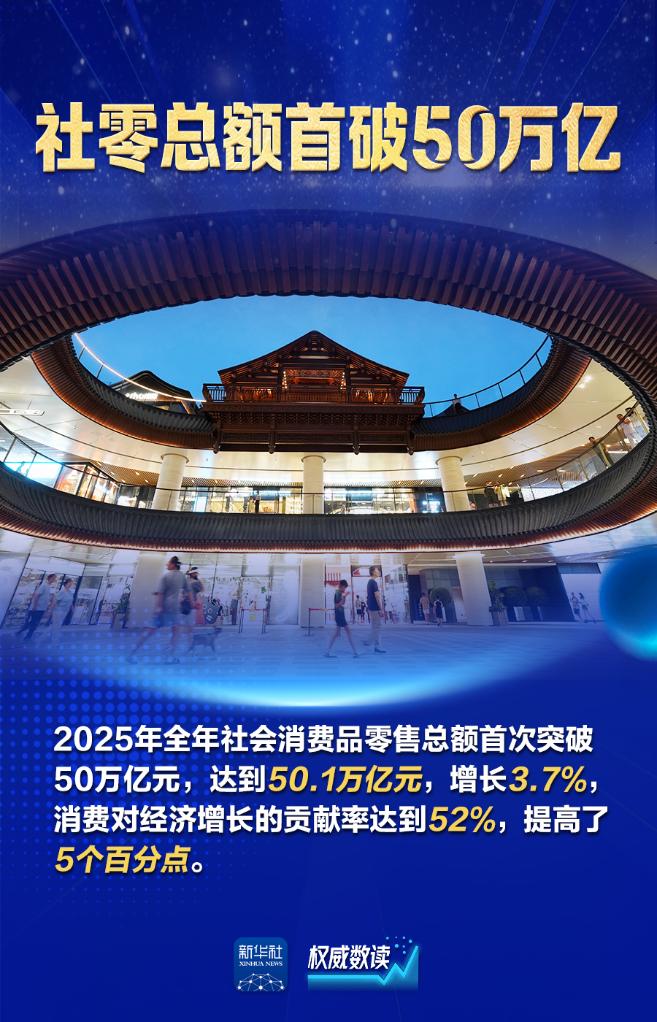
权威数读|社零总额首破50万亿元!2025年提振消费加力显效
Xin Hua She· 2026-01-26 12:20
Group 1 - The core viewpoint of the article highlights the robust vitality of China's consumer market in 2025, with total retail sales of consumer goods exceeding 50 trillion yuan for the first time and consumption contributing 52% to economic growth [1] - The "old-for-new" policy and initiatives like "China Purchase" and "Guochao Culture" have become prevalent, indicating a shift in consumer behavior and preferences [1] - The article emphasizes that consumption continues to play a pivotal role as the main engine of economic development, providing significant opportunities for countries worldwide [1] Group 2 - The sales revenue of related products under the "old-for-new" policy, including automobiles, home appliances, and mobile phones, reached 2.61 trillion yuan [4] - Retail sales of household appliances, communication equipment, and furniture increased by 11%, 20.9%, and 14.6% respectively, while passenger car retail volume rose by 3.8% [11] - The online retail sales of physical goods grew by 5.2%, and the market penetration rate of new energy passenger vehicles reached 53.9% [14] Group 3 - Per capita service consumption expenditure increased by 4.5%, accounting for 46.1% of total per capita consumption expenditure, with sectors like leisure, tourism, and transportation showing double-digit growth [8] - Rural retail sales of consumer goods reached 6.8 trillion yuan, growing by 4.1%, outpacing urban growth by 0.5 percentage points [17]
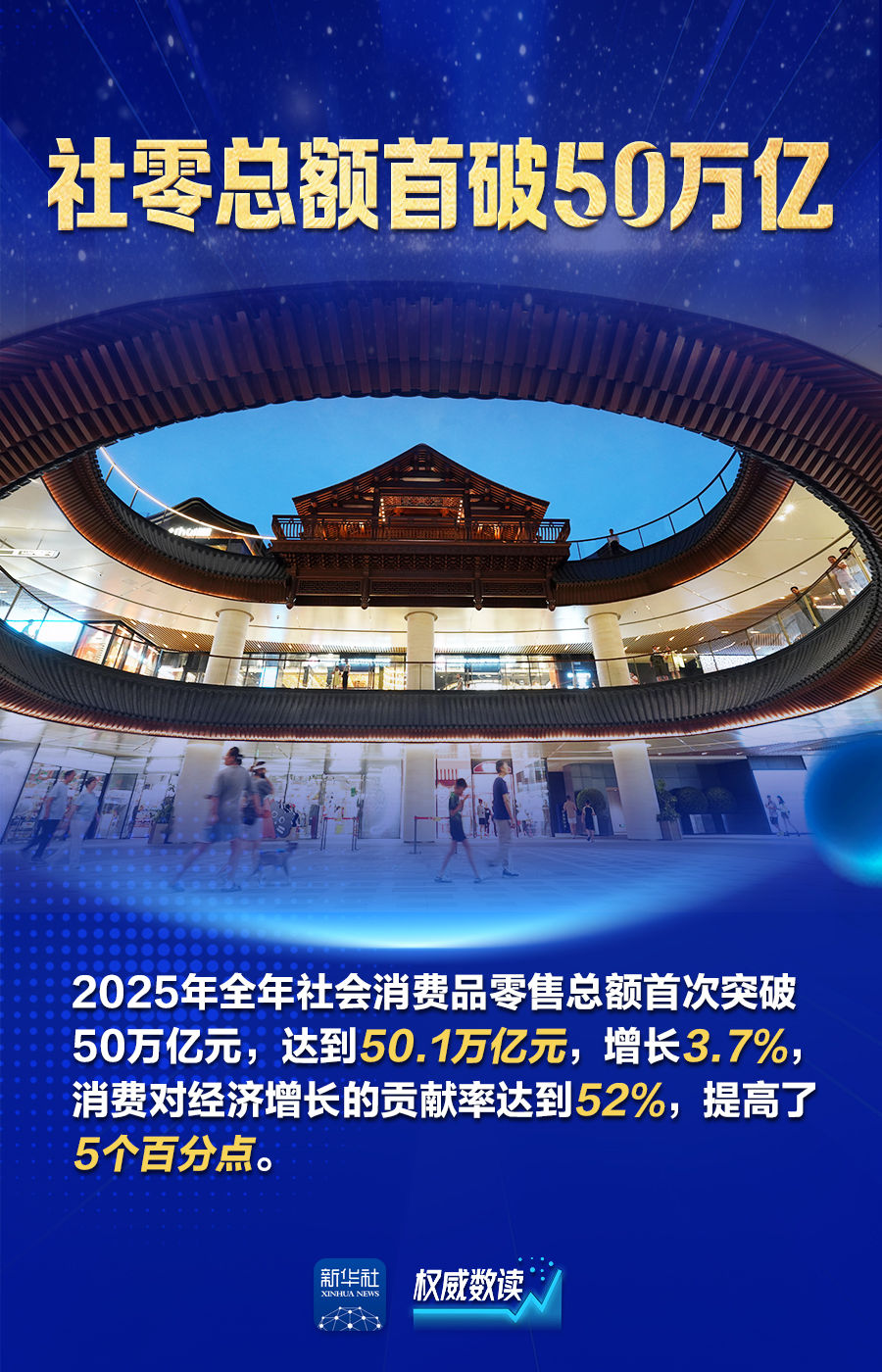
消费首破50万亿元背后
Xin Hua Wang· 2026-01-26 09:27
Group 1 - The core viewpoint of the articles indicates that by 2025, China's total retail sales of consumer goods are expected to reach 50.1 trillion yuan, with a growth rate of 3.7%, contributing 52% to economic growth, an increase of 5 percentage points [1] - In terms of product consumption, the trade-in policy is projected to drive sales of automobiles, home appliances, and mobile phones to 2.61 trillion yuan, benefiting 366 million people [3] - The retail sales of durable goods are expected to grow rapidly, with retail sales of home appliances, communication equipment, and furniture increasing by 11%, 20.9%, and 14.6% respectively, while passenger car retail volume is expected to rise by 3.8% [5] Group 2 - New consumption patterns are emerging, with digital, green, and health consumption gaining traction, and online retail sales of physical goods expected to grow by 5.2%, while the market penetration rate of new energy passenger vehicles is projected to reach 53.9% [7] - Rural consumption is showing active performance, with retail sales of consumer goods in rural areas reaching 6.8 trillion yuan, growing by 4.1%, outpacing urban growth by 0.5 percentage points [7] - The inbound consumption trend is rising, with the sales of tax refund goods nearly doubling due to the expansion of visa-free countries and the optimization of tax refund policies, alongside a nearly 30% increase in foreign visitors under the 240-hour visa-free transit policy [9] Group 3 - In 2026, measures to boost consumption will focus on policy implementation, event organization, and improving consumption environments, including optimizing the trade-in policy and promoting durable goods consumption [11] - The Ministry of Commerce plans to organize over 20 "Buy in China" themed events and support local activities to create a strong consumption atmosphere [11] - Efforts will be made to accelerate the cultivation of international consumption center cities and promote new consumption scenarios to enhance the overall consumer experience [11]