
户外用品

Search documents
探路者:8月25日召开董事会会议
Mei Ri Jing Ji Xin Wen· 2025-08-25 16:11
截至发稿,探路者市值为81亿元。 每经AI快讯,探路者(SZ 300005,收盘价:9.12元)8月25日晚间发布公告称,公司第六届第五次董事 会会议于2025年8月25日在公司阿尔卑斯会议室以现场与通讯相结合的方式召开。会议审议了《关于择 期召开股东会的议案》等文件。 每经头条(nbdtoutiao)——租下2.5万亩"试验田",兽医学博士在非洲种粮:首季亩产250斤,打算扩至 10万亩,月薪1~2万元招人 2024年1至12月份,探路者的营业收入构成为:户外用品行业占比86.03%,芯片业务占比13.97%。 (记者 胡玲) ...

探路者拟定增募资不超19.3亿元补流 合理性待解
Zheng Quan Shi Bao Wang· 2025-08-25 15:08
Core Viewpoint - The company, Explorer (300005), has announced a private placement plan to raise up to 1.93 billion yuan, primarily to supplement working capital, with the issuance price set at 7.28 yuan per share [1] Group 1: Fundraising Details - The issuance will involve the company's actual controller, Li Ming, and his controlled enterprise, Tongyu Heying, who will subscribe to all shares in cash [1] - The total number of shares issued will not exceed 30% of the company's total share capital prior to the issuance, amounting to a maximum of 265 million shares [1] - After the issuance, the controlling shareholder will change from Tongyu Zhonghe to Tongyu Heying, which will hold a 26.68% stake in the company [1] Group 2: Business Overview - Explorer was established in 1999 and has focused on the outdoor products market, entering the chip sector mainly through acquisitions [2] - In September 2021, the company acquired 60% of Beijing Xinneng for 260 million yuan, which specializes in Mini/Micro LED display driver chips [2] - In March 2023, Explorer acquired 72.79% of overseas high-end touch chip company G2Touch for 38.52 million USD, which has shown better performance compared to Beijing Xinneng [2] Group 3: Financial Performance - For the first half of 2025, the company expects a net profit attributable to shareholders of 16 million to 22 million yuan, a decline of 74.27% to 81.29% year-on-year [3] - The decline is attributed to poor sales in the outdoor business and increased inventory impairment provisions, despite overall positive development in the chip business [3] - The company emphasizes the necessity of the fundraising to support its dual main business strategy of "outdoor + chips" and to enhance its financial reserves for innovation and project investment [3] Group 4: Regulatory Considerations - The China Securities Regulatory Commission (CSRC) has introduced new rules requiring that raised funds must be used specifically for main business operations, and cannot be used for permanent working capital supplementation or repaying bank loans [4] - The company's plan to use all raised funds for working capital without specifying the exact allocation raises questions about the rationality of the fundraising [4]
浙江自然:关于为控股子公司提供担保的公告
Zheng Quan Ri Bao· 2025-08-25 14:05
证券日报网讯 8月25日晚间,浙江自然发布公告称,公司全资子公司越南大自然户外用品有限责任公司 因业务发展需要,拟向包括但不限于银行、融资租赁公司等金融机构申请获得500万美元综合授信额 度,用于流动资金贷款、外汇管理额度等。最终授信金额、期限等具体事项以实际签署的合同文本为 准。针对该授信,公司拟通过向金融机构申请开立备用信用证或银行保函的方式为越南大自然提供500 万美元授信担保。本次新增担保额度占公司最近一期净资产比例为1.66%。担保有效期为董事会审议通 过相关议案之日起12个月。 (文章来源:证券日报) ...


探路者特定对象承诺特定期间不减持 为发行股票护航
Xin Lang Zheng Quan· 2025-08-25 13:06
Core Points - The company, Tanuo Holdings Group Co., Ltd., held its sixth board meeting on August 25, 2025, where it approved a proposal for issuing shares to specific investors [1] - The investors, Mr. Li Ming and Beijing Tongyu Huying Investment Management Co., Ltd., provided a commitment letter stating that they had not reduced their holdings in Tanuo shares in the six months prior to the pricing benchmark date [2] - Both investors committed not to reduce their holdings from the pricing benchmark date until six months after the issuance, and they also pledged not to sell the shares acquired in this issuance for 36 months [3] Commitment and Accountability - The commitment letter emphasizes the seriousness and reliability of the investors' promises, stating that any violation would result in the company retaining all profits from any reductions and the investors facing legal responsibilities [4]
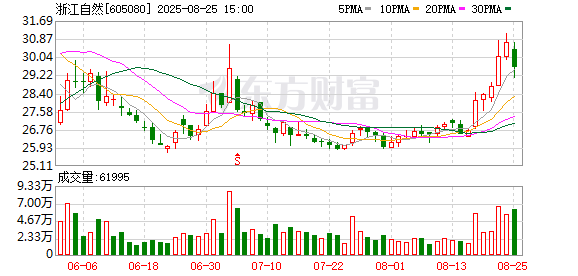
浙江自然股价跌5.01%,景顺长城基金旗下1只基金位居十大流通股东,持有87万股浮亏损失133.98万元
Xin Lang Cai Jing· 2025-08-25 06:19
Group 1 - The stock price of Zhejiang Natural fell by 5.01% to 29.19 CNY per share, with a trading volume of 141 million CNY and a turnover rate of 3.39%, resulting in a total market capitalization of 4.133 billion CNY [1] - Zhejiang Natural Outdoor Products Co., Ltd. was established on September 4, 2000, and went public on May 6, 2021. The company specializes in the research, design, production, and sales of outdoor sports products, including inflatable mattresses, outdoor bags, and headrest cushions [1] - The main revenue composition of the company includes inflatable mattresses (58.48%), bags (20.37%), other products (13.34%), headrest cushions (6.95%), and supplementary items (0.86%) [1] Group 2 - In the top ten circulating shareholders of Zhejiang Natural, a fund under Invesco Great Wall, specifically the Invesco Great Wall Consumer Select Mixed A (010104), entered the top ten shareholders in the first quarter, holding 870,000 shares, which accounts for 0.61% of the circulating shares [2] - The Invesco Great Wall Consumer Select Mixed A fund was established on September 24, 2020, with a current scale of 1.117 billion CNY. Year-to-date returns are 6.82%, ranking 6149 out of 8259 in its category, while the one-year return is 23.73%, ranking 5102 out of 8023. Since its inception, the fund has experienced a loss of 24.03% [2] Group 3 - The fund manager of Invesco Great Wall Consumer Select Mixed A is Deng Jingdong, who has been in the position for 5 years and 104 days, with a total fund asset size of 1.872 billion CNY. The best fund return during his tenure is 47.9%, while the worst is -25.56% [3] - Liu Su, another fund manager, has been in the position for 13 years and 245 days, managing a total fund asset size of 12.507 billion CNY. The best fund return during his tenure is 129.48%, with the worst being -25.56% [3]
鞋和女性,正在成为亚玛芬的杀手锏
Hu Xiu· 2025-08-24 10:55
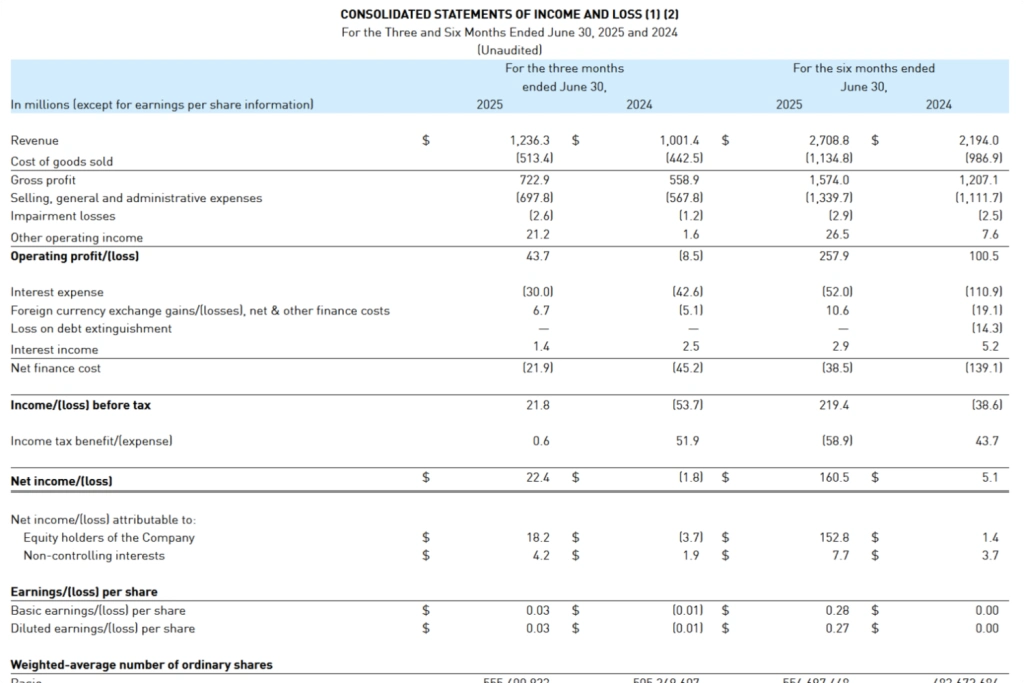
Core Insights - The company reported significant growth in Q2, with gross margin increasing by 270 basis points to 58.5% and adjusted gross margin rising by 250 basis points to 58.7% [1] - Operating profit surged by 614% to $44 million, while adjusted operating profit grew by 130% to $67 million, aided by a $19 million government subsidy received during the quarter [1][4] - The company has raised its full-year revenue guidance, expecting a 20%-21% increase for FY2025 [5] Financial Performance - Q2 revenue reached $1,236.3 million, up from $1,001.4 million in the same period last year, marking a growth of approximately 23.5% [3] - Gross profit for the quarter was $722.9 million, compared to $558.9 million in Q2 2024 [3] - The company reported a net income of $22.4 million, a significant recovery from a net loss of $1.8 million in the previous year [3] Regional Growth - The Asia-Pacific region (excluding China) saw the fastest revenue growth at 47%, reaching $311 million, while the Greater China region grew by 42% to $856 million, accounting for approximately 31.61% of total revenue [3][4] Business Segments - The footwear segment has emerged as a new growth engine, with Salomon's footwear business experiencing a 35% revenue increase to $414 million in Q2 [4][10] - The technical apparel segment, which includes Arc'teryx, saw a revenue increase of 23% to $509 million, while the outdoor performance segment grew by 35% [6] - The company is transitioning Arc'teryx from a clothing brand to a full-category outdoor equipment company, focusing on footwear and women's markets [7][8] Strategic Initiatives - Arc'teryx has established an independent footwear division, aiming to enhance product development and brand marketing [8] - The company plans to optimize its store network in Greater China, focusing on high-quality and efficient locations rather than merely expanding the number of stores [9] Market Positioning - Salomon is becoming a key player in the market, particularly among young consumers in China, with a focus on women's products, which now account for 50% of its customer base in the region [11][12] - The company is leveraging its experience with Arc'teryx to enhance Salomon's market presence through high-end positioning and refined operational strategies [12]
李宁需要自己的「始祖鸟」,但不需要做「安踏」
3 6 Ke· 2025-08-21 23:36
Core Viewpoint - Li Ning needs to regain lost time as its recent financial performance shows only a slight revenue increase while profits are declining, especially compared to competitors like Anta and Adidas [1][3] Financial Performance - Li Ning's revenue for the first half of the year reached 14.817 billion yuan, a year-on-year increase of 3.3%, but gross margin decreased by 0.4 percentage points to 50% and operating profit margin fell by 0.2% [1] - In comparison, Anta's revenue was 33.735 billion yuan and Adidas China reported approximately 15.263 billion yuan, indicating Li Ning's significant lag behind its competitors [1] Market Strategy - Li Ning is diversifying its strategy by entering the outdoor market through its family investment in the Swedish outdoor brand Haglöfs, which is expanding its presence in China [3][6] - The outdoor category is showing strong growth in China, with Anta's other brands experiencing retail sales growth of 60%-65% [3][4] Competitive Landscape - Li Ning's core categories of running and basketball are facing challenges, with a 21% decline in basketball revenue for 2024 [3][4] - The outdoor market is becoming increasingly competitive, with various brands like The North Face and Columbia also gaining traction in China [12][14] Brand Positioning - Haglöfs is being positioned as a high-end outdoor brand, similar to how Anta has positioned its brand Arc'teryx, aiming to attract a new generation of consumers seeking high-quality outdoor products [10][12] - Li Ning is not directly managing Haglöfs, which limits the potential for resource sharing and synergy that competitors like Anta enjoy [16] Future Opportunities - Li Ning has the opportunity to enhance its brand image and international presence by becoming a partner for the Chinese Olympic Committee, covering major international events from 2026 to 2028 [16][17] - The company is also focusing on improving operational efficiency and expanding into lower-tier cities to enhance profitability [16]

浙江自然(605080):经营夯实 拐点已现
Xin Lang Cai Jing· 2025-08-21 08:33
Core Viewpoint - The company is a leading outdoor inflatable mattress manufacturer with solid profitability, driving growth through expanding existing product lines and accelerating new product categories, resulting in better-than-expected performance [1] Group 1: Revenue and Profit Forecast - The company is projected to achieve revenue of 1 billion and net profit of 185 million in 2024, with expectations of returning to growth after inventory depletion and successfully onboarding large clients in the new energy sector [2] - The company anticipates a compound annual growth rate (CAGR) of over 30% in revenue from 2025 to 2027, driven by both existing product line expansion and new product category growth [2] Group 2: Domestic Factory Performance - The company holds a significant market share in the inflatable mattress category, with expectations for steady growth following inventory depletion in the first half of 2023 and a recovery in the second half of 2024 [3] - Continuous customer expansion efforts, alongside the ramp-up of new energy vehicles, are expected to contribute positively to traditional product growth, exceeding market expectations [3] Group 3: International Factory Developments - The company is expanding into new categories such as insulated hard cases and surfboards, leveraging its existing customer base and the scarcity of overseas production capacity [4] - The company has established strong customer relationships, particularly in Vietnam and Cambodia, which are expected to facilitate order growth despite concerns over tariffs affecting U.S. orders [4] Group 4: Performance Indicators and Catalysts - Key performance indicators include financial reports and order outlooks, with catalysts being better-than-expected performance and order forecasts in the second half of 2025 [7][8] Group 5: Profitability and Valuation - Revenue projections for 2025-2027 are 1.27 billion, 1.87 billion, and 2.4 billion respectively, with year-on-year growth rates of 27%, 47%, and 29% [9] - The company is expected to maintain strong profitability compared to peers, with a projected price-to-earnings ratio of 16.1, 10.7, and 8.3 for the respective years [9]
美联储降息预期下小盘股跑出“补涨行情” 分析师看好这些股票
Jin Rong Jie· 2025-08-20 23:55
Group 1 - The focus of the U.S. stock market is shifting from the "seven giants" tech stocks to small-cap stocks, with the S&P SmallCap 600 and Russell 2000 indices rising by 6% and 7% respectively over the past three months, although still lagging behind the Nasdaq 100's nearly 9% increase [1][3] - Francis Gannon from Royce Investment Partners believes that value-oriented small-cap stocks will benefit the most from potential interest rate cuts, as these companies hold more floating-rate debt compared to large enterprises, making their financing costs more directly impacted [1][2] - The recent "Big and Beautiful" bill passed by Congress, which includes stimulus and tax reduction measures, may further boost the performance of small-cap companies [1] Group 2 - Bank of America’s strategy team indicates that interest rate cuts could lead to stronger short-term excess returns for small-cap stocks, which are more sensitive to interest rate changes [2] - The report highlights that during the Federal Reserve's easing cycle, value-oriented small-cap stocks tend to outperform growth stocks, with high-quality stocks outperforming high-risk companies [2] - The S&P 600 index currently has a price-to-earnings ratio of about 17 times, nearly 30% lower than that of the S&P 500, indicating a valuation advantage for small-cap stocks [2]
霸州市尚美户外用品有限公司成立 注册资本5万人民币
Sou Hu Cai Jing· 2025-08-20 22:43
天眼查App显示,近日,霸州市尚美户外用品有限公司成立,法定代表人为李龙飞,注册资本5万人民 币,经营范围为一般项目:户外用品销售;日用杂品制造;日用杂品销售;渔具制造;家居用品制造;家具制 造;五金产品制造;金属结构制造;塑料制品制造;家具零配件生产;针织或钩针编织物及其制品制造;服装制 造;面料纺织加工;交通安全、管制专用设备制造;五金产品批发;日用品批发;鞋帽批发;家具销售;家具零配 件销售;渔具销售;日用百货销售;家居用品销售;塑料制品销售;金属结构销售;针纺织品销售;特种劳动防护 用品销售;箱包销售;互联网销售(除销售需要许可的商品);货物进出口;技术进出口(除依法须经批准 的项目外,凭营业执照依法自主开展经营活动)。 ...