
品类扩张

Search documents
晨光生物20260316
2026-03-17 02:07
Summary of Conference Call for Morning Light Bio (晨光生物) Industry Overview - The industry is currently at an absolute bottom, with prices for chili red and chili extract at near 10-20 year lows, and lutein profit margins at historical lows, indicating limited downside potential. A cyclical reversal is expected in the second half of 2026 [2][3] - Supply-demand dynamics are shifting towards a tight balance, with a significant decline in raw material planting areas expected in 2025, leading to gradual inventory digestion. If planting further decreases in 2026, a supply gap may trigger a nonlinear price rebound [2][4] Company Performance and Strategy - Customized business is expanding significantly, with the proportion of customized chili red sales expected to rise to nearly 20% in 2025 from 5% in 2023. The price and gross margin of food-grade lutein are significantly higher than feed-grade, enhancing customer stickiness and pricing power [2][4] - Product category expansion supports growth, with sales of stevia glycosides projected to reach 280 million yuan in 2025, a tenfold increase over five years. The company is also expanding into monk fruit, Sichuan pepper extract, and health product ODM, with health product capacity expected to support a scale of 200 million yuan in 2026 [2][4] - The cottonseed business is optimizing its structure by reducing trade ratios and concentrating core production capacity in cost-effective Xinjiang, with the high-value 60 protein ratio expected to rise to 60%-80% [2][4] Financial Projections - R&D expense ratio is expected to decline as customized projects conclude, product prices stabilize, and cottonseed trade reduces, with a forecasted return to stability in 2026 [3][6] - The company anticipates that the overall R&D expense ratio will decrease in 2026 and remain stable in the following years, aligning with business growth [6][7] Market Dynamics - The cottonseed market has seen price fluctuations due to international trade tensions and commodity price increases, with a return to normal levels expected after initial irrational price spikes [8][9] - The company has shifted its chili extract raw material sourcing entirely to Yunnan, eliminating purchases from Xinjiang since 2025, which has affected product pricing and market strategy [10][11] Future Outlook - The company is focusing on stabilizing planting areas for lutein in 2026, with expectations of a tight supply-demand balance. Price adjustments are anticipated to be influenced by supply conditions rather than direct market inquiries [12] - The company aims to enhance its capabilities in product customization and downstream applications, with plans to gradually build its own brand in health products while prioritizing ODM business in the short term [7][8] Key Takeaways - The industry is at a low point, with potential for recovery in 2026 due to supply constraints - The company is expanding its customized product offerings and optimizing its cottonseed business - Financial metrics indicate a potential decline in R&D expenses as the business stabilizes - Strategic shifts in sourcing and product development are aimed at enhancing market competitiveness and customer relationships

乐舒适20260310
2026-03-11 08:12
Company and Industry Summary Company Overview - **Company Name**: 乐舒适 (Leshu Shi) - **Market Position**: Leading player in the African hygiene products market, with a market share of over 35% in baby diapers in Sub-Saharan Africa and 20.3% in the overall African market for diapers, leading over Procter & Gamble and other international brands [2][3] Core Products and Business Layout - **Core Product Categories**: - Baby diapers (approximately 70% of revenue) - Sanitary napkins (approximately 20% of revenue) - Other products including training pants and wet wipes (approximately 10% of revenue) [3] - **Geographical Revenue Contribution**: Over 97% of revenue comes from Africa, with East Africa (46%) and West Africa (40%) being the primary markets [3] Competitive Advantages - **Local Manufacturing**: 100% local manufacturing provides a cost advantage of 20%-30% compared to international brands due to government support policies [2][3] - **Distribution Network**: Strong penetration into rural areas through a deep distribution network, achieving nearly 90% brand recognition [2][3] - **Management and Branding**: High local employment (over 90% of employees) and effective brand management strategies enhance market adaptability [3] Market Dynamics - **Market Size and Growth Potential**: The African hygiene products market is approximately $4 billion, with a projected CAGR of 7% over the next five years. The low penetration rates (20% for diapers and 30% for sanitary napkins) indicate significant growth potential [4] - **Demographic Drivers**: Over 40 million newborns in 2024 and a young population (over 50% under 20 years old) contribute to market growth [4] Competitive Landscape - **Market Share**: Leshu Shi leads the diaper market with a 20.3% share, followed by Procter & Gamble (17.4%) and another brand (9%). In the sanitary napkin market, it holds a 15.6% share, ahead of Procter & Gamble (10%) and Kimberly-Clark (6.8%) [4] - **Opportunities**: Many international brands lack a focused strategy for the African market, providing Leshu Shi with opportunities to deepen market penetration and product development [4] Growth Strategy and Performance Expectations - **Revenue Growth Forecast**: Expected CAGR of 15%-20% over the next three years, driven by existing market growth and new market expansion [5] - **New Market Focus**: Latin America is a strategic target, with plans to increase revenue share from 3% to 15% by 2028, leveraging new production capacity in Peru by the end of 2025 [5] - **Product Category Expansion**: Potential for asset injection from the parent company, Sen Da Group, which has a significant presence in other consumer goods [5] Currency Risk Management - **Currency Exposure**: The company faces currency risk due to local currency sales and costs primarily in USD and RMB. Strategies include timely currency exchange and price adjustments to mitigate local currency depreciation impacts [6][7] Investment Perspective - **Valuation**: Current stock price corresponds to a PE ratio of approximately 15-16 times for 2026, considered undervalued compared to a reasonable range of 20-25 times [8] - **Long-term Investment Value**: - Benefit from demographic trends and low market penetration in Africa - Proven local operational capabilities create competitive barriers - Potential for category expansion through the parent company's consumer goods business - Anticipated liquidity premium from entering the Hong Kong Stock Connect [8][9]
消费洞察-春节后连锁业态龙头的经营情况变化
2026-03-01 17:22
Summary of Conference Call Records Industry Overview - The records focus on the performance of leading chain brands in the coffee and tea industry, including Luckin Coffee, Gu Ming, and Guoquan, during early 2026, highlighting their resilience and same-store sales growth rates reaching mid to high single digits, with some exceeding 10% [1][2][11]. Key Insights and Arguments Same-Store Sales Performance - Leading chain brands maintained a positive operational stance, with same-store sales growth observed to be at least mid to high single digits, and some companies achieving over 10% growth during January and the Spring Festival period of 2026 [2][11]. - Gu Ming and Mi Xue Bing Cheng showed a divergence in same-store performance, with Gu Ming achieving significant growth due to effective category expansion [11][12]. Impact of Subsidies - The 2025 delivery and instant retail subsidies had a temporary disruptive effect on the coffee and tea sector, impacting same-store data and suppressing product pricing [1][2][3]. - By Q1 2026, signs of price stabilization emerged, indicating a reduction in the directional impact of subsidies [3][6]. Pricing and Channel Strategy Changes - Brands began to show positive changes in pricing and channel structure, with some chains, including Luckin, indicating a tendency to raise prices or at least stop further declines [4][6]. - Luckin's self-owned platform order ratio began to recover slowly, reducing reliance on third-party subsidies [4][6]. Profitability and Pricing Trends - The lowest point for profitability and cup prices for Luckin is expected to have occurred in Q4 2025, with a basis for marginal improvement in Q1 2026 [6][11]. - The impact of subsidies on profitability is expected to diminish, with concerns about declining profitability significantly alleviated [6][7]. Membership and Customer Retention - The core drivers of same-store sales continuity are linked to customer repurchase frequency and cross-selling, which are highly correlated with private membership operations [2][10][13]. - The importance of membership operation capabilities and category expansion is emphasized over supply chain capabilities among leading brands [12][17]. Additional Important Insights - The structural choice in platform subsidy allocation favors categories with higher average order values, indicating that coffee and tea may not be the primary focus for future subsidy resources [5]. - The long-term value of third-party subsidies for mature chain leaders is questioned, as they may not significantly drive new user retention or long-term repurchase [8]. - The expansion capability of chain enterprises is primarily supported by single-store efficiency and same-store continuity rather than merely the opening of new stores [9]. Conclusion - The records indicate a cautious optimism for the coffee and tea industry, with signs of recovery in pricing and profitability, alongside a focus on enhancing membership operations to drive customer loyalty and sales growth. The competitive landscape is expected to evolve as subsidy impacts diminish and operational efficiencies become more pronounced [17][20].

东方雨虹20260204
2026-02-05 02:21
Summary of Dongfang Yuhong Conference Call Company Overview - **Company**: Dongfang Yuhong - **Industry**: Waterproofing materials and construction materials Key Points Market Expansion and Revenue Growth - Dongfang Yuhong has significantly increased its market share and concentration by expanding into non-real estate sectors such as water conservancy projects and old housing renovations, effectively countering the decline in the real estate market [2][3] - The Public Construction Group faced revenue challenges due to business adjustments, including the abandonment of major real estate clients, but the revenue decline has narrowed, with expectations of stabilization by 2026 [2][3] - The Civil Construction Group maintained over 9 billion in revenue through rapid growth in new categories like membrane repair and special mortars, with continued expansion into new categories and lower-tier markets expected to stabilize revenue [2][3] - The Sand Powder Group achieved rapid growth, with sales reaching 12 million tons in 2025, a 50% increase, and aims for 20 million tons in 2026, optimizing product structure to enhance gross margins [2][6][7] Strategic Initiatives - The company is actively penetrating lower-tier markets through initiatives like the New Farmer Program and local market events, aiming to tap into growth potential in rural areas amidst overall C-end demand pressure [2][4] - Product category expansion is a key strategy, with new categories such as membrane repair and adhesives being introduced to counteract market changes, as existing C-end market share is already substantial [5] International Development - The Overseas Development Group focuses on trade, investment, and acquisitions, targeting North America, South America, Asia-Pacific, and the Middle East and Africa, with revenue projected to reach 4 billion in 2026 [2][8][10] - Successful entry into the Mexican market through partnerships, such as with Home Depot, has laid a foundation for future international expansion [9][10] Competitive Landscape - The waterproofing industry has seen intense competition, particularly price wars, leading to a need for effective price negotiation mechanisms among leading companies [11][12] - Despite some price adjustments, the lack of a cohesive pricing strategy has hindered significant price increases in the market [12][13] - In 2026, there is potential for establishing effective price negotiation mechanisms, as major companies express a desire to stabilize and improve profit margins [14] Financial Management - The company has successfully addressed historical accounts receivable issues, with expectations of continued improvement in 2026, allowing for a more streamlined operational approach [17] - Cost control measures have been implemented, with a projected decrease in overall expense ratios due to strict budget management and improved revenue performance [16] Coverage and Market Presence - Dongfang Yuhong has established a presence in county-level markets but aims to enhance coverage in rural areas, indicating significant growth potential in the coming years [15]

瑞银:消费出现复苏迹象,行业估值仍有吸引力
IPO早知道· 2026-01-21 01:31
Group 1: Consumer Confidence and Market Trends - UBS believes that consumer confidence is improving, with a notable shift in preferences among consumers [3] - The firm conducted discussions with approximately 35 consumer companies and observed a recovery in consumer sentiment despite a short-term downturn in the real estate market [3] - UBS indicates that the valuation of the consumer sector remains attractive, being about one standard deviation below the 10-year average, and has not yet reflected the recovery in consumption [3] Group 2: Sector-Specific Insights - The snack industry is expected to benefit from category expansion and channel restructuring, presenting structural growth opportunities [6] - In the liquor sector, private consumption and potential easing of drinking bans for government institutions may support mid-range liquor demand, with companies accelerating channel transformation for sustainable long-term earnings growth [5] - The ready-to-drink beverage (FMB) segment is projected to capture market share from bottled beverages, driven by rapid store expansion and more efficient business models [5] Group 3: Dairy and Other Beverages - Despite resilience in fresh milk, liquid milk sales are expected to remain weak in 2025, with a slight recovery anticipated in 2026 due to improved raw milk supply and demand, alongside marketing and innovation efforts [5] - The beer segment is experiencing short-term consumption fatigue, but product diversification and home consumption channel expansion continue to drive premiumization [5] Group 4: Other Consumer Goods - The pet food sector shows confidence in domestic market growth despite varying overseas growth prospects [7] - The home appliance industry is expected to see higher growth overseas compared to the domestic market, with strategies to cope with rising material costs differing among companies [9] - In the jewelry sector, brands with differentiated product designs and craftsmanship may pursue consolidation following VAT reforms [10]



“乳业第三”君乐宝IPO:低温业务保持强劲增长 “简醇”、“悦鲜活”成重要增长引擎
Xin Lang Cai Jing· 2026-01-20 11:56
Core Viewpoint - Junlebao Dairy Group has officially submitted its main board listing application to the Hong Kong Stock Exchange, marking a significant step towards its public offering and enhancing its market presence and brand image [1][8]. Company Overview - Junlebao ranks third among comprehensive dairy product companies in China, with a market share of 4.3% based on the 2024 retail market data [2][9]. - The company has achieved a revenue scale of 19.832 billion yuan by 2024 [2][9]. - In the low-temperature liquid milk market, Junlebao holds the second position with a market share of 14.5%, and in the low-temperature yogurt market, it also ranks second with a market share of 17.2% [2][9]. Growth Performance - Junlebao has maintained growth despite industry challenges, achieving a revenue growth rate of 13% in 2024, while the median revenue growth rate for listed dairy companies was -8.86% [10]. - The company’s low-temperature yogurt revenue grew by 12.57%, and fresh milk revenue increased by 44.54% in 2024, indicating strong competitive performance [10][3]. Product Innovation - Junlebao has introduced several successful products, including "Jianchun" in 2017 and "Yuexianhuo" in 2019, which have become leading brands in their respective categories [3][10]. - The company has also upgraded its infant formula with the launch of "Youcuibaoai" [3][10]. Market Position and Strategy - The low-temperature fresh milk sector is a key growth area, with Junlebao benefiting from its self-owned farms, achieving a milk source self-sufficiency rate of 66% [11]. - Junlebao's "Yuexianhuo" utilizes advanced sterilization technology to extend shelf life while maintaining nutritional quality, enhancing its distribution capabilities [11]. Distribution and Expansion - Junlebao has established a nationwide sales network covering approximately 2,200 districts, accounting for 77% of China's county-level administrative regions [11]. - The company plans to use funds from its IPO to expand production facilities and enhance supply capabilities in key regions, including new factories in Anhui and Guangdong [12][6]. Revenue Structure - The largest revenue sources for Junlebao are low-temperature yogurt and infant formula, accounting for 27.6% and 22.1% of total revenue, respectively [13]. - The company is also exploring new retail channels, including coffee and tea chains, to reach a broader consumer base [12][13]. Industry Potential - The Chinese dairy market is projected to reach 653.5 billion yuan in 2024, with per capita consumption significantly below the global average, indicating substantial growth potential for the industry [14].
东鹏饮料(605499):收入突破200亿元,维持长线价值区间判断
Yin He Zheng Quan· 2026-01-14 11:41
Investment Rating - The report maintains a "Recommended" rating for the company [3] Core Insights - The company is expected to achieve a revenue of approximately 207.6 to 211.2 billion yuan in 2025, representing a year-on-year growth of 31.1% to 33.3% [7] - The company’s revenue growth is anticipated to transition from high-speed to medium-high speed as it reaches a revenue scale of 200 billion yuan, with a focus on healthier growth quality [7] - The net profit margin for 2025 is projected to be around 20.9% to 21.7%, with a slight year-on-year increase [7] - The report highlights the importance of monitoring sales dynamics during the Spring Festival and the "water head" catalyst in March for revenue growth [7] - Long-term growth opportunities are identified in category expansion and international market penetration, particularly in Southeast Asia and future plans for the US and Middle East markets [7] Financial Forecasts - Revenue projections for 2024A, 2025E, 2026E, and 2027E are 15,839 million yuan, 20,913 million yuan, 26,559 million yuan, and 32,217 million yuan respectively, with growth rates of 40.63%, 32.04%, 27.00%, and 21.31% [2] - The expected net profit for the same years is 3,327 million yuan, 4,474 million yuan, 5,679 million yuan, and 6,980 million yuan, with profit growth rates of 63.09%, 34.48%, 26.95%, and 22.90% [2] - The diluted EPS is projected to be 6.40 yuan, 8.60 yuan, 10.92 yuan, and 13.42 yuan for the years 2024A to 2027E [2] - The PE ratio is expected to decrease from 40.33 in 2024A to 19.22 in 2027E, indicating a potential increase in valuation attractiveness over time [2]

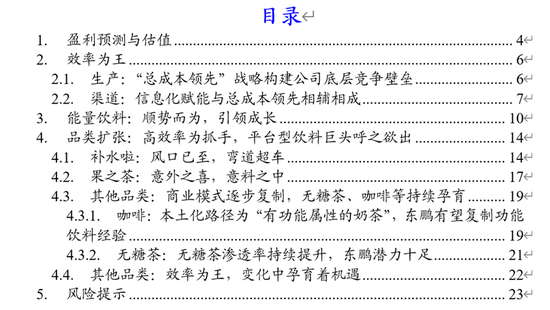
国泰海通食饮团队:东鹏饮料 效率为王,平台型饮料巨头呼之欲出
Xin Lang Cai Jing· 2025-12-19 07:25
Core Insights - The management efficiency improvement enables the company to save significant profits to reward channels and consumers, aligning with the growing consumer emphasis on high cost-performance in the beverage industry, thus the company's category expansion is expected to exceed market expectations [1][5]. Group 1: Category Expansion - The company's category expansion is anticipated to surpass expectations. The market believes that the company, leveraging its high cost-performance strategy and nationwide channel expansion, is likely to follow the leading energy and sports drink brands, gradually becoming a second-tier player in the niche market. However, as national expansion is nearly complete, future growth potential may be limited [2][5]. - The company aims to become a platform beverage enterprise by continuously enhancing management efficiency, allowing it to save profits to benefit channels and consumers, thus meeting the increasing price sensitivity of beverage consumers [2][5]. Group 2: Competitive Strategy - The company's "total cost leadership" strategy and information technology empowerment work in tandem to build a true competitive moat. By reducing costs and increasing efficiency on the production side while enhancing channel capabilities through information technology, the company can save more profits to reward channels and consumers, leading to a more pronounced effect of "consumers willing to buy and channels willing to sell" [2][5]. - The company is expanding into emerging segments such as energy drinks, sports drinks, sugar-free tea, and coffee, relying on high cost-performance products, continuous channel reach improvement, and marketing efforts to broaden its consumer base and consumption scenarios [3][6]. Group 3: Market Positioning - The company is expected to continue growing in the energy and sports drink sectors, potentially surpassing foreign leaders to become an industry leader. Additionally, the penetration rates of sugar-free tea and ready-to-drink coffee are steadily increasing, providing the company with opportunities for robust growth [3][6]. - In traditional segments like sugary tea, the company is expected to gradually squeeze traditional players by leveraging higher operational efficiency and offering differentiated product experiences, aiming for long-term excess returns [3][6].

茶百道20251216
2025-12-17 02:27
Summary of Cha Bai Dao Conference Call Company Overview - **Company**: Cha Bai Dao - **Industry**: Beverage (Tea and Coffee) Key Points and Arguments Financial Performance - In Q1 2025, Cha Bai Dao experienced a year-on-year decline due to a high base effect, but Q2 and Q3 saw a 20% increase in revenue driven by product and store adjustments, as well as delivery subsidies [2][5] - Q4 2025 is expected to show over 10% year-on-year growth, with accelerating monthly growth indicating a recovery trend [2][3] - For Q1 2026, the company anticipates double-digit same-store growth, although Q2 and Q3 may see flat or slight declines due to reduced delivery subsidies [2][5] Strategic Initiatives - Core strategies include broadening price ranges to penetrate lower-tier markets, increasing new product contribution to over 30%, and recovering consumers lost due to public relations issues [2][5] - The company plans to open 1,000 new stores annually, focusing on lower-tier markets [2][7] Product Development and Supply Chain - Cha Bai Dao aims to differentiate in the coffee segment by leveraging existing supply chain advantages, such as fresh fruit delivery and low-temperature milk supply [2][9] - The company is introducing HPP juice factories to ensure standardized product flavors and improve supply chain responsiveness [14][18] Market Insights and Consumer Engagement - The company utilizes market insight teams and data analysis to capture consumer demand and optimize products [2][13] - New product development is based on consumer feedback and market trends, with a focus on maintaining high product quality [12][13] Profitability and Cost Management - Expected gross margin increase of 1-2 percentage points in 2026 due to GMV growth, strict cost control, and revenue growth driving net profit [4][16] - Long-term profitability improvements are anticipated through supply chain standardization and optimization of management systems [18] Store Operations and Expansion Plans - As of mid-2025, the number of stores remained stable at 8,444, with a conservative opening pace due to quality control and franchisee management [6][7] - The company plans to focus on strategic markets like Korea and the US, with 100 new stores expected in 2026, 60% of which will be in these key markets [4][23] Competitive Landscape and Market Positioning - Cha Bai Dao faces competition primarily from franchisee structures and aims to avoid internal competition by allowing existing franchisees to open additional stores in their regions [33][35] - The company emphasizes the attractiveness of the tea beverage sector, with a relatively low initial investment and a quick return on investment compared to other retail sectors [34][35] Pricing Strategy - The pricing strategy for coffee products aims to maintain a balance between quality and profitability, with an average price above 10 yuan despite market price wars [10][27] Delivery and Dine-in Strategy - The company expects delivery to account for around 60% of sales in 2026, with initiatives to enhance dine-in rates through pricing strategies and loyalty programs [28][29] Challenges and Regulatory Environment - Recent tax and social security policies have had a limited impact on franchisees, with most being single-store operators benefiting from reduced tax burdens [30][31] Conclusion - Cha Bai Dao is strategically positioned for growth in both domestic and international markets, with a focus on product innovation, supply chain efficiency, and market expansion while maintaining profitability and competitive advantage in the beverage industry [2][4][18]
安井食品:虾滑品类已成为公司所有新品中增长最强劲大单品,表现超预期
Cai Jing Wang· 2025-12-04 11:17
Group 1 - The company plans to expand into the halal food market by acquiring and utilizing the "Anzhai" brand, which aligns with its existing brand identity and has shown potential based on previous trial sales [1] - The shrimp product line has become the strongest growth driver for the company, achieving high double-digit growth and exceeding expectations, with new packaging introduced to expand consumption scenarios [1] - The company has established partnerships to promote shrimp-related products, using them as a key entry point into new distribution channels [1] Group 2 - The company will launch the upgraded Lock Fresh 6.0 product line in December, featuring new shapes and applications to cater to diverse cooking methods beyond traditional hot pot [2] - Future iterations of the Lock Fresh series will focus on health trends, including low GI and low-calorie options, with a cautious rollout strategy based on market feedback [2] - The long-term goal for the Lock Fresh series is to increase the proportion of high-end products in the consumer market to 50%, while maintaining consistent sales and profit growth over the past five years [2]
