汽车制造业

Search documents
2026年利率年度策略:市场锚点与多空潮汐
Southwest Securities· 2026-01-19 07:13
Core Insights - The report indicates that the bond market will enter a "game" era in 2025, driven by increased fiscal policy and a focus on "debt reduction + development," with the deficit rate expected to rise to 4% [5][12] - The "15th Five-Year Plan" aims for a nominal GDP growth rate of around 5.5% to achieve a per capita GDP of $20,000 to $30,000 by 2035, necessitating a compound annual growth rate (CAGR) of 3.6%-7.5% from 2026 to 2035 [31][32] - The report emphasizes the need for a shift in investment strategies towards a focus on "coupon and leverage" rather than solely capital gains, as the market lacks clear trends [5][21] Group 1: Supply and Monetary Policy - The fiscal policy will continue to expand, with a focus on "debt reduction + development," leading to a significant increase in special bond issuance [7][12] - The monetary policy will maintain a cautious approach, with expectations of 1-2 rate cuts in 2026 to support fiscal efforts and alleviate bank liabilities [5][13] - The bond market is expected to face challenges due to a high supply of government bonds in the second and third quarters of 2026, which may test market sentiment [5][12] Group 2: Economic Growth and Internal Demand - The report highlights a shift in global monetary policy towards differentiation, with domestic growth needing to focus more on internal demand expansion [32][40] - The "15th Five-Year Plan" emphasizes the importance of innovation-driven growth and the establishment of a unified national market to enhance economic efficiency [31][32] - The expected economic growth will require a stable inflation rate and a focus on enhancing internal growth dynamics to recover from the impacts of previous economic models [31][32] Group 3: Investment Strategy and Market Dynamics - The report suggests prioritizing duration control in investment strategies for 2026, focusing on capturing short-term opportunities and structural adjustments in bond types [5][21] - The changing landscape of asset pricing and institutional demand may lead to differentiated investment behaviors among banks, insurance companies, and funds [5][12] - The report warns against a mechanical extension of duration for capital gains, advocating for a more active management approach to enhance returns [5][21]
国家统计局:2025年汽车制造业投资增长11.7%
Sou Hu Cai Jing· 2026-01-19 04:20
Core Viewpoint - The article discusses the trends and statistics of fixed asset investment in China for 2025, highlighting the focus on effective investment in key areas and the optimization of investment structure, despite an overall decline in fixed asset investment compared to the previous year. Group 1: Overall Investment Trends - In 2025, the total fixed asset investment (excluding rural households) reached 48,518.6 billion yuan, a decrease of 3.8% from the previous year [1] - Investment in the primary industry grew by 2.3%, while the secondary industry saw a growth of 2.5%. However, the tertiary industry experienced a decline of 7.4% [1] Group 2: Industrial Investment - Industrial investment in 2025 increased by 2.6%, contributing 0.9 percentage points to overall investment growth [2] - Mining investment rose by 2.5%, contributing 0.1 percentage points, while manufacturing investment grew by 0.6%, also contributing 0.1 percentage points [2] - Notable growth in specific manufacturing sectors included transportation equipment (17.5%), chemical fiber (12.3%), and automotive manufacturing (11.7%) [2] - Investment in electricity, heat, gas, and water production and supply increased by 9.1%, contributing 0.7 percentage points to overall investment growth [2] Group 3: Infrastructure Investment - Infrastructure investment in key areas saw significant growth, with pipeline transportation investment increasing by 36.0% [3] - Investment in internet and related services grew by 23.8%, while multimodal transport and logistics services increased by 22.9% [3] - Private investment in infrastructure rose by 1.7%, accounting for 21.0% of total infrastructure investment, an increase of 0.8 percentage points from the previous year [3] Group 4: Equipment Investment - Investment in equipment and tools saw a substantial increase of 11.8%, contributing 1.8 percentage points to overall investment growth [4] - This category accounted for 18.0% of total investment, an increase of 2.5 percentage points from the previous year [4] Group 5: High-Tech Service Investment - Investment in high-tech services grew by 3.5%, representing 5.6% of total service investment, an increase of 0.6 percentage points [5] - Information service investment surged by 28.4% [5] Group 6: Social Welfare Investment - In 2025, investments in social welfare sectors showed positive trends, with forestry investment increasing by 28.5% and fisheries investment by 12.4% [6] - Other sectors such as electricity and heat production (11.1%), agricultural processing (9.2%), and wholesale and retail (5.6%) also experienced growth [6] - The government aims to enhance investment effectiveness in 2026, focusing on major national strategies and the optimization of traditional industries while fostering emerging sectors [6]
加中战略合作落地:中国电车绕过美国,北美防线出现裂口
Sou Hu Cai Jing· 2026-01-19 04:13
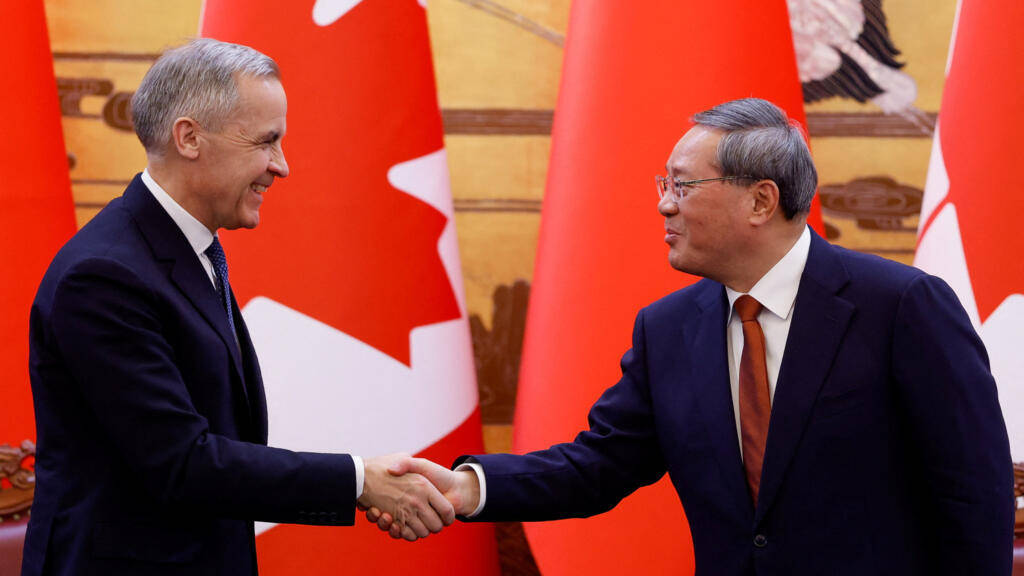
Group 1 - Canada has decided to eliminate 100% tariffs on electric vehicles from China, marking a significant shift in its trade policy and a move away from U.S. influence [1][3] - The agreement allows 49,000 Chinese electric vehicles to enter Canada at a reduced Most Favored Nation tax rate of 6.1%, while China will lower tariffs on Canadian canola from 84% to approximately 15% by March 1 [1][5] - This deal is seen as a strategic maneuver for Canada to address domestic agricultural issues and to gain access to the Chinese market, which is crucial for its resource-dependent economy [3][5] Group 2 - The relationship between Canada and the U.S. has become strained, with Canada feeling that U.S. policies have been detrimental to its interests, particularly in the context of tariffs on aluminum, steel, and softwood [3][5] - The Canadian government under Prime Minister Carney is taking a calculated risk by engaging with China, as it seeks to stabilize its economy and support its agricultural sector while potentially facing U.S. retaliation [5][7] - This shift indicates a broader trend of allies seeking more flexible relationships and prioritizing national interests over traditional alliances, reflecting a potential decline in U.S. hegemony [7]

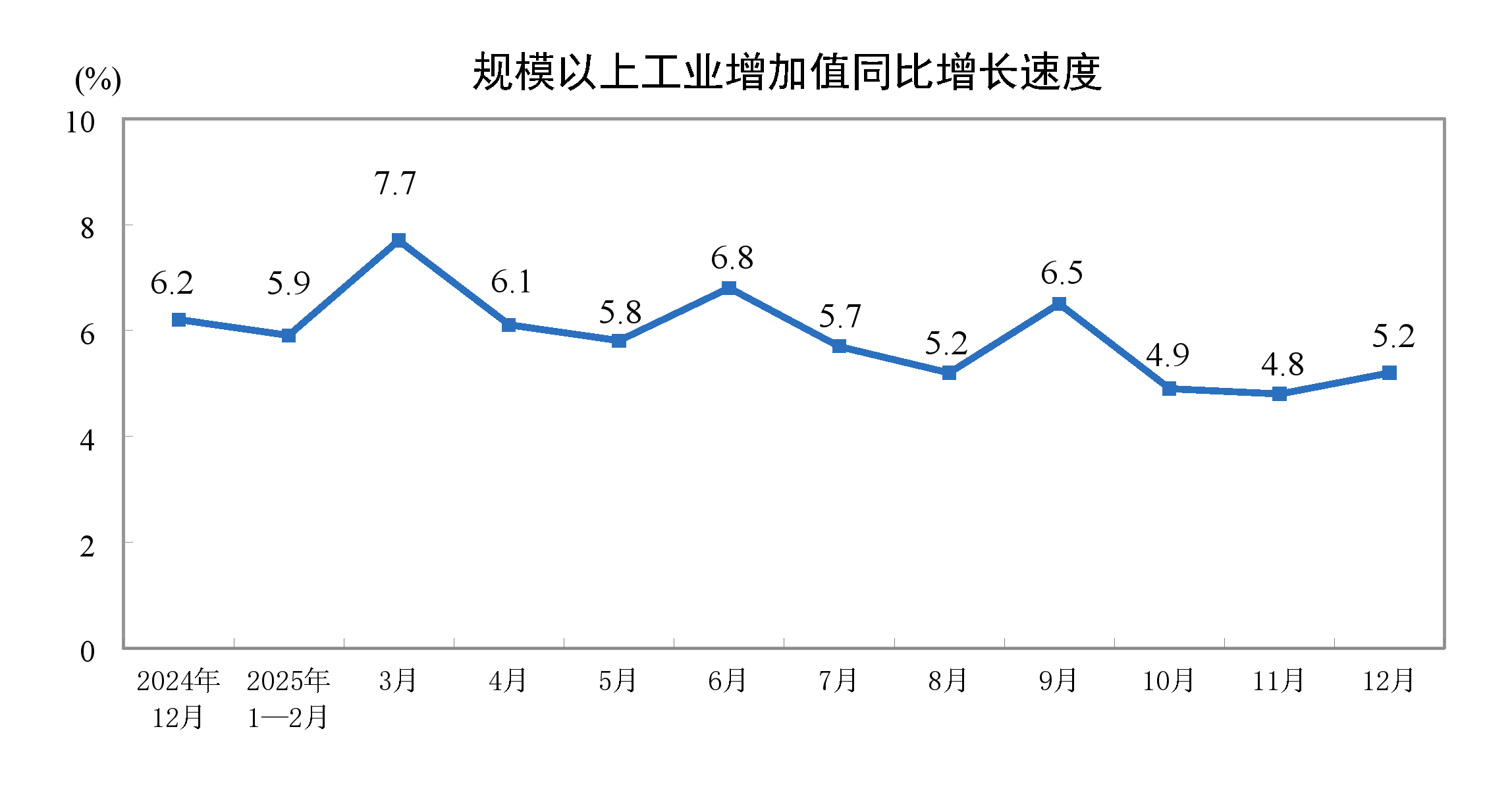
【图解】多数关键指标飘红!一图看懂12月工业数据
Zhong Guo Jing Ji Wang· 2026-01-19 03:41
Core Insights - The industrial added value for large-scale industries in December increased by 5.2% year-on-year and 0.49% month-on-month [1] By Industry Category - Mining industry increased by 5.4% [1] - Manufacturing industry increased by 5.7% [1] - Electricity, heat, gas, and water production and supply industry increased by 0.8% [1] By Economic Type - Shareholding enterprises increased by 5.8% [2] - State-controlled enterprises increased by 3.9% [2] - Foreign and Hong Kong, Macao, and Taiwan enterprises increased by 2.7% [2] - Private enterprises increased by 4.2% [2] By Specific Industries - Out of 41 major industries, 33 maintained year-on-year growth [3] - Coal mining and washing industry increased by 6.4% [3] - Oil and gas extraction industry increased by 3.7% [3] - Food processing industry increased by 3.2% [3] - Beverage and refined tea manufacturing decreased by 0.5% [3] - Textile industry increased by 3.7% [3] - Chemical raw materials and products manufacturing increased by 8.0% [3] - Non-metallic mineral products industry increased by 0.2% [3] - Black metal smelting and rolling industry increased by 0.7% [3] - Non-ferrous metal smelting and rolling industry increased by 4.8% [3] - General equipment manufacturing increased by 7.5% [3] - Specialized equipment manufacturing increased by 8.2% [3] - Automobile manufacturing increased by 8.3% [3] - Railway, ship, aerospace, and other transportation equipment manufacturing increased by 9.2% [3] - Electrical machinery and equipment manufacturing increased by 4.3% [3] By Product - Out of 623 products in large-scale industries, 325 saw year-on-year production growth [4] - Steel production was 115.31 million tons [4] - Cement production was 144.16 million tons, a decrease of 6.6% [4] - Production of ten non-ferrous metals was 7.21 million tons, an increase of 4.9% [4] - Ethylene production was 3.56 million tons, an increase of 3.0% [4] Automotive Sector - Total automobile production was 3.412 million units, a decrease of 2.8% [5] - New energy vehicles production was 1.791 million units, an increase of 8.7% [5] Power Generation - Power generation reached 858.6 billion kWh, an increase of 0.1% [5] - Crude oil processing volume was 62.46 million tons [5]

国家统计局:2025年12月新能源汽车产量同比增长8.7%
Bei Jing Shang Bao· 2026-01-19 02:37
分行业看,12月,41个大类行业中有33个行业增加值保持同比增长,其中,汽车制造业增长8.3%。分 产品看,12月,规模以上工业623种产品中有325种产品产量同比增长。其中,汽车341.2万辆,下降 2.8%;新能源汽车179.1万辆,增长8.7%。 北京商报讯(记者 蔺雨葳)1月19日,国家统计局发布的数据显示,2025年12月,规模以上工业增加值 同比实际增长5.2%。 ...
国家统计局:2025年电力、热力、燃气及水生产和供应业增加值同比增长2.3%
Guo Jia Tong Ji Ju· 2026-01-19 02:31
Economic Growth Overview - In December, the industrial added value increased by 5.2% year-on-year, with mining growing by 5.4%, manufacturing by 5.7%, and electricity, heat, gas, and water production and supply by 0.8% [2][5]. Industry Performance - Among 41 major industries, 33 reported year-on-year growth in added value in December. Notable growth sectors included coal mining and washing (6.4%), oil and gas extraction (3.7%), and food processing (3.2%). However, the beverage and refined tea manufacturing sector saw a decline of 0.5% [3][5]. - High-tech manufacturing experienced significant growth at 11.0% year-on-year [5]. Economic Type Analysis - State-owned enterprises saw a 3.9% increase in added value, while joint-stock enterprises grew by 5.8%. Foreign and Hong Kong, Macau, and Taiwan-invested enterprises increased by 2.7%, and private enterprises grew by 4.2% [3][5]. Product Output - In December, out of 623 industrial products, 325 saw year-on-year output growth. Key products included ten types of non-ferrous metals (721 million tons, up 4.9%), ethylene (356 million tons, up 3.0%), and automotive production (341.2 million units, down 2.8%). Notably, new energy vehicles increased by 8.7% to 179.1 million units [4][6]. Sales and Export Performance - The sales rate for industrial enterprises was 98.2%, a decrease of 0.7 percentage points year-on-year. The export delivery value reached 1,493.2 billion yuan, reflecting a nominal growth of 3.2% year-on-year [4][6].
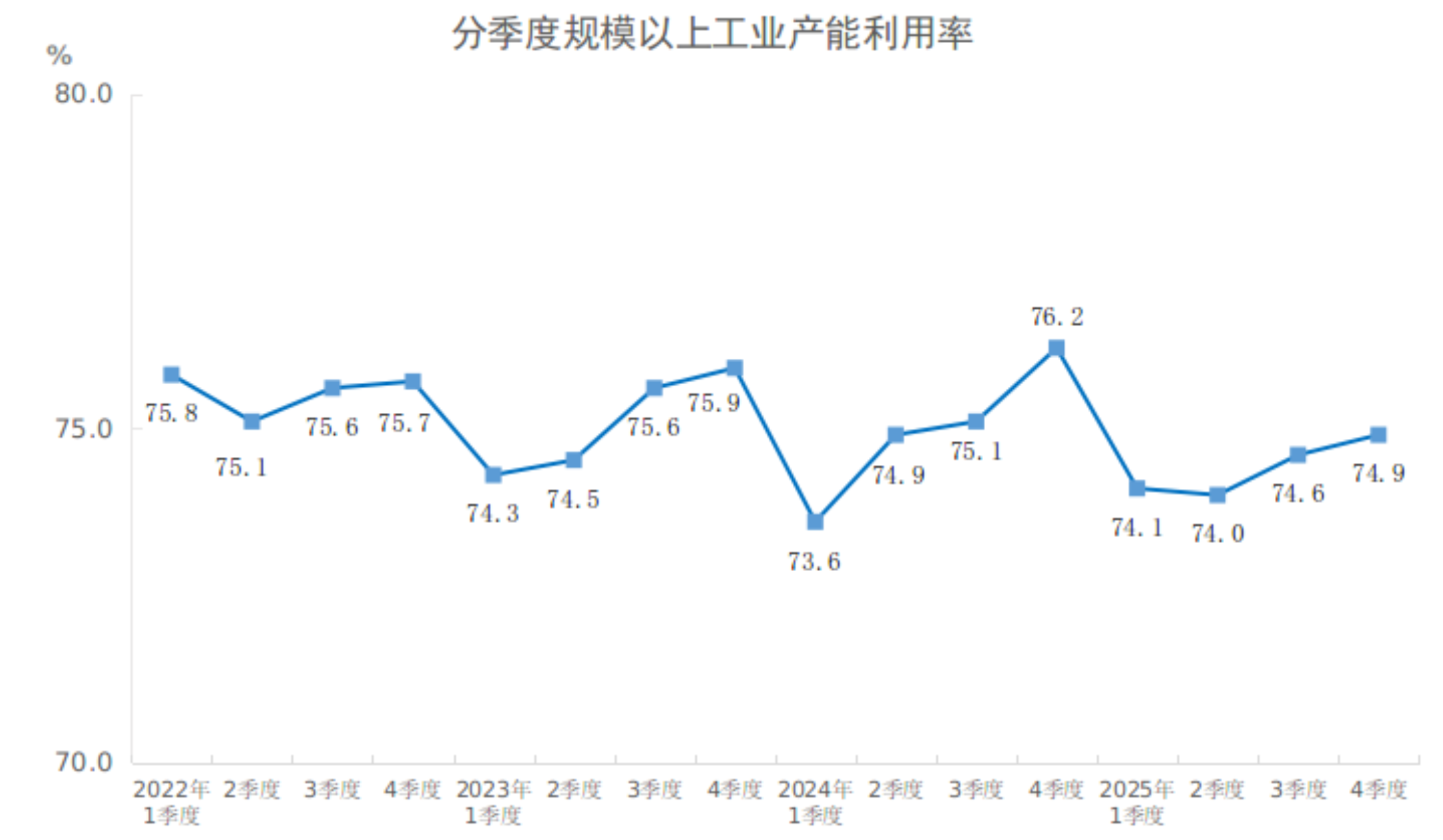
2025年四季度全国规模以上工业产能利用率为74.9%
Guo Jia Tong Ji Ju· 2026-01-19 02:01
Core Viewpoint - The national industrial capacity utilization rate for large-scale industries in Q4 2025 is reported at 74.9%, showing a 0.3 percentage point increase from Q3 but a 1.3 percentage point decrease compared to the same period last year [1][4]. Group 1: Overall Industrial Capacity Utilization - The overall industrial capacity utilization rate for the entire year of 2025 is 74.4%, which is a decrease of 0.6 percentage points from the previous year [6]. - The Q4 capacity utilization rate reflects a mixed performance across different sectors, with some industries experiencing significant declines [6]. Group 2: Sector-Specific Capacity Utilization - In Q4 2025, the mining industry has a capacity utilization rate of 71.7%, down by 3.9 percentage points year-on-year [6]. - The manufacturing sector's capacity utilization rate stands at 75.2%, a decrease of 1.2 percentage points from the previous year [6]. - The electricity, heat, gas, and water production and supply sector shows a capacity utilization rate of 74.0%, down by 0.8 percentage points year-on-year [6]. Group 3: Detailed Industry Breakdown - Coal mining and washing industry has a capacity utilization rate of 69.1%, down by 4.8 percentage points year-on-year [6]. - The food manufacturing industry reports a capacity utilization rate of 68.5%, a decrease of 2.2 percentage points from the previous year [6]. - The textile industry has a capacity utilization rate of 77.1%, down by 1.7 percentage points year-on-year [6]. - The chemical raw materials and products manufacturing industry shows a capacity utilization rate of 74.1%, down by 2.3 percentage points [6]. - The black metal smelting and rolling industry has a capacity utilization rate of 78.5%, with a slight increase of 0.4 percentage points year-on-year [6]. - The automotive manufacturing industry reports a capacity utilization rate of 76.0%, down by 1.2 percentage points from the previous year [6]. - The computer, communication, and other electronic equipment manufacturing industry has a capacity utilization rate of 79.7%, showing a slight increase of 0.3 percentage points year-on-year [6].
新三板打造专精特新服务高地 2025年新增同意挂牌超300家
Zhong Guo Zheng Quan Bao· 2026-01-18 22:55
近日记者从全国股转公司获悉,2025年,全国股转公司新增受理挂牌申请318家(含直联15家),出具 同意挂牌函333家(含直联11家),一批质地优良、结构多元的企业通过新三板实现规范发展,八成新 增同意挂牌企业属于制造业,新三板在精准对接国家战略、服务实体经济方面成效显著。同时,新三板 与北交所的协同联动不断深化,为中小企业构建起全周期资本市场服务体系,切实发挥多层次资本市场 塔基作用。 增量企业质效双优 全国股转公司介绍,2025年新三板挂牌审核工作始终坚持质量导向,形成"增量带动存量"的良性发展格 局。数据显示,2025年新增同意挂牌企业最近一年平均营业收入达8.50亿元,平均净利润6072.24万元, 平均研发投入2892.79万元,分别是存量挂牌公司2024年对应指标的2.74倍、4.68倍、2.26倍,盈利能力 与创新能力显著优于存量企业。 业内人士表示,未来,随着各项改革措施的持续深化,新三板将进一步发挥培育规范功能,与北交所形 成更强协同效应,为创新型中小企业提供更优质的资本市场服务,助力实体经济高质量发展。 值得一提的是,三四板对接绿色通道的品牌效应持续凸显,成为服务专精特新企业的"快车道"。 ...
新三板打造专精特新服务高地
Zhong Guo Zheng Quan Bao· 2026-01-18 20:44
● 本报记者 杨洁 近日记者从全国股转公司获悉,2025年,全国股转公司新增受理挂牌申请318家(含直联15家),出具 同意挂牌函333家(含直联11家),一批质地优良、结构多元的企业通过新三板实现规范发展,八成新 增同意挂牌企业属于制造业,新三板在精准对接国家战略、服务实体经济方面成效显著。同时,新三板 与北交所的协同联动不断深化,为中小企业构建起全周期资本市场服务体系,切实发挥多层次资本市场 塔基作用。 增量企业质效双优 全国股转公司介绍,2025年新三板挂牌审核工作始终坚持质量导向,形成"增量带动存量"的良性发展格 局。数据显示,2025年新增同意挂牌企业最近一年平均营业收入达8.50亿元,平均净利润6072.24万元, 平均研发投入2892.79万元,分别是存量挂牌公司2024年对应指标的2.74倍、4.68倍、2.26倍,盈利能力 与创新能力显著优于存量企业。 2025年,新三板精准对接国家战略,将服务实体经济、普惠金融与专精特新培育紧密结合,形成特色鲜 明的市场定位。2025年新增同意挂牌企业中,50.75%为国家级专精特新"小巨人"企业,33.03%为省级 专精特新企业,新三板通过与工信部专精特 ...
“县”场周周看|两会锚定新目标,拼劲十足抓项目
Sou Hu Cai Jing· 2026-01-18 13:49
Core Viewpoint - The article emphasizes the importance of county-level economies in driving China's modernization, highlighting various counties' economic achievements and future goals in Jiangsu province [1]. Group 1: Economic Performance and Goals - Kunshan has ranked first among China's top 100 counties for 21 consecutive years, with a projected GDP of approximately 560 billion yuan by 2025, outpacing both Suzhou and the provincial average [3]. - Jiangyin aims for a GDP growth of around 5% this year, with a target of 730 billion yuan in fixed asset investment and a 4% increase in retail sales [4]. - Rugao's GDP is expected to reach nearly 170 billion yuan by 2025, with a budget revenue of 8.303 billion yuan, reflecting a growth of 3.8% [6]. - Danyang targets a GDP of over 160 billion yuan by 2025, with a growth rate exceeding the provincial average and a budget revenue of 8.418 billion yuan [6][7]. - Shuyang aims for a GDP increase of over 6% this year, with a budget revenue target of 7.4 billion yuan [9]. Group 2: Development Strategies and Initiatives - Jiangyin's government report outlines a strategy to build a regional center city focused on industrial innovation and ecological living [4]. - Rugao plans to break free from traditional county thinking and embrace competitive strategies to enhance its economic standing [6]. - Danyang's report emphasizes optimizing advantages and showcasing unique characteristics to achieve its development goals [7]. - Shuyang's strategy includes a focus on comprehensive development, aiming for a high-quality living environment and economic prosperity [9]. Group 3: Project Developments and Collaborations - Nanjing's Jiangbei New Area is set to enhance its innovation ecosystem through collaborations in smart laboratory development and digital transformation [11]. - Zhangjiagang has seen significant project advancements, including a $150 million semiconductor equipment project aimed at upgrading the local industry [11]. - New projects in Jiangyan include technological upgrades in textile manufacturing and advancements in low-altitude economy sectors [12].