船舶制造

Search documents
中船集团召开2026年度工作会议|奋力开启建设世界一流船舶集团新征程
Xin Lang Cai Jing· 2026-01-08 22:05
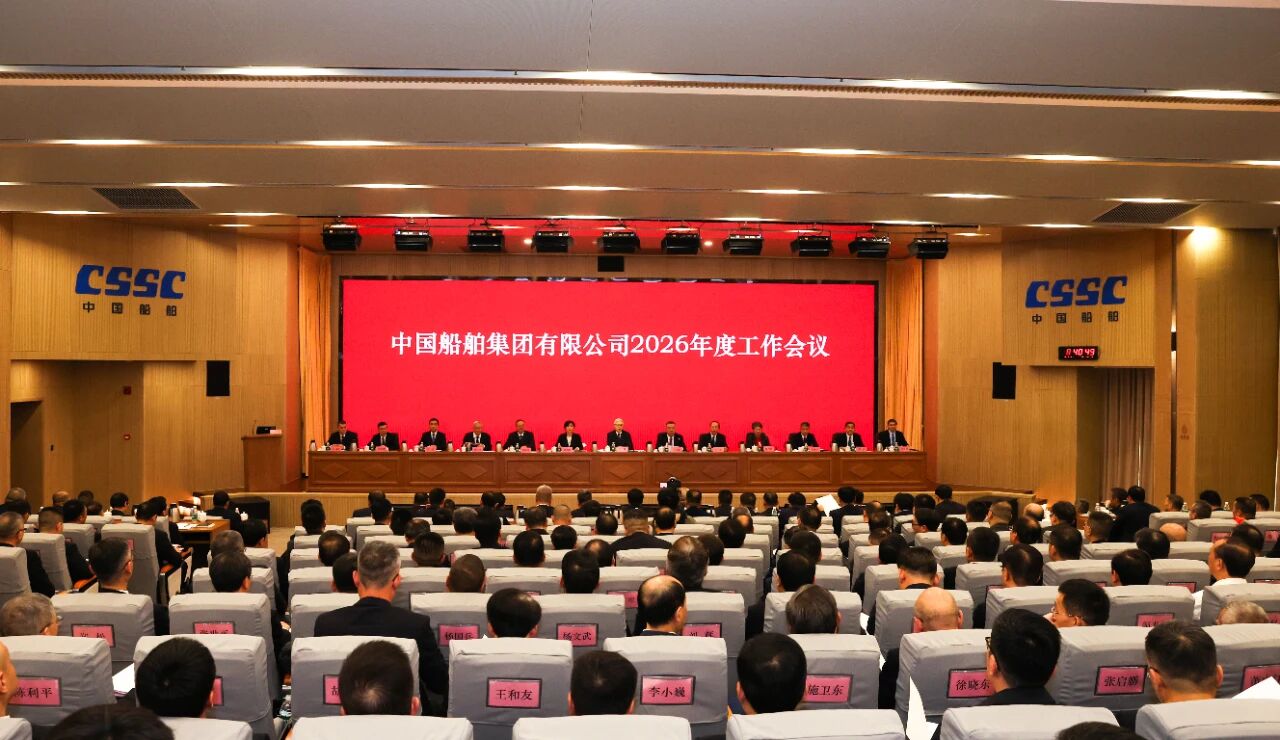
Core Viewpoint - China Shipbuilding Group held its 2026 annual work meeting, emphasizing the importance of adhering to Xi Jinping's thoughts and the directives from the 20th National Congress of the Communist Party of China, aiming to summarize past work and set future tasks [1][3]. Group 1: Meeting Highlights - Xu Peng, the Chairman of China Shipbuilding Group, delivered a report focusing on solidifying foundations, fully exerting efforts, and aiming for world-class shipbuilding capabilities [3]. - The meeting was attended by key executives and board members, highlighting the collective leadership and commitment to the company's strategic goals [3][9]. Group 2: Strategic Goals for 2026 - The company aims to achieve significant contributions during the 14th Five-Year Plan period, focusing on enhancing competitiveness in defense and non-defense sectors, technological innovation, and risk management [3][4]. - The strategic focus includes eight key areas: supporting military development, advancing industrial upgrades, driving innovation, enhancing value creation, reforming for empowerment, digital transformation, ensuring safety, and promoting sustainable development [5]. Group 3: Implementation and Accountability - Wang Guoqiang outlined five key principles for implementing the meeting's resolutions, emphasizing strict adherence, prompt action, practical execution, bold initiatives, and personal involvement from leadership [6]. - The meeting also included recognition of achievements from 2025, such as quality awards and contributions to civilian products, reinforcing the importance of performance accountability [7][6].


中国海防(600764)披露2025年中期权益分派实施公告,1月8日股价上涨4.89%
Sou Hu Cai Jing· 2026-01-08 14:14
Core Viewpoint - China Shipbuilding Industry Corporation (China Haifang) has announced a mid-term profit distribution plan for 2025, which includes a cash dividend of 0.07 yuan per share, reflecting the company's commitment to returning value to shareholders [1] Group 1: Stock Performance - As of January 8, 2026, China Haifang's stock closed at 29.38 yuan, marking a 4.89% increase from the previous trading day [1] - The stock opened at 28.1 yuan, reached a high of 29.7 yuan, and a low of 27.96 yuan, with a trading volume of 7.89 billion yuan and a turnover rate of 3.82% [1] Group 2: Dividend Announcement - The company will distribute a total cash dividend of 49,744,057.02 yuan based on a total share capital of 710,629,386 shares [1] - The record date for the dividend is January 14, 2026, with the ex-dividend date and payment date set for January 15, 2026 [1] - Individual shareholders and securities investment funds will be subject to a differentiated personal income tax policy based on their holding period, while QFII and Shanghai Stock Connect investors will have a withholding tax rate of 10% [1]

周建祥任中船澄西董事长、张新龙任总经理
Xin Lang Cai Jing· 2026-01-08 11:44
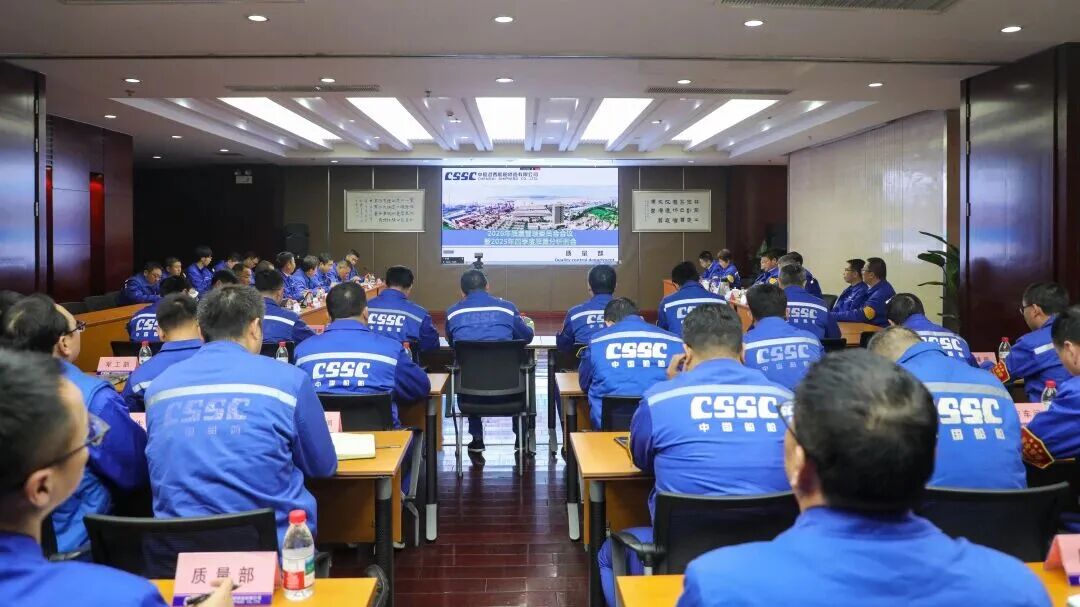
Core Viewpoint - China Shipbuilding Group's subsidiary, CSSC Chengxi Shipyard Co., Ltd., is actively engaging in quality management and safety production initiatives to enhance operational efficiency and safety standards in the shipbuilding and repair industry [1][3][5]. Group 1: Company Overview - CSSC Chengxi is a member of China Shipbuilding Group, focusing on four main business sectors: defense industry, shipbuilding and marine engineering, application industry, and marine services [5][9]. - The company operates three production bases: Chengxi Headquarters, Chengxi Equipment, and Chengxi Yangzhou, with capabilities to repair and modify 200 vessels of 20,000 tons and below annually, construct 17 vessels of the Karsam type and below, produce 200,000 tons of steel structures, and manufacture 500 wind power towers each year [5][9]. - The headquarters is strategically located in Jiangyin, a key transportation hub in the Su-Xi-Chang economic belt, only 80 nautical miles from the Yangtze River estuary, covering an area of 770,000 square meters with extensive docking facilities [5][9]. Group 2: Recent Meetings and Initiatives - On January 6, CSSC Chengxi held the 2026 Quality Management Committee meeting and the 2025 Q4 Quality Analysis meeting, attended by key executives including Chairman Zhou Jianxiang and General Manager Zhang Xinlong [1]. - On January 4, the company conducted its first Safety Production Committee meeting for 2026, which included signing responsibility agreements related to safety, environmental protection, occupational health, fire safety, and security [3][7].
交付新船72艘!上海三大船企年度成绩单
Xin Lang Cai Jing· 2026-01-08 11:44
Core Insights - In 2025, China's shipbuilding industry, represented by China Shipbuilding Group's three major companies, delivered a total of 72 new ships, reinforcing its leading position in the global high-end ship market and facilitating a transition from "scale leadership" to "quality and scale co-leadership" [1][12]. Group 1: High-End Ship Delivery and Structural Optimization - The three major shipbuilding companies in Shanghai achieved batch deliveries in the high-end ship sector, optimizing their product structure towards high technology and high added value, characterized by "stable quantity, improved quality, and structural optimization" [5][16]. - Jiangnan Shipyard delivered 28 ships, including 6 large container ships, 10 very large ethane carriers (VLEC), 3 LNG carriers, and 4 PCTCs, showcasing its dominance in large container and high-end gas transport vessels [5][16]. - Hudong-Zhonghua delivered 15 ships, including 11 LNG carriers and 4 dual-fuel container ships, achieving the highest construction efficiency for NO96-type LNG carriers globally [6][17]. - Waigaoqiao Shipbuilding delivered 29 ships, exceeding its annual target by 7 vessels, with a significant portion of its deliveries being Aframax tankers, which are expected to account for 9.98% of the global fleet [6][17]. Group 2: Technological Innovation and Green Development - The three major shipbuilding companies prioritized technological innovation, aligning with global trends towards green and low-carbon development, and increased R&D investments [7][18]. - Jiangnan Shipyard developed several new ship types that received approval from major international classification societies, including a 19,200 cubic meter LNG carrier and a 19,000 TEU LNG & battery hybrid container ship [8][19]. - Hudong-Zhonghua and Waigaoqiao Shipbuilding also achieved significant certifications for their innovative vessels, enhancing their competitive edge in the market [8][19]. Group 3: Supply Chain and Localization - The companies focused on enhancing the localization of key components in their supply chains, with Jiangnan Shipyard taking on significant projects to ensure core technologies are domestically controlled [9][20]. - Hudong-Zhonghua expanded its supply chain ecosystem, increasing the number of domestic LNG supporting enterprises from over 20 to more than 130, creating a market worth hundreds of billions [9][20]. Group 4: Digital Transformation and Smart Manufacturing - Digital transformation and smart upgrades became strategic foundations for enhancing core competitiveness, with the companies integrating digital technologies across all processes [10][21]. - Jiangnan Shipyard and Hudong-Zhonghua were recognized for their advanced smart factory projects, while Waigaoqiao Shipbuilding achieved a high-level certification for its digital transformation efforts [10][21]. - The shift towards digital and intelligent manufacturing is expected to significantly improve production efficiency and product quality, marking a transition to an "intelligent shipbuilding" era [10][21]. Group 5: Overall Industry Outlook - 2025 marked a year of significant achievements for the three major shipbuilding companies, reflecting the robust strength and responsibility of China's shipbuilding industry [11][22]. - The companies are committed to continuing their focus on technological innovation and digital transformation to support China's transition from a major shipbuilding nation to a strong shipbuilding power [11][22].

我国首艘集成式大型压裂船开启试航
Xin Lang Cai Jing· 2026-01-08 11:43
"海洋石油696"号由中国船舶集团有限公司旗下上海船舶研究设计院自主研发设计,是一艘高度集成化、自动化、数 字化、智能化,且总体性能达到世界先进水平的集成式一体化压裂船。该船总长99.8米,型宽22米,型深9.9米,建 成后将满足我国全海域大规模压裂作业、海上多井次批量化压裂作业,以及气井、超深层压裂作业等新需求,填补 我国海上油田压裂技术和工程领域的空白,具有重要的战略意义。 该船压裂作业能力强、集成化程度高、推进性能优越、自动化程度高且绿色智能,具有大排量、高功率、大存储量 的安全作业能力,是中国首艘集成式海上油田压裂工程船,其总体性能达到了世界领先水平。该型船主要用于海上 低渗油气田潜力储量开采,可最大化提升单井井控储量、累产和整体采收率,达到稳产增产的目的。 在船舶建造的重要节点中,"建造完工"与"试航"紧密衔接,共同构成船舶交付前的关键环节。建造完工是指完成船 舶物理建造,包括船体结构、设备安装等,使其达到可交付状态。而试航是建造完工后进行的实船试验与验收,通 过实际操作验证性能是否符合技术规范,是交付前的最终检验。 2025年12月28日,芜湖造船厂为中国海油建造的我国首艘集成式大型压裂船"海洋石 ...

暗盘大涨26%!
中国基金报· 2026-01-08 11:14
Core Viewpoint - The article highlights the performance of the Hong Kong stock market on January 8, 2023, with a notable increase in MINIMAX's stock price ahead of its IPO, indicating strong investor interest in AI-related companies [2][9]. Market Performance - On January 8, the Hang Seng Index fell by 1.17% to 26,149.31 points, with a total market turnover of HKD 268.3 billion and net selling by southbound funds amounting to HKD 4.901 billion [2][3]. - The Hang Seng Technology Index decreased by 1.05%, while the Hang Seng China Enterprises Index dropped by 1.09% [3]. Sector Performance - The technology sector saw more declines than gains, with automotive dealership stocks collectively falling, while military stocks showed strength, particularly China Shipbuilding Defense, which rose by 6.59% [4][5]. Military Industry Outlook - A report from Guotai Junan indicates a positive long-term trend for the military industry, driven by the Chinese government's commitment to modernizing defense and military capabilities as outlined in the recent Central Committee meeting [6]. IPO Highlights - MINIMAX, an AI company, is set to debut on the Hong Kong Stock Exchange on January 9, 2023, with its shares trading at HKD 208.00 in the dark market, reflecting a 26.06% increase from the offering price [9][10]. - The IPO was significantly oversubscribed, with a subscription rate of 1,209 times for the public offering portion [12]. - Key cornerstone investors in MINIMAX include major funds and institutions, collectively subscribing to 18,034,240 shares, representing 71.03% of the offering [11]. Other IPOs - On the same day, three new stocks were listed on the Hong Kong Stock Exchange, with notable gains: Jingfeng Medical-B up by 30.90%, Tianshu Zhixin up by 8.44%, and Zhipu AI, the first global model company, up by 13.17% [8]. Company Ratings - Daiwa raised the rating for Goldwind Technology from "Hold" to "Outperform," citing potential investment returns and a share buyback plan that could support the stock price [14].
主力资金丨10股遭主力资金大幅出逃
Zheng Quan Shi Bao Wang· 2026-01-08 11:02
Group 1 - The core viewpoint of the news highlights the significant net inflow of funds into the defense and computer industries, each exceeding 1.1 billion yuan, amidst a mixed performance of A-share indices on January 8 [1] - The A-share market saw a total net outflow of 37.435 billion yuan, with 12 industries experiencing net inflows, including defense, computer, banking, building materials, and automotive sectors [1] - The electronic industry faced the largest net outflow, amounting to 14.155 billion yuan, followed by communication, non-ferrous metals, and power equipment sectors, each exceeding 3 billion yuan in outflows [1] Group 2 - Individual stocks showed that 61 had net inflows exceeding 200 million yuan, with 10 stocks receiving over 500 million yuan in net inflows [2] - Notable individual stock inflows included Aerospace Science and Technology, Hailanxin, Hand Information, and Qian Zhao Optoelectronics, with net inflows of 910 million yuan, 887 million yuan, 847 million yuan, and 730 million yuan respectively [3] - Hailanxin's stock reached a "20cm" limit up, focusing on marine electronic technology products and systems [3] Group 3 - Hand Information submitted an application for overseas listing (H-shares) to the Hong Kong Stock Exchange on December 29, 2025 [4] - A total of 90 stocks experienced net outflows exceeding 200 million yuan, with significant outflows from stocks like Zhongji Xuchuang, Luxshare Precision, and Aerospace Development, each exceeding 1 billion yuan [4] Group 4 - At the market close, the total net outflow was 658 million yuan, with the power equipment sector seeing a net inflow exceeding 1 billion yuan [5] - Individual stocks such as Goldwind Technology and Qian Zhao Optoelectronics had substantial net inflows exceeding 400 million yuan at the close [5] - Stocks like Zhongji Xuchuang, New Yisheng, and Huhua Electric experienced net outflows exceeding 200 million yuan at the close [6]


技术看市:沪指15连阳释放重要信号,市场进入良性循环,谨防部分指数顶部结构
Jin Rong Jie· 2026-01-08 10:58
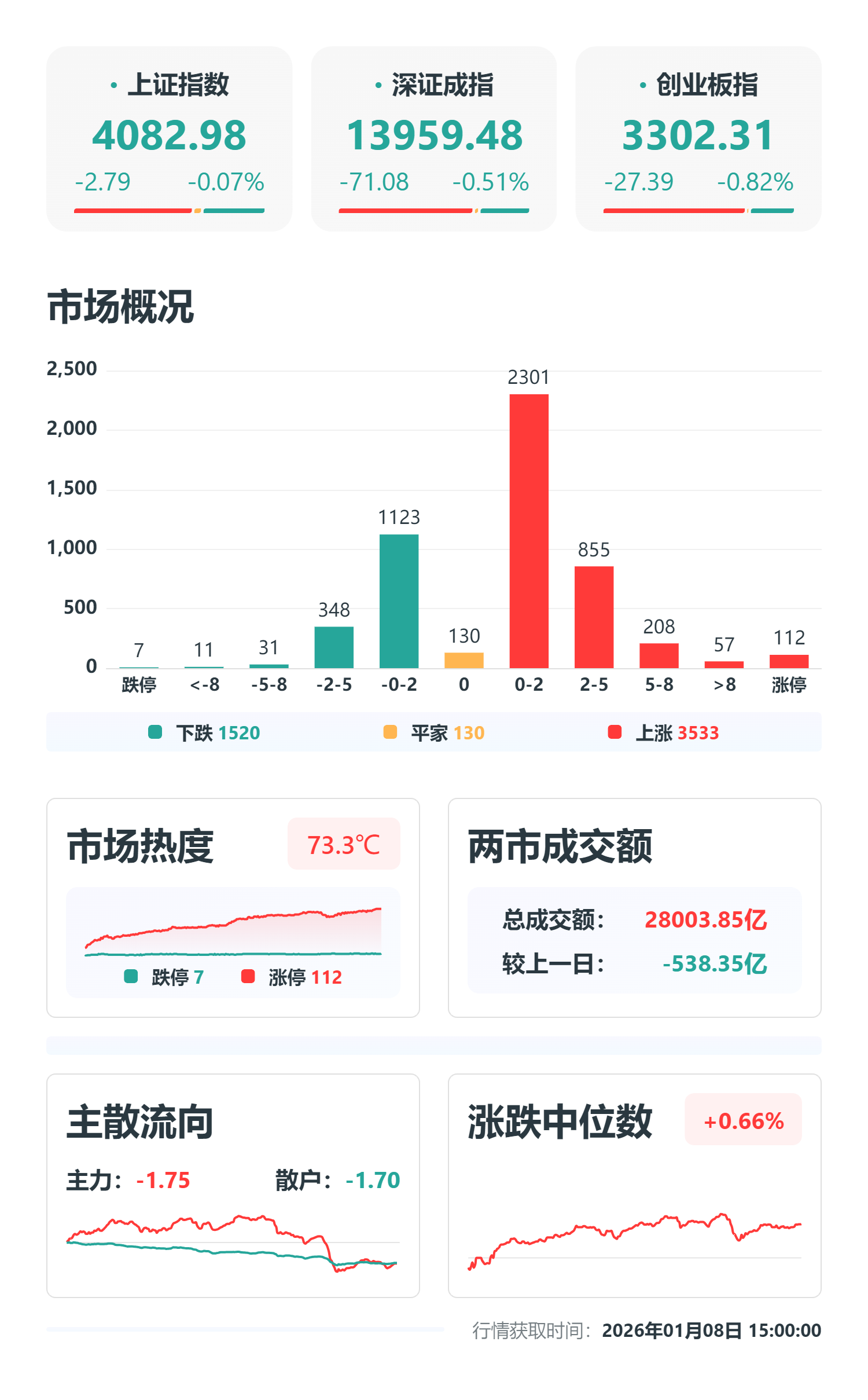
Group 1 - The A-share market experienced a slight decline after a 15-day consecutive rise, with the Shanghai Composite Index down 0.07% to 4082.98 points, and the Shenzhen Component Index down 0.51% [1] - The total trading volume in the Shanghai and Shenzhen markets was 2.80 trillion yuan, a decrease of approximately 538.34 billion yuan compared to the previous trading day, with a net outflow of 536.40 billion yuan from major funds [1] - Among the sectors, aerospace and aviation saw a net inflow of 46.53 billion yuan, while communication equipment experienced the largest net outflow of 95.05 billion yuan [1] Group 2 - Key sectors that saw significant gains included space computing power, shipbuilding, phased array antennas, deep-sea technology, and low-orbit satellites, while silver, energy metals, tungsten, insurance, and brokerage firms faced notable declines [7] - Market expert Xu Xiaoming noted that the consecutive rise of the Shanghai Composite Index is a record not seen in many years, although the overall increase is modest [8] - Xu highlighted that there is a divergence among the indices, indicating a potential top structure, with the Shanghai Composite, CSI 500, and Shanghai 50 showing signs of stabilization, while the Shenzhen Component, ChiNext, and CSI 300 indices still exhibit significant divergence [8]
10.33亿主力资金净流入,中船系概念涨3.64%
Zheng Quan Shi Bao Wang· 2026-01-08 09:32
Core Viewpoint - The China Shipbuilding sector has shown a significant increase, with a rise of 3.64% as of the market close on January 8, positioning it as the fourth highest in terms of growth among concept sectors [1]. Group 1: Sector Performance - Within the China Shipbuilding sector, ten stocks experienced gains, with Jiuzhiyang, China Haifang, and China Shipbuilding leading the way, rising by 6.71%, 4.89%, and 4.09% respectively [1]. - The top-performing concept sectors for the day included domestic aircraft carriers at 4.70%, military information technology at 4.20%, and terahertz technology at 4.14%, while the China Shipbuilding sector followed closely [2]. Group 2: Capital Inflow - The China Shipbuilding sector attracted a net inflow of 1.033 billion yuan from main funds, with eight stocks receiving net inflows, and seven of those exceeding 10 million yuan [2]. - China Shipbuilding led the sector with a net inflow of 726 million yuan, followed by Jiuzhiyang and China Haifang with net inflows of 168 million yuan and 92.9 million yuan respectively [2]. - In terms of capital inflow ratios, China Shipbuilding, China Haifang, and ST Emergency had the highest net inflow rates at 13.48%, 11.78%, and 9.53% respectively [3]. Group 3: Individual Stock Performance - The top stocks in the China Shipbuilding sector based on daily performance included: - China Shipbuilding: 4.09% increase, 2.01% turnover rate, and a main fund flow of 725.63 million yuan with a net inflow ratio of 13.48% [4]. - Jiuzhiyang: 6.71% increase, 13.31% turnover rate, and a main fund flow of 167.61 million yuan with a net inflow ratio of 8.04% [4]. - China Haifang: 4.89% increase, 3.82% turnover rate, and a main fund flow of 92.92 million yuan with a net inflow ratio of 11.78% [4].


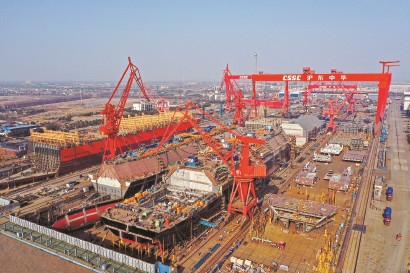
沪东中华基地马力全开 造船订单已排满至2029年
Ren Min Wang· 2026-01-08 09:20
Core Viewpoint - The shipbuilding industry is experiencing a significant surge in demand, with Hudong-Zhonghua Shipbuilding's Changxing Island base operating at full capacity and a record number of LNG ship orders in progress [2] Group 1: Company Operations - Hudong-Zhonghua Shipbuilding is currently constructing a record 24 LNG ships simultaneously in a single dock [2] - The company holds over 50 LNG ship orders and more than 30 large container ship orders, indicating strong future production commitments [2] - Production tasks at Hudong-Zhonghua are fully booked until 2029, reflecting robust demand in the shipbuilding sector [2]