
钨

Search documents
再论稀土-钨-铀战略价值
2026-03-22 14:35
Summary of Key Points from Conference Call Records Industry Overview - The conference call discusses the strategic value of rare earths, tungsten, and uranium, highlighting their market dynamics and investment opportunities in the context of geopolitical tensions and macroeconomic conditions [1][2][3][4]. Tungsten Market Insights - Tungsten concentrate prices have stabilized around 1.03 million CNY per ton, driven by war narratives and consistent demand for ammunition and inventory replenishment [1][2]. - Despite a price increase of 7 to 8 times over the past year, the demand driven by war-related consumption is expected to sustain the high price levels for the next 2-3 years [2][3]. - The supply side is anticipated to see some incremental increases in 2026-2027, but these are unlikely to offset the demand driven by military spending [2][3]. - Companies to watch include Zhongtung High-tech and Xiamen Tungsten, which have resource growth expectations, as well as China Uranium and CGN Mining, which are entering a favorable valuation range [1][3]. Rare Earth Market Dynamics - After the Spring Festival in 2026, prices for praseodymium and neodymium oxide have retreated due to increased downstream operating rates and the conclusion of proactive inventory replenishment [3]. - Despite the price drop, processing fees for medium and heavy rare earths remain strong, indicating a scarcity in the smelting segment rather than at the mining level [3]. - The long-term upward trend in rare earth prices remains intact, supported by strong demand in high-tech sectors and overseas inventory replenishment needs [3]. - Key companies to consider include Northern Rare Earth, China Rare Earth, and Shenghe Resources, particularly in the context of macroeconomic hedging against geopolitical uncertainties [3]. Uranium Market Analysis - The spot price of natural uranium has stabilized around $86, with a backwardation situation compared to the long-term price of approximately $90 [4]. - 2026 is projected to be a pivotal year for the uranium industry, marked by capital expenditure expansion, inventory replenishment, and price increases [4]. - The adjustment in stock prices is attributed to both commodity price pressures and valuation concerns, but companies like China Uranium and CGN Mining are expected to enter a highly favorable valuation range if stock prices continue to adjust [4]. - Investment opportunities are highlighted in the context of the upcoming nuclear power projects in China, with a focus on the strong resource growth potential of CGN Mining [4]. Additional Considerations - The overall sentiment in the tungsten market remains cautious, with a focus on the balance between supply and demand amid ongoing geopolitical tensions [2][3]. - The rare earth sector is seen as a macro hedge against the backdrop of de-globalization and U.S.-China relations, emphasizing the importance of strategic resource allocation [3].
有色金属行业研究:有色金属周报:宏观扰动错杀,看好钨、稀土价格走稳回升-20260322
SINOLINK SECURITIES· 2026-03-22 11:40
Investment Ratings - The report does not explicitly provide investment ratings for the industries discussed. Core Insights - The report highlights significant price declines across various metals, including copper, aluminum, and gold, driven by macroeconomic factors and geopolitical tensions. The overall sentiment indicates a cautious outlook for the near term, with potential recovery in specific sectors anticipated due to underlying demand dynamics [12][15][62]. Summary by Sections Copper - LME copper price decreased by 7.07% to $11,834.5 per ton, while Shanghai copper fell by 5.55% to ¥94,700 per ton. The processing fee for imported copper concentrate dropped to -$67.32 per ton. National copper inventory decreased by 8.85% week-on-week, but increased by 17.67% year-on-year. The operating rate of waste anode plate enterprises fell to 58.31%, with expectations of further decline to 54.65% next week. Cable enterprises saw a slight increase in orders, but overall operating rates only rose by 3.93% to 70.52% due to cautious purchasing sentiment [13][14]. Aluminum - LME aluminum price fell by 7.18% to $3,192.0 per ton, and Shanghai aluminum decreased by 3.77% to ¥24,000 per ton. Domestic aluminum rod inventory decreased to 369,500 tons. The operating rate of downstream aluminum processing enterprises slightly increased by 1% to 62.9%, indicating a slight recovery in demand. The operating rate for aluminum foil enterprises rose to 73.6%, supported by strong orders for battery and packaging foils [14]. Gold - COMEX gold price dropped by 10.36% to $4,492.0 per ounce, with SPDR gold holdings decreasing by 13.72 tons to 1,056.99 tons. Geopolitical risks, particularly related to the ongoing conflict involving Israel and Iran, have contributed to market volatility. The report notes that the situation remains fluid, with potential implications for energy supply and prices [15]. Rare Earths - The price of praseodymium-neodymium oxide decreased by 12.44% to ¥702,800 per ton. The report anticipates a gradual recovery in prices due to improved demand and easing export restrictions. Key companies to watch include China Rare Earth, Northern Rare Earth, and Baotou Steel Rare Earth [39][40]. Tungsten - Tungsten prices fell by 3.00%, attributed to profit-taking by traders rather than a fundamental downturn. The report suggests that tungsten remains a priority due to increased strategic stockpiling overseas [42]. Lithium - The average price of lithium carbonate decreased by 2.2% to ¥154,300 per ton, while lithium hydroxide fell by 2.8% to ¥153,500 per ton. Lithium production increased to 24,200 tons, with a slight rise in inventory levels. The market is characterized by cautious purchasing behavior, with upstream suppliers reluctant to sell at lower prices [63]. Cobalt - Cobalt prices decreased by 0.2% to ¥431,000 per ton, with stable demand expected to support prices in the medium term. The report highlights a steady upward trend in cobalt's market dynamics [64].
钨行业月度跟踪:2月供给收缩支撑钨价加速上行,关注新年度开采总量控制指标-20260306
Xiangcai Securities· 2026-03-06 07:48
Investment Rating - The industry investment rating is maintained at "Overweight" [2][41] Core Insights - The tungsten industry continues to show strong market performance, with a cumulative increase of 35.91% in February, significantly outperforming the benchmark (CSI 300) by 35.82 percentage points [5] - The valuation of the industry (TTM P/E ratio) has risen from 55.45x at the beginning of the month to 75.76x, currently at 97.52% of its historical percentile [5] - Domestic tungsten product prices have surged due to tight resource supply, with significant increases in both black and white tungsten concentrate prices [6][8] - The international tungsten prices have also risen, reflecting the upward trend in domestic prices [8] Monthly Performance Summary - In February, the domestic tungsten concentrate price for 65% black tungsten increased by 32.89% month-on-month to 684,500 CNY/ton, and by 375.35% year-on-year [8] - The price for 65% white tungsten rose by 32.92% month-on-month to 682,000 CNY/ton, with a year-on-year increase of 379.06% [8] - The ammonium paratungstate (88.5%) price increased by 32.63% month-on-month to 1,006,000 CNY/ton, with a year-on-year increase of 374.87% [8] - Tungsten powder prices also saw significant month-on-month increases, with prices for tungsten powder (≥99.7%, 2-10um) rising by 37.32% to 1,717.5 CNY/kg, and a year-on-year increase of 440.99% [8] Supply and Demand Dynamics - The tungsten supply chain is experiencing a seasonal decline in production, exacerbating supply tightness, with domestic tungsten concentrate production dropping by 39.46% month-on-month in February [9] - The operating rate for tungsten concentrate production fell to 35.31%, below the previous year's levels during the Spring Festival [9] - Inventory levels across the tungsten supply chain are at historical lows, with significant reductions in stock for tungsten concentrate, ammonium paratungstate, and tungsten powder [11] Profit Distribution and Market Outlook - The profit margins for tungsten concentrate are expanding due to resource scarcity and price increases, with simulated gross profit reaching 539,400 CNY/ton, a month-on-month growth of 50.71% [11] - The midstream sector is also seeing profit expansion, while the downstream sector faces pressure due to cost transmission issues [11] - Long-term, the tightening of tungsten supply due to various factors, including declining ore grades and stricter mining controls, is expected to support higher tungsten prices [11][38] - The report suggests that the first batch of tungsten mining control indicators for 2026 is expected to tighten, reinforcing the supply constraint logic [38]

量化大势研判202603:3月核心推荐预期成长风格
Guolian Minsheng Securities· 2026-03-04 07:27
Quantitative Models and Construction Methods - **Model Name**: Quantitative Market Trend Judgment Framework **Model Construction Idea**: The model aims to identify the dominant market style by comparing asset characteristics and prioritizing superior assets based on their intrinsic attributes. It incorporates a bottom-up quantitative approach to analyze the lifecycle of industries and their corresponding asset styles[6][10][17] **Model Construction Process**: 1. Define five asset style stages: external growth, quality growth, quality dividend, value dividend, and bankruptcy value[6] 2. Use a priority framework of $g > ROE > D$ to evaluate assets based on growth expectations, profitability, and dividend yield[6][7] 3. Compare mainstream assets (expected growth, actual growth, and profitability) and secondary assets (quality dividend, value dividend, and bankruptcy value) based on their crowding levels and fundamental factors[10][17] 4. Allocate industries using equal weights within each strategy, selecting five industries per strategy per period[17] **Model Evaluation**: The framework has demonstrated strong explanatory power for A-share market style rotations since 2009, achieving an annualized return of 27.81%[17] Quantitative Factors and Construction Methods - **Factor Name**: Expected Growth ($gf$) **Factor Construction Idea**: Measures the expected growth rate of industries based on analysts' forecasts, regardless of the lifecycle stage[7] **Factor Construction Process**: 1. Calculate the expected net profit growth rate ($g_{f,ttm}$) for each industry 2. Rank industries based on $g_{f,ttm}$ and select the top-performing ones[7][23] **Factor Evaluation**: The factor has shown consistent performance in identifying high-growth industries, with significant excess returns since 2019[37] - **Factor Name**: Actual Growth ($g$) **Factor Construction Idea**: Focuses on industries with the highest performance momentum ($\Delta g$), particularly during transition and growth phases[7] **Factor Construction Process**: 1. Calculate the actual net profit growth rate ($g_{ttm}$) for each industry 2. Identify industries with the highest $\Delta g$ values[7][27] **Factor Evaluation**: The factor has delivered strong excess returns in growth-dominated environments[38] - **Factor Name**: Profitability (ROE) **Factor Construction Idea**: Targets industries with high ROE and low valuation under the PB-ROE framework, focusing on mature phases[7] **Factor Construction Process**: 1. Calculate the PB-ROE residuals for each industry 2. Rank industries based on residuals and select the top-performing ones[7][41] **Factor Evaluation**: The factor performed well from 2016 to 2020 but weakened from 2021 to mid-2024[41] - **Factor Name**: Quality Dividend (DP+ROE) **Factor Construction Idea**: Combines dividend yield (DP) and ROE to identify high-quality industries, focusing on mature phases[7] **Factor Construction Process**: 1. Calculate DP and ROE for each industry 2. Combine the two metrics into a composite score and rank industries[7][44] **Factor Evaluation**: The factor has shown significant excess returns in 2016, 2017, and 2023[44] - **Factor Name**: Value Dividend (DP+BP) **Factor Construction Idea**: Combines dividend yield (DP) and book-to-price ratio (BP) to identify undervalued industries, focusing on mature phases[7] **Factor Construction Process**: 1. Calculate DP and BP for each industry 2. Combine the two metrics into a composite score and rank industries[7][47] **Factor Evaluation**: The factor has delivered strong excess returns in 2009, 2017, and 2021-2023[47] - **Factor Name**: Bankruptcy Value (PB+SIZE) **Factor Construction Idea**: Targets industries with low PB and small size, focusing on stagnation and recession phases[7] **Factor Construction Process**: 1. Calculate PB and SIZE for each industry 2. Combine the two metrics into a composite score and rank industries[7][50] **Factor Evaluation**: The factor has shown significant excess returns in 2015-2016 and 2021-2023[50] Model Backtesting Results - **Quantitative Market Trend Judgment Framework**: - Annualized return: 27.81% since 2009 - Significant excess returns in 2017, 2020, 2021, and 2022[17][20] Factor Backtesting Results - **Expected Growth ($gf$)**: - Recent performance: Top industries include automotive sales, lithium battery equipment, and tungsten, with mixed returns over the past three months (e.g., -4.47% for automotive sales, +0.25% for lithium battery equipment)[37] - **Actual Growth ($g$)**: - Recent performance: Top industries include photovoltaic equipment and insurance, with mixed returns over the past three months (e.g., -8.92% for photovoltaic equipment, -6.04% for insurance)[39] - **Profitability (ROE)**: - Recent performance: Top industries include agriculture and garden engineering, with mixed returns over the past three months (e.g., -4.19% for agriculture, -2.07% for garden engineering)[41] - **Quality Dividend (DP+ROE)**: - Recent performance: Top industries include forestry and lithium battery equipment, with mixed returns over the past three months (e.g., +1.21% for forestry, +0.25% for lithium battery equipment)[44] - **Value Dividend (DP+BP)**: - Recent performance: Top industries include security and buses, with mixed returns over the past three months (e.g., +6.09% for security, +12.65% for buses)[47] - **Bankruptcy Value (PB+SIZE)**: - Recent performance: Top industries include automotive sales and textile products, with mixed returns over the past three months (e.g., -4.47% for automotive sales, +4.09% for textile products)[50]
中钨高新(000657):PCB微钻领先者,钨矿资源注入可期
BOHAI SECURITIES· 2026-03-03 09:24
Investment Rating - The report assigns an "Accumulate" rating to the company, indicating a positive outlook for its future performance [4][8]. Core Insights - The company, a subsidiary of China Minmetals, is positioned to benefit from rising tungsten prices, with significant profit growth expected as high-quality tungsten resources are injected into the company starting in 2024 [1][4]. - The tungsten industry is characterized by strong supply rigidity and supported demand, with China's dominance in tungsten resources and limited growth in global production capacity [2][24]. - The company is set to enhance its profitability through the injection of tungsten resources and expansion in PCB micro-drill production, capitalizing on the growing demand driven by advancements in AI and automation [3][4]. Summary by Sections Company Overview - The company operates across multiple segments of the tungsten industry, from mining to deep processing, and has been a publicly listed entity since 1996. It has been under the control of China Minmetals since 2010, which has facilitated the injection of various tungsten assets into the company [18][19]. Tungsten Industry Dynamics - China holds over 80% of the global tungsten supply and more than 50% of tungsten reserves, with strict controls on mining operations limiting short-term supply growth. The demand for tungsten is expected to be supported by various sectors, including automation, military spending, and renewable energy [2][26][30]. Resource Injection and Production Expansion - The company currently controls five tungsten mines, with a self-supply rate exceeding 70%. The injection of additional mines is anticipated by 2029, which, along with the expansion of existing operations, is expected to significantly boost revenue from mining activities [3][4]. - The company’s subsidiary, Jinzhou, is a leading supplier of PCB micro-drills, with production capacity set to increase significantly in response to rising demand from the AI sector [3][4]. Financial Projections - The report forecasts the company's net profit for 2025 to be approximately 1.32 billion yuan, with expected growth rates of 40.7% and 37.8% for the following years [4][6]. The earnings per share (EPS) are projected to rise from 0.58 yuan in 2025 to 1.00 yuan by 2027 [4][9].
A股二月收官 沪指月线三连阳 涨价主线大幅领跑
Shang Hai Zheng Quan Bao· 2026-02-27 19:04
Market Overview - The A-share market concluded February with the Shanghai Composite Index closing at 4162.88 points, up 0.39%, marking a monthly increase of 1.09% and achieving three consecutive monthly gains [2] - The Shenzhen Component Index decreased by 0.06%, while the ChiNext Index fell by 1.04% [2] - Trading activity remained robust post-Spring Festival, with the total trading volume exceeding 2.2 trillion yuan for four consecutive trading days, and a daily trading volume of approximately 2.51 trillion yuan on February 27 [2] Price Increase Themes - Price increase themes emerged as the core investment logic throughout February, with the chemical and non-ferrous metal sectors showing significant strength [3] - The chemical sector experienced rapid internal rotation, with notable gains in dye and phosphate chemical segments, such as a 32% increase for Chuyuan Co. and a 58% increase for Jinzhengda [3] - The non-ferrous metal sector was highlighted by a 78% increase in Zhangyuan Tungsten's stock, driven by strict supply-side controls and recovering demand [3][4] Company Highlights - YN Holdings saw a remarkable monthly increase of 115%, driven by its dual focus on computing power and electricity integration [5] - Following an announcement on February 11 regarding its acquisition of Zhengzhou Heying Data Co., YN Holdings' stock surged from 6.85 yuan to 13.34 yuan, nearly doubling in value [5] - The company is expected to achieve a net profit of 305 million to 391 million yuan by 2025, attributed to declining power generation costs and improved operational performance [6] Institutional Insights - Institutions believe that the price increase logic will continue to be significant in March, with price increases serving as a direct signal of performance improvement and economic recovery [7] - The market is expected to validate price increase signals in March and April, with a broader range of sectors likely to experience price increases [7] - East Wu Securities suggests that sectors related to oil and gas, non-ferrous metals, chemicals, and public utilities may become the main focus, alongside technology hardware related to AI narratives [8]



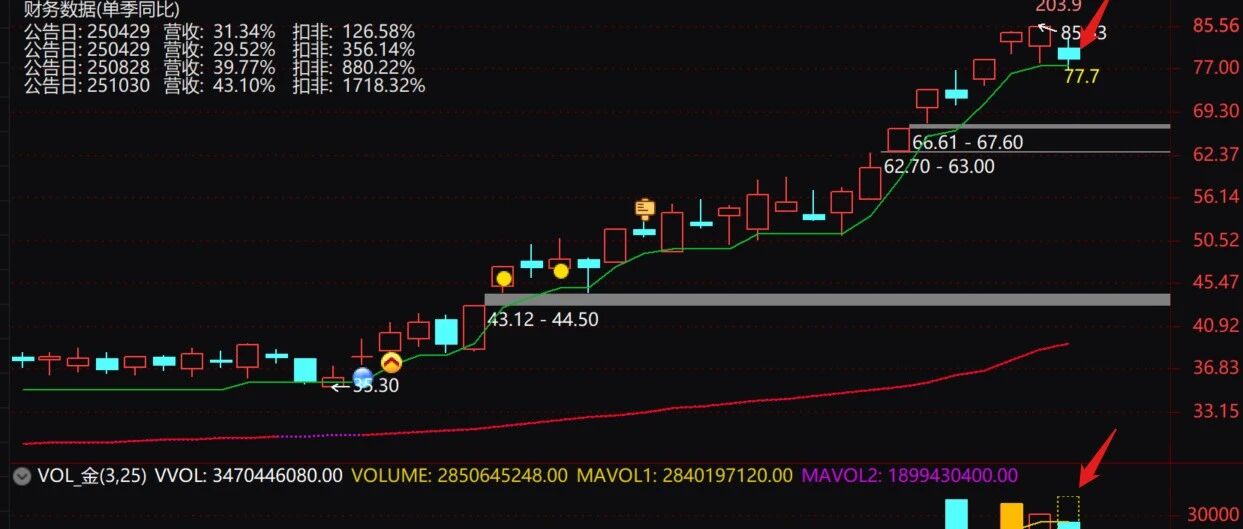
放量反切阴线如何处理
猛兽派选股· 2026-02-27 14:16
Group 1 - The article discusses the recent market fluctuations in the fiberglass sector, indicating that while there are pullbacks, leading stocks like Honghe are still showing resilience, suggesting a cautious approach to holding positions [1][2] - International composite materials are experiencing similar pullbacks but are maintaining their positions above key support levels, indicating potential for continued investment [2] - Companies like Jushi and Zhongcai are performing well, and it is advised to continue holding shares while planning for potential reductions in positions to manage risk [3] Group 2 - A price increase announcement from Japanese giant Resonac for copper-clad laminates by 30% due to rising upstream material costs highlights the price transmission effect in the market, suggesting a strategic shift towards copper-clad laminates may be beneficial [4] - The article emphasizes the importance of analyzing market movements, including volume and price action, to make informed decisions about reducing positions in stocks like tungsten, which have shown signs of volatility [6] - The performance of companies like Weichai Power and Yingliu is analyzed, with specific financial metrics provided, indicating their current market standing and potential for future growth [8][10]
章源钨业6天4板!章源钨业9:45再度涨停,背后逻辑揭晓
Jin Rong Jie· 2026-02-26 02:03
Group 1 - The core viewpoint of the article highlights the recent active performance of Zhangyuan Tungsten Industry, which has achieved a six-day streak of four consecutive trading limits [1] - The stock reached a trading limit at 9:45 AM with a transaction amount of 1.572 billion yuan and a turnover rate of 3.63% [1] - The increase in tungsten raw material prices has led to a rise in production costs for the company, prompting a price adjustment for its welding machine blade products [1] Group 2 - The non-ferrous tungsten sector has recently attracted market attention, resulting in active performance of related stocks [1]

国泰海通 · 晨报260226|银行、有色
国泰海通证券研究· 2026-02-25 14:22
Group 1: Core Insights - The article highlights a significant increase in short-term loans from large banks, while credit growth in small and medium-sized banks is slowing down [1][4]. - The article discusses the impact of the Spring Festival on deposit fluctuations, noting a year-on-year increase of 3.5 trillion yuan in unit deposits, with a notable shift of personal deposits from small to large banks [2][4]. - The investment strategy for the banking sector in 2026 focuses on identifying targets with potential for growth, banks with convertible bond expectations, and maintaining a dividend strategy [5]. Group 2: Liability Side - Unit deposits saw a year-on-year increase of 3.5 trillion yuan, with demand for current deposits rising by 2.5 trillion yuan and a decrease in time deposits by 912 billion yuan, attributed to the Spring Festival's timing [2]. - Personal deposits experienced a year-on-year increase of only 3.3 trillion yuan, with current and time savings deposits decreasing by 1.9 trillion yuan and 398.7 billion yuan respectively, indicating a migration trend from small to large banks [2]. - Non-bank deposits increased by 2.9 trillion yuan, with large banks contributing 2.2 trillion yuan and small banks 646.1 billion yuan, driven by a low base effect from regulatory changes [2]. Group 3: Asset Side - Total loans decreased by 489.3 billion yuan year-on-year, with large banks and small banks seeing reductions of 213 billion yuan and 276.3 billion yuan respectively, reflecting subdued credit demand and increased pressure on small banks [4]. - Short-term loans saw a significant increase of 347.8 billion yuan, with large banks experiencing a rise of 419.7 billion yuan, driven by both corporate and consumer short-term loans [4]. - Bond investments increased by 205.7 billion yuan year-on-year, with large banks increasing by 376 billion yuan and small banks decreasing by 170.3 billion yuan [4][5].

继续看多稀土、钨,锡价或迎拐点
2026-02-25 04:10
Summary of Conference Call on Metal Market Trends Industry Overview - The conference focused on the metal market, particularly rare earths, tungsten, and tin, indicating a bullish outlook for these sectors. The discussion highlighted the potential turning points in tin prices and the strong performance of rare earths and tungsten [1][2]. Key Points and Arguments Rare Earths - The analysts maintain a bullish stance on rare earths, citing strong supply and demand dynamics as key drivers for price increases. They predict that prices will reach new highs due to a combination of supply constraints and increased demand [3][4]. - The supply side is expected to undergo significant changes starting in 2024, with new regulations aimed at eliminating non-compliant supply, which could reduce supply by approximately 5-10% [6][7]. - The price of rare earths has already shown a significant increase, with prices rising from around 500,000 to 850,000 per ton, driven by regulatory changes and increased processing fees [5][6]. - The demand for rare earths is anticipated to strengthen, particularly due to overseas inventory replenishment and strategic stockpiling, with a projected supply-demand imbalance of about 10% in 2026 [9][10]. Tungsten - Tungsten is also highlighted as a strong investment opportunity, with both civilian and military demand contributing to price increases. The analysts expect prices to rise significantly, potentially reaching 1,000,000 per ton by 2026 [15][17]. - The demand for tungsten is closely linked to global manufacturing trends, with a strong correlation to PMI (Purchasing Managers' Index) indicating robust industrial activity [15][16]. - The analysts emphasize that the current low inventory levels across the supply chain further support the bullish outlook for tungsten prices [17]. Tin - The tin market is expected to experience upward pressure due to potential export restrictions from Indonesia, which accounts for about 15% of global tin supply. This could lead to a significant reduction in supply and increased prices [18][19]. - The analysts predict that tin prices could rebound to the range of 400,000 to 500,000 per ton in the short term, driven by supply constraints and increased demand from sectors like AI and electric vehicles [19][20]. Other Metals - The discussion also touched on antimony and molybdenum, with expectations of recovery in exports and potential price increases due to supply-demand dynamics [21][22]. - The analysts noted that molybdenum could serve as a substitute for tungsten in certain applications, which may further drive demand [22][23]. Additional Insights - The analysts highlighted the importance of regulatory changes and geopolitical factors in shaping the metal markets, particularly for rare earths and tungsten [14][18]. - There is a strong emphasis on the potential for asset consolidation within the industry, particularly among companies facing competitive pressures, which could enhance market valuations [11][12][13]. Conclusion - The overall sentiment from the conference is one of optimism for the metal markets, particularly for rare earths, tungsten, and tin, with significant price increases expected in the coming years due to supply constraints and robust demand [14][23].


