智能汽车

Search documents
从“汽车大脑”到“机器人大脑”,横跨两大高景气赛道的黑芝麻智能(02533)有望加速价值跃迁
智通财经网· 2025-11-21 01:08
Core Viewpoint - Black Sesame Intelligence has officially entered a new phase of "vehicle-machine" technology collaboration, launching the SesameX™ multi-dimensional computing platform aimed at full-brain intelligence [1][9]. Company Overview - Black Sesame Intelligence has developed the SesameX platform as a comprehensive computing solution for robotics, integrating hardware, software, toolchains, and model ecosystems, marking it as the industry's first platform for commercial deployment in robotics [3][8]. - The SesameX platform consists of three major computing platforms: SesameX Kalos for commercial service robots and light autonomous devices, SesameX Aura for multi-task execution and special operation robots, and SesameX Liora for embodied intelligence and advanced self-evolving robots, covering all types of robots [5][6]. Technological Advancements - SesameX Liora is designed for humanoid robots and advanced bionic robots, featuring over 500 TOPS of efficient NPU computing power and a variety of processing capabilities, including multi-channel visual perception [6]. - The platform aims to overcome reliability bottlenecks in computing, enabling real-time, precise, and stable collaboration between decision-making and control systems in complex environments [7]. Market Potential - The humanoid robot market in China is projected to reach 10.471 billion yuan by 2026, with a compound annual growth rate of 83.7% until 2030, and is expected to exceed 300 billion yuan by 2035 [8]. - Black Sesame Intelligence is strategically positioned to benefit from the rapid growth of the robotics industry, leveraging its SesameX platform to address core bottlenecks in large-scale production and establishing unique competitive barriers [8]. Strategic Direction - The launch of the SesameX platform represents a critical step in Black Sesame Intelligence's strategy to transition from "empowering smart vehicles" to "empowering intelligent terminals," aiming to define the next generation of robotic "intelligence hubs" [9]. - The company is expected to accelerate its market share in the burgeoning embodied intelligence market, driven by the high degree of technological and supply chain overlap between smart vehicles and robotics [9].


直击车展 | MoLA架构发布 鸿蒙座舱率先迈入L3专业助理阶段
Xin Lang Ke Ji· 2025-11-21 00:47
Core Viewpoint - Huawei's HarmonyOS cockpit has entered the L3 professional assistant stage, showcasing advanced capabilities such as long-term memory and fuzzy intent understanding [1] Group 1: Technological Advancements - The L3 stage offers proactive service capabilities, allowing the cockpit to remember user commuting habits and create scenarios automatically [1] - The cockpit can answer vehicle-related questions through mixed media formats and can link with external tools for tasks like coffee reservations [1] Group 2: MoLA Architecture - The MoLA mixed large model Agent architecture was introduced, which integrates multi-modal perception, general large models, and domain-specific intelligent agents [1] - MoLA establishes a complete link from user intent to hardware execution, enhancing the overall user experience [1] Group 3: User Metrics - The number of HarmonyOS cockpit users has surpassed 1.2 million [1] - The average net promoter score for the AITO models equipped with HarmonyOS from January to October 2025 is 93.6% [1]
华为乾崑技术再升级 生态更融合 智能汽车迈入“安全美好”新阶段
Zhong Guo Zheng Quan Bao· 2025-11-21 00:44
Core Insights - The Huawei QianKun Ecological Conference highlighted the transition of the smart automotive industry from single-vehicle intelligence to ecosystem integration, emphasizing the vision of making travel safer and life better through technology [1] - The conference showcased significant technological upgrades and ecosystem service achievements, providing a strategic blueprint for Huawei QianKun and practical examples for the entire industry [1] Group 1: Technological Advancements - The QianKun Intelligent Driving ADS series upgrade was a focal point, with the ADS 4 Pro featuring the innovative Limera sensor for real-time data fusion, capable of identifying obstacles even at high speeds [2] - The ADS 4 Max version introduces eAES 2.0, enabling proactive maneuvers in critical situations, with an OTA update planned for Q1 2026 to enhance navigation assistance across over 20 vehicle models [2] - Huawei has invested over 50 billion yuan in R&D for QianKun Intelligent Driving, with 10 billion yuan allocated for 2024, achieving significant advancements in AI capabilities [2] Group 2: Market Performance - As of October 2025, vehicles equipped with QianKun Intelligent Driving surpassed 100,000 units sold, with a market share of 27.8% for urban navigation assistance and over 50% in the luxury segment priced above 350,000 yuan [3] - The HarmonySpace 5 smart cockpit has entered the L3 era, enhancing user interaction through a more intuitive interface [3] - New high-end smart brands, such as Qijiang and Yijing, were introduced in collaboration with GAC and Dongfeng, respectively, aiming to cater to diverse consumer segments [3] Group 3: Ecosystem Development - The shift from vehicles as mere transportation tools to smart terminals is underway, with the introduction of the "10-minute QianKun Intelligent Driving Life Circle" concept, facilitating seamless services like parking and charging [4] - Collaborations with partners like Keta, Star Charging, and Tuhu Car Maintenance are enabling practical implementations of this life circle, enhancing user convenience [4] - The launch of the QianKun Intelligent Driving ecosystem open platform aims to provide a one-stop vehicle experience by integrating services such as parking, charging, and insurance [4] Group 4: Industry Collaboration - Huawei QianKun is addressing industry challenges by providing technical standards to upstream suppliers and assisting automakers in enhancing their smart capabilities [5] - Continuous upgrades from ADS 2 to ADS 4 allow existing users to benefit from new features, improving user experience and reducing costs [5] - The establishment of a closed-loop ecosystem encompassing technology, products, and services positions Huawei QianKun to accelerate the adoption of smart technologies and enhance China's competitive edge in the global automotive market [5]
辰奕智能单季营收降14%首亏220.7万 推2.89亿收购跨界智能汽车座舱谋突围
Chang Jiang Shang Bao· 2025-11-20 23:57
Core Viewpoint - The company, Chenyi Intelligent (301578), is planning its first capital operation by acquiring a 55% stake in Dongguan Huaze Electronics for 289 million yuan, aiming to enter the smart automotive cockpit controller market [1][2]. Group 1: Acquisition Details - The acquisition marks Chenyi Intelligent's first capital operation since its listing in December 2023 [2]. - The company signed a framework agreement with Huaze Electronics' shareholders, with the final transaction details to be determined after due diligence and negotiations [2][3]. - Huaze Electronics, established in April 2010, has a registered capital of 30 million yuan, with major shareholders holding 89% of the company [2]. Group 2: Financial Performance - Chenyi Intelligent's financial performance has been under pressure, with a decline in revenue and net profit in 2024 and the first three quarters of 2025 [1][6]. - In Q3 2025, the company reported a revenue of 186 million yuan, a year-on-year decrease of 14.03%, and a net loss of 2.21 million yuan, marking its first quarterly loss since listing [1][6]. - The company's revenue for 2023 was 720 million yuan, a decline of 3.31%, while the net profit was 91 million yuan, a growth of only 2.23% [5]. Group 3: Strategic Rationale - The acquisition is seen as a strategic move to enhance Chenyi Intelligent's competitiveness in the smart home and automotive sectors, leveraging synergies between the two companies [6]. - The company believes that its existing technology in smart home products aligns well with Huaze Electronics' automotive technologies, potentially improving market competitiveness and profitability [6]. - The performance commitment from Huaze Electronics includes a net profit target of at least 150 million yuan over three years, with specific annual targets set for 2025 to 2027 [3].
黑客大会上,汽车厂商被群嘲
汽车商业评论· 2025-11-20 23:07
Core Viewpoint - The article highlights the increasing cybersecurity risks faced by the automotive industry, particularly with the rise of "software-defined vehicles" and the vulnerabilities that come with advanced technologies like autonomous driving and connected car systems [8][24][30]. Group 1: Cybersecurity Challenges - The automotive industry is experiencing a surge in cybersecurity threats, with approximately 3 million attacks on smart driving privacy data reported in China since 2020 [8]. - High-profile data breaches have occurred, such as the leak of 22,800 internal employee records and 399,000 user ID card data from NIO, leading to a ransom demand of $2.25 million in Bitcoin [9]. - In 2024, a configuration error in BMW's cloud storage exposed sensitive internal data, highlighting the industry's vulnerabilities [12]. Group 2: Vulnerabilities in Smart Vehicles - Remote attacks pose significant risks, as hackers can potentially take control of vehicles through vulnerabilities in onboard networks and communication systems [15][20]. - A notable incident involved hackers attempting to exploit a vulnerability in Tesla's OTA system to interfere with vehicle operation, which was fortunately intercepted by Tesla's security team [16]. - The automotive industry is criticized for its slow response to cybersecurity threats, with many companies prioritizing speed to market over thorough security testing [28]. Group 3: Industry Response and Collaboration - Despite the challenges, automotive companies are beginning to recognize the importance of cybersecurity and are collaborating with ethical hackers to identify and fix vulnerabilities [30][32]. - Tesla has been proactive in engaging with white hat hackers through bounty programs and competitions, offering substantial rewards for discovering security flaws [33][35]. - Regulatory frameworks are being established globally, such as the EU's Automotive Cybersecurity Law and various regulations in China, to enforce stringent cybersecurity standards throughout the vehicle lifecycle [37].

【小米集团(1810.HK)】汽车业务首次单季盈利转正,但手机&汽车毛利率或将面临压力——2025三季度业绩点评(付天姿/黄铮)
光大证券研究· 2025-11-20 23:03
Core Viewpoint - The company reported strong financial performance in Q3 2025, with significant growth in revenue and net profit, driven by innovative business segments like smart cars and AI [4]. Group 1: Financial Performance - Q3 2025 revenue reached 113.1 billion yuan, representing a year-over-year increase of 22.3% but a quarter-over-quarter decrease of 2.4% [4]. - Non-IFRS net profit for Q3 2025 was 11.3 billion yuan, up 80.9% year-over-year and 4.4% quarter-over-quarter, with a corresponding net profit margin of 10% [4]. Group 2: Smartphone Business - Revenue from smartphone sales in Q3 2025 was 46 billion yuan, down 3.1% year-over-year but up 1% quarter-over-quarter [5]. - The company shipped 43.3 million smartphones, achieving a slight year-over-year increase of 0.5%, maintaining a top-three global market share for 21 consecutive quarters [5]. - The average selling price (ASP) of smartphones decreased to 1,062.8 yuan, down 3.6% year-over-year and 1% quarter-over-quarter, primarily due to declining ASP in overseas markets [5]. - Smartphone gross margin was 11.1%, a decrease of 0.6 percentage points year-over-year and 0.4 percentage points quarter-over-quarter, impacted by rising core component prices and intensified competition in mainland China [5]. Group 3: IoT Business - IoT revenue for Q3 2025 was 27.6 billion yuan, reflecting a year-over-year increase of 5.6% but a significant quarter-over-quarter decline of 28.8% [6]. - The gross margin for IoT improved to 23.9%, up 3.1 percentage points year-over-year and 1.4 percentage points quarter-over-quarter, driven by higher sales of high-margin products [6]. - The company faces challenges in the IoT segment due to seasonal fluctuations and increased competition, with future strategies focusing on international expansion and product positioning [6]. Group 4: Internet Advertising - Internet revenue reached 9.4 billion yuan in Q3 2025, a year-over-year increase of 10.8% and a quarter-over-quarter increase of 3.1%, marking a historical high [7]. - The number of global monthly active users reached 742 million, up 8.2% year-over-year [7]. - Advertising revenue grew by 17.4% year-over-year to 7.2 billion yuan, with overseas internet revenue also increasing by 19.1% to 3.3 billion yuan, both achieving historical highs [8]. Group 5: Automotive Business - Revenue from automotive and innovative businesses was 29 billion yuan in Q3 2025, a year-over-year increase of 199.2% and a quarter-over-quarter increase of 36.4% [9]. - The company delivered 109,000 vehicles, with an ASP of 260,000 yuan, benefiting from high ASP models like Xiaomi YU7 and SU7 Ultra [9]. - The automotive segment achieved a gross margin of 25.5% and recorded a positive operating profit of 700 million yuan for the first time in a single quarter [9].

"境",来了!华为汽车,新"境界"!
Zheng Quan Shi Bao· 2025-11-20 20:36
Core Insights - Huawei has officially launched its new smart car brand "Jing" series, which includes the "Qijing" and "Yijing" models, complementing the existing "Jie" series, marking a significant expansion in Huawei's automotive ecosystem [1][4] - The "Gankun" brand, introduced by Huawei, focuses on smart driving solutions and includes products like the Gankun Intelligent Driving System and Gankun Digital Platform [1] - The CEO of Qijing announced plans to release an SUV and a sedan by mid-next year, both equipped with Huawei's L3 autonomous driving system [1] Market Performance - From January to September 2025, new car sales in China with urban navigation assistance reached 1.628 million units, with Huawei's Gankun solutions capturing a market share of 27.8% [2] - In the luxury car segment priced above 350,000 yuan, Huawei's Gankun solutions account for 53%, indicating strong penetration in the high-end market [2] - In October alone, sales of models equipped with Gankun Intelligent Driving exceeded 100,000 units [2] R&D Investment - Huawei has invested over 50 billion yuan in the overall development of Gankun Intelligent Driving, with an expected investment of over 10 billion yuan in the car business unit in 2024 [3] - The R&D investment for ADS 5 has reached 10 billion yuan, showcasing Huawei's commitment to building a technological "moat" through intensive and comprehensive self-research [3] Strategic Partnerships - The collaboration between Dongfeng and Huawei is characterized by significant investment, with both companies forming a dedicated team to support the development of the new brands [4] - The "Yijing" brand is positioned as a high-end smart car brand, with its first model set to debut at the Beijing Auto Show next year, maintaining an annual launch schedule for new models [3] Ecosystem Expansion - Huawei's automotive business has transitioned from initial exploration to a phase of scaling up, with its models covering a wide price range from tens of thousands to over a million yuan [4] - Major state-owned car manufacturers and companies like BYD are increasingly adopting Huawei's Gankun Intelligent Driving solutions, indicating a growing ecosystem [4]
华为乾崑技术再升级 生态更融合
Zhong Guo Zheng Quan Bao· 2025-11-20 20:09
Core Insights - The Huawei QianKun Ecological Conference highlighted the transition of the smart automotive industry from single-vehicle intelligence to ecosystem integration, emphasizing the vision of making travel safer and life better through technology [1][2] Technology and Product Development - Huawei QianKun's core competitiveness is built on a continuously iterating technology ecosystem and a comprehensive product layout, with significant R&D investments exceeding 50 billion yuan and over 10 billion yuan planned for 2024 [2] - The ADS 4 Pro enhanced version features the Limera sensor for real-time data fusion, enabling advanced obstacle recognition even at high speeds [2] - The ADS 4 Max version introduces eAES 2.0 for proactive evasive maneuvers and safe parking after tire blowouts, with an OTA update scheduled for Q1 2026 [2] - Sales data indicates that over 100,000 vehicles equipped with QianKun technology were sold by October 2025, with a market share of 27.8% for urban navigation assistance in the luxury segment [3] User-Centric Innovations - The HarmonySpace 5 smart cockpit has entered the L3 era, allowing for seamless interaction without wake-up commands, enhancing user experience [3] - New vehicle models, including the high-end brand "Qijing" in collaboration with GAC and the "Yijing" brand with Dongfeng, are set to launch in mid-2026, featuring the latest QianKun technologies [3] Ecosystem and Industry Collaboration - The smart automotive sector is evolving into an intelligent terminal, with the "10-minute QianKun driving life circle" concept facilitating seamless services like parking, charging, and car washing [4] - Collaborations with partners such as Keta Co., Star Charging, and Tuhu Car Maintenance are enabling practical implementations of the service ecosystem, including automated parking and charging solutions [4][5] - The QianKun ecosystem aims to address industry pain points by providing technology standards to upstream suppliers and supporting automakers in enhancing their smart capabilities [5] Strategic Vision - Huawei QianKun is building a closed-loop ecosystem of technology, products, and services, aiming to accelerate the adoption of smart technologies and position the Chinese smart automotive industry competitively on a global scale [5]
鸿蒙智行首款MPV或落地智界品牌
Mei Ri Jing Ji Xin Wen· 2025-11-20 18:33
Core Viewpoint - Huawei's Executive Director, Yu Chengdong, announced that the first MPV of the HarmonyOS Smart Driving will officially launch, potentially under the Zhijie brand, featuring advanced technology and dual power options [1] Group 1 - The new MPV is built on a high-end platform and will include a "pure HarmonyOS" cockpit and an ADS high-level intelligent driving system [1] - The vehicle will offer both pure electric and range-extended power options [1] - Yu Chengdong claimed that the new vehicle will surpass all existing MPVs on the market [1]
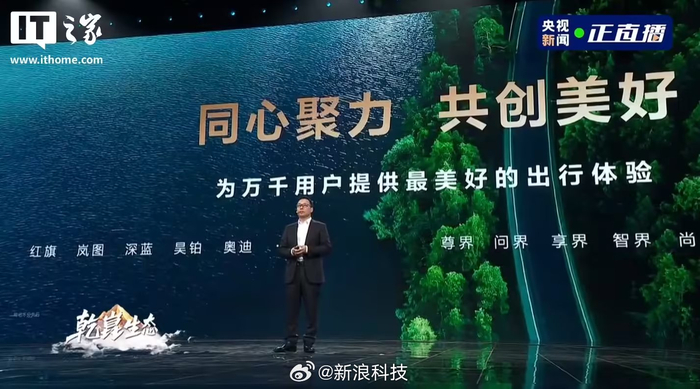
一汽红旗确认与华为合作,明年推全栈华为方案车型
Xin Lang Ke Ji· 2025-11-20 15:26
Core Insights - FAW Hongqi has officially confirmed its partnership with Huawei during the Huawei QianKun Ecological Conference [1] - The collaboration will see the launch of a new model next year that incorporates Huawei's full-stack solutions, including QianKun Intelligent Driving, HarmonyOS Cockpit, QianKun Vehicle Control, and QianKun Cloud Services [1] Group 1 - FAW Hongqi's partnership with Huawei marks a significant step in the automotive industry, focusing on advanced technology integration [1] - The new model set to launch next year will leverage Huawei's comprehensive automotive solutions, indicating a shift towards more intelligent vehicle features [1]