冰雪装备制造

Search documents
“尔滨”3.0,不止有冰雪!
Xin Lang Cai Jing· 2026-01-05 06:23
Core Viewpoint - The article highlights the upcoming 2026 Harbin International Ice and Snow Economic Expo, emphasizing its role in promoting Harbin as a hub for ice and snow-related industries and tourism, showcasing a comprehensive approach to the ice and snow economy that includes various sectors and opportunities for businesses [3][26]. Group 1: Event Overview - The Harbin International Ice and Snow Economic Expo will take place from January 6 to 8, 2026, featuring ice sculptures and a wide range of activities [3]. - The expo aims to present a "full-chain win" approach to the ice and snow economy, covering everything from equipment manufacturing to tourism operations [14][26]. Group 2: Economic Opportunities - The event is designed to attract both international and local businesses, with over 300 domestic and foreign enterprises expected to participate, including representatives from ice and snow industry powerhouses like Canada and Finland [26]. - The expo will serve as a platform for cross-border cooperation, enhancing Harbin's global business network and positioning it as a key player in the ice and snow economy [22][24]. Group 3: Community Engagement - The expo will feature over 300 million square meters of interactive experience areas, promoting a vibrant atmosphere for visitors and enhancing the overall experience of the ice and snow culture [4]. - Local culinary offerings will be integrated into the event, showcasing a blend of northern and southern Chinese cuisines, further enriching the visitor experience [10][12]. Group 4: Technological Integration - The expo will highlight advancements in technology related to the ice and snow industry, including VR skiing experiences and smart ice control systems, showcasing the innovative aspects of the sector [18][21]. - The event will also focus on the integration of technology with traditional ice and snow activities, appealing to a broader audience and enhancing engagement [22].


瞭望·治国理政纪事丨把冰雪经济打造成新的增长点
Xin Hua She· 2026-01-04 02:06
Core Viewpoint - The development of the ice and snow economy in Heilongjiang is positioned as a new growth point for high-quality development and international cooperation, transforming natural resources into cultural and economic assets [1][4][28]. Group 1: Policy and Strategic Initiatives - In 2024, the State Council issued opinions to promote the high-quality development of the ice and snow economy, emphasizing the integration of ice and snow sports, culture, equipment, and tourism [4][10]. - Heilongjiang has implemented a series of policies to accelerate the construction of a world-class ice and snow tourism destination and economic hub, including the "Implementation Plan for High-Quality Development of Ice and Snow Sports" [4][5]. - The province has established a statistical monitoring system for the ice and snow economy, covering four major sectors: tourism, sports, culture, and equipment, to better quantify its economic impact [20]. Group 2: Economic Impact and Growth - The total output of Heilongjiang's ice and snow economy is projected to reach 266.17 billion yuan in 2024, with ice and snow tourism contributing the largest share at 182.33 billion yuan [5][20]. - The province aims to create a 100 billion yuan-level industrial cluster in the ice and snow economy, leveraging its unique climatic conditions to attract investment and talent [27][28]. - The ice and snow economy has significantly boosted local tourism, with the number of visitors and tourism revenue doubling during the 2023-2024 season [8][10]. Group 3: Infrastructure and Technological Advancements - Infrastructure improvements include the expansion of Harbin Airport and upgrades to urban transport networks, enhancing connectivity between airports, train stations, and tourist attractions [11]. - The introduction of smart technologies in venue management and visitor services has improved the overall experience for tourists, showcasing a model for managing large crowds effectively [18]. - The province is focusing on developing a comprehensive ice and snow equipment manufacturing sector, which has seen significant growth and innovation, including partnerships with leading brands [25]. Group 4: Cultural and Tourism Development - The transformation of Harbin Ice and Snow World into a year-round attraction reflects a shift from seasonal tourism to a more sustainable, all-year-round model [24]. - Collaborative efforts with neighboring provinces aim to create a Northeast Ice and Snow Tourism Grand Circuit, enhancing resource sharing and visitor experiences across the region [24]. - The integration of local culture and history into ice and snow tourism experiences is being emphasized to enhance the appeal and uniqueness of the offerings [17].

大家谈|引育留用 集聚高水平冰雪人才
Xin Lang Cai Jing· 2026-01-01 22:54
Core Viewpoint - The development of the ice and snow economy in Heilongjiang is heavily reliant on cultivating a high-quality talent pool, which is essential for driving innovation and sustaining growth in the industry [1][2]. Group 1: Talent Acquisition - The strategy emphasizes precise talent acquisition to meet the specific needs of the ice and snow industry, focusing on areas such as equipment manufacturing, tourism services, and technological research [1]. - A dual recruitment system is proposed to attract long-term talent while allowing them to maintain their original affiliations, facilitating resource sharing [1]. - The establishment of both online and offline platforms is crucial for attracting talent, with offline efforts centered around industrial parks and online initiatives involving a talent alliance [1]. Group 2: Talent Development - A sustainable talent development approach is necessary, combining external recruitment with internal training to create a continuous talent reservoir [2]. - The integration of education and industry is highlighted, with a focus on building collaborative platforms between leading companies, educational institutions, and research organizations [2]. - A multi-dimensional training matrix is proposed to streamline the transition from education to employment, ensuring that training aligns with industry needs [2]. Group 3: Talent Retention - Retaining talent and fostering a sense of belonging is critical for maintaining long-term competitiveness in the ice and snow industry [3]. - A comprehensive incentive mechanism is needed to enhance job security, career development, and rights protection for talent [3]. - Establishing a systematic career development pathway with multiple channels is essential for providing diverse growth opportunities for ice and snow professionals [3]. Group 4: Talent Utilization - Effective talent utilization is key to transforming talent strength into industrial strength, necessitating precise management of human resources [3]. - The creation of a talent sharing database is proposed to facilitate the movement of talent across enterprises, educational institutions, and regions [3]. - The development of a smart management system and a big data platform for talent in the ice and snow industry is essential for optimizing talent allocation and ensuring rapid matching of skills to job requirements [3].
万亿元冰雪经济“滚烫升级”
Jing Ji Wang· 2025-12-31 02:43
Core Insights - The Chinese ice and snow industry is expected to exceed 1 trillion yuan by 2025, reaching 10,053 billion yuan, marking a significant growth phase driven by increased participation in ice and snow sports [1] - The industry is transitioning from a policy-driven phase to a high-quality development stage, focusing on structural optimization and expansion [1] Industry Growth and Trends - The popularity of ice and snow tourism is rising, with regions like Harbin and Changchun attracting more visitors from southern China during peak seasons [1][2] - The 2025-2026 snow season is anticipated to see a 50% to 70% increase in hotel bookings in areas with ski resorts, indicating strong demand [2] - The North Dake Lake Ski Resort reported over 1 million visitors for the 2024-2025 season, with pre-sale activities for the upcoming season exceeding 100 million yuan [2] Competitive Landscape - Ski resorts are enhancing their competitiveness through refined services, such as direct bus routes from airports and beginner-friendly ski packages [3] - The emergence of indoor ski resorts in southern China, like the world's largest indoor ski center in Shenzhen, is expanding the market and attracting diverse demographics [4] Industry Ecosystem - The ice and snow economy is creating a comprehensive industrial chain that includes equipment manufacturing, event operations, training services, and cultural tourism integration [5] - Consumers are increasingly seeking multifaceted experiences, leading ski resorts to offer combined activities like snow parties and cultural events [6] Challenges and Innovations - The industry faces challenges such as homogenization and safety management, with many ski resorts still focusing on basic skiing experiences [8][9] - To address these issues, new ice and snow projects are being developed, integrating local culture and technology to enhance visitor experiences [8] - Safety measures are being implemented, including reservation systems and smart monitoring to manage visitor flow and enhance safety [9] Future Outlook - The ice and snow economy is evolving from a focus on scale expansion to value creation, necessitating improvements in product differentiation and operational management [8] - The industry is moving towards a more sustainable model, appealing to a broader audience and promoting a healthy lifestyle [7]
热雪经济 沸腾浙里
Xin Lang Cai Jing· 2025-12-30 23:17
Core Insights - The launch of the Changxing Badujia Ski Resort, with a total investment of 320 million yuan and covering over 50,000 square meters, adds a new dimension to Zhejiang's ice and snow economy, featuring four professional ski trails and a 3,500 square meter snow play area for local tourists [5][6] Group 1: Industry Development - Zhejiang has developed a unique "snow-making" path through technological breakthroughs and scene innovation, despite lacking natural snow resources [5] - The province has seen the emergence of over 10 ice and snow recreational facilities since the establishment of its first outdoor ski resort in 2006, significantly boosting public interest in ice and snow sports [5] - The expected number of ski visits in Zhejiang for the 2024-2025 season is projected to reach 1.29 million, ranking sixth nationally and first in southern China [5] Group 2: Economic Impact - The ice and snow industry in Zhejiang has formed a comprehensive industrial chain, with over 500 related enterprises covering research, production, and sales, contributing to a year-round thriving ice and snow economy [6] - Ningbo Ninghai is recognized as the "Hometown of Sports Poles," producing about 60% of global ski poles, with domestic orders expected to grow by over 50% this year [6] - Taizhou Luqiao is known as the "Hometown of Snow Boots," accounting for one-third of national production, with an annual output value exceeding 1 billion yuan [6] - The ice and snow industry clusters in regions like Huzhou, Ningbo, Jinhua, and Jiaxing are creating a full industrial chain ecosystem that integrates experience, equipment manufacturing, and business innovation [6]
冷资源”催生“热产业” 万亿元冰雪经济“滚烫升级
Zheng Quan Ri Bao· 2025-12-30 17:39
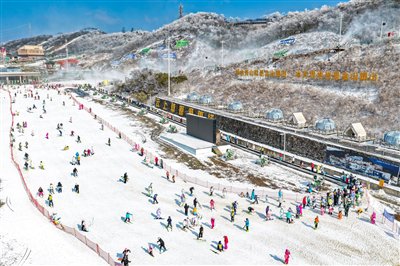
在哈尔滨冰雪大世界近120万平方米的冰雕玉砌园区内,来自南京的游客举着手机与高达40余米的"冰雪 之冠"合影;不远处的冰滑梯旁,孩子们正排队等候;非遗代表性传承人现场用冰雪雕琢传统纹样…… 这片冰雪筑就的童话世界,正是中国冰雪经济升温的生动切片。 《中国冰雪产业发展研究报告(2025)》显示,2025年中国冰雪产业规模预计首次突破万亿元大关,达 到10053亿元。 近年来,随着"带动三亿人参与冰雪运动"成果的不断巩固和扩大,冰雪产业已从政策引导的起步阶段, 迈入规模扩张、结构优化的高质量发展新阶段。 元旦假期即将到来,"冰雪游"热度持续提升。哈尔滨、长春等地不断吸引南方游客北上赏雪玩冰。但同 时,同质化等问题制约着相关产业的提质升级,只有破解这些痛点,才能让"冰雪世界"垒得更高、持续 更久。 临近傍晚,吉林北大湖滑雪度假区的售票大厅里暖意融融,排队换雪具、雪服的游客摩肩接踵,工作人 员忙着帮游客调试雪鞋、固定雪板。 "这儿的雪质特别好,粉雪蓬松柔软。"游客宋先生告诉《证券日报》记者,这是他首次体验夜滑,度假 区完善的照明和安全保障让他印象深刻,而且滑完雪还能就近泡温泉。 去哪儿旅行数据显示,2025—2026 ...
“冷资源”催生“热产业” 万亿元冰雪经济“滚烫升级”
Zheng Quan Ri Bao· 2025-12-30 16:18
Core Insights - The Chinese ice and snow industry is expected to exceed 1 trillion yuan by 2025, reaching 10,053 billion yuan, marking a significant growth phase driven by increased participation in ice and snow sports [1] - The industry is transitioning from a policy-driven phase to a high-quality development stage, focusing on structural optimization and expansion [1] Group 1: Industry Growth and Trends - The popularity of "ice and snow tourism" is rising, with cities like Harbin and Changchun attracting more visitors from southern regions during peak seasons [1][2] - The 2025-2026 snow season is anticipated to see a 50% to 70% increase in hotel bookings in regions with ski resorts, indicating strong demand [2] - The North Dake Ski Resort reported over 1 million visitors for the 2024-2025 season, with pre-sale activities for the upcoming season exceeding 100 million yuan [2] Group 2: Competitive Landscape and Consumer Preferences - Ski resorts are enhancing their competitiveness through refined services, such as direct bus routes from airports and beginner-friendly ski packages [3] - Consumers are seeking more than just sightseeing; they desire integrated experiences combining skiing with culture, social activities, and wellness [6] - The North Dake Ski Resort has expanded its offerings to include entertainment parks and cultural events, increasing its commercial facilities to 50 [6] Group 3: Industry Ecosystem and Supply Chain - The ice and snow economy is creating a comprehensive industry chain that includes equipment manufacturing, event management, training services, and cultural tourism [5] - The demand for ice and snow activities is boosting the growth of the upstream equipment manufacturing sector, with companies reporting order volumes three times higher than previous years [7] - The industry is evolving from a niche market to a more mainstream health-oriented lifestyle, supported by the integration of various industry segments [7] Group 4: Challenges and Innovations - The industry faces challenges such as homogenization and safety management issues, with many ski resorts still focusing on basic skiing experiences [8][9] - To address these challenges, new ice and snow projects are being developed, and safety measures are being enhanced through technology [8][9] - The shift from "scale expansion" to "value creation" is essential for the sustainable growth of the ice and snow economy, requiring improvements in product differentiation and operational management [8][9]
从关键词读懂2025丨锚定新质生产力 产业发展开启多元“融合”
Xin Hua She· 2025-12-30 02:30
Core Insights - The article emphasizes the acceleration of new productive forces and the deepening of industrial transformation and upgrading, with "integration" becoming a prominent theme in industrial development [1] Group 1: Industrial Growth and Trends - The expected growth rate of industrial added value for the year is 5.9%, while digital industry revenue is projected to increase by 9% [1] - The core scale of the artificial intelligence industry is anticipated to exceed 1 trillion yuan [1] - The integration of traditional and emerging industries is breaking down barriers and fostering a more resilient and vibrant modern industrial system [1] Group 2: Cross-Industry Collaboration - Companies like ByteDance and ZTE are collaborating to launch new products, such as the "Doubao phone," reflecting a trend of cross-industry terminal creation [2] - In agriculture, traditional practices are evolving into smart agriculture through partnerships with emerging industries, enhancing efficiency and reducing costs [2] - In the automotive sector, companies like Dongfeng Motor are collaborating with tech firms like Huawei to innovate in areas such as intelligent driving systems and semiconductor production [3] Group 3: Digital and Real Economy Integration - Ulanqab in Inner Mongolia is becoming a key node in the "East Data West Computing" project, with significant investments in data centers and computing power [5] - National data shows a 10.2% year-on-year increase in enterprise spending on digital technologies, indicating a strong push towards digital integration in traditional industries [6] - The establishment of leading smart factories marks a significant leap towards intelligent manufacturing, with high application rates of AI technologies [6] Group 4: Innovation and Policy Support - The integration of technological and industrial innovation is being prioritized in national policy, with a focus on enhancing productivity and fostering new growth spaces [8] - Collaborative efforts between research institutions and industries are driving a comprehensive "two-innovation integration" practice across various sectors [8] - The rapid development of technology in areas like low-frequency technology for air conditioning and autonomous driving platforms showcases the vibrant innovation landscape in China [9]
辽宁营造花式过冬新场景
Jing Ji Ri Bao· 2025-12-27 00:34
Group 1 - The core idea of the news is that Liaoning and the entire Northeast region are actively exploring new opportunities in the "ice and snow economy" by introducing various innovative experiences and consumption models during the winter season [1] - The Northeast provinces are collaborating to enhance tourism offerings, with initiatives like the "Kanto Emotion·Ice and Snow Warm World" travel ticket, which connects popular ice and snow cities and offers discounts for travelers [2] - Liaoning is working with other provinces to develop the "Northeast Ice and Snow Corridor," integrating various cultural and tourism resources to create a synergistic effect in promoting ice and snow tourism [3] Group 2 - Liaoning is leveraging its northern cultural heritage by creating unique winter consumption scenarios and promoting them online, allowing consumers to earn points redeemable for tickets and local products [4] - The province has identified four core themes for winter tourism: "Ice and Snow + Hot Springs," "Ice and Snow + Ocean," "Ice and Snow + Sports," and "Ice and Snow + Folk Customs," focusing on enhancing the cultural experience [5] - A wide range of cultural activities, including nearly 300 events, are being organized to enrich the visitor experience, such as high-level artistic performances and local folk markets [6] Group 3 - Liaoning's winter tourism is characterized by accessible and affordable activities, such as skiing, which are designed to attract a broad audience [7] - New experiences like ice fishing are gaining popularity, with local businesses offering unique winter activities that combine leisure and cultural immersion [8] - The market for ice and snow equipment is growing, with local companies beginning to establish a presence in the sector, particularly in snow gear and related products [9]
新华视点丨“冷资源”涌动“热浪潮”——从雪场到工厂,冰雪经济全链升温
Xin Hua Wang· 2025-12-25 07:23
Group 1 - The popularity of ice and snow tourism is on the rise, with the ice and snow economy becoming a significant driver for consumption and regional high-quality development [1][3] - Hebei Province's Wanquan County, with an average altitude of about 1500 meters and a winter snow period lasting 120 days, provides excellent conditions for the development of ice and snow tourism [3] - In the new snow season, ski resorts in Hebei Chongli are enhancing facilities, introducing events, and optimizing services to create a more professional and enjoyable skiing destination [5] Group 2 - The "Ice and Snow +" consumption model is being developed to stimulate consumer activity, with projections indicating that China's ice and snow industry will exceed 1 trillion yuan by 2025 [7] - During the 2025-2026 snow season, Chongli will host numerous high-level international and national snow sports events, allowing enthusiasts to experience the excitement of competitive sports [8] - Heilongjiang Province's Tieli City is leveraging its ice and snow resources to launch unique tourism products, such as "Ice and Snow + Hot Springs" and "Ice and Snow + Sports" [10] Group 3 - The booming ice and snow sports sector is driving demand for ice and snow venues and equipment, with companies in Hebei enhancing their R&D capabilities in areas like skis and snow-making machines [12] - Hebei has established four ice and snow industry clusters, with parks dedicated to the R&D, manufacturing, sales, and service of ice and snow equipment [14] - In Ningbo, Zhejiang Province, there are 34 companies producing sports poles, with an annual production value exceeding 920 million yuan, primarily for export [16]