
可再生能源发电

Search documents
五部门印发《工业绿色微电网建设与应用指南(2026—2030年)》
国家能源局· 2026-01-09 09:24
Core Viewpoint - The article emphasizes the importance of developing industrial green microgrids as a key strategy for achieving low-carbon transformation in industrial energy use and meeting carbon peak targets in the industrial sector. It outlines guidelines for the construction and application of these microgrids from 2026 to 2030, integrating renewable energy sources and advanced technologies to enhance energy efficiency and sustainability [2][4]. Summary by Sections Construction Principles - Promote efficient multi-energy complementary utilization by integrating local solar, wind, hydrogen, and waste heat resources to create a clean energy supply system that meets diverse industrial energy needs [2]. - Encourage high local consumption of renewable energy by analyzing industrial load conditions and planning the scale and mix of renewable energy and new storage systems [2]. Main Construction Content - Industrial green microgrids should include renewable energy generation, industrial waste energy utilization, clean hydrogen production and use, new energy storage applications, energy conversion, and digital energy management systems [5]. - Renewable energy generation should aim for a self-consumption rate of at least 60% for new solar and wind projects, with distributed photovoltaic systems participating in the electricity market [5][6]. Construction Models - Two main construction models are proposed: self-built by industrial enterprises or parks, and third-party co-built with qualified service providers. Each model has specific operational and regulatory responsibilities [13][14]. Application Scenarios - High energy-consuming industries such as steel, petrochemicals, and non-ferrous metals should utilize waste heat and renewable energy to improve energy efficiency and reduce reliance on fossil fuels [17]. - Flexible application scenarios for industries like machinery and textiles should leverage clean energy output and load forecasting to optimize energy use and reduce costs [15]. - Scalable adjustable applications in sectors like electrolytic aluminum and polysilicon should utilize real-time load adjustment capabilities to participate in demand response and ancillary services [16]. Construction Requirements - Strict adherence to standards and regulations for microgrid construction and operation is essential to ensure safety and reliability [18]. - Accelerate the application of advanced technologies such as AI, big data, and IoT to enhance the intelligence of industrial green microgrids [19]. - Ensure economic feasibility by analyzing cost-effectiveness and encouraging social capital participation in project construction [20].


韩文亚:绿色转型方向不变力度不减
Jing Ji Ri Bao· 2026-01-09 00:03
Group 1 - The 2025 Central Economic Work Conference emphasizes "adhering to 'dual carbon' leadership and promoting comprehensive green transformation" as one of the eight key tasks for economic work in 2026, signaling a consistent and strong policy direction for green low-carbon development in China [1] - The advancement of the "dual carbon" goals represents a fundamental transformation of the traditional high-carbon development paradigm, requiring three types of policy tools: regulatory control through strict carbon emission standards, innovation-driven technological empowerment, and market incentives for price discovery [1] - As of October 2025, China's total installed capacity for renewable energy generation reached 2.22 billion kilowatts, accounting for nearly 60% of the national total, with over one-third of electricity consumption coming from green power [1] Group 2 - The restructuring of the industrial system injects new momentum into the green transition, with China leading the world in new energy vehicle production and sales for ten consecutive years and establishing the largest electric vehicle charging network globally [2] - The scale of the green low-carbon industry has reached approximately 11 trillion yuan, supported by the establishment of 6,430 green factories and 491 green industrial parks [2] - The national carbon emission trading market has expanded its coverage to include over 60% of carbon emissions, making it the largest carbon market globally, while 27 provinces have implemented carbon inclusive policies to promote quantifiable and redeemable public green behaviors [2] Group 3 - The green transition is recognized as a core strategy within China's modernization framework, with the goal of achieving significant progress in building a "Beautiful China" as outlined in the 15th Five-Year Plan [3] - The "dual carbon" initiative is seen as a strategic choice to address resource and environmental constraints while fostering new productive forces and shaping new international competitive advantages [3]
绿色转型方向不变力度不减
Jing Ji Ri Bao· 2026-01-08 21:45
Group 1 - The 2025 Central Economic Work Conference emphasizes "adhering to 'dual carbon' leadership and promoting comprehensive green transformation" as one of the eight key tasks for economic work in 2026, signaling a consistent and strong policy direction for green and low-carbon development in China [1] - The advancement of the "dual carbon" goals represents a fundamental transformation of the traditional high-carbon development paradigm, requiring three types of policy tools: regulatory control through strict carbon emission standards, innovation-driven technological empowerment, and market incentives for price discovery [1] - As of October 2025, China's total installed capacity for renewable energy generation reached 2.22 billion kilowatts, accounting for nearly 60% of the national total, with over one-third of electricity consumption coming from green power [1] Group 2 - The restructuring of the industrial system injects new momentum into the green transition, with China leading the world in new energy vehicle production and sales for ten consecutive years and establishing the largest electric vehicle charging network globally [2] - The scale of the green low-carbon industry has reached approximately 11 trillion yuan, supported by the establishment of 6,430 green factories and 491 green industrial parks [2] - The national carbon emission trading market has expanded its coverage to include over 60% of national carbon emissions, becoming the largest carbon market globally, with over ten national standards for product carbon footprints established [2] Group 3 - The green transition is recognized as a core strategy within China's modernization efforts, with significant progress in building a "Beautiful China" as a major goal outlined in the 15th Five-Year Plan [3] - The "dual carbon" initiative is seen as a strategic choice to address resource and environmental constraints while fostering new productive forces and shaping new international competitive advantages [3]
国家能源局印发文件加强规范绿证管理
Xin Lang Cai Jing· 2026-01-08 21:02
Core Viewpoint - The National Energy Administration has issued the "Implementation Rules for the Management of Renewable Energy Green Power Certificates (Trial)", aiming to enhance and standardize the management of green certificates [1] Group 1: Green Certificate Issuance - Green certificates will be issued monthly based on renewable energy generation, with 1 certificate issued for every 1000 kilowatt-hours of renewable energy generated, and any shortfall will be carried over to the next month [1] - The issuance of green certificates will vary by generation type, covering wind, solar, biomass, geothermal, and ocean energy projects, as well as newly commissioned conventional hydropower plants that are fully market-oriented from January 1, 2023 [1] Group 2: Non-Tradable Certificates - Non-tradable green certificates will be issued for self-consumed electricity, off-grid renewable energy generation, and conventional hydropower plants commissioned before January 1, 2023 [1] - Independent energy storage facilities will not be eligible for green certificate issuance [1]
国家能源局发布绿证新规:风光绿证可交易,独立储能设施放电电量不核发绿证
Xin Lang Cai Jing· 2026-01-07 10:52
Core Viewpoint - The National Energy Administration has issued the "Implementation Rules for the Management of Renewable Energy Green Power Certificates (Trial)" to establish a comprehensive management mechanism for green certificates, covering issuance, transfer, cancellation, and related management work for renewable energy power generation projects in China [4][38]. Group 1: Overview of the Rules - The rules consist of 10 chapters and 45 articles, detailing responsibilities, account management, certificate issuance, transfer, cancellation, dispute resolution, information management, and supervision [4][38]. - The rules aim to provide institutional support for the standardized operation of renewable energy environmental rights [4][38]. Group 2: Certificate Issuance - Green certificates are issued monthly based on renewable energy generation, with one certificate issued for every 1,000 kilowatt-hours of renewable energy generated; any unissued certificates from the current month will be carried over to the next month [4][38][13]. - Different types of renewable energy projects, such as wind, solar, biomass, geothermal, and marine energy, will receive tradable green certificates if they are connected to the grid and meet specific criteria [4][38][39]. - Non-tradable green certificates will be issued for self-consumed energy, off-grid renewable energy generation, and conventional hydropower plants commissioned before January 1, 2023 [4][38][40]. Group 3: Certificate Transfer - Power generation companies, project owners, and electricity users can choose any green certificate trading platform for transactions, with transaction details required to be synchronized with the national green certificate issuance and trading system [5][41]. - Certificates corresponding to self-consumed energy are non-tradable, and transfers must reflect the actual application scenario [5][41][57]. Group 4: Certificate Cancellation - Starting January 1, 2026, the year of production for the green certificate must match the year of green power consumption during cancellation [5][41][60]. - The effective period of green certificates is set at two years, with production months counted as the zero month, ending on the last day of the 24th month [5][41][55]. Group 5: Responsibilities and Management - The National Energy Administration is responsible for the design and management of the green certificate system, including the establishment and management of the national green certificate issuance and trading system [4][38][45]. - Various entities, including renewable energy information management centers and trading platforms, are tasked with supporting the system's operation and ensuring data accuracy [4][38][46].
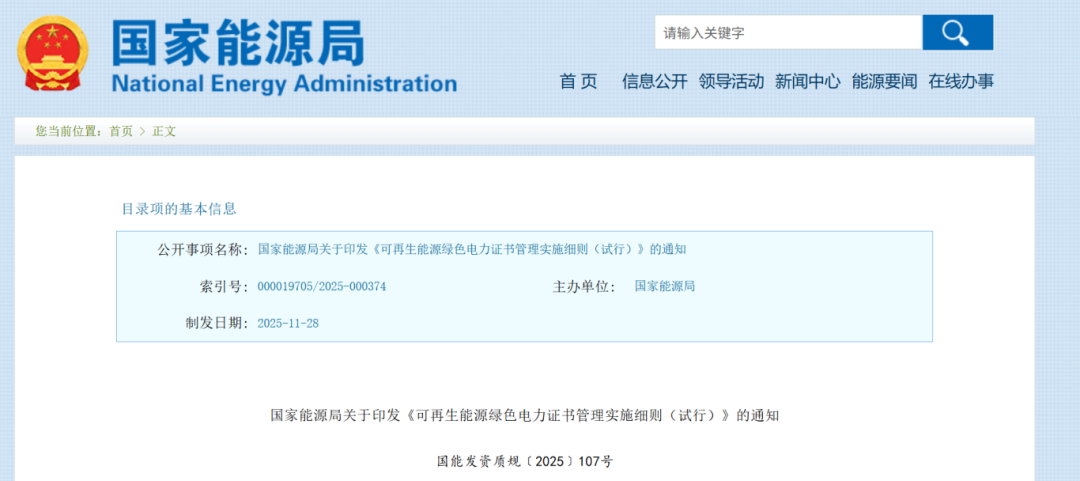
国家能源局关于印发《可再生能源绿色电力证书管理实施细则(试行)》的通知
国家能源局· 2026-01-07 09:45
Core Viewpoint - The article outlines the implementation details of the "Renewable Energy Green Power Certificate Management Implementation Rules (Trial)" issued by the National Energy Administration, aiming to enhance and standardize the management of green certificates in China [2][3]. Chapter Summaries Chapter 1: General Principles - The rules aim to improve the mechanism for promoting green energy consumption and standardize the issuance and management of green power certificates (green certificates) based on relevant laws and policies [5]. Chapter 2: Responsibilities - The National Energy Administration is responsible for the design and management of the green certificate system, including the establishment and management of the national green certificate issuance and trading system [7]. - Various entities, including provincial energy authorities and power grid companies, are tasked with supporting the management and data reporting necessary for green certificate issuance and trading [8]. Chapter 3: Account Management - The green certificate issuing authority will establish unique accounts for relevant entities in the national green certificate issuance and trading system, recording all transactions related to green certificates [10]. - Electric power users can establish unique accounts to participate in the issuance and trading of green certificates, with specific documentation required for registration [12]. Chapter 4: Green Certificate Issuance - Green certificates will be issued monthly based on renewable energy generation, with one certificate issued for every 1,000 kilowatt-hours of renewable energy generated [13]. - Different types of renewable energy projects will have specific rules for certificate issuance, with some projects receiving tradable certificates while others receive non-tradable ones [14]. Chapter 5: Green Certificate Transfer - The national green certificate issuance and trading system is the sole channel for transferring, freezing, and distributing green certificates, ensuring smooth transactions across various platforms [21]. - Green certificates associated with electricity transactions must be clearly defined in terms of pricing and transfer details [25]. Chapter 6: Green Certificate Cancellation - The issuing authority will cancel certificates that exceed their validity period or are associated with specific consumption declarations [28]. - Users must select the environmental rights jurisdiction when canceling certificates, ensuring that the cancellation aligns with the physical consumption of electricity [29]. Chapter 7: Dispute Handling - Parties with disputes regarding the issuance or transfer of green certificates must submit their claims within three months, providing necessary documentation for verification [31]. Chapter 8: Information Management - Entities must ensure the accuracy of information submitted to the national green certificate issuance and trading system, with a focus on maintaining data integrity [36]. Chapter 9: Green Certificate Supervision - The National Energy Administration and local governments will oversee the implementation of the green certificate system, addressing any violations or discrepancies in the issuance process [42].

【中央媒体看甘肃】甘肃敦煌首次实现全年全域绿电供应
Xin Lang Cai Jing· 2026-01-06 00:56
转自:新华社 图为敦煌国际会展中心同塔四回线路。新华社发 "敦煌市实现全域全年绿电供应后,将为甘肃省新能源综合示范区建设起到示范引领作用,对丝绸之路沿线城市发展可再生能源提供借鉴,并 对西部地区能源结构调整、区域协调发展提供参考。"苟健说。 责任编辑:曹旭 新华社兰州1月5日电(记者 王紫轩)记者日前从甘肃省敦煌市政府、国网敦煌市供电公司获悉,2025年敦煌市电源总装机容量达434万千瓦, 全部为风、光、水等可再生能源。敦煌市首次实现全年全域绿电供应。 国网敦煌市供电公司指挥中心主任苟健介绍,2025年,敦煌市新能源发电40亿千瓦时,本地消纳7.49亿千瓦时,剩余32.51亿千瓦时通过"西电 东送"骨干工程送往湖南。 近年来,甘肃全力推动构建新型电力系统和新型能源体系,加快建设陇电外送通道。截至目前,敦煌市共有1座750千伏、5座330千伏、13座 110千伏变电站,构建起覆盖全域、衔接顺畅的新能源外送及就地消纳电网框架,实现绿电"发得出、送得走、用得好"。 绿电是在生产过程中二氧化碳排放量为零或趋近于零的电力,主要来源为太阳能、风力等可再生能源。甘肃省风、光资源富集,生产绿电具备 先天优势。"十四五"以来, ...
可再生能源产出激增席卷欧洲电网 2025年负电价频率创历史新高
智通财经网· 2026-01-05 09:04
Group 1 - The core issue is the increasing frequency of negative electricity prices in Europe due to a surge in renewable energy production, which is outpacing demand and grid capacity [1][4][6] - Germany recorded 573 hours of negative electricity prices in 2025, a 25% increase from the previous year, while Spain has seen its frequency of negative prices double since first experiencing them in 2024 [1][4] - The expansion of renewable energy capacity is expected to continue leading to negative pricing patterns through 2026, as the growth of grid infrastructure and energy storage lags behind new generation facilities [4][6][8] Group 2 - The increase in negative pricing is reshaping the European electricity market, squeezing revenues for renewable energy developers while creating new opportunities for trading firms to profit from price volatility [4][6] - The reliance on fossil fuels remains significant for backup support during periods of renewable energy output fluctuations, leading to potential price spikes when demand exceeds supply [6][8] - Efforts to develop more renewable energy face challenges from slow recovery in electricity demand and the increasing role of natural gas and coal in meeting additional load in certain markets [6]

雅砻江流域水风光一体化基地两座百万千瓦光伏电站同步投产
Xin Hua She· 2025-12-31 03:04
Core Insights - The Yalong River region has accelerated the construction of integrated hydropower and solar energy bases with the simultaneous commissioning of two 1 million kilowatt solar projects, the Suolong and Chaburang solar power stations [1] Group 1: Project Details - The Suolong solar power station is located in Litang County, Garze Tibetan Autonomous Prefecture, Sichuan Province, with an installed capacity of 1 million kilowatts [1] - The Chaburang solar power station is situated in Muli County, Liangshan Yi Autonomous Prefecture, Sichuan Province, also with an installed capacity of 1 million kilowatts [1] - Together with the Ke La Phase I and II solar power stations and the Erhekou hydropower station, these projects form a complementary system of 3 million kilowatts of hydropower and 3 million kilowatts of solar power [1] Group 2: Environmental Impact - The two solar power stations are expected to generate approximately 3.9 billion kilowatt-hours of clean electricity annually, saving about 1.2 million tons of standard coal and reducing carbon dioxide emissions by approximately 3.1 million tons each year [1] Group 3: Overall Capacity - With the commissioning of these two solar power stations, the Yalong River integrated hydropower and solar energy base has nearly 23 million kilowatts of clean energy capacity in operation and about 12 million kilowatts under construction [1]
国家能源局:11月核发绿证2.58亿个
中国能源报· 2025-12-26 11:35
Green Certificate Issuance - In November 2025, the National Energy Administration issued 258 million green certificates, covering 509,700 renewable energy generation projects, with 150 million being tradable, accounting for 58.25% of the total [1] - The green certificates corresponding to renewable energy generation in October 2025 amounted to 225 million, representing 87.17% [1] - From January to November 2025, a total of 2.736 billion green certificates were issued, with 1.743 billion being tradable [1] Green Certificate Issuance by Type - Wind power accounted for 75.96 million certificates in November and 946.25 million from January to November [2] - Solar power generated 58.04 million certificates in November and 624.64 million from January to November [2] - Conventional hydropower contributed 108.22 million certificates in November and 994.26 million from January to November [2] - Biomass power produced 13.31 million certificates in November and 154.04 million from January to November [2] - Other renewable energy sources issued 2.80 million certificates in November and 16.73 million from January to November [2] Green Certificate Trading - In November 2025, a total of 132 million green certificates were traded, including 25.39 million for green electricity [4] - From January to November 2025, the total number of traded green certificates reached 728 million, with 228 million for green electricity [4] Green Certificate Trading by Type - Wind power accounted for 54.75 million traded certificates in November and 347.01 million from January to November [5] - Solar power generated 68.97 million traded certificates in November and 331.60 million from January to November [5] - Biomass power contributed 3.14 million traded certificates in November and 30.99 million from January to November [5] - Other renewable energy sources had 5.27 million traded certificates in November and 18.20 million from January to November [5] Green Certificate Trading Prices - The average trading price for certificates from the year 2024 was 4.28 yuan per certificate, with a month-on-month increase of 66.80% [7] - The average trading price for certificates from the year 2025 was 5.16 yuan per certificate, with a month-on-month decrease of 1.19% [7]
