天然气

Search documents
中金:优化工业品供给,保障能粮安全——大宗商品解读《政府工作报告》
中金点睛· 2026-03-25 10:43
Core Viewpoint - The article emphasizes the increasing volatility in the global commodity market since 2026, driven by geopolitical instability and rising supply risks, while domestic demand for commodities is expected to stabilize due to government policies aimed at efficiency and structural adjustments [1]. Group 1: Industrial Supply Optimization - The government report highlights the implementation of a dual control system for carbon emissions and the comprehensive rectification of "involution" competition, particularly affecting the steel and coal industries [2]. - In the steel sector, supply governance is shifting from merely reducing output to optimizing capacity, with carbon constraints becoming a key driver for this optimization [2]. - The steel industry is expected to transition towards a clearing phase, benefiting profit levels as carbon constraints tighten over time [2]. Group 2: Coal Industry Dynamics - The coal sector faces constraints on capacity utilization due to "involution" policies, limiting the elasticity of coal production, although large-scale capacity reduction is unlikely due to energy security concerns [3]. - Under the dual carbon goals, coal consumption will face increasing pressure from renewable energy alternatives, with coal power expected to enter a "peak zone" during the 14th Five-Year Plan [3]. - The projected compound annual growth rate (CAGR) for coal power generation during the 14th Five-Year Plan is -0.3%, indicating a slow decline with potential fluctuations due to weather conditions [3]. Group 3: Energy Security and Structure - The report sets a target for energy production capacity to reach 5.8 billion tons of standard coal by 2025, enhancing energy self-sufficiency [4]. - By 2025, China's primary energy production capacity is expected to reach 5.13 billion tons of standard coal, marking a 3.6% year-on-year increase, with natural gas and electricity generation growing at rates of 6.3% and 4.8%, respectively [4]. - Coal remains a cornerstone of China's energy system, with coal production expected to contribute approximately 3.46 billion tons of standard coal by 2025, despite a declining share [4]. Group 4: Food Security Measures - The government report outlines a shift in agricultural policy towards a balanced focus on quantity, capacity, and overall efficiency, emphasizing a comprehensive approach to food security [5]. - The target for grain production is set to stabilize at around 1.4 trillion jin, reflecting a commitment to absolute food supply security and basic self-sufficiency [6]. - Policies aim to address structural contradictions in grain and oil supply, including bolstering soybean production and expanding oilseed cultivation to reduce reliance on imports [6].

停战了又怎样?能源市场的伤,没那么快好
雪球· 2026-03-25 07:52
以下文章来源于摩根在野 ,作者摩根在野 摩根在野 . 前IT行业资深人士,现数字游民,个人投资者|越野跑爱好者|分享个人思考感悟&投资理财观点&多元资产配置&海外科技观察 ↑点击上面图片 加雪球核心交流群 ↑ 风险提示:本文所提到的观点仅代表个人的意见,所涉及标的不作推荐,据此买卖,风险自负。 作者:摩根在野 来源:雪球 昨晚 , 国会山股神又TACO了 : 川普发文宣布 , 美国将"推迟5天"打击伊朗发电站及能源基础设施 , 并称美伊双方在过去两天进行了"非常良 好且富有成效的对话" 。 消息一出 , 布伦特原油价格下跌近9% , 至每桶97美元 : 自3月19日以来首次跌破100美元关口 ; WTI原油价格则下跌近10% , 至每桶88 美元 。 市场的反应很诚实 : 人们太渴望这件事是真的了 。 然而 , 伊朗媒体随即发出否认 , 称伊朗与美国之间"目前没有任何直接或间接的沟通" 。 无论你信不信川普 , 但有一系列现实问题值得我们思 考 : 如果明天正式停战 , 霍尔木兹海峡马上重新通航 , 油价能回到开战前吗 ? 预期中的通货膨胀会避免吗 ? 美联储会停止加息吗 ? 答案恐怕会让很多人失望 。 一场 ...

花旗:昆仑能源(00135)去年纯利逊预期 零售天然气单位利润下跌
智通财经网· 2026-03-25 06:21
Group 1 - The core viewpoint of the report is that Citigroup maintains a "Buy" rating for Kunlun Energy (00135) with a target price of HKD 8.4 [1] - Kunlun Energy's net profit decreased by 10.3% year-on-year to RMB 5.346 billion, which is 12% lower than market expectations [1] - The core profit fell by 6.9% year-on-year to RMB 5.923 billion, while the annual dividend per share remained at 31.58 cents, with a payout ratio increasing by 5.2 percentage points to 51.1% [1] Group 2 - The pre-tax profit from natural gas sales dropped by 17.6% year-on-year to RMB 6.756 billion, with unit gross profit decreasing by RMB 0.02 to RMB 0.45 per cubic meter [1] - Natural gas sales volume increased by 9.4% year-on-year to 59.26 billion cubic meters, with retail gas volume growing by 2.3% to 33.51 billion cubic meters and distribution and trading gas volume rising by 20.2% to 25.75 billion cubic meters [1] - The average selling price of natural gas fell by RMB 0.11 to RMB 2.73 per cubic meter, while the average procurement cost decreased by RMB 0.09 to RMB 2.28 per cubic meter [1] Group 3 - The total gasification and loading volume of two LNG receiving stations increased by 3.7% year-on-year to 16.527 billion cubic meters, with the average utilization rate rising by 3.2 percentage points to 90.8% [2] - The processing volume of 14 LNG plants grew by 5.3% to 3.737 billion cubic meters, but revenue fell by 11.8% to RMB 3.88 billion due to a decline in average selling prices [2] - Operating cash flow for Kunlun Energy was RMB 12.585 billion, a slight decrease of 1.2% year-on-year, while capital expenditure reduced by 4.6% to RMB 6.257 billion [2]

美伊释放和谈信号,地缘扰动边际降温
Hua Tai Qi Huo· 2026-03-25 05:30
Group 1: Market Analysis - The tail risk of the Iran situation should be emphasized. After the US and Israel's air strikes on Iran on February 28, Iran's Islamic Revolutionary Guard Corps launched a large - scale counter - attack. On March 19, the Middle East conflict escalated again, and Qatar's LNG facilities were damaged. Subsequently, the situation cooled down as the US may lift sanctions on Iranian oil at sea in the coming days. The main affected varieties are crude oil, LPG, and the shipping sector, and the continuous rise in oil prices has affected the oil - chemical and oilseed sectors, and may cause concerns about inflation and economic recession [1]. - Global expectations of interest rate hikes are rising. The Fed maintained the interest rate at 3.5% - 3.75% on March 19. Different Fed officials have different views on interest rate hikes. The Bank of England maintained the interest rate and removed the "rate cut" wording. The Bank of Japan kept the policy unchanged, and the European Central Bank maintained the rate at 2% but has a tougher stance. The rise in oil prices and supply - chain disruptions have led to a special copper - oil seesaw pattern [2]. - In China, policies are being implemented in advance, and the economic structure is divided. The government work report in 2026 aims for an economic growth of 4.5% - 5%, with a deficit rate of about 4% and a deficit scale of 5.89 trillion yuan. China's February foreign - trade data shows high growth, and there are different trends in various economic sectors such as consumption, industry, and real estate. The central bank will conduct a 5000 - billion - yuan MLF operation on March 25 [3]. Group 2: Commodity Analysis - In the short term, the Iran situation and oil prices dominate commodity fluctuations. The non - correlation between the non - ferrous metals, precious metals, and oil prices is worthy of attention. The IEA has approved the release of a record - high 4 - billion - barrel crude oil reserve, and the US plans to release 1.72 billion barrels of strategic oil reserves. Oil price increases have a driving effect on oil - chemical products, and the EU, Russia, and South Korea have taken measures to deal with the energy crisis. The oil - seed sector in agriculture is also affected by the spill - over effect of oil prices, and the black metal sector should focus on domestic policy expectations and low - valuation repair [4]. Group 3: Strategy - For commodities and stock index futures, it is advisable to go long on stock indices, precious metals, and some chemical products at low prices [5]. Group 4: Key News - US March PMI data shows different trends in manufacturing, services, and the composite index. Pakistan's prime minister is ready to host US - Iran talks. Egypt's foreign minister has held consultations with multiple countries on the Middle East situation. Eurozone, German, and French March PMI data show different trends in manufacturing and services. China's central bank will conduct a 5000 - billion - yuan MLF operation on March 25 [7].
昆仑能源公布2025年业绩 股东应占溢利53.46亿元 同比减少10.3%
Zhi Tong Cai Jing· 2026-03-24 23:44
Core Viewpoint - Kunlun Energy reported a revenue of 193.979 billion yuan for 2025, representing a year-on-year increase of 3.71%, while the profit attributable to shareholders decreased by 10.3% to 5.346 billion yuan, with basic earnings per share at 0.6174 yuan and a proposed final dividend of 0.1684 HKD per share [3] Group 1: Natural Gas Sales - Revenue growth in the natural gas sales segment was driven by increased sales volume from industrial users and distribution and trading businesses [3] - The company developed 11 new urban gas projects across 8 provinces, increasing annual sales capacity by 780 million cubic meters, with the customer base growing to 17.19 million households [3] - The total natural gas sales volume reached 59.26 billion cubic meters, a year-on-year increase of 9.4%, with retail gas volume at 33.51 billion cubic meters [3] Group 2: LNG Processing and Storage - LNG sales achieved a milestone with annual sales surpassing 10 billion cubic meters, and total outbound volume from Jiangsu and Tangshan receiving stations reached a record high of 16.53 billion cubic meters [4] - The LNG processing volume was 3.74 billion cubic meters, reflecting a year-on-year growth of 5.3%, with an average load factor of 67.2%, the highest in history [4] - The offshore LNG refueling business expanded into the Guangdong and Hong Kong markets, with refueling volume increasing by 60.7% to 176,600 tons [4] Group 3: LPG Sales - LPG sales volume returned to over 6 million tons for the first time in five years, with a year-on-year increase of 6.3% to 6.148 million tons [4] - The company developed 8 new industrial direct supply customers, with sales volume from industrial direct supply increasing by 23.4% [4] - Resource allocation was optimized to maintain a reasonable supply-demand balance in resource-rich regions, enhancing market-driven sales [4] Group 4: Exploration and Production - The company increased development efforts in exploration and production, achieving stable revenue with crude oil sales volume of approximately 8.45 million barrels, a year-on-year increase of 160,000 barrels, or 2.0% [4] - The average selling price for crude oil was reported at 54.4 USD per barrel [4]
昆仑能源(00135)公布2025年业绩 股东应占溢利53.46亿元 同比减少10.3%
Zhi Tong Cai Jing· 2026-03-24 13:00
(原标题:昆仑能源(00135)公布2025年业绩 股东应占溢利53.46亿元 同比减少10.3%) 智通财经APP讯,昆仑能源(00135)公布2025年业绩,收入1939.79亿元,同比增长3.71%;公司股东应占 溢利53.46亿元,同比减少10.3%;每股基本盈利61.74分,拟派付末期股息每股16.84港仙。 公告称,收入增加主要由于工业用户与分销与贸易业务增长带动销售量增加,使天然气销售板块收入增 加。 天然气销售业务:深耕市场、优化结构,核心业务顶压前行。坚持存量市场挖潜与增量市场合作开发并 重,依托覆盖全国的客户规模和网络站点,在内蒙古、山东、贵州、江苏等8个省市新开发城燃项目11 个,新增年销售能力7.8亿立方米,客户规模增长到1,719万户。持续推进终端价格顺导,居民用气顺价 率69%,同比提高8.3个百分点。不断优化销售结构,工业气量保持较快增长,占零售气量比重77.7%, 同比提升2.8个百分点。天然气总销量592.6亿立方米、同比增长9.4%,其中零售气量达到335.1亿立方 米。 LNG加工与储运业务:延伸产业链、提升价值链,逐步成长为第二利润增长极。LNG销售取得里程碑 式跨越, ...
美伊战争大反转?
泽平宏观· 2026-03-24 08:24
Core Viewpoint - The article discusses the recent developments in the US-Iran conflict, highlighting the potential implications for oil prices, inflation, and the upcoming US midterm elections. It suggests that the conflict is influenced by multiple pressures on the US, including high oil prices, political pressures, and military expenditures, which may lead to a shift in strategy towards negotiations with Iran [2][7]. Group 1: Recent Developments - On March 21, Trump demanded Iran to open the Strait of Hormuz within 48 hours or face destruction of its power plants. On March 23, he signaled a willingness to negotiate, announcing a five-day pause in attacks on Iranian energy facilities [2][5]. - Following Trump's announcement, global market panic eased, leading to a significant drop in oil prices, with WTI crude oil contracts falling by 9.53% and Brent crude by 9.44% on the same day [6][7]. - The US is under pressure from high oil prices, which have surged from around $70 per barrel to nearly $120, impacting inflation and economic growth [7][8]. Group 2: Future Scenarios - The article outlines three potential scenarios for the US-Iran conflict: 1. Substantial negotiations leading to a de-escalation of conflict, resulting in a significant drop in energy prices and easing inflation concerns [3][12]. 2. A psychological warfare phase where both sides engage in limited negotiations while maintaining military readiness, potentially leading to fluctuating oil prices [16][20]. 3. A prolonged conflict characterized by strategic deception, where the US aims to weaken Iran without genuine negotiations, possibly leading to a global energy crisis reminiscent of the 1970s [22][24]. Group 3: Geopolitical Implications - The US seeks to maintain dominance in the Middle East by undermining Iran's nuclear capabilities and controlling its energy resources, as Iran holds significant oil and gas reserves [9][10]. - The conflict is viewed as part of a broader resource war, with the US aiming to secure its interests in oil and maintain the "petrodollar" system amidst rising global competition for resources [10][25]. - Historical parallels are drawn to previous oil crises, suggesting that the current situation could lead to similar economic disruptions if the conflict escalates [25][28].

霍尔木兹:达摩克里斯之剑的拷问
新财富· 2026-03-24 08:10
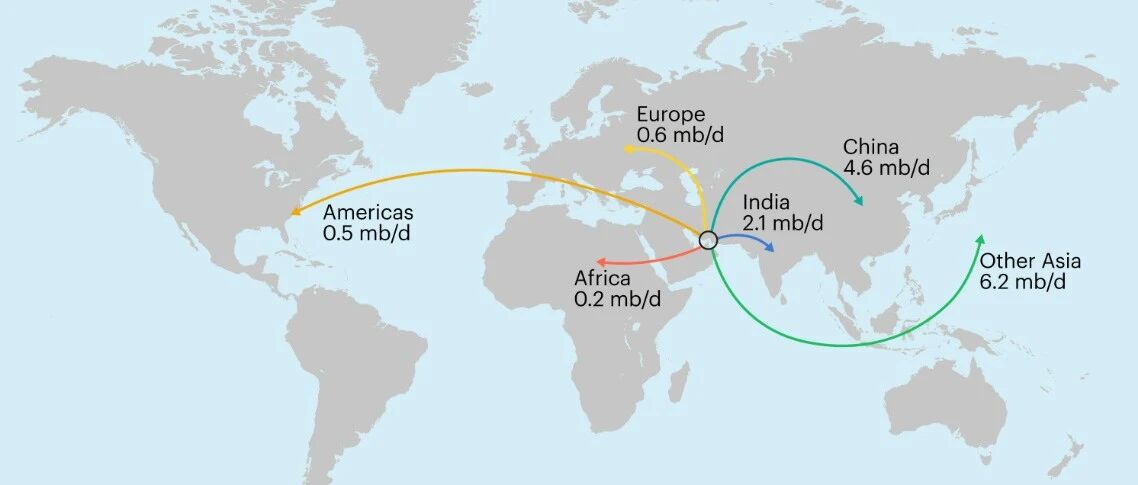
Core Viewpoint - The article discusses the increasing energy vulnerability of countries in the context of geopolitical conflicts and the need for a resilient energy system to withstand uncertainties [2]. Group 1: Energy Vulnerability Assessment - Energy vulnerability should be assessed through three dimensions: import dependency, source concentration, and transportation path reliance [3]. - Japan's energy self-sufficiency rate was only 12.6% in 2022, with fossil fuels making up 80.8% of its energy mix, leading to high external dependency [3]. - Germany's reliance on Russia for energy was significant before the Ukraine conflict, with 55% of its natural gas and 35% of its oil sourced from Russia [8]. - Transportation path reliance is critical, as exemplified by the Strait of Hormuz, which handles 20 million barrels of oil daily, accounting for about 25% of global maritime oil trade [10]. - Countries with high import dependency, source concentration, and transportation reliance, like Japan and South Korea, face severe supply uncertainties during conflicts [12]. - Mid-risk countries, such as China and India, have diversified sources but still face significant external dependencies [12]. - Low-risk countries, like the U.S. and Middle Eastern resource-rich nations, can ensure energy security and benefit from energy exports during crises [13]. - The essence of energy vulnerability lies in structural dependencies rather than isolated metrics [14]. Group 2: Changes in Energy Systems - Geopolitical turmoil leads to a phased adjustment in energy policies: short-term supply assurance, mid-term diversification, and long-term restructuring [16]. - In the short term, countries prioritize energy supply stability, as seen in Europe’s response to the Ukraine conflict, which included reviving coal power and extending nuclear power lifespans [17]. - Mid-term strategies focus on diversifying energy sources to reduce systemic risks, with the EU increasing LNG imports from 22% to over 40% between 2021 and 2023 [20]. - Long-term restructuring aims to redefine the roles of renewable energy and nuclear power, emphasizing controllability over low carbon emissions [22]. - The shift in energy policy reflects a move towards ensuring stable and controllable energy supplies in uncertain environments [22]. Group 3: Power Generation Types - The energy generation landscape is categorized into three types based on stability and controllability: high stability/high controllability (e.g., U.S. natural gas), medium stability/strong controllability (e.g., nuclear power), and low stability/strong controllability (e.g., wind and solar) [28]. - Countries with favorable geographic conditions, like Austria, rely heavily on hydropower, which offers high utilization hours and local resource dependence [30]. - Nuclear power is increasingly viewed as a universal solution for countries lacking resource endowments, with nations like France maintaining a nuclear share above 60% [31]. - Wind and solar power are seen as supplementary sources, with offshore wind in regions like the UK approaching stable baseload generation [35]. - The current energy landscape indicates a preference for stable energy sources like gas, coal, hydropower, and nuclear, while solar and wind are important complements [36].
伊朗称美以袭击伊两处能源基础设施
证券时报· 2026-03-24 04:33
Group 1 - The article reports that on March 24, Iranian sources stated that the United States and Israel attacked two energy infrastructure sites in Iran, specifically in Isfahan and Khorramshahr [1] - The attack targeted a natural gas company building and a gas pressure reduction station in Isfahan, causing damage to some facilities and surrounding residential areas [1] - Additionally, a gas pipeline at the power plant in Khorramshahr was also targeted, but there were no reported casualties [1]

全球能源市场波动加剧,欧盟委员会呼吁提前启动天然气储备工作
中国能源报· 2026-03-24 03:33
Core Viewpoint - The European Commission has called for EU member states to initiate natural gas storage preparations early to address uncertainties in the energy market caused by the situation in the Middle East [1]. Group 1 - The European Commission highlighted that the global energy market is experiencing increased volatility due to the Middle East situation, although the overall energy supply in the EU remains secure [1]. - EU Energy Commissioner Jozef Sikela emphasized the need for coordinated action to ensure smooth replenishment of natural gas reserves before winter [1]. - Early initiation of gas storage is crucial to extend the injection period, alleviate price pressures, and avoid risks associated with concentrated replenishment at the end of summer [1].