
数码和智能产品

Search documents
2026年“国补”利好“科技购” 不仅是补贴换新 更为培育未来市场
Ke Ji Ri Bao· 2026-01-02 00:56
Core Viewpoint - The 2026 "National Subsidy" policy aims to enhance consumer spending on digital and smart products, addressing the current trend of technological consumption and promoting the upgrade of related industries [1][2]. Group 1: Subsidy Scope - The subsidy will expand to include not only digital products like smartphones and tablets but also smart products, with smart glasses being added for the first time [1]. - Local governments are allowed to implement subsidies for smart home products, including those designed for the elderly, based on regional needs [1][2]. Group 2: Implementation Mechanism - The policy stipulates a 15% subsidy on the purchase price of digital and smart products, capped at 500 yuan per item for products priced under 6000 yuan [3]. - A combination of national uniform standards and local autonomy in subsidy implementation is established, ensuring equal treatment across regions while allowing local customization [3]. Group 3: Ensuring Accurate Distribution of Benefits - The policy emphasizes strict regulation to prevent issues such as fraudulent claims and delays in subsidy payments, with a commitment to tackle violations promptly [4]. - Enhanced transparency and improved complaint channels are introduced to minimize manipulation and ensure that subsidies effectively reach consumers [5].
重庆即日起全面启动2026年消费品以旧换新补贴政策
Zheng Quan Shi Bao Wang· 2026-01-01 12:26
Core Viewpoint - Chongqing has launched a comprehensive subsidy policy for the replacement and recycling of automobiles and home appliances, aiming to stimulate consumer spending and promote the upgrade of consumer goods [1] Group 1: Subsidy Details - The subsidy for automobile scrapping and updating is set at 210 million yuan for the first quarter of 2026 [1] - The subsidy for automobile replacement and updating amounts to 555 million yuan [1] - A total of 450 million yuan is allocated for home appliance subsidies, while 301 million yuan is designated for digital and smart product subsidies [1]
2026年新增智能产品补贴!最新汽车“国补”细则来啦→
Xin Lang Cai Jing· 2026-01-01 05:25
Core Viewpoint - The National Development and Reform Commission and the Ministry of Finance have issued a notice regarding the implementation of large-scale equipment updates and consumer goods replacement policies in 2026, optimizing the support scope, subsidy standards, and implementation mechanisms for the "Two New" policy [1] Group 1: Optimization of Support Scope - The support scope for equipment updates will generally continue from 2025, while the consumer goods replacement policy will focus resources on key consumer goods with strong coverage and driving effects [2] - The policy will enhance support for the installation of elevators in old residential areas, equipment updates in elderly care institutions, and updates of safety equipment such as firefighting and inspection devices [3] Group 2: Optimization of Subsidy Standards - The subsidy for updating old residential elevators will shift from a fixed amount to a tiered subsidy based on the number of elevator floors [2] - The subsidy for scrapping old operational trucks will prioritize updates to electric trucks, while maintaining the upper limit for automobile subsidies, adjusting the fixed subsidy to a percentage of the vehicle price [3] Group 3: Implementation Mechanism - The project application mechanism and review process for equipment updates will be optimized to lower the investment threshold for applications, increasing support for small and medium-sized enterprises [2] - The policy will implement a unified subsidy standard nationwide for automobile scrapping and replacement, six categories of household appliances, and four categories of digital and smart products [4] Group 4: Specifics for Automobile Subsidies - The 2026 automobile scrapping and replacement subsidy details include a maximum subsidy of 20,000 yuan for scrapping and 15,000 yuan for replacement, with a 30-working-day period for subsidy disbursement [5] - Eligibility for scrapping subsidies is defined by the registration date of the old vehicle, with specific cut-off dates for gasoline, diesel, and new energy vehicles [6]
2026“国补”来了,一图读懂!
Xin Hua She· 2026-01-01 01:25
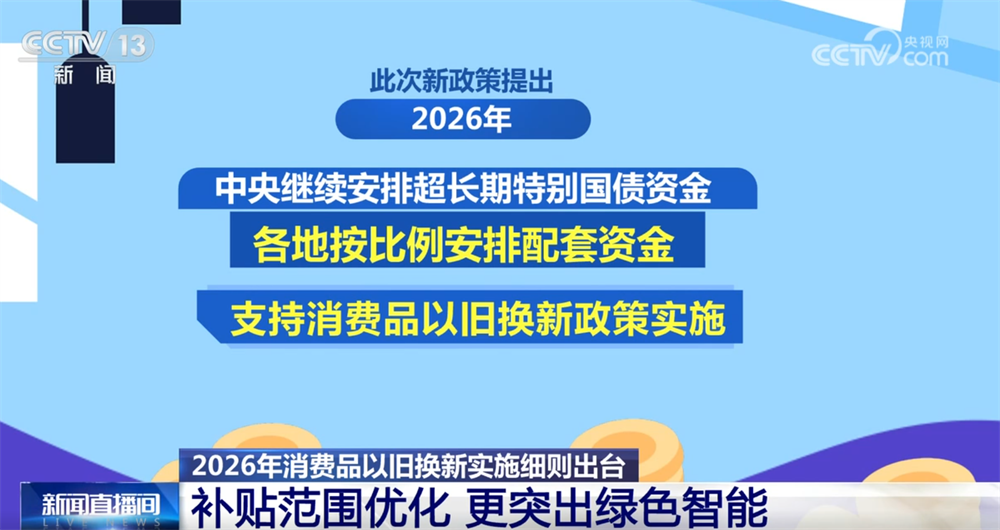
Group 1: Policy Overview - The notice regarding the large-scale equipment update and consumer goods trade-in policy will be released on December 30, 2025, outlining the support scope, subsidy standards, and work requirements for the "Two New" policy in 2026 [1]. Group 2: Equipment Updates - The policy will enhance equipment updates in the livelihood sector, including the installation of elevators in old residential areas and the updating of equipment in elderly care institutions [3]. - In the safety sector, the policy will increase updates for firefighting and rescue equipment, as well as inspection and testing equipment [3]. - The policy will also focus on updating equipment in consumer infrastructure, such as commercial complexes, shopping centers, department stores, and large supermarkets [3]. - The subsidy for updating old residential elevators will be adjusted from a fixed amount to a tiered subsidy based on the number of elevator floors [7]. Group 3: Consumer Goods Trade-In - The trade-in policy for consumer goods will concentrate resources on key consumer products with a broad coverage and strong driving effect [5]. - The subsidy for scrapping old operational trucks will prioritize support for the replacement with electric trucks [8]. - The subsidy for trade-in of old cars will remain capped for automobiles, with a shift from fixed subsidies to a percentage of the vehicle price [10]. Group 4: Specific Subsidy Standards - For scrapped eligible old vehicles replaced with new energy passenger cars, a subsidy of 12% of the new car sales price (including tax) will be provided, with a maximum subsidy of 2 million [12]. - For scrapped eligible fuel passenger cars replaced with fuel passenger cars with an engine displacement of 2.0 liters or less, a subsidy of 10% of the new car sales price will be provided, with a maximum subsidy of 15,000 [13]. - For eligible trade-ins of new energy passenger cars, a subsidy of 8% of the new car sales price will be provided, with a maximum subsidy of 15,000 [15]. - The trade-in for eligible fuel passenger cars will receive a subsidy of 6% of the new car sales price, with a maximum subsidy of 13,000 [15]. Group 5: Home Appliances and Digital Products - The home appliance trade-in policy will be adjusted to provide a subsidy of 15% for products meeting the 1st-level energy efficiency or water efficiency standards, with a maximum subsidy of 1,500 per item [17][18]. - The eligible home appliances include refrigerators, washing machines, televisions, air conditioners, water heaters, and computers [18]. - The subsidy standards for digital and smart products will remain unchanged, providing a 15% subsidy for items priced under 6,000, with a maximum subsidy of 500 per item [20].


2026年“两新”“两重”政策将进一步加力扩围 “真金白银”扩内需促消费
Yang Shi Wang· 2025-12-31 11:32
Core Viewpoint - The Chinese government has announced an upgraded policy for the "old-for-new" consumption scheme for key consumer goods, including automobiles, home appliances, and digital products, aimed at enhancing quality and efficiency by 2026 [1][2]. Group 1: Automotive Sector - The 2026 policy will continue to implement subsidies for scrapping and replacing old vehicles, with a unified national subsidy based on a fixed percentage of the new car sales price [4]. - For scrapping old vehicles, consumers purchasing eligible new energy vehicles will receive a subsidy of 12% of the new car sales price, capped at 20,000 yuan; for scrapping fuel vehicles, the subsidy is 10%, capped at 15,000 yuan [4]. - The policy also includes subsidies for trade-ins, with 8% for new energy vehicles and 6% for fuel vehicles, with maximum subsidies of 15,000 yuan and 13,000 yuan respectively [4]. Group 2: Home Appliances and Digital Products - Starting January 1, 2026, consumers purchasing energy-efficient home appliances and certain digital products will receive a subsidy of 15% of the final sales price after discounts, limited to one item per category per person [6]. - The maximum subsidy for home appliances is 1,500 yuan per item, while for digital products, it is capped at 500 yuan [6]. Group 3: Equipment Upgrade Policies - The National Development and Reform Commission (NDRC) will continue to optimize equipment upgrade policies in 2026, expanding the coverage to 22 categories, which encompasses most industries [10]. - The NDRC aims to lower the investment threshold for project applications, allowing more small and medium-sized enterprises to access funding support [12]. - Enhanced regulatory measures will be implemented to ensure efficient use of funds and project quality, with a focus on comprehensive oversight of equipment upgrade projects [14]. Group 4: Investment in Infrastructure - The NDRC has announced a preliminary list of "two heavy" construction projects for 2026, with a total investment of approximately 295 billion yuan, focusing on urban infrastructure and logistics cost reduction [15]. - Over 75 billion yuan will be allocated to support 673 projects in urban renewal, water conservation, ecological restoration, and pollution control [18]. - The NDRC is also promoting "soft construction" initiatives to improve investment efficiency and project implementation [21].
最高补贴1500元,品类、范围和标准明确!2026年这些家电享受补贴
21世纪经济报道· 2025-12-31 05:04
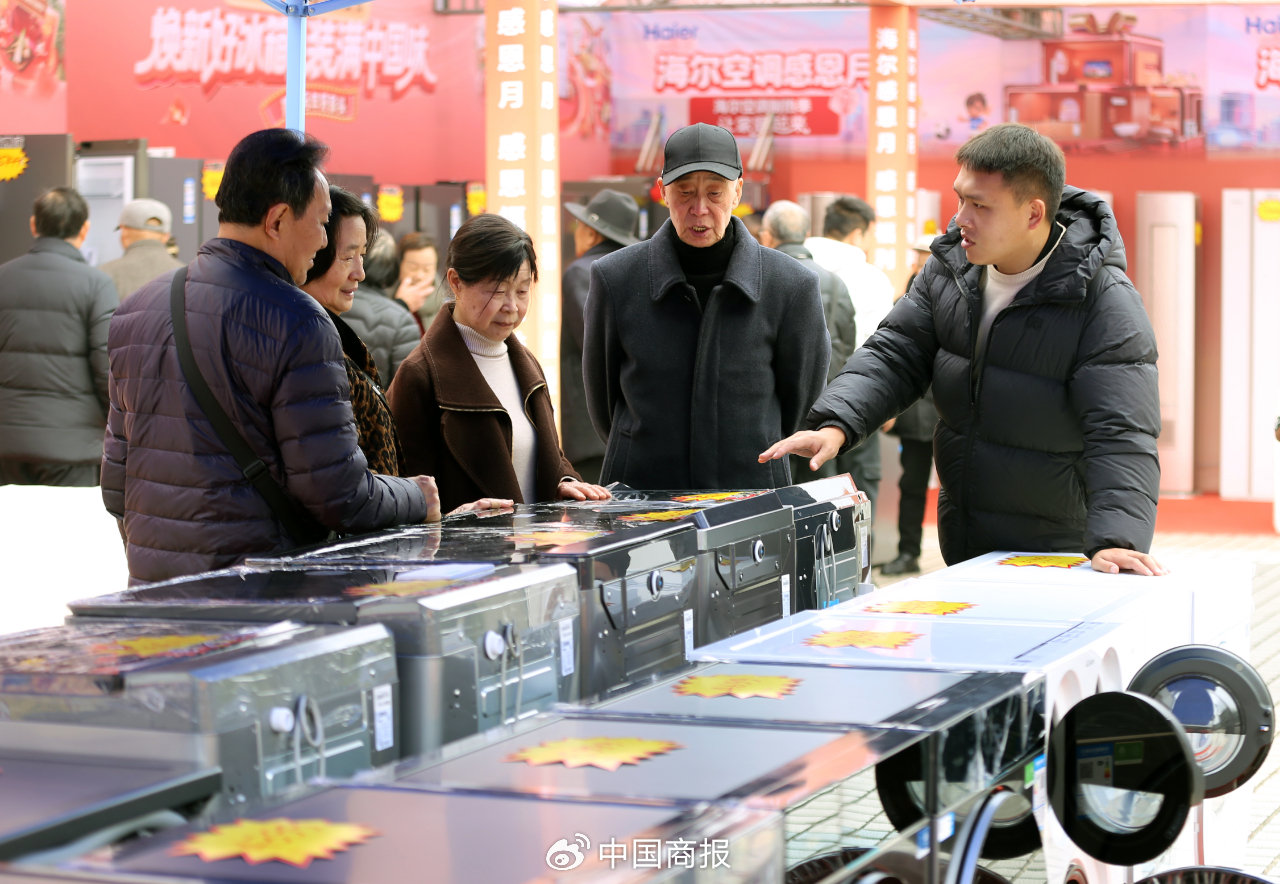
Group 1 - The article outlines a subsidy policy effective from January 1, 2026, for consumers purchasing energy-efficient home appliances and certain digital products, providing a 15% subsidy on the final sales price, with specific caps on the amount per item [1] - The policy aims to support the development of physical retail by promoting trade-in programs for old appliances and encouraging diverse sales channels, both online and offline [2] - It emphasizes ensuring that rural residents can access the subsidy by increasing offline retail presence and guiding online channels to serve rural areas effectively [3] Group 2 - The implementation of the subsidy policy will be optimized by regularly updating the list of participating businesses and ensuring compliance with legal standards, with strict penalties for violations [4] - There are guidelines for the sale of subsidized products, requiring transparency in pricing and prohibiting practices like price inflation before subsidies [5] - The article stresses the importance of timely fund allocation and auditing processes to alleviate financial pressure on participating businesses [6] Group 3 - Digital monitoring systems will be established to track subsidy product information and prevent fraudulent activities, utilizing big data and AI for anomaly detection [7] - Participating businesses must adhere to ethical practices and protect consumer information, ensuring data integrity and compliance with subsidy regulations [8] - Logistics and delivery management will be enhanced to prevent fraud, with a focus on monitoring unusual delivery patterns [9] Group 4 - The article discusses the need for a robust recycling system for old appliances, encouraging businesses to offer one-stop services for new purchases and old appliance recycling [10] - It highlights the importance of supervisory measures to ensure compliance with subsidy regulations, including penalties for non-compliance and illegal activities [11] - A positive public atmosphere will be fostered through widespread promotion of the subsidy policy and the establishment of complaint channels for consumers [13]
官方正式确认!2026年“国补”扩围提质
Xin Lang Cai Jing· 2025-12-31 04:32
Core Viewpoint - The new policy for 2026, focusing on large-scale equipment updates and consumer goods replacement, aims to stimulate domestic demand, promote industrial transformation, and improve people's livelihoods, marking a significant step in economic recovery and high-quality development [1][8]. Summary by Relevant Sections Optimization of Support Scope - The 2026 policy continues to support the equipment update scope established in 2025, with new additions in the areas of elderly community elevator installations and equipment updates for elderly care institutions [2][3]. - In the safety sector, updates for firefighting and inspection equipment are included, while consumer infrastructure support now covers commercial complexes, shopping centers, department stores, and large supermarkets [2]. Optimization of Subsidy Standards - The subsidy model has shifted from a flat-rate to a differentiated and proportional approach, enhancing efficiency and guidance in fund usage [6]. - In the automotive sector, the subsidy for scrapping old vehicles and purchasing new energy vehicles is set at 12% of the vehicle price, with a maximum of 20,000 yuan [6]. - For home appliances, the subsidy is now 15% of the price for energy-efficient products, with a cap of 1,500 yuan per item [6]. Optimization of Implementation Mechanism - The policy has streamlined the project application and review processes, lowering investment thresholds to support small and medium-sized enterprises [7]. - A unified subsidy standard will be implemented nationwide for vehicle scrapping, vehicle replacement, and various consumer goods [7]. - The government has allocated 62.5 billion yuan in special long-term bonds to support the consumer goods replacement program, ensuring smooth policy implementation during peak consumption periods [8].
五部门:各地要科学制定补贴资金使用及兑付计划,减轻政策参与经营主体垫资压力
Xin Lang Cai Jing· 2025-12-31 04:29
Core Viewpoint - The Ministry of Commerce and four other departments have issued a notice regarding the implementation of a subsidy program for the replacement of old home appliances and the purchase of new digital and smart products in 2026, emphasizing the need for a structured and efficient subsidy distribution process [1] Group 1: Subsidy Implementation - Local authorities are required to scientifically formulate plans for the use and disbursement of subsidy funds, ensuring balanced monthly usage and smooth transitions between weeks and across months and quarters [1] - At the provincial level, there will be enhanced coordination to provide unified and clear requirements for the application materials, methods, processes, and review procedures for businesses participating in the subsidy program [1] Group 2: Risk Management and Fund Disbursement - The program aims to simplify the fund approval process and accelerate disbursement to alleviate the financial burden on participating businesses, ensuring timely payment of eligible subsidy funds [1] - Local conditions may allow for the use of pre-allocated funds and rolling disbursement methods to enhance the efficiency of fund distribution while maintaining risk control [1]
商务部等:各地要做好家电以旧换新、数码和智能产品购新补贴工作组织实施
Zheng Quan Shi Bao Wang· 2025-12-31 04:10
Core Viewpoint - The Ministry of Commerce and four other departments have issued a notice regarding the implementation of subsidies for the replacement of old home appliances and the purchase of new digital and smart products in 2026, emphasizing the importance of utilizing both online and offline sales channels to enhance consumer engagement and support the development of physical retail stores [1] Group 1 - The notice encourages local authorities to effectively organize and implement the subsidy policies for home appliance replacement and the purchase of new digital and smart products [1] - It highlights the need to leverage the advantages of different sales channels, specifically integrating online and offline platforms to maximize the impact of the subsidy programs [1] - The document calls for enhanced guidance and technical support for participating businesses, aiming to foster a diverse consumer experience in physical retail environments [1] Group 2 - There is a focus on encouraging offline stores to create varied consumption scenarios, which could help in tapping into the potential of brand specialty stores and professional retail outlets [1] - The initiative aims to further support the development of physical retail, thereby increasing the surrounding consumption stimulation effect [1]
关注2026“两新”政策推进
Hua Tai Qi Huo· 2025-12-31 03:19
Industry Investment Rating - No information provided Core Viewpoints - The industry presents a mixed picture with different trends in various sectors, and policies such as the "Two New" policy in 2026 and the automotive digital transformation plan will have an impact on relevant industries [1][2] Summary by Directory Middle - view Event Overview Production Industry - The Ministry of Industry and Information Technology and other four departments issued the "Implementation Plan for the Digital Transformation of the Automotive Industry". By 2027, the intelligent manufacturing capability maturity level of benchmark vehicle manufacturers will be upgraded by one level, the digital level of component enterprises will be significantly improved, the penetration rate of R & D and design tools will exceed 95%, and the numerical control rate of key processes will exceed 70%. By 2030, the industry will achieve a high - level digital and intelligent development [1] Service Industry - The National Development and Reform Commission and the Ministry of Finance issued the "Notice on Implementing the Policy of Large - scale Equipment Renewal and Consumer Goods Trade - in in 2026", supporting home appliance trade - in, new purchases of digital and smart products, and new purchases of smart home products with corresponding subsidy standards [2] Industry Overview Upstream - In the non - ferrous sector, copper prices continue to rise; in the energy sector, liquefied natural gas prices continue to fall; in the agricultural sector, the prices of pork, cotton, and palm oil rise slightly [3] Middle - stream - In the chemical industry, the operating rates of PTA and PX remain low; in the energy sector, the coal consumption of power plants increases [4] Downstream - In the real estate sector, the sales of commercial housing in first - and second - tier cities continue to pick up; in the service sector, the number of domestic flights increases [5] Key Industry Price Indicators Tracking - Agricultural products such as corn, eggs, palm oil, cotton, and pork show price increases, with the price of pork rising by 2.19% [40] - Non - ferrous metals including copper, zinc, aluminum, and nickel also see price increases, with copper rising by 4.39% [40] - Energy products like WTI crude oil have a slight price increase of 0.12%, while Brent crude oil and liquefied natural gas prices fall, with liquefied natural gas dropping by 5.39% [40] - Chemical products such as PTA have a price increase of 2.49%, while polyethylene and urea prices fall [40] - In the real estate - related sector, the cement price index and building materials comprehensive index decline slightly [40]