生物柴油

Search documents
国内首单内贸B5生柴加注,生物船燃需求前景可期 | 投研报告
Zhong Guo Neng Yuan Wang· 2025-11-21 09:06
Core Viewpoint - The report highlights the increasing demand for biodiesel driven by terminal demand growth and regulatory changes, particularly in the context of the EU's RED III implementation and domestic initiatives in China [2][4]. Group 1: Biodiesel Price Trends - As of November 19, the FOB prices for China's first and second generation biodiesel are $1,165 and $1,900 per ton, reflecting increases of 11% and 24% respectively since the beginning of 2025 [2][3]. - The steady growth in biodiesel prices since 2025 is attributed to rising terminal demand [2]. Group 2: Domestic and International Demand Drivers - The first domestic B5 biodiesel injection for internal trade was completed, marking a significant step in the domestic biodiesel market [3]. - The implementation of the "IMO net-zero framework" is expected to increase the demand for biodiesel in both domestic and international shipping [3]. - In 2024, China's internal trade ship fuel consumption is projected to be 4.48 million tons, indicating substantial potential for biodiesel substitution in the future [3]. Group 3: EU Regulatory Impact - The RED III legislation, effective from 2026, raises the renewable energy consumption target from 32% to at least 42.5%, and the renewable energy target in the transport sector from 14% to 29% [4]. - The removal of the double carbon reduction policy for used cooking oil (UCO) is expected to significantly boost the demand for biodiesel and UCO, potentially doubling the demand [4]. - It is estimated that the demand for biodiesel produced from UCO in the EU will increase by at least 400,000 tons following the RED III implementation [4]. Group 4: Beneficiary Companies - Companies such as卓越新能, 海新能科, 嘉澳环保, and 山高环能 are identified as potential beneficiaries of the growing biodiesel market [5].


开源证券:国内首单内贸B5生柴加注 生物船燃需求前景可期
智通财经网· 2025-11-21 06:19
Core Viewpoint - The report from Kaiyuan Securities highlights the increasing demand for biodiesel in China and globally, driven by terminal demand growth and regulatory changes, particularly the implementation of the RED III directive in the EU starting in 2026 [1][4]. Domestic Market Developments - The first domestic B5 biodiesel injection for internal trade was completed on November 20, marking a significant step in the use of biodiesel in domestic shipping [2][3]. - The Ministry of Commerce's recent policy supports the blending of domestic biodiesel with marine fuel oil, which is expected to enhance the domestic biodiesel market [2]. International Market Trends - The "IMO net-zero framework" is anticipated to increase the demand for biodiesel, with projections indicating that Singapore's marine fuel injection could require millions of tons of biodiesel by 2030 [3]. - China's bonded marine fuel injection is expected to reach 1,988 million tons in 2024, with a potential increase of nearly 400 million tons in biodiesel demand if 20% biodiesel is blended [3]. Regulatory Changes in the EU - The RED III directive will raise the renewable energy consumption target in the EU from 32% to at least 42.5% by 2030, significantly increasing the demand for biodiesel, especially second-generation biodiesel [4]. - The removal of the double carbon reduction policy for used cooking oil (UCO) is expected to nearly double the demand for biodiesel and UCO in the EU [4]. Beneficiary Companies - Companies likely to benefit from these trends include Zhuoyue New Energy (688196.SH), Haineng Technology (300072.SZ), Jiaao Environmental Protection (603822.SZ), and Shanggou Environmental Energy (000803.SZ) [5].
生物柴油供需持续偏紧,坚定看好产业景气上行趋势 | 投研报告
Zhong Guo Neng Yuan Wang· 2025-11-21 04:18
Group 1 - The report highlights a significant increase in SAF (Sustainable Aviation Fuel) prices, with EU and China prices reaching $2,500 and $2,960 per ton respectively, marking increases of 39% and 60% since the beginning of 2025 [1][2] - The profit margin for SAF in China is calculated to exceed 4,000 yuan per ton, indicating strong profitability in the sector [1] - The tightening supply of SAF is driven by the upcoming EU and UK verification of a 2% SAF blending ratio, alongside maintenance shutdowns at major production facilities like NESTE [2] Group 2 - The implementation of the RED III legislation in the EU starting in 2026 will raise carbon reduction targets and eliminate the double carbon credit policy for biodiesel produced from used cooking oil (UCO), leading to increased demand for biodiesel and UCO [3] - The projected demand for biodiesel produced from UCO in the EU is expected to rise significantly, with estimates suggesting an increase from 3.74 million tons in 2025 to an additional 4 million tons in 2026 [3] - The maritime sector is also expected to see increased demand for biodiesel, with new regulations requiring a shift towards electric or 100% biofuel-powered vessels by 2030 [3]

行业点评报告:国内首单内贸B5生柴加注,生物船燃需求前景可期
KAIYUAN SECURITIES· 2025-11-21 01:45
Investment Rating - The industry investment rating is "Positive" (maintained) [1] Core Viewpoints - The report highlights a sustained increase in demand for biodiesel driven by terminal demand growth and regulatory changes, particularly the implementation of the EU RED III directive starting in 2026, which is expected to significantly boost biodiesel demand [5][7] - The successful completion of China's first domestic B5 biodiesel injection for inland trade marks a significant step in increasing domestic biodiesel consumption, with projections indicating a substantial increase in demand for biodiesel in both domestic and international markets [6][7] Summary by Sections Industry Trends - The report indicates a positive outlook for the biodiesel industry, with prices for first and second-generation biodiesel increasing by 11% and 24% respectively since the beginning of 2025 [5] - The global context of carbon reduction is expected to further enhance the demand for biodiesel, particularly in light of the EU's stricter carbon reduction targets [7] Regulatory Developments - The EU's RED III directive aims to increase the renewable energy consumption target from 32% to at least 42.5% by 2030, which will likely double the demand for biodiesel and its raw materials [7] - The cancellation of the double carbon reduction policy for used cooking oil (UCO) as a biodiesel feedstock is expected to further increase demand [7] Market Opportunities - The report identifies potential beneficiaries of the biodiesel demand surge, including companies like卓越新能, 海新能科, 嘉澳环保, and 山高环能 [7] - The anticipated increase in biodiesel demand is supported by both domestic initiatives and international regulatory frameworks, indicating a robust growth trajectory for the industry [6][7]
开源证券:生物柴油供需持续偏紧 坚定看好产业景气上行趋势
Zhi Tong Cai Jing· 2025-11-20 07:57
Core Viewpoint - The report from Kaiyuan Securities indicates that the demand for biodiesel is expected to increase due to the EU's enhanced carbon reduction targets and the upcoming verification of SAF (Sustainable Aviation Fuel) blending ratios by the end of the year, leading to a tightening supply-demand situation in the SAF market [2][3]. Price and Profitability - As of November 19, the FOB prices for SAF in the EU and China are $2,500 and $2,960 per ton, respectively, representing increases of 39% and 60% compared to early 2025. The profit margin for SAF in China exceeds 4,000 RMB per ton [1][2]. Regulatory Changes - The EU will gradually implement the Renewable Energy Directive III (RED III) starting in 2026, which raises carbon reduction targets and eliminates the double carbon reduction policy for biodiesel produced from used cooking oil (UCO). This is expected to significantly boost the demand for biodiesel and UCO [2][4]. Supply Chain Dynamics - Neste plans to conduct maintenance on its Rotterdam and Singapore SAF production facilities in late 2025, which may further tighten the supply of SAF. The UK is currently at a 1.6% SAF blending ratio, still short of the 2% target, which will be assessed at the year's end [3][4]. Future Demand Projections - By 2027, global SAF demand is projected to reach 3-4 million tons, driven by the CORSIA requirements for member countries to implement SAF blending ratios. The International Air Transport Association (IATA) anticipates that global SAF demand could reach 40 million tons by 2050 [3][4]. Beneficiary Companies - Companies likely to benefit from these trends include Jiaao Environmental Protection (603822.SH), Shanggou Environmental Energy (000803.SZ), Zhuoyue New Energy (688196.SH), Haineng Technology (300072.SZ), and Pengyao Environmental Protection (300664.SZ) [5].
棕榈油周期展望
2025-11-16 15:36
Summary of Palm Oil Industry Conference Call Industry Overview - The palm oil industry is experiencing significant changes due to government policies in Indonesia and China, which are expected to impact supply and demand dynamics in the coming years [2][6][27]. Key Points Indonesian Policies - Indonesia plans to implement the B50 biodiesel policy in the second half of 2026, which is expected to significantly increase palm oil demand. However, short-term capacity additions are limited, potentially leading to a supply gap [2][10]. - The Indonesian government is recovering illegal palm oil plantations, but mismanagement by the military has led to a 30%-60% decrease in yield, with an estimated annual loss of about 4 million tons expected to manifest in 2026 [2][13][30]. - The government is also adjusting tax policies to maintain high revenue levels, which may support domestic industry interests [6][10]. Demand Dynamics - China's biodiesel policy indicates future demand growth potential, with China Aviation Oil planning to implement a B5 aviation kerosene policy, expected to drive an additional 1.5 million tons of demand for palm oil [2][5]. - India is expected to replenish palm oil stocks from December 2025 to January 2026, with monthly purchases of about 420,000 tons, which could support palm oil prices [2][24]. Supply Constraints - Global vegetable oil supply is tight, with a projected reduction of 11.24 million tons in soybean oil exports by 2026. This tight supply situation is expected to persist, supporting palm oil prices [2][12]. - The palm oil price has experienced fluctuations, with a recent decline due to increased production in Malaysia and Indonesia, as well as competition from soybean oil in India [3][19]. Price Trends - Palm oil prices are expected to gradually increase, with projections indicating a low of around 8,000-8,500 CNY per ton in 2025 and a potential high of over 10,000 CNY if the B50 policy is implemented [19][20]. - The price difference between crude palm oil (CPO) and soybean oil has reached 45-50 USD, making CPO a more attractive option for buyers [3][5]. Market Sentiment - The oil market is anticipated to stabilize in the coming months, with a potential upward trend starting around mid-December 2025, influenced by external factors such as U.S. biodiesel policies [4][29]. - The palm oil market is currently in a destocking phase, with Indonesia and Malaysia adjusting their inventories in response to market conditions [23]. Other Considerations - The palm kernel oil (PKO) market is also expected to see price increases due to tight supply conditions, influenced by overall palm fruit processing rates [15][18]. - The U.S. biodiesel blending policy is expected to be implemented in Q1 2026, which will positively impact the palm oil market [25][27]. Conclusion - The palm oil industry is at a critical juncture with various government policies shaping its future. The interplay between supply constraints, demand growth, and price dynamics will be crucial for stakeholders in the coming years [2][6][12][19].
2026年环保行业投资策略:市政环保红利属性强化,双碳+AI引领板块成长
Shenwan Hongyuan Securities· 2025-11-16 10:11
Group 1 - The report highlights the stable profitability and cash flow improvement in the municipal environmental sector, driven by debt reduction and water price adjustments, leading to opportunities in high-dividend environmental assets. Recommended companies include Hanlan Environment, Xingrong Environment, Green Power, Junxin Co., Yongxing Co., Hongcheng Environment, Conch Venture, Everbright Environment, and Yuehai Investment [4][27]. - The transportation sector's carbon reduction initiatives are fully underway, with the biodiesel industry expected to benefit significantly from policies such as the EU RED3, which will increase demand for biodiesel in road transport, shipping, and aviation [4][33]. - AI empowerment is driving secondary growth in the municipal environmental sector, with significant potential in waste management and autonomous sanitation. The integration of AI in waste-to-energy projects can enhance profitability and cash flow, with examples showing net profit increases of 83% to 146% [4][27]. Group 2 - The report details the stable revenue and income from municipal water and solid waste services, which are essential for urban operations. The typical operating model involves exclusive rights for 25-30 years, ensuring long-term revenue stability [10][11]. - Water price adjustments are accelerating, with various regions implementing increases that can enhance the profitability of water companies. For instance, cities like Guangzhou and Shenzhen have proposed significant price hikes, with increases ranging from 13% to 31% [19][21]. - The report provides a summary of high-dividend companies in the environmental sector, showcasing their market capitalization, PE ratios, net profits, and dividend rates, indicating a trend towards higher shareholder returns [9][24]. Group 3 - The report emphasizes the expected increase in free cash flow for municipal environmental companies due to a significant decline in capital expenditures (Capex), which is projected to enhance dividend rates over time [25][27]. - Specific companies are recommended based on their growth potential and dividend stability, including Hanlan Environment, Xingrong Environment, Junxin Co., Yongxing Co., and Hongcheng Environment, each with unique strengths in their respective markets [27][28]. - The biodiesel industry is set to expand significantly due to EU policies that broaden the scope of renewable energy requirements across various transport sectors, indicating a robust growth trajectory for companies involved in biodiesel production [33][34].


生物柴油板块11月14日跌4.59%,海新能科领跌,主力资金净流出3.9亿元
Sou Hu Cai Jing· 2025-11-14 09:24
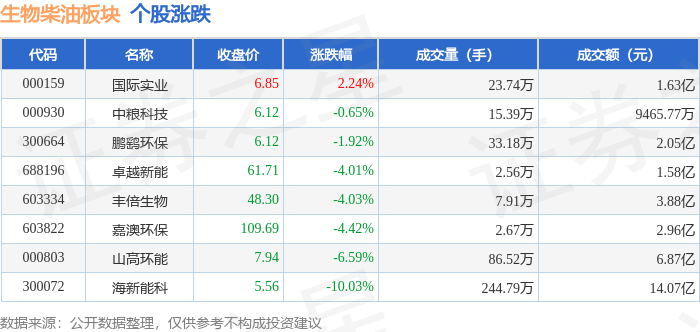
Core Insights - The biodiesel sector experienced a decline of 4.59% on November 14, with Hai Xin Energy leading the drop [1] - The Shanghai Composite Index closed at 3990.49, down 0.97%, while the Shenzhen Component Index closed at 13216.03, down 1.93% [1] Stock Performance - International Industrial (000159) closed at 6.85, up 2.24% with a trading volume of 237,400 shares and a transaction value of 163 million [1] - Zhongliang Technology (000930) closed at 6.12, down 0.65% with a trading volume of 153,900 shares and a transaction value of 94.66 million [1] - Pengpeng Environmental (300664) closed at 6.12, down 1.92% with a trading volume of 331,800 shares and a transaction value of 205 million [1] - Excellent New Energy (688196) closed at 61.71, down 4.01% with a trading volume of 25,600 shares and a transaction value of 158 million [1] - Fengbei Biological (603334) closed at 48.30, down 4.03% with a trading volume of 79,100 shares and a transaction value of 38.8 million [1] - Jiaao Environmental (603822) closed at 109.69, down 4.42% with a trading volume of 26,700 shares and a transaction value of 296 million [1] - Shangaohuan Energy (000803) closed at 7.94, down 6.59% with a trading volume of 865,200 shares and a transaction value of 687 million [1] - Hai Xin Energy (300072) closed at 5.56, down 10.03% with a trading volume of 2,447,900 shares and a transaction value of 1.407 billion [1] Capital Flow - The biodiesel sector saw a net outflow of 390 million from main funds, while retail investors contributed a net inflow of 288 million [1] - The detailed capital flow for individual stocks shows varying trends, with International Industrial seeing a net inflow of 3.08 million from main funds, while Hai Xin Energy experienced a net outflow of 150 million [2]


全球减碳+SAF价格暴涨70%+政策三重催化!生物柴油开启千亿赛道
Jin Rong Jie· 2025-11-13 02:37
Core Insights - The biodiesel sector is experiencing significant positive developments, with core stocks showing notable price increases due to favorable policies and market conditions [1][4] - The International Air Transport Association (IATA) projects that Sustainable Aviation Fuel (SAF) will contribute approximately 65% to the aviation sector's net-zero carbon target by 2050 [1] - The Chinese government has set ambitious targets for biodiesel utilization, aiming for 2 million tons by 2025 and 5 million tons by 2030, alongside mandatory blending standards [2] Industry Developments - The European SAF FOB price has risen over 58% since the beginning of the year, reaching $2840-$2860 per ton, while domestic prices have increased to $2450-$2650 per ton [1] - The National Development and Reform Commission's "14th Five-Year Plan" emphasizes the importance of biodiesel in renewable energy development [2] - The International Maritime Organization is promoting biodiesel as a key option for reducing emissions in the shipping sector [2] Technological Advancements - Third-generation biodiesel technologies have achieved conversion efficiencies exceeding 92%, significantly reducing pollutant emissions and ensuring compatibility with existing maritime and aviation equipment [3] - Leading domestic companies are extending their production capabilities into the SAF supply chain, enhancing product value [3] Market Activity - The demand for biodiesel is expanding into high-value applications, with increased trading activity in the sector as market expectations for growth rise [4] - Core stocks in the biodiesel sector are attracting significant investor interest, driven by policy and price catalysts [4] Company Spotlight: Shango Environmental - Shango Environmental (000803.SZ) is a leading player in the biodiesel raw material sector, focusing on the resource utilization of used cooking oil (UCO) [5] - The company has an annual production capacity of 60,000 tons of UCO and is well-positioned to benefit from the explosive growth in global SAF demand [5] - For the first half of 2025, the company anticipates a net profit of 40-45 million yuan, representing a year-on-year increase of 214.28%-228.56% [5] Competitive Advantages - Shango has established a robust network for collecting used cooking oil, enhancing its raw material self-sufficiency [6] - The company is upgrading its production facilities to meet both domestic and international SAF production standards, supporting future market expansion [6] - Plans to increase biodiesel production capacity to 500,000 tons per year are in place, leveraging raw material advantages to extend the supply chain into SAF production [6]
A股五张图:“拉一踩一”的下场
Xuan Gu Bao· 2025-11-12 10:35
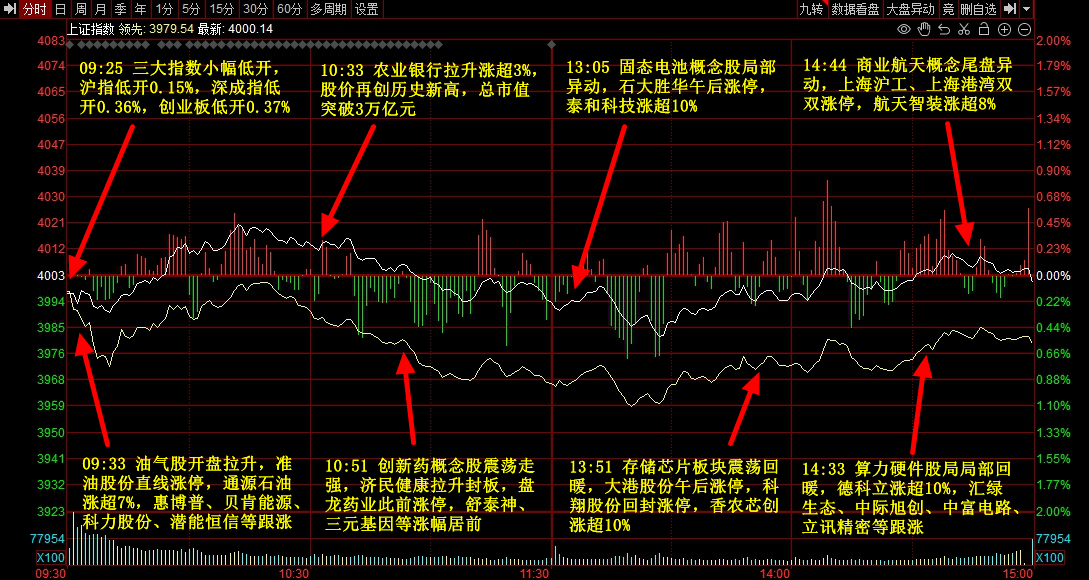
Market Overview - Technology stocks experienced a collective pullback, with indices showing a slight V-shaped recovery [3] - The biodiesel sector saw significant gains, with stocks like Shanhigh Environmental and Jiaao Environmental hitting the daily limit [3] - Gene editing stocks surged, with companies such as Nanjing Xinbai and Jimin Health reaching their daily limits [3] - Oil service stocks also performed well, with companies like Zhun Oil and Shandong Molong hitting the daily limit [3] - The satellite internet sector saw a late-stage rally, with Shanghai Huguang and Shanghai Gangwan both experiencing sharp increases [3] Banking Sector - The banking sector showed resilience amidst the overall market decline, with major banks like Agricultural Bank of China leading the way [5] - Agricultural Bank of China saw a significant increase of 3.49%, reaching a market capitalization of over 3 trillion, solidifying its position as the second-largest bank globally [6] Satellite Internet - The satellite internet sector rebounded sharply in the late trading session, with notable gains from companies like Aerospace Zhizhuang and China Satellite [10] - The catalyst for this rally was the announcement of a new, cheaper Starlink home package by SpaceX, priced at $40 per month [10] Company-Specific Developments - Xingsen Technology experienced a rise of 6% after rumors of a partnership with Nvidia surfaced, although these claims were later disputed [12][13] - Daily Interaction saw a volatile trading session, initially declining but then surging over 10% due to speculation around a new product release related to DeepSeek [19]