
美容护理

Search documents
A股三大指数收跌,消费板块大涨,白银期货跌超10%
Sou Hu Cai Jing· 2026-02-05 07:39
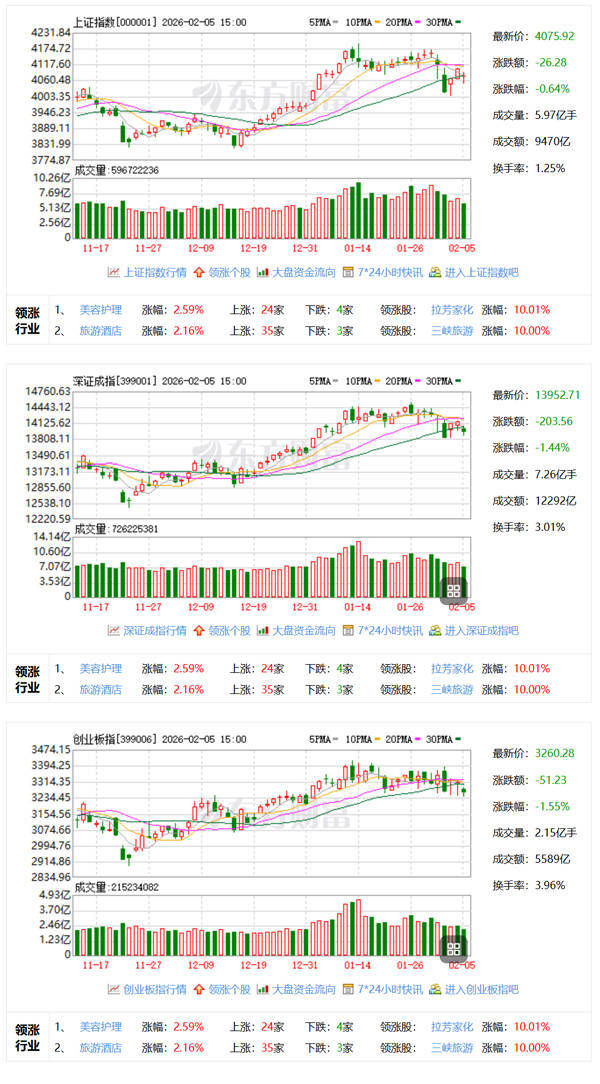
Market Overview - The three major A-share indices collectively retreated, with the Shanghai Composite Index down 0.64% closing at 4075.92 points, the Shenzhen Component Index down 1.44% closing at 13952.71 points, and the ChiNext Index down 1.55% closing at 3260.28 points [1] - The trading volume in the Shanghai and Shenzhen markets was only 2.1945 trillion, a decrease of 309 billion compared to the previous day [1] Sector Performance - The financial sector showed strength in the afternoon, with Huayin Securities and Xiamen Bank hitting the daily limit [6] - The consumer sector experienced significant gains, with food and beverage, retail, film and television, and tourism hotel sectors being particularly active [7] - The beauty care and tourism hotel sectors led the gains, with the tourism hotel sector rising by 2.16%, featuring 35 gainers and only 3 losers, with Sanxia Tourism up by 10.00% [5] Individual Stock Highlights - Over 1600 stocks rose, with more than 50 stocks hitting the daily limit [7] - Notable stocks included Hengdian Film and Television with 6 gains in 5 days, Hangzhou Department Store with 2 consecutive gains, and several food and tourism stocks reaching the daily limit [7] - The commercial aerospace concept saw localized activity, with Shenjian Co. achieving 2 boards in 3 days [6]

A股低开低走,缩量震荡:大消费逆势走强,两市成交超2.1万亿元
Xin Lang Cai Jing· 2026-02-05 07:33
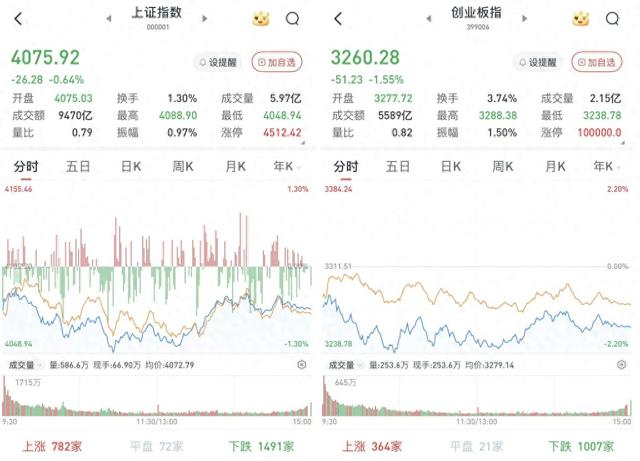
Market Overview - The A-share market experienced a significant decline on February 5, with all three major indices opening sharply lower and showing slight recovery in the afternoon [2] - The Shanghai Composite Index fell by 0.64% to 4075.92 points, the ChiNext Index dropped by 1.55% to 3260.28 points, and the Shenzhen Component Index decreased by 1.44% to 13952.71 points [2] Stock Performance - A total of 1616 stocks rose while 3715 stocks fell across the two exchanges and the Beijing Stock Exchange, with a total trading volume of 21,762 billion yuan, down from 24,809 billion yuan in the previous trading day [3] - In terms of individual stock performance, 59 stocks saw gains of over 9%, while 42 stocks experienced declines of over 9% [4] Sector Analysis - Bank stocks showed resilience, with notable gains including Xiamen Bank reaching the daily limit, and Chongqing Bank and Shanghai Bank rising over 4% [5] - The beauty and personal care sector also performed well, with companies like Lafang Home and Dengkang Dental hitting the daily limit [5] - Conversely, the gold and precious metals sector faced significant declines due to a sharp drop in international gold prices, with several stocks hitting the daily limit down [5] Market Sentiment and Future Outlook - Analysts suggest that the A-share market is currently in a phase of repair and fluctuation, with limited potential for a new sustained trend due to recent adjustments and the upcoming Spring Festival [7] - The first quarter is expected to show the effects of growth-stabilizing policies, with liquidity remaining relatively loose [7] - Concerns over tightening U.S. dollar liquidity and rising market volatility are noted, with a warning of increased investment risks [8] - The upcoming Spring Festival is anticipated to influence consumer demand positively, potentially leading to a more stable market outlook [8]
收评:沪指跌0.64% 大消费板块集体走强
Zhong Guo Jin Rong Xin Xi Wang· 2026-02-05 07:32
板块方面,美容护理、旅游酒店、银行、商业百货板块涨幅居前,贵金属、光伏设备、能源金属、小金 属、电网设备、有色金属板块跌幅居前。 盘面热点 盘面上,大消费板块大涨,食品饮料、零售、影视院线、旅游酒店方向轮番活跃,横店影视6天5板,杭 州解百2连板,安记食品、海欣食品、金逸影视、三峡旅游涨停。大金融板块午后走强,华林证券、厦 门银行涨停。商业航天概念局部活跃,神剑股份3天2板。算力租赁概念回暖,群兴玩具4天2板,二六三 封涨停。下跌方面,有色金属、电网设备、油气等板块跌幅居前。 个股方面,全市场超3700只个股下跌。 机构观点 中信建投:2025年家电板块受困于关税、以旧换新政策波动以及下半年高基数预期,整体跑输沪深 300。立足长期视角,企业的竞争力终将回归产品创新与效率优势的本质,因此从投资视角来看,认为 2026年家电板块主要有两条主线,一是出海继续成为增长的最重要来源,二是变革红利。 转自:新华财经 新华财经北京2月5日电(王媛媛)A股三大指数全天在低位震荡运行,午后指数跌幅集体收窄,此前一 度均跌超1%。截至收盘,沪指报4075.92点,跌0.64%,成交9470亿元;深证成指报13952.71点,跌 ...
收评:沪指震荡调整跌0.64% 影视等消费板块走强
Zhong Guo Jing Ji Wang· 2026-02-05 07:16
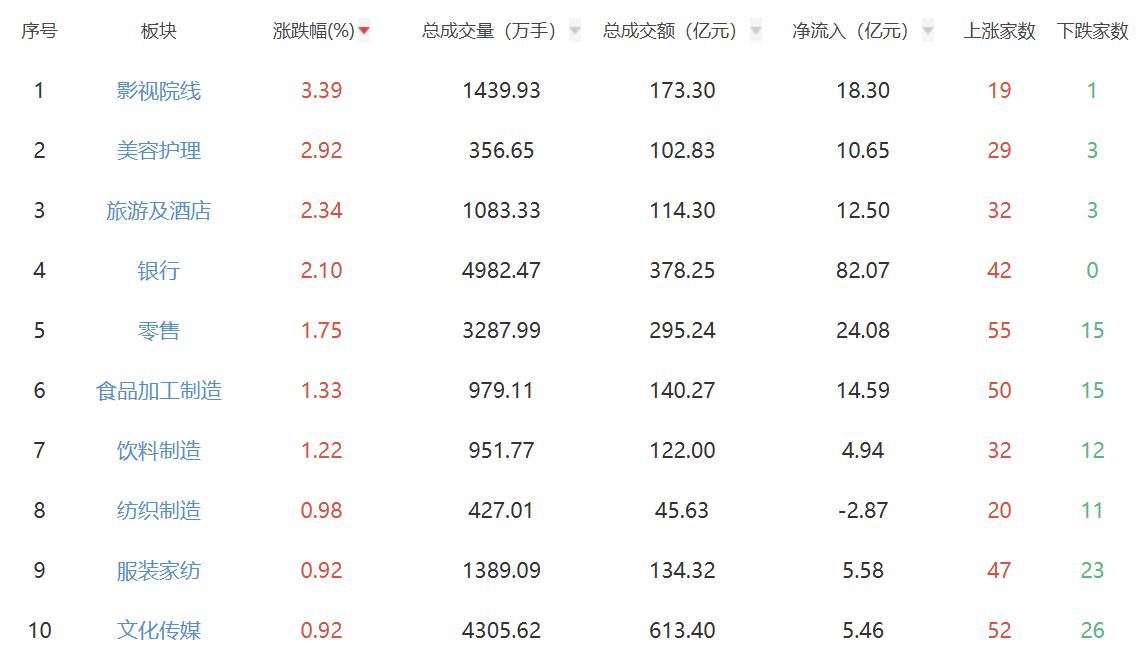
Market Overview - The A-share market experienced a decline across all three major indices, with the Shanghai Composite Index closing at 4075.92 points, down 0.64%, and a total trading volume of 946.99 billion yuan [1] - The Shenzhen Component Index closed at 13952.71 points, down 1.44%, with a trading volume of 1229.23 billion yuan [1] - The ChiNext Index closed at 3260.28 points, down 1.55%, with a trading volume of 552.29 billion yuan [1] Sector Performance - The film and television sector led the gains with an increase of 3.39%, totaling a trading volume of 1439.93 million hands and a turnover of 173.30 billion yuan [2] - The beauty care sector rose by 2.92%, with a trading volume of 356.65 million hands and a turnover of 102.83 billion yuan [2] - The tourism and hotel sector increased by 2.34%, with a trading volume of 1083.33 million hands and a turnover of 114.30 billion yuan [2] Declining Sectors - The photovoltaic equipment sector saw a significant decline of 5.31%, with a trading volume of 5922.03 million hands and a turnover of 1048.23 billion yuan [2] - The energy metals sector decreased by 4.49%, with a trading volume of 298.96 million hands and a turnover of 145.11 billion yuan [2] - The coal mining and processing sector fell by 2.55%, with a trading volume of 2524.05 million hands and a turnover of 210.16 billion yuan [2]
连续大涨!贵州茅台重回市场“C位”
天天基金网· 2026-02-05 05:21
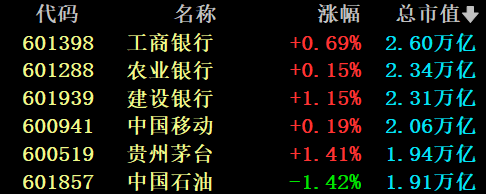
Group 1 - Guizhou Moutai has regained its market "C position," with a stock price increase of 1.41% today, reaching a peak of 1559.89 CNY per share and a market capitalization of 1.94 trillion CNY, surpassing China Petroleum to become the fifth largest in A-shares [2][3] - Since the rebound on January 29, Guizhou Moutai's stock price has increased by over 16%, leading to a recent active performance in consumer stocks [2][3] - The strong performance of consumer stocks is reflected in the significant gains in sectors such as beauty and personal care, with companies like Lafang Jiahua hitting the daily limit [7][8] Group 2 - The price recovery of Feitian Moutai is a key catalyst for Guizhou Moutai's recent strength, driven by adjustments in both channel and pricing systems [11] - The company launched a direct sales initiative on the "i Moutai" platform, attracting 6.28 million new users and achieving over 2.12 million orders in January [11] - Analysts expect that the price stabilization of Feitian Moutai around 1500 CNY will enhance market confidence and support the company's performance throughout the year [11] Group 3 - The precious metals market experienced a sharp decline, with spot gold dropping by 1.81% to 4878.345 USD per ounce and spot silver falling by 13.35% to 76.847 USD per ounce [4][14] - The decline in precious metals is attributed to profit-taking and increased market volatility, although long-term support factors for gold remain intact [14][16] - The overall performance of the non-ferrous metals sector has been weak, with significant drops in major companies [12][15]


贵州茅台,重回市场“C位”
Zhong Guo Zheng Quan Bao· 2026-02-05 05:05
Group 1 - Guizhou Moutai (600519) has regained its position in the market, with a stock price increase of 1.41% today, reaching a peak of 1559.89 CNY per share and a market capitalization of 1.94 trillion CNY, surpassing China Petroleum [1][2] - Since the rebound on January 29, Guizhou Moutai's stock price has accumulated a rise of over 16%, leading to increased activity in consumer stocks [1] - The performance of consumer stocks has been strong, with significant gains in sectors such as beauty and personal care, tourism, and food processing [5][8] Group 2 - The recent strength of Guizhou Moutai is attributed to the recovery of the price of its flagship product, Feitian Moutai, driven by adjustments in both distribution channels and pricing systems [8] - The company launched a direct sales initiative on the "i Moutai" platform, which has attracted 6.28 million new users and generated over 2.12 million orders, indicating strong consumer demand [8] - Analysts expect that the price stabilization of Feitian Moutai around 1500 CNY will enhance market confidence and support the company's performance across economic cycles [8]
重要信号!市场普跌,资金却在悄悄布局这三条线
Sou Hu Cai Jing· 2026-02-05 04:55
第三,需求端持续验证。从票房到演出数据,都证实了线下文娱消费的强劲复苏。IP的多元变现(游 戏、衍生品、文旅)正在打开估值天花板。 因此,影视板块在当前时点,提供了一个罕见的"确定性组合":短期有春节档的业绩催化(高预售锁定 部分业绩),中期有AI降本增效的利润率改善逻辑,长期有IP运营的成长空间。在市场迷茫期,这种 逻辑清晰、且暂时与宏观经济波动关联度不高的板块,成为资金天然的避风港和进攻抓手。 展望后市,市场可能进入一个阶段的震荡期,用于重新评估成长股的业绩兑现与估值匹配度。在此期 间,具备业绩确定性(消费旺季)、高分红(银行)、或产业趋势明确改善(如影视、部分创新药)的 板块,可能更具韧性。 今日午盘,市场呈现普跌格局,但结构分化极具启发性。上证跌1.03%,创业板指跌1.94%,科创50跌 2.00%,成长风格压力显著。半日成交14475亿,环比缩量,资金活跃度有所下降。 板块上,两极分化。上涨方向高度集中于"消费+防御":美容护理(+3.26%)、银行、食品饮料领涨。 下跌方向则是"周期+新能源":有色金属(-5.21%)、电力设备深度调整。这种盘面语言很清楚:资金 在从高位、高波动、与全球宏观挂钩 ...
帮主郑重午评:指数集体跳水,消费逆势突围,午后怎么应对?
Sou Hu Cai Jing· 2026-02-05 04:48
Core Viewpoint - The market experienced a significant adjustment with all three major indices dropping over 1%, while the consumer sector showed resilience, driven by defensive capital flows and the upcoming Spring Festival consumption peak [3][4]. Group 1: Market Performance - The overall market saw a decline, with over 3,700 stocks in the Shanghai, Shenzhen, and Beijing markets in the red, and a trading volume of 1.46 trillion [1]. - The consumer sector, particularly in beauty care, film, and food, outperformed the market, with several stocks hitting the daily limit [1][3]. Group 2: Sector Analysis - The consumer sector's strength is attributed to its defensive nature during market adjustments, alongside supportive consumption policies as the Spring Festival approaches [3]. - In contrast, the space photovoltaic sector faced a collective adjustment after a previous surge, with companies clarifying they were not involved in the space photovoltaic business, leading to a rapid decline in speculative sentiment [3]. - The precious metals sector continued to decline, with companies like Hunan Gold and Hunan Silver hitting the daily limit down, influenced by ongoing international gold price corrections and previous excessive gains [3]. Group 3: Investment Strategy - The strategy for the afternoon is clear: hold onto high-quality consumer stocks while considering profit-taking during peaks, and avoid chasing high-priced speculative stocks [4]. - Investors holding space photovoltaic and precious metals stocks are advised to reduce positions during rallies and wait for stabilization signals before re-entering [4]. - For those currently in cash, it is recommended to observe the consumer sector's performance and market stabilization before making new investments, focusing on leading consumer stocks for small-scale testing [4].

午评:三大指数跌超1% 消费类板块逆势走强
Zhong Guo Jing Ji Wang· 2026-02-05 03:44
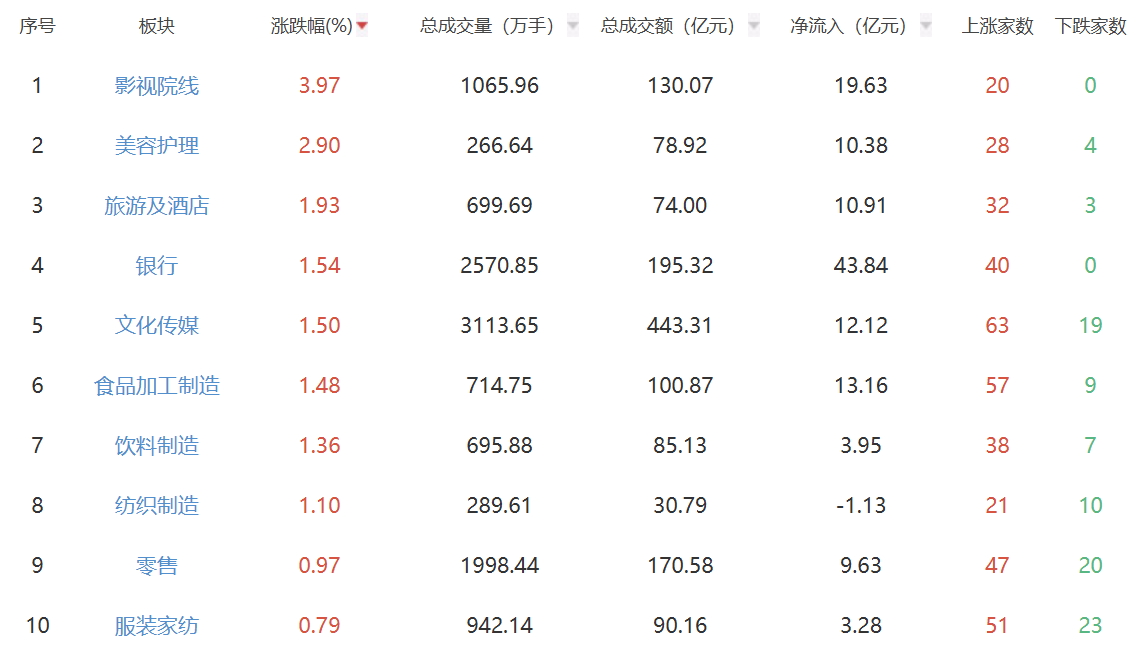
中国经济网北京2月5日讯 A股三大指数下挫,截至午间收盘,上证指数报4059.91点,跌幅1.03%;深证成指报13900.33点,跌幅1.81%;创业板指报 3247.28点,跌幅1.94%。 行业板块方面,影视院线、美容护理、旅游及酒店等板块涨幅居前,贵金属、光伏设备等板块跌幅居前。 A股市场板块涨跌幅排行 | 序号 | 板块 | 涨跌幅(%)▼ | | 总成交量(万手) ▼ 总成交额(亿元)▼ | 浄流入(亿元) ▼ | 上涨家数 | 下跌5 | | --- | --- | --- | --- | --- | --- | --- | --- | | 1 | 影视院线 | 3.97 | 1065.96 | 130.07 | 19.63 | 20 | O | | 2 | 美容护理 | 2.90 | 266.64 | 78.92 | 10.38 | 28 | ব | | 3 | 旅游及酒店 | 1.93 | 699.69 | 74.00 | 10.91 | 32 | ന | | ব | 银行 | 1.54 | 2570.85 | 195.32 | 43.84 | 40 | O | | 5 | 文化传媒 | 1 ...
午评:三大指数均跌超1%,大消费板块逆势走强
Xin Lang Cai Jing· 2026-02-05 03:33
市场早间震荡调整,三大指数均跌超1%。大消费板块逆势走强,美容护理、影视、食品等方向领涨, 拉芳家化、浙文影业、横店影视、海欣食品等多股涨停。下跌方面,太空光伏概念调整,钧达股份、双 良节能等跌停;贵金属板块下挫,湖南黄金、湖南白银触及跌停。个股跌多涨少,沪深京三市超3700股 飘绿,上午半天成交1.46万亿。午间收盘沪指跌1.03%,深成指跌1.81%,创业板跌1.94%。 ...