
跨境电商

Search documents
跨境通涨2.16%,成交额1.79亿元,主力资金净流入1183.33万元
Xin Lang Cai Jing· 2026-01-12 02:43
Group 1 - The stock price of Kuaijingtong increased by 2.16% on January 12, reaching 4.74 CNY per share, with a trading volume of 179 million CNY and a turnover rate of 2.45%, resulting in a total market capitalization of 7.385 billion CNY [1] - Year-to-date, Kuaijingtong's stock price has risen by 4.64%, with a 3.72% increase over the last five trading days, an 8.97% increase over the last 20 days, and a 3.66% decrease over the last 60 days [1] - The company primarily engages in cross-border e-commerce, with 92.33% of its revenue coming from maternal and infant products and 7.67% from apparel and home goods [1] Group 2 - As of December 26, Kuaijingtong had 214,800 shareholders, with an average of 7,206 circulating shares per person, showing no change from the previous period [2] - For the period from January to September 2025, Kuaijingtong reported a revenue of 4.018 billion CNY, a year-on-year decrease of 4.30%, while the net profit attributable to shareholders was -16.8253 million CNY, an increase of 5.28% year-on-year [2] - Kuaijingtong has distributed a total of 291 million CNY in dividends since its A-share listing, with no dividends paid in the last three years [3]

吉宏股份20260109
2026-01-12 01:41
Summary of Ji Hong Co., Ltd. Conference Call Industry and Company Overview - **Company**: Ji Hong Co., Ltd. - **Industry**: Cross-border e-commerce and packaging Key Points and Arguments Cross-border E-commerce Growth - Ji Hong's cross-border e-commerce business is experiencing rapid growth in Northeast Asia and Eastern Europe, with Eastern Europe benefiting from the application of AIGC tools, achieving growth rates of 60%-70%, with some quarters exceeding 100% year-on-year [2][4] - The annual growth rate in Northeast Asia is stable at 30%-40% [2][5] - The company expects overall revenue growth in cross-border e-commerce to exceed 20% by 2026, driven by continued expansion in Northeast Asia, Europe (especially Eastern Europe), and Southeast Asia [2][7] Profitability and Margins - Ji Hong has improved its gross margin from approximately 50% in 2021 to nearly 60%, with specific regions reaching 70% [2][9] - The net profit margin for the cross-border e-commerce business remains stable at 5%-8%, focusing more on market share and order volume [2][10] - The e-commerce model features low inventory, with a stock-to-sales ratio maintained at no higher than 4%, significantly lower than the industry average [2][13] Regional Performance - Northeast Asia accounts for about 40% of total revenue, with a high customer loyalty and low fulfillment costs [4] - Eastern Europe contributes approximately 25% of total revenue, with significant growth potential due to the application of AIGC tools [4] - Southeast Asia represents about 20% of revenue, with an annual growth rate of 10%-15% [4][6] Inventory Management - Ji Hong's low inventory model is characterized by a stock-to-sales ratio of no more than 4%, compared to the industry standard of 15%-20% [2][13] - The company employs a model where 50% of orders are fulfilled based on existing orders, which requires high logistics and customer service efficiency [2][13] Currency Risk Management - The company collaborates with financial institutions like HSBC and Citibank to hedge against currency fluctuations, ensuring that cross-border e-commerce revenues are protected [2][16] Free Brand Development - Ji Hong has developed four major brands since launching its free brand strategy in 2022, with total revenue expected to exceed 400 million RMB in 2025 and target 600-800 million RMB in 2026 [3][17] - The brands include a sunshade brand, women's lingerie, pet strollers, and electric mountain bikes [17] Packaging Business Performance - The packaging business is expected to grow significantly in 2025, particularly in food-grade packaging, with over 10% revenue growth [21] - The company plans to build a new food-grade factory in Zhangjiagang, Jiangsu, to further expand its QSR packaging business [21] AI Integration - Ji Hong has invested in AI tools since 2018, significantly enhancing its e-commerce operations and achieving a substantial increase in gross margins and order volumes [26] - The company anticipates that the number of orders will exceed 20 million by 2026, showcasing the importance of AI in its business model [26] Future Plans - Ji Hong plans to add two new factories in 2026, including one in Jiangsu and another overseas, to significantly increase production capacity [27] - The company aims for social e-commerce to achieve over 20% growth in Northeast Asia and Europe [27] Other Important Insights - The company maintains a focus on controlling downside risks in capital utilization rather than pursuing high returns [15] - Ji Hong's strategy includes long-term partnerships with local events to enhance brand visibility and consumer engagement [20]

三态股份1月9日获融资买入1542.68万元,融资余额1.37亿元
Xin Lang Zheng Quan· 2026-01-12 01:35
Core Viewpoint - SanTai Co., Ltd. has shown a mixed financial performance with slight revenue growth but a significant decline in net profit, indicating potential challenges ahead for the company [2]. Group 1: Stock Performance and Financing - On January 9, SanTai's stock rose by 2.26%, with a trading volume of 107 million yuan. The financing buy-in amount for the day was 15.43 million yuan, while the net financing buy was 2.86 million yuan [1]. - As of January 9, the total financing and securities lending balance for SanTai was 137 million yuan, which is 7.26% of its market capitalization, indicating a low financing balance compared to the past year [1]. - In terms of securities lending, on January 9, SanTai repaid 100 shares and sold 13,600 shares, with a selling amount of 116,800 yuan, reflecting a low securities lending balance [1]. Group 2: Financial Performance - For the period from January to September 2025, SanTai achieved a revenue of 1.252 billion yuan, representing a year-on-year growth of 0.15%. However, the net profit attributable to shareholders decreased by 25.94% to 31.84 million yuan [2]. - Since its A-share listing, SanTai has distributed a total of 110 million yuan in dividends [3]. Group 3: Shareholder Structure - As of December 31, the number of shareholders for SanTai was 27,500, a decrease of 2.12% from the previous period. The average number of circulating shares per person increased by 2.17% to 7,968 shares [2]. - Among the top ten circulating shareholders, Hong Kong Central Clearing Limited is the second-largest shareholder with 2.2594 million shares, a decrease of 1.0691 million shares from the previous period [3].
“抢跑”!10只基金开年首周,涨超20%!
券商中国· 2026-01-11 23:32
Core Viewpoint - The A-share market experienced a strong start in 2026, with the Shanghai Composite Index surpassing 4100 points and the Shenzhen Component Index exceeding 14000 points, marking significant highs in recent years. Institutional investors, particularly public funds, had already positioned themselves ahead of this rally, leading to substantial gains in various sectors such as commercial aerospace, semiconductor chips, and innovative pharmaceuticals [1][5]. Group 1: Fund Manager Strategies - Fund managers proactively increased their positions in late 2025, anticipating a spring market rally, with many reducing their exposure during market downturns in late 2025 [2][3]. - A notable fund manager highlighted the importance of macroeconomic indicators, such as stabilizing PMI data and a shift in overseas liquidity expectations, which prompted them to increase their holdings in semiconductor stocks, particularly storage chips, leading to over 15% returns in the recent rally [2][3]. - Institutional investors' early positioning is evidenced by several companies' buyback announcements, revealing that many fund managers had increased their stakes in key stocks during the fourth quarter of 2025 [3]. Group 2: Market Performance and Sector Highlights - The first week of 2026 saw ten funds achieving over 20% returns, with significant contributions from sectors like commercial aerospace and technology [5][6]. - The commercial aerospace sector emerged as a standout performer, with the China Satellite Industry Index rising by 85.7% from November 24, 2025, to January 9, 2026, and several key stocks experiencing over 200% gains [5][6]. - The semiconductor industry, particularly storage chips, is benefiting from increased demand driven by advancements in AI technology, with funds heavily invested in this sector reporting substantial profits [6][7]. Group 3: Future Market Outlook - Analysts predict a volatile market in 2026, with a positive sentiment expected in the first quarter, particularly for growth sectors like semiconductors and artificial intelligence [4][8]. - The macroeconomic environment, including favorable policies and improving economic fundamentals, is seen as a driving force for the continuation of the current market rally [8][9]. - Investment strategies are expected to focus on both technology and cyclical sectors, with potential price increases in industries like lithium batteries anticipated due to supply constraints and recovering demand [9][10].


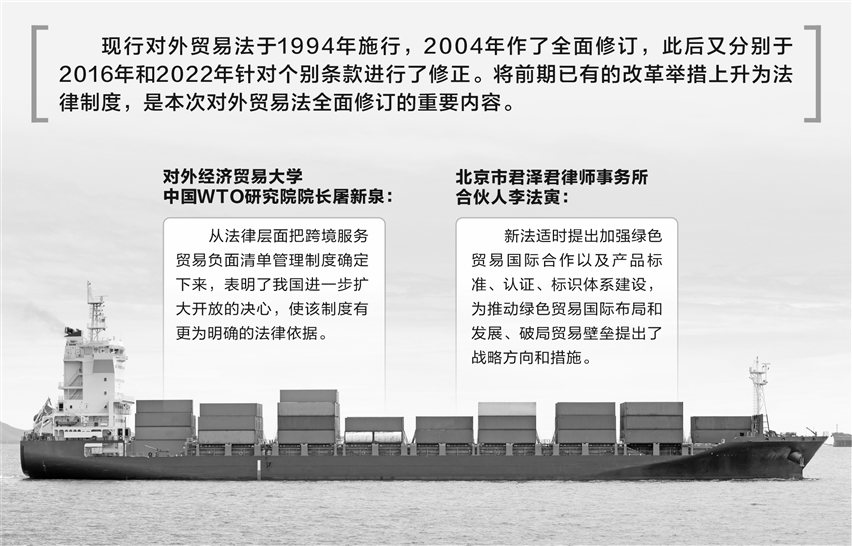
外贸“基本法”大修 固定改革成果保障高水平对外开放
Zheng Quan Shi Bao Wang· 2026-01-11 23:13
Core Viewpoint - The newly revised Foreign Trade Law of the People's Republic of China will take effect on March 1, 2026, marking a significant overhaul aimed at enhancing the legal framework for foreign trade and expanding high-level openness in the sector [2][3]. Group 1: Legislative Changes - The new law consists of 11 chapters and 83 articles, establishing a negative list management system for cross-border service trade, reflecting China's commitment to opening up international service trade [3][4]. - The law incorporates previous reform measures into a legal framework, enhancing the stability and authority of policies related to cross-border service trade [5]. Group 2: Support for Small and Medium Enterprises - The law explicitly states that the government will support and facilitate small and medium-sized enterprises (SMEs) in engaging in foreign trade, providing conveniences in regulation, financing, and foreign exchange settlement [9]. - It also establishes a trade adjustment assistance system to support enterprises affected by trade remedy measures, enhancing their resilience [9][10]. Group 3: Promotion of Green Trade - The new law emphasizes the establishment of a green trade system, encouraging the export of green low-carbon products and promoting international cooperation in green trade [6][7]. - It aims to address trade barriers related to green products, providing strategic directions for international collaboration and standardization [6][7]. Group 4: Digital Trade and New Business Models - The law recognizes the importance of new business models such as cross-border e-commerce and supports the use of electronic documents and international mutual recognition of digital certificates and signatures [8]. - This legal backing is expected to facilitate the development and transformation of digital trade, ensuring compliance with international standards [8].
基金“抢跑”春季行情 10只产品拿到开年“大红包”
Zheng Quan Shi Bao· 2026-01-11 17:00
Group 1 - The A-share market experienced a strong start in 2026, with the Shanghai Composite Index breaking through 4100 points, reaching a nearly 10-year high, and the Shenzhen Component Index surpassing 14000 points, marking a nearly 4-year high [1] - Institutional investors, particularly public funds, had already increased their positions by the end of Q4 2025, anticipating the "spring rally" [2][3] - The market showed significant gains in sectors such as commercial aerospace, semiconductor chips, and innovative pharmaceuticals, with 10 funds achieving over 20% returns in the first week of the year [4] Group 2 - Fund managers reported that they reduced their positions to 70% during the market's downturn in late 2025, but began to increase their holdings in late November to early December as positive macroeconomic signals emerged [2] - Specific funds, such as those managed by Dazheng Jingheng and other notable managers, have been revealed to have increased their stakes in companies like Jiete Bio and Huakai Yibai, which saw significant stock price increases [3] - The average position of active equity funds was reported at 85.74% by the end of last year, with notable increases in sectors like basic chemicals, non-bank financials, and home appliances [3] Group 3 - The commercial aerospace sector has been highlighted as a key driver of the recent market rally, with the China Satellite Industry Index rising by 85.7% from November 2025 to January 2026 [4][5] - Fund managers emphasized the importance of the commercial aerospace industry's growth, driven by technological breakthroughs, capital support, and policy backing, marking 2026 as a transformative year for the sector [5] - The semiconductor industry, particularly in storage chips, is also experiencing significant growth, with funds heavily invested in this area reporting substantial returns [5] Group 4 - Analysts predict that the strong performance of the A-share market is supported by a favorable macroeconomic environment, increased capital inflows, and improvements in economic fundamentals [6] - The consensus among institutions is that "technology" and "cyclical" sectors will be key themes in 2026, with ongoing discussions about the sustainability of the current market rally [6][7] - Investment strategies are focusing on technology sectors, particularly AI and semiconductor industries, as well as cyclical commodities like chemicals and industrial metals, which are expected to benefit from supply constraints and moderate demand recovery [7]
2025年交易额破万亿元 深圳跨境电商确立全国“超级枢纽”地位
Sou Hu Cai Jing· 2026-01-11 11:20
Core Insights - Shenzhen's cross-border e-commerce online transaction volume is projected to exceed 1 trillion RMB by 2025, following a scale of 900 billion RMB in 2024, maintaining its position as the national leader for several consecutive years [1][3] Group 1: Industry Overview - The 2026 China (Shenzhen) Cross-Border E-commerce Industry Summit Forum revealed that Shenzhen hosts approximately 120,000 cross-border e-commerce sellers and 100,000 supporting service providers, accounting for half of the national total [3] - Shenzhen is recognized as a "super hub" for cross-border e-commerce due to its substantial market base and complete industrial chain ecosystem [3][4] Group 2: Brand Strength and Market Position - Shenzhen leads the nation in brand influence, with 51 brands listed in the "Top 100 Cross-Border E-commerce Brands in China (First Half of 2025)" [4] - Among the 120,000 sellers, 18 listed companies form a "core group," and there are 130 brands with an annual GMV exceeding 25 million RMB [4] Group 3: Future Development Trends - The cross-border e-commerce industry is expected to enter a phase of "high-quality growth" and "structural reshuffling" by 2026, with a shift from a focus on traffic and low prices to product innovation, brand value, and supply chain efficiency [4][5] - Future trends include upgrading from "selling products" to "selling ecosystems," enhancing supply chain resilience, diversifying market outreach, and ensuring compliance and transparency in operations [5][6] Group 4: Challenges and Opportunities - The industry has faced challenges such as low brand recognition, product homogeneity, and logistical inefficiencies, which have historically hindered small and medium-sized enterprises [7] - Companies that prioritize long-term strategies, user insights, and compliance are more likely to thrive in the evolving landscape [7][8] Group 5: Policy Support and Industry Guidance - Shenzhen's "Deep 10" e-commerce support policy, set to launch in 2025, will provide special rewards for cross-border e-commerce platforms, with potential funding up to 25 million RMB [7] - Industry organizations are focusing on compliance and risk management, offering training and practical solutions to help businesses navigate legal risks and supply chain challenges [8]

2025年潍坊市跨境电子商务大赛圆满收官:一场连接今天与未来的“实战演练”
Sou Hu Cai Jing· 2026-01-11 04:44
Group 1 - The core event of the 2025 Weifang Cross-Border E-Commerce Competition concluded successfully, showcasing the talent pool and industrial vitality in the cross-border e-commerce sector of Weifang [1][3] - The competition was organized by multiple local government departments and attracted over 100 teams from educational institutions, numerous corporate teams, and 17 government agency representatives, highlighting the comprehensive talent representation from schools to enterprises and government [3][4] - The competition featured three tracks: educational institutions, enterprises, and government agencies, focusing on practical skills, real performance, and policy understanding, respectively, to create a realistic talent landscape in Weifang's cross-border e-commerce ecosystem [4][6] Group 2 - Winners emerged from each track, with 4 teams in the educational track receiving first prizes, and companies like Weifang Jiexing Trading Co., Ltd. winning in the enterprise track, demonstrating substantial capabilities [6] - The competition also served as a platform for a talent matchmaking event, where over 30 key enterprises engaged with local educational institutions to establish cooperation agreements for targeted training and internships, indicating a proactive approach to meet industry needs [7] - The cross-border e-commerce sector in Weifang reported an import and export volume of 22.7 billion yuan from January to November 2025, ranking second in the province, reflecting the deepening integration of cross-border e-commerce with industrial development [9]

推动更多“网感人”取代“工具人”
Xin Lang Cai Jing· 2026-01-10 21:36
Group 1 - The core viewpoint of the article highlights the urgent need for skilled talent in the cross-border e-commerce sector in Nanjing, as nearly 6000 companies compete for innovative and practical professionals amidst evolving industry challenges [1][2][3] - The cross-border e-commerce industry in Jiangsu is experiencing rapid growth, with various business models such as B2C, B2B, and overseas warehouses emerging, supported by platforms like Amazon and Alibaba [2][3] - The industry is transitioning from a low-cost selling model to a more sophisticated approach focused on brand compliance and operational efficiency, driven by increasing global regulations and market saturation [2][3][4] Group 2 - Companies are facing significant challenges in transitioning to cross-border e-commerce, requiring a new set of skills and innovative thinking to navigate the complex rules and market dynamics [3][4] - There is a notable talent gap in the industry, with companies expressing a need for individuals who possess not only operational skills but also the ability to innovate and understand market trends [4][5] - The government and educational institutions are responding to the talent shortage by implementing a comprehensive talent cultivation plan, aiming to train over 8000 individuals by 2026 through various programs [5][6] Group 3 - The focus of the talent cultivation plan is on practical training, with many universities integrating hands-on experience into their curricula to better prepare students for real-world challenges in cross-border e-commerce [6][7] - Innovative partnerships between companies and educational institutions are being established to enhance talent development, ensuring that graduates are equipped with the necessary skills to meet industry demands [6][7] - The upcoming three-year action plan for cross-border e-commerce aims to leverage AI technologies and improve service offerings, further enhancing the talent supply chain and operational efficiency in the sector [7]
南京市跨境电商:首发“全层级人才培育计划”
Sou Hu Cai Jing· 2026-01-10 19:25
本文由 AI算法生成,仅作参考,不涉投资建议,使用风险自担 【1月9日跨境电商人才培养交流大会在宁举行,首发"全层级人才培育计划"】1月9日,以"金陵聚智跨 境育才"为主的跨境电商人才培养交流大会等会议在南京举办。200余位来自政府、院校等代表,共同见 证南京市跨境电商"全层级人才培育计划"首发。该计划聚焦"人才培育+跨境电商"融合路径,建培养体 系、定制课程,促学以致用,培养专业化队伍。 ...