
服务业

Search documents
冠通期货2025年10月PMI数据
Guan Tong Qi Huo· 2025-10-31 03:39
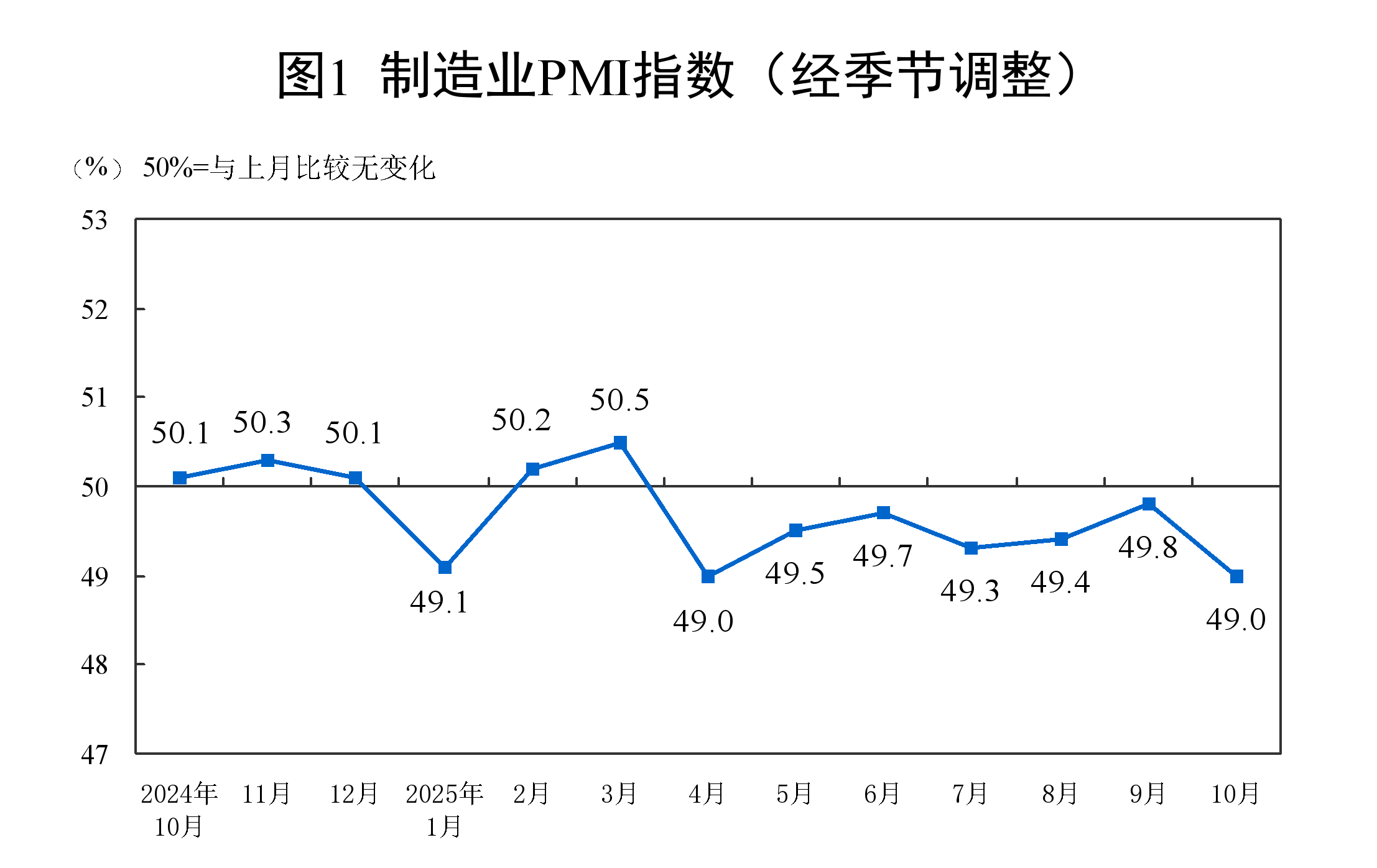
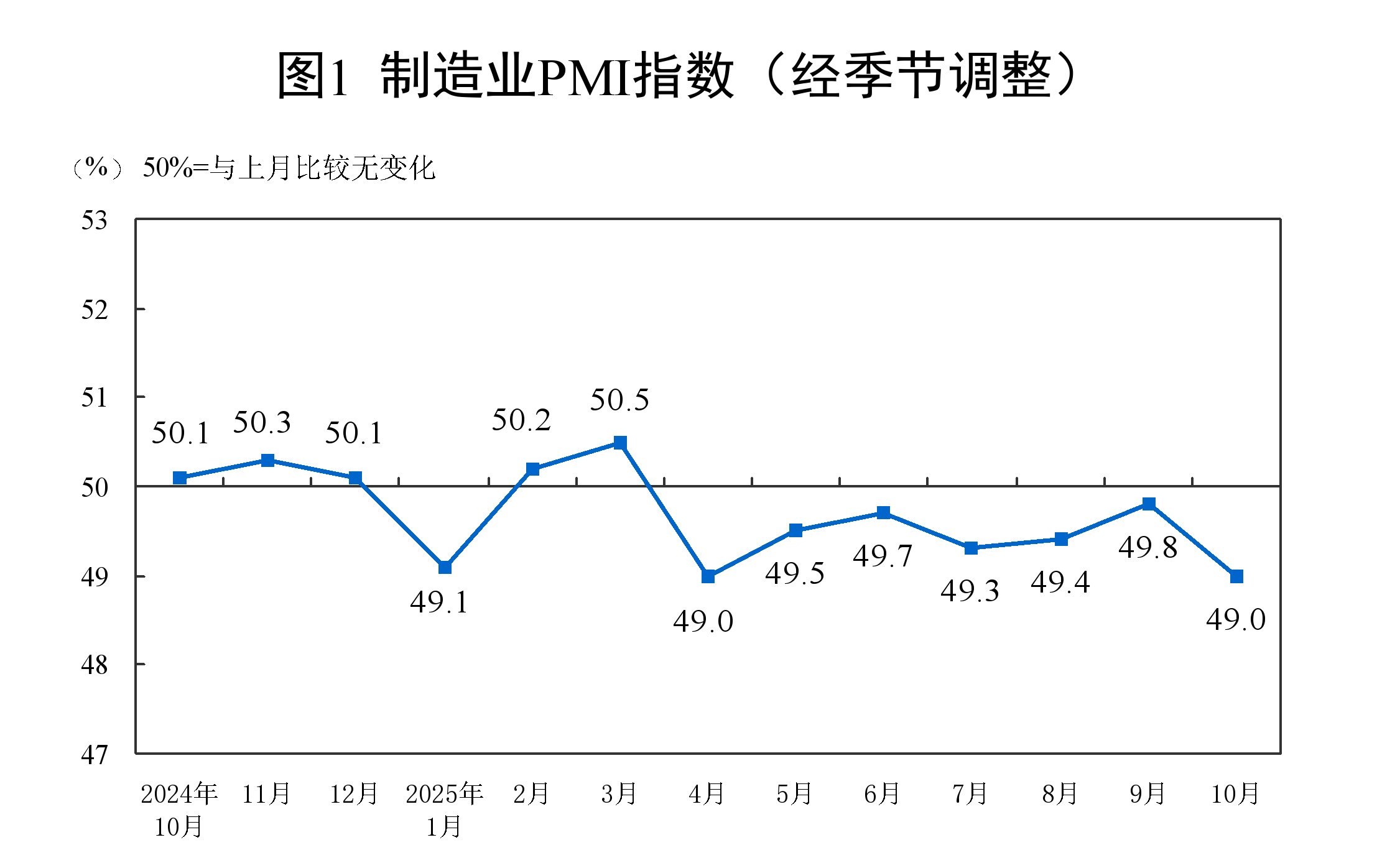
国家统计局服务业调查中心和中国物流与采购联合会10月31日发布2025年10月中国采购经理指数运行情况。 数据显示,10月份,制造业采购经理指数(PMI)为49.0%,比上月下降0.8个百分点,制造业景气水平有所回落。从企业规模看,大、中、小型企业PMI分别为49.9%、48.7%和47.1%,比上月下降1.1个、0.1个 和1.1个百分点,均低于临界点。从分类指数看,在构成制造业PMI的5个分类指数中,供应商配送时间指数位于临界点,生产指数、新订单指数、原材料库存指数和从业人员指数均低于临界点。 生产指数为 49.7%,比上月下降2.2个百分点,表明制造业生产有所放缓。新订单指数为48.8%,比上月下降0.9个百分点,表明制造业市场需求有所回落。原材料库存指数为47.3%,比上月下降1.2个百分点,表明制造业主要 原材料库存量继续减少。从业人员指数为48.3%,比上月下降0.2个百分点,表明制造业企业用工景气度小幅回落。供应商配送时间指数为50.0%,比上月下降0.8个百分点,位于临界点,表明制造业原材料供应商 交货时间与上月基本持平。 2025年10月PMI数据 发布日期 2025/10/31 10月份, ...
制造业PMI回落至49%
第一财经· 2025-10-31 03:38
Core Viewpoint - The manufacturing PMI in October decreased to 49.0%, indicating a decline in manufacturing activity after two months of growth, influenced by pre-holiday demand release and a complex international environment [3][4]. Manufacturing Sector Analysis - The manufacturing PMI fell by 0.8 percentage points from the previous month, reflecting a contraction in manufacturing sentiment [3][4]. - The production index for manufacturing dropped to 49.7%, down 2.2 percentage points, indicating a slight slowdown in production activities [8]. - New export orders index decreased to 45.9%, marking a significant contraction in export demand, particularly in equipment manufacturing, high-tech manufacturing, and consumer goods manufacturing [9][10]. Supply and Demand Dynamics - Both supply and demand are experiencing a slowdown, with the procurement index falling to 49%, down 2.6 percentage points, indicating reduced purchasing activities among manufacturers [8]. - The overall market demand is weak, driven by external uncertainties and seasonal factors, leading to cautious production intentions among manufacturers [9]. Price Trends - Despite the slowdown, there are positive price changes in the manufacturing sector, with the purchasing price index and factory price index in equipment manufacturing rising for three consecutive months [12]. - The consumer goods manufacturing sector saw a decrease in purchasing price index by 2.5 percentage points, indicating reduced cost pressures, which may benefit profit margins [13]. Non-Manufacturing Sector Insights - The non-manufacturing business activity index rose to 50.1%, indicating expansion, driven by holiday effects and increased consumer activity in sectors like transportation and hospitality [16]. - The business activity expectation index remains high at 56.1%, suggesting strong confidence among service sector enterprises regarding future growth [16].

10月份中国制造业采购经理指数为49%
Yang Shi Wang· 2025-10-31 02:01
Manufacturing PMI Overview - In October, China's Manufacturing Purchasing Managers' Index (PMI) was 49.0%, a decrease of 0.8 percentage points from the previous month, indicating a decline in manufacturing activity [1] - The PMI for large, medium, and small enterprises was 49.9%, 48.7%, and 47.1% respectively, all below the critical point [4] Sub-indices of Manufacturing PMI - The production index was 49.7%, down 2.2 percentage points, indicating a slowdown in manufacturing production [5] - The new orders index was 48.8%, a decrease of 0.9 percentage points, suggesting a decline in market demand [6] - The raw materials inventory index was 47.3%, down 1.2 percentage points, indicating a continued reduction in inventory levels [6] - The employment index was 48.3%, a slight decrease of 0.2 percentage points, reflecting a minor decline in employment conditions [7] - The supplier delivery time index was at 50.0%, down 0.8 percentage points, indicating stable delivery times compared to the previous month [8] Non-Manufacturing PMI Overview - In October, the non-manufacturing business activity index was 50.1%, an increase of 0.1 percentage points, indicating expansion [9] - The construction industry business activity index was 49.1%, down 0.2 percentage points, while the services industry index was 50.2%, up 0.1 percentage points [9] Non-Manufacturing Sub-indices - The new orders index for non-manufacturing was 46.0%, unchanged from the previous month, indicating weak market demand [9] - The input prices index was 49.4%, up 0.4 percentage points, suggesting a narrowing decline in input prices [9] - The sales prices index was 47.8%, an increase of 0.5 percentage points, still below the critical point, indicating lower sales prices overall [10] - The employment index for non-manufacturing was 45.2%, up 0.2 percentage points, indicating slight improvement in employment conditions [10] - The business activity expectation index was 56.1%, up 0.4 percentage points, reflecting optimism among non-manufacturing enterprises regarding market prospects [10] Comprehensive PMI Overview - The comprehensive PMI output index was 50.0%, a decrease of 0.6 percentage points, indicating overall stability in production and business activities [11]
国家统计局:10月份制造业采购经理指数有所回落 非制造业商务活动指数略有回升
Xin Hua Cai Jing· 2025-10-31 01:56
Group 1: Manufacturing Sector - The manufacturing Purchasing Managers' Index (PMI) decreased to 49.0% in October, down 0.8 percentage points from the previous month, indicating a slowdown in production activities [1][2] - The production index and new orders index for the manufacturing sector were 49.7% and 48.8%, respectively, reflecting declines of 2.2 and 0.9 percentage points from the previous month [2] - Large enterprises maintained a PMI above the critical point, with large, medium, and small enterprises recording PMIs of 49.9%, 48.7%, and 47.1%, respectively, showing varying degrees of decline [2] Group 2: Key Industries - High-tech manufacturing, equipment manufacturing, and consumer goods industries reported PMIs of 50.5%, 50.2%, and 50.1%, respectively, remaining in the expansion zone and supporting overall manufacturing performance [3] - High-energy-consuming industries saw a PMI of 47.3%, indicating a decline in economic activity [3] Group 3: Non-Manufacturing Sector - The non-manufacturing business activity index rose to 50.1%, up 0.1 percentage points from the previous month, indicating a slight recovery [4] - The service sector's business activity index increased to 50.2%, with significant growth in sectors closely related to consumer travel, such as rail transport and accommodation, which exceeded 60.0% [4] - The construction sector's business activity index fell to 49.1%, indicating a slight decline in activity, although the business activity expectation index improved to 56.0% [4] Group 4: Composite PMI - The composite PMI output index stood at 50.0%, indicating overall stability in production and business activities across sectors [5]
国家统计局:10月份制造业PMI为49.0% 环比下降0.8个百分点
智通财经网· 2025-10-31 01:53
2025年10月中国采购经理指数运行情况 国家统计局服务业调查中心 中国物流与采购联合会 一、中国制造业采购经理指数运行情况 智通财经APP获悉,10月31日,国家统计局公布2025年10月中国采购经理指数运行情况。10月份,制造业采购经理指数(PMI)为49.0%,比上月下降0.8个百 分点,制造业景气水平有所回落。从企业规模看,大、中、小型企业PMI分别为49.9%、48.7%和47.1%,比上月下降1.1个、0.1个和1.1个百分点,均低于临 界点。从分类指数看,在构成制造业PMI的5个分类指数中,供应商配送时间指数位于临界点,生产指数、新订单指数、原材料库存指数和从业人员指数均 低于临界点。 原文如下: 10月份,制造业采购经理指数(PMI)为49.0%,比上月下降0.8个百分点,制造业景气水平有所回落。 从企业规模看,大、中、小型企业PMI分别为49.9%、48.7%和47.1%,比上月下降1.1个、0.1个和1.1个百分点,均低于临界点。 从分类指数看,在构成制造业PMI的5个分类指数中,供应商配送时间指数位于临界点,生产指数、新订单指数、原材料库存指数和从业人员指数均低于临 界点。 生产指数为4 ...
国家统计局服务业调查中心首席统计师霍丽慧解读2025年10月中国采购经理指数
Guo Jia Tong Ji Ju· 2025-10-31 01:52
Group 1: Manufacturing PMI Insights - In October, the Manufacturing Purchasing Managers' Index (PMI) decreased to 49.0%, down 0.8 percentage points from the previous month, indicating a slowdown in manufacturing activity [2][3] - The production index and new orders index were reported at 49.7% and 48.8%, respectively, reflecting declines of 2.2 and 0.9 percentage points, suggesting weakened production and market demand [3] - Large enterprises maintained a PMI above the critical point, with large, medium, and small enterprises reporting PMIs of 49.9%, 48.7%, and 47.1%, respectively, indicating varying levels of economic activity [3] Group 2: Non-Manufacturing PMI Insights - The Non-Manufacturing Business Activity Index rose to 50.1%, an increase of 0.1 percentage points, indicating a slight expansion in the non-manufacturing sector [5] - The service sector's business activity index reached 50.2%, with significant growth in sectors closely related to consumer travel, such as rail and air transport, which exceeded 60.0% [5] - The construction sector's business activity index fell to 49.1%, down 0.2 percentage points, indicating a slight decline in construction activity, although the business activity expectation index improved to 56.0% [5] Group 3: Composite PMI Insights - The Composite PMI Output Index stood at 50.0%, indicating overall stability in production and business activities across sectors [7] - The manufacturing production index and non-manufacturing business activity index contributed to the composite index, reported at 49.7% and 50.1%, respectively [7]
国家统计局解读2025年10月中国采购经理指数
Guo Jia Tong Ji Ju· 2025-10-31 01:49
Group 1: Manufacturing PMI Insights - In October, the Manufacturing Purchasing Managers' Index (PMI) decreased to 49.0%, down 0.8 percentage points from the previous month, indicating a slowdown in manufacturing activity [1][2] - Both production index and new orders index fell to 49.7% and 48.8%, respectively, reflecting a decline in production and market demand [2] - Large enterprises maintained a PMI above the critical point, with indices at 50.9% for production and 50.1% for new orders, indicating sustained demand in this segment [2][3] Group 2: Non-Manufacturing PMI Insights - The Non-Manufacturing Business Activity Index rose to 50.1%, up 0.1 percentage points from the previous month, indicating expansion in the non-manufacturing sector [1][4] - The service sector's business activity index increased to 50.2%, with significant growth in sectors closely related to consumer travel, such as rail and air transport, which exceeded 60.0% [4] - The construction sector's business activity index slightly declined to 49.1%, but the business activity expectation index improved to 56.0%, suggesting a positive outlook for future market development [4] Group 3: Comprehensive PMI Insights - The Comprehensive PMI Output Index stood at 50.0%, indicating overall stability in production and business activities across sectors [1][5] - The manufacturing production index and non-manufacturing business activity index were recorded at 49.7% and 50.1%, respectively, contributing to the comprehensive index's position at the critical point [5]
国家统计局:10月份制造业PMI有所回落,非制造业商务活动指数略有回升
Di Yi Cai Jing· 2025-10-31 01:45
(三)三大重点行业保持扩张。高技术制造业、装备制造业和消费品行业PMI分别为50.5%、50.2%和 50.1%,继续位于扩张区间,且明显高于制造业总体水平,行业支撑作用持续显现。高耗能行业PMI为 47.3%,比上月下降0.2个百分点,景气水平有所回落。 10月份,制造业采购经理指数为49.0%,比上月下降0.8个百分点;非制造业商务活动指数为50.1%,比 上月上升0.1个百分点;综合PMI产出指数为50.0%,比上月下降0.6个百分点,我国经济总体产出保持总 体稳定。 一、制造业采购经理指数有所回落 10月份,受"十一"假期前部分需求提前释放及国际环境更趋复杂等因素影响,制造业生产活动较上月放 缓,PMI降至49.0%。 (一)供需两端有所放缓。生产指数和新订单指数分别为49.7%和48.8%,比上月下降2.2个和0.9个百分 点,制造业企业生产和市场需求均有所回落。从行业看,农副食品加工、汽车、铁路船舶航空航天设备 等行业生产指数和新订单指数均位于52.0%及以上,产需两端较为活跃;纺织服装服饰、化学纤维及橡 胶塑料制品、非金属矿物制品等行业两个指数均低于临界点,行业供需偏弱。 (二)大型企业产需指数 ...
10月PMI数据解读|宏观经济
清华金融评论· 2025-10-31 01:39
Group 1: Manufacturing PMI Analysis - In October, the Manufacturing Purchasing Managers' Index (PMI) decreased to 49.0%, down 0.8 percentage points from the previous month, indicating a slowdown in manufacturing activity [4] - Both production index and new orders index fell to 49.7% and 48.8%, respectively, reflecting a decline in production and market demand [4] - Large enterprises maintained a PMI above the critical point, with indices at 50.9% for production and 50.1% for new orders, indicating sustained demand in this segment [4] Group 2: Key Industry Performance - High-tech manufacturing, equipment manufacturing, and consumer goods industries continued to expand, with PMIs of 50.5%, 50.2%, and 50.1%, respectively, all above the overall manufacturing level [5] - Conversely, high-energy-consuming industries saw a PMI of 47.3%, indicating a decline in economic activity [5] - Market expectations remain optimistic, with a production and business activity expectation index of 52.8%, suggesting confidence among manufacturers [5] Group 3: Non-Manufacturing PMI Insights - The Non-Manufacturing Business Activity Index rose to 50.1%, up 0.1 percentage points, indicating a slight recovery in the non-manufacturing sector [6] - The service sector's business activity index increased to 50.2%, with significant growth in sectors related to consumer travel and spending, such as rail and air transport [6][7] - The construction sector's business activity index fell to 49.1%, indicating a slight decline, but the business activity expectation index improved to 56.0%, reflecting better future outlooks [7] Group 4: Composite PMI Overview - The Composite PMI Output Index stood at 50.0%, indicating overall stability in production and business activities across sectors [8] - The manufacturing production index was recorded at 49.7%, while the non-manufacturing business activity index was at 50.1%, contributing to the composite figure [8]

2025年10月中国采购经理指数运行情况
Guo Jia Tong Ji Ju· 2025-10-31 01:33
Group 1: Manufacturing PMI Overview - In October, the Manufacturing Purchasing Managers' Index (PMI) was 49.0%, a decrease of 0.8 percentage points from the previous month, indicating a decline in manufacturing activity [2][30] - The PMI for large, medium, and small enterprises was 49.9%, 48.7%, and 47.1% respectively, all below the critical point [4] - The production index was 49.7%, down 2.2 percentage points, suggesting a slowdown in manufacturing production [5] - The new orders index was 48.8%, a decrease of 0.9 percentage points, indicating a drop in market demand [6] - The raw materials inventory index was 47.3%, down 1.2 percentage points, showing a continued reduction in inventory levels [7] - The employment index was 48.3%, a slight decrease of 0.2 percentage points, reflecting a minor decline in employment levels in manufacturing [8] Group 2: Non-Manufacturing PMI Overview - In October, the Non-Manufacturing Business Activity Index was 50.1%, an increase of 0.1 percentage points, indicating expansion in the non-manufacturing sector [18] - The construction industry business activity index was 49.1%, down 0.2 percentage points, while the service industry index was 50.2%, up 0.1 percentage points [20] - The new orders index for non-manufacturing was 46.0%, unchanged from the previous month, indicating weak market demand [22] - The input prices index was 49.4%, up 0.4 percentage points, suggesting a narrowing decline in input prices for non-manufacturing enterprises [22] - The sales prices index was 47.8%, an increase of 0.5 percentage points, indicating that sales prices remained below the previous month [22] - The employment index for non-manufacturing was 45.2%, up 0.2 percentage points, indicating slight improvement in employment conditions [22] Group 3: Comprehensive PMI Overview - The Comprehensive PMI Output Index was 50.0%, a decrease of 0.6 percentage points, indicating overall stability in production and business activities across sectors [30]