
智能电动汽车

Search documents
又爆了!雷军最新发声!
券商中国· 2025-05-27 15:23
Core Viewpoint - Xiaomi Group's Q1 2025 performance shows significant growth, with revenue increasing by 47.4% year-on-year to 111.3 billion yuan and adjusted net profit surpassing 10.7 billion yuan, a 64.5% increase year-on-year [2][4]. Financial Performance - Xiaomi Group's adjusted net profit has been on a continuous rise for three consecutive quarters, with Q1 2025 setting a new record [4]. - The core business revenue from mobile and IoT reached 92.7 billion yuan, a 22.8% increase year-on-year, with mobile revenue at 50.6 billion yuan (up 8.9%) and IoT revenue at 32.3 billion yuan (up 58.7%) [4]. - Major home appliance sales saw significant growth, with air conditioner shipments exceeding 1.1 million units (up over 65%), refrigerators over 880,000 units (up over 65%), and washing machines over 740,000 units (up over 100%) [4]. Automotive and Innovation Business - Revenue from smart electric vehicles and AI innovation reached 18.6 billion yuan, with approximately 75,900 units of the Xiaomi SU7 series delivered in Q1 2025, totaling over 258,000 units delivered by May 21, 2025 [4][8]. - Xiaomi aims to deliver 350,000 vehicles in 2025, indicating a strong focus on the automotive sector [8]. Market Position and Valuation - Xiaomi Group's stock price has seen significant increases, with a 121% rise in 2022, and a 49.42% increase in 2023 despite recent market fluctuations [7][8]. - The company has a rolling P/E ratio of 52.4, making it the highest valued among companies with a market cap exceeding 1 trillion HKD [7]. Research and Development Investment - In Q1 2025, Xiaomi invested 6.7 billion yuan in R&D, a 30.1% increase year-on-year, with plans to reach 30 billion yuan in total R&D investment for the year [8]. - The company announced a commitment to invest 200 billion yuan in R&D over the next five years, aiming to become a leader in core technology [8]. Fund Management and Market Sentiment - Public funds have increased their holdings in Xiaomi Group, with a total of 49.31 million shares added in Q1, bringing the total market value of holdings to 43.1 billion yuan [11]. - Xiaomi ranks third in market value among Hong Kong stocks, following Tencent and Alibaba, indicating strong institutional interest [11].


小米YU7预约咨询量超同期SU7,留资用户数达3倍左右!卢伟冰:SU7发布这么久没有对手,一个能打的都没有
Mei Ri Jing Ji Xin Wen· 2025-05-27 14:19
Group 1 - Xiaomi's SU7 Ultra has exceeded 23,000 pre-orders, significantly surpassing expectations, and the company aims to achieve an annual delivery target of 350,000 vehicles [1] - The YU7 model has received a strong positive response, with user inquiries three times higher than those for the SU7 at the same stage, indicating a broader audience appeal [1] - Xiaomi's first-quarter revenue for 2025 reached RMB 111.3 billion, a historical high, with a year-on-year growth of 47.4% [5] Group 2 - The smartphone and AIoT segment generated RMB 92.7 billion in revenue, reflecting a year-on-year increase of 22.8% [5] - The smart electric vehicle and AI segment reported revenue of RMB 18.6 billion, with a gross margin of 23.2%, although it incurred an operating loss of RMB 500 million [5] - Xiaomi's air conditioning business aims to rank among the top three in China's retail market, with a complete product line and self-developed technology [2]

印度宣布:全球第四,仅次于美中德丨今日财讯
Sou Hu Cai Jing· 2025-05-27 13:59
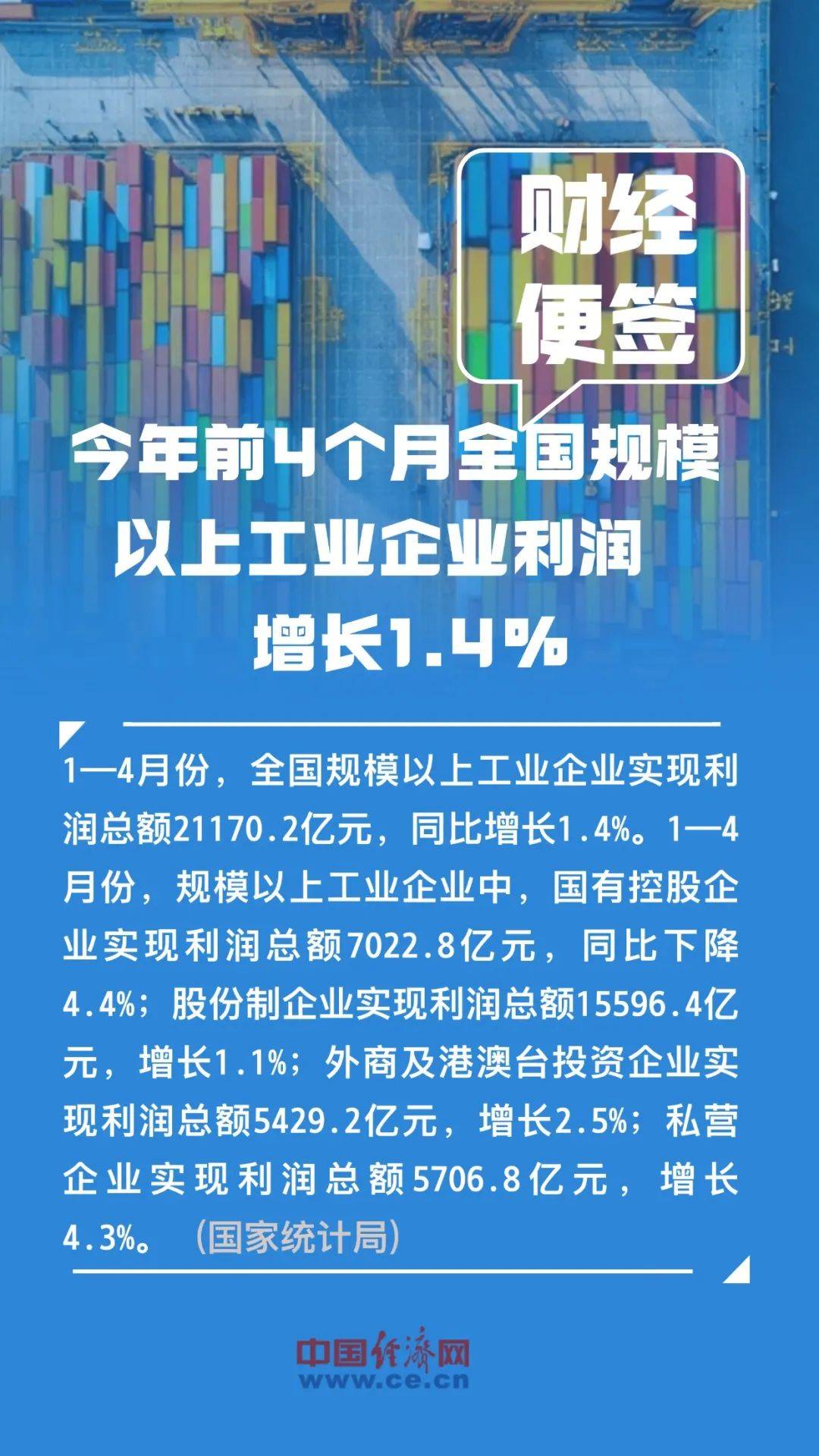
Group 1 - The profit of large-scale industrial enterprises in China increased by 1.4% year-on-year in the first four months, totaling 21,170.2 billion yuan [2] - State-owned enterprises reported a profit of 7,022.8 billion yuan, showing a decline of 4.4% year-on-year [2] Group 2 - The Chinese yuan reached a six-month high, with the onshore and offshore exchange rates surpassing 7.17 yuan against the US dollar [5] - Gold prices fell below 3,300 USD per ounce, with the latest price reported at 3,299.70 USD per ounce, a decrease of 1.27% [5] Group 3 - Xiaomi reported a record revenue of 111.3 billion yuan for Q1 2025, marking a growth of 47.4%, with adjusted net profit increasing by 64.5% to 10.7 billion yuan [5] - Revenue from innovative businesses, including smart electric vehicles and AI, reached 18.6 billion yuan, with 75,869 new cars delivered [5] - Xiaomi's R&D expenditure was 6.7 billion yuan, up 30.1%, with plans to exceed 30 billion yuan this year and a five-year investment plan of 200 billion yuan [5] Group 4 - California's Attorney General expressed readiness to sue the US government over proposed tariffs on Apple phones manufactured abroad [6] - India claims to have surpassed Japan to become the world's fourth-largest economy, with a GDP of 4 trillion USD [8] - Japan has lost its status as the world's largest creditor nation for the first time in 34 years, despite record overseas asset levels [9] Group 5 - Elon Musk confirmed the upcoming launch of X Money, a payment and banking application, currently in beta testing [10]
5月27日晚间新闻精选
news flash· 2025-05-27 13:45
Group 1 - The Ministry of Industry and Information Technology, the Ministry of Science and Technology, and the Ministry of Finance issued a plan to enhance the digital transformation of the electronic information manufacturing industry, focusing on the construction of new information infrastructure and the large-scale application of advanced computing, 5G-A, and artificial intelligence [1] - The State Council's Anti-Monopoly and Anti-Unfair Competition Committee held a meeting to discuss key tasks such as accelerating the establishment of a unified national market, addressing "involution" competition, and strengthening competition regulatory enforcement [1] - Several companies in the automotive industry received notifications to participate in a seminar aimed at promoting high-quality development of the used car market, focusing on "zero-kilometer" used cars and further stimulating used car circulation consumption [1] Group 2 - Xiaomi Group reported a 47.4% year-on-year increase in revenue for Q1 2025, with adjusted net profit rising by 64.5%; the company delivered 75,869 units of the SU7 series electric vehicles, generating 18.1 billion yuan in revenue from smart electric vehicles [1]



小米汽车、芯片排名、网络水军、价格战……小米高管一一回应
Zheng Quan Shi Bao Wang· 2025-05-27 13:21
Core Viewpoint - Xiaomi Group reported record high revenue and adjusted net profit for Q1 2025, showcasing strong performance across various business segments [2] Group 1: Automotive Business - Xiaomi SU7 Ultra has exceeded 23,000 pre-orders as of May 26, significantly surpassing expectations [3] - The SU7 series has delivered a total of 258,000 units since its launch, with Q1 2025 deliveries reaching 75,869 units, reflecting a quarter-on-quarter growth of 8.9% [3] - The company aims to achieve an annual delivery target of 350,000 units for its electric vehicles [4] Group 2: Financial Performance - Revenue from Xiaomi's smart electric vehicles and AI innovation businesses reached 18.6 billion yuan [5] - The IoT and consumer products segment generated 32.3 billion yuan, marking a robust year-on-year growth of 58.7% [9] - The home appliance business saw a doubling of revenue year-on-year in Q1, with significant sales increases in air conditioners, washing machines, and refrigerators [10] Group 3: Chip Development - Xiaomi's self-developed 3nm flagship SoC chip, Xuanjie O1, is currently planned for use in high-end flagship products only [6] - The Xuanjie O1 chip features 19 billion transistors, positioning it alongside Apple's A18 Pro in terms of performance [7] - The company emphasizes the integration of its chip business with its operating system and AI capabilities for enhanced platform strength [8] Group 4: Air Conditioning Business - Xiaomi aims to rank among the top three in China's air conditioning market by 2030, competing with global benchmark brands [9] - The company has completed its full product line layout for air conditioners and plans to enhance its manufacturing capabilities with a new smart manufacturing facility expected to launch this year [10] - Xiaomi's strategy focuses on product strength and efficiency, indicating that price wars will not significantly impact its business model [10]
小米一季度营收再超千亿元 汽车业务贡献度超16% 卢伟冰:全力保障年度交付目标实现
Mei Ri Jing Ji Xin Wen· 2025-05-27 13:01
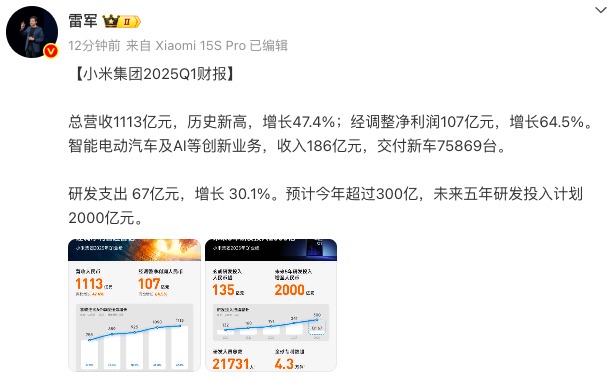
每经记者|李星 每经编辑|孙磊 5月27日晚间,小米集团发布的2025年一季报显示,小米集团当期实现营收约1112.93亿元,创历史新高,同比增长47.4%;经调整单季度净利润首次突破百 亿元,达到107亿元,同比增幅达64.5%。 小米集团总裁卢伟冰在财报电话会上称,在"人车家全生态"总体牵引下,小米集团各业务板块实现了多点开花、全面增长,交出了一份小米史上最强的一季 报。 在技术研发方面,小米集团研发开支由2024年第一季度的52亿元增长至2025年第一季度的67亿元,同比增加30.1%,主要是由于与智能电动汽车及AI等创新 业务相关的研发开支增加所致。 财报显示,2025年第一季度,小米集团智能电动汽车收入181亿元,占智能电动汽车及AI等创新业务总营收的比例超97%。而智能电动汽车及AI等创新业务 的毛利率则由2024年第一季度的12.6%上升至2025年第一季度的23.2%;智能电动汽车及AI等创新业务经营亏损5亿元。 对于小米集团一季度的表现,小米集团创始人、董事长兼CEO雷军在其个人微博上发文称,2025年一季度,小米集团智能电动汽车及AI等创新业务的收入 为186亿元,交付新车(SU7系列)约 ...
小米集团业绩再创历史新高!
新华网财经· 2025-05-27 11:28
小米集团公布财报,2025年第一季度,集团收入及盈利均再次创下历史新高。2025年第一季 度,小米集团总收入为人民币1,113亿元,创历史新高,同比增长47.4%。业务分部来看, 2025年第一季度,手机×AIoT分部收入为人民币927亿元,同比增长22.8%,智能电动汽车及 AI等创新业务分部收入为人民币186亿元。本季度,集团经调整净利润为人民币107亿元,创 历史新高,同比增长64.5%。 2025年第一季度,小米SU7系列交付新车达75869辆。同时公司将扩充产能,目前小米SU7系 列累计交付量超258000台。2025年第一季度,智能电动汽车及AI等创新业务分部总收入为人 民币186亿元,其中,智能电动汽车收入人民币181亿元,其他相关业务收入人民币5亿元。 本季度,智能电动汽车及AI等创新业务分部毛利率为23.2%。2025年第一季度,智能电动汽 车及AI等创新业务分部经营亏损为人民币5亿元。 2025年第一季度公司研发支出达到人民币67亿元,同比增长30.1%。截至2025年3月31日, 公司的研发人员数创历史新高,达21731人,占员工总数47.7%。此外,截至2025年3月31 日,小米集团 ...
小米集团(01810) - 2025 Q1 - 电话会议演示
2025-05-27 11:10
Xiaomi Corporation Q1 2025 Results Announcement Disclaimer By attending the meeting where this presentation is made, or by reading the presentation materials, you agree to be bound by the following limitations: The information in this presentation has been prepared by representatives of Xiaomi Corporation (the "Company", and together with its subsidiaries, the "Group") for use in presentations by the Group and does not constitute a recommendation regarding the securities of the Group. No part of this presen ...
小米一季度财报:营收同比增长47.4%,汽车及AI等创新业务收入186亿元
Xin Hua Cai Jing· 2025-05-27 10:23
Core Viewpoint - Xiaomi Group reported a strong performance in Q1 2025, with revenue reaching 111.3 billion yuan, a year-on-year increase of 47.4%, and adjusted net profit exceeding 10.7 billion yuan, up 64.5%, surpassing market expectations [2] Group 1: Financial Performance - Revenue from the core business of smartphones and AIoT was 92.7 billion yuan, a year-on-year increase of 22.8% [2] - Smartphone revenue was 50.6 billion yuan, reflecting an 8.9% year-on-year growth [2] - IoT and lifestyle product revenue reached 32.3 billion yuan, a significant increase of 58.7%, marking a historical high [2] - Internet services revenue was 9.1 billion yuan, up 12.8% year-on-year, with a gross margin of 76.9% [4] Group 2: Market Position - Xiaomi's smartphone shipment in mainland China ranked first for the first time in ten years, with a market share of 18.8%, up 4.7 percentage points year-on-year [3] - Globally, Xiaomi maintained a top-three position for 19 consecutive quarters, with a market share of 14.1% [3] Group 3: Innovation and Growth - Revenue from smart electric vehicles and AI-related businesses reached 18.6 billion yuan, with the SU7 series delivering 75,869 units in Q1 [3] - The SU7 series has cumulatively delivered over 258,000 units as of May 21, 2025, with a target of 350,000 units for the year [3] - R&D investment increased by 30.1% to 6.7 billion yuan, with a total expected investment of 30 billion yuan for the year [4][5]
小米Q1收入及净利润均创新高 智能大家电收入同比暴增113.8%
Hua Er Jie Jian Wen· 2025-05-27 10:18
Core Insights - Xiaomi Group reported a record revenue of RMB 111.3 billion for Q1 2025, representing a year-on-year growth of 47.4% and a net profit increase of 64.5% [2] - The smart home appliance segment saw a significant revenue growth of 113.8% year-on-year, driven by strong sales in air conditioners, refrigerators, and washing machines [3][6] - The electric vehicle segment delivered 75,869 units of the Xiaomi SU7 series in Q1, contributing nearly 17% to the group's total revenue [5][6] Financial Performance - Total revenue for Q1 2025 reached RMB 111.3 billion, up from RMB 75.5 billion in Q1 2024, marking a 47.4% increase [2] - Gross profit for the quarter was RMB 25.4 billion, a 51.0% increase from RMB 16.8 billion in the previous year [2] - Adjusted net profit was RMB 10.7 billion, reflecting a 64.5% increase compared to RMB 6.5 billion in Q1 2024 [2][5] Business Segments - The IoT and lifestyle products segment generated RMB 323 billion in revenue, with a year-on-year growth of 58.7% [6][7] - The smartphone and AIoT segment reported revenue of RMB 927 billion, a 22.8% increase, with smartphone revenue at RMB 506 billion, up 8.9% [7] - The electric vehicle and AI innovation segment achieved revenue of RMB 186 billion, with a gross margin of 23.2% [5][6] Product Performance - Air conditioner shipments exceeded 1.1 million units, with a growth rate over 65% [6] - Refrigerator shipments surpassed 880,000 units, also with a growth rate over 65% [6] - Washing machine shipments exceeded 740,000 units, with a growth rate exceeding 100% [6] Market Position - Xiaomi regained the top position in smartphone shipments in mainland China, with a market share of 18.8%, up 4.7% year-on-year [7] - The global smartphone market share reached 14.1%, an increase of 0.3% year-on-year, ranking Xiaomi among the top three globally [7]