
文化旅游

Search documents
13次提示风险!603843 停牌核查结束 今日复牌
Shang Hai Zheng Quan Bao· 2025-11-11 22:59
Core Viewpoint - *ST Zhengping has completed its stock trading review and will resume trading on November 12, 2025, after a significant stock price increase of 152.42% from September 1 to October 28, 2025, indicating potential market overheating and irrational speculation risks [2][3]. Group 1: Stock Trading and Review - The stock of *ST Zhengping was suspended from trading for review due to concerns over excessive price increases and potential risks [2][3]. - The review confirmed that non-operating fund occupation has been fully repaid, but the company faces significant uncertainties regarding its mineral resource mining capabilities and risks of delisting [3][4]. Group 2: Financial Performance - For the year 2024, *ST Zhengping reported a revenue of 1.362 billion yuan and a net loss of 484 million yuan, with a net loss of 990 million yuan for the first three quarters of 2025 [7]. - The company has been actively expanding into new business areas such as renewable energy construction and intelligent computing services to foster new growth points [7]. Group 3: Mining Operations and Risks - The company has received a mining license but lacks sufficient mining capacity, requiring significant investment for future development, which is uncertain due to financial constraints [6][7]. - As of June 30, 2025, the company had 102 million yuan in cash, with 81.6642 million yuan restricted, and a high debt ratio of 92.22% [6]. Group 4: New Business Ventures - *ST Zhengping has established a partnership with Hangzhou Bingtai Technology Co., focusing on data software development and computing services [8][10]. - The company is working on collaborative projects with local governments to develop intelligent computing and renewable energy initiatives [7].


21个涨停板!核查完成 明起复牌
Zhong Guo Zheng Quan Bao· 2025-11-11 15:10
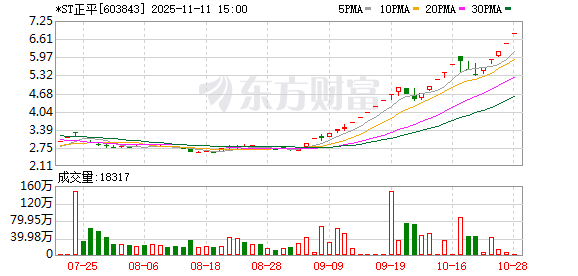
Core Viewpoint - *ST Zhengping has completed the stock trading suspension verification and will resume trading on November 12, 2023, despite facing significant uncertainties in future development and risks of delisting due to audit limitations [2][4]. Group 1: Stock Trading and Performance - *ST Zhengping's stock was suspended from trading on October 29, 2023, after a significant price increase, closing at 6.79 yuan per share with a market capitalization of 4.75 billion yuan [2]. - From September 1 to October 28, 2023, the stock price increased by 152.42%, achieving 21 trading limit-ups in 29 trading days [3]. - The company has issued 13 risk warning announcements due to abnormal stock trading activities [3]. Group 2: Financial and Operational Status - The verification results indicate that the company has cleared non-operating fund occupation, but it faces major uncertainties regarding its mineral resource extraction capabilities [4]. - For the fiscal year 2024, *ST Zhengping reported revenues of 1.362 billion yuan and a net loss of 484 million yuan [5]. - In the first three quarters of 2025, the company achieved revenues of 652 million yuan, a year-on-year decrease of 20.92%, with a net loss of approximately 99.76 million yuan [5]. Group 3: Risks and Warnings - The company has been issued a delisting risk warning due to an audit report that could not express an opinion for the 2024 annual report [4][5]. - If the issues related to the non-standard audit opinions are not resolved by 2025, the company's stock may be delisted [5].
东盟经贸促进会会长波尚琅与青海省副省长杨志文举行工作会谈
Zhong Guo Jing Ying Bao· 2025-11-11 07:30
Core Insights - The meeting between ASEAN Economic Promotion Association President Bo Shanglang and Qinghai Province Vice Governor Yang Zhiwen focused on deepening practical cooperation in trade, technology, and education, reaching multiple consensus points [1][2]. Group 1: Economic Cooperation - Qinghai Province emphasizes its commitment to comprehensive cooperation with ASEAN countries, aiming to implement the consensus on building a China-ASEAN community of shared future and promote high-quality development in cooperation [1]. - Qinghai is positioned as a treasure trove of ecological resources and a hub for green industry development, planning to collaborate with ASEAN countries in clean energy, ecological agriculture, and cultural tourism [1]. Group 2: Educational Collaboration - Both parties agreed to establish a comprehensive partnership between Cambodian universities and Qinghai University of Technology, focusing on discipline construction, faculty exchange, and student exchange to enhance educational resource sharing and cultural exchange [2]. Group 3: Strategic Initiatives - The ASEAN Economic Promotion Association will act as a bridge to facilitate business connections, organizing forums, enterprise visits, and project negotiations to align Qinghai's advantageous industrial resources with ASEAN market demands [1].
果麦文化:关于与专业投资机构共同投资的进展公告
Zheng Quan Ri Bao Zhi Sheng· 2025-11-10 14:13
Core Viewpoint - Guomai Culture announced the acquisition of a stake in the Chengdu Chuan Shang No. 3 Equity Investment Fund Center for RMB 59.1674 million, becoming a limited partner in the fund, which indirectly holds shares in Shaanxi Tourism Cultural Industry Co., Ltd. [1] Group 1 - The company signed a partnership share transfer agreement with Guangzhou Fengsheng Fuxin Investment Partnership, acquiring a stake worth RMB 27.5852 million in the Chengdu Chuan Shang No. 3 fund [1] - After the transfer, the company will indirectly hold 1,039,912 shares of Shaanxi Tourism, representing 1.793% of the total share capital as of the agreement signing date [1] - The initial public offering application for Shaanxi Tourism has been approved by the Shanghai Stock Exchange's listing review committee [1]
艺术赋能绘就县域发展新图景——2025铁岭县文化艺术嘉年华暨第三届“踏飞燕·中国马主题造型艺术精品展”启幕
Ren Min Ri Bao· 2025-11-10 09:36
Core Viewpoint - The 2025 Tieling County Cultural Arts Carnival and the third "Treading the Flying Swallow: China Horse-Themed Sculpture Art Exhibition" have commenced, showcasing national artistic talent and integrating local culture, highlighting the role of culture in rural revitalization and the synergy of agriculture, culture, commerce, and tourism [1][2]. Group 1: Cultural Significance - Tieling County is recognized for its rich cultural heritage and artistic environment, being the birthplace of "Tieling Reining Horse" and a hub for traditional Chinese painting [2]. - The establishment of the Hongma Art Museum, the first art museum in Chinese art history dedicated to horse themes, reflects Tieling's commitment to cultural and artistic development [2]. - The "Treading the Flying Swallow" series of exhibitions has evolved into a nationally influential platform for horse-themed art, enhancing Tieling's cultural recognition and impact [2]. Group 2: Event Highlights - The current exhibition features over 4,000 submissions from across the country, with more than 160 high-quality works displayed, including traditional Chinese paintings, oil paintings, sculptures, and seal carving [2]. - The event includes interactive activities such as calligraphy sessions and live art creation, fostering engagement between artists and art enthusiasts [2]. - The integration of online and offline activities, including live streaming of artworks and online auctions, expands the reach of the event and promotes cultural accessibility [2]. Group 3: Economic and Social Impact - The carnival features a cultural market with 60 booths showcasing intangible cultural heritage, cultural products, and local agricultural specialties, demonstrating Tieling's regional culture and industrial characteristics [2]. - The event promotes the fusion of culture and industry, with discussions on artistic inheritance, talent cultivation, and industrial collaboration, contributing to the high-quality development of local art [2]. - Tieling County is exploring a multi-faceted approach to development, combining culture, industry, livelihood, and education, aiming to transform cultural "soft power" into "hard support" for growth [2].
“天地造物 美生未来”诗画浙江主题展演活动在老挝举行
人民网-国际频道 原创稿· 2025-11-10 07:16
与会嘉宾纷纷表示,浙江的展示既传统又现代,既有文化厚度又有科技温度,令人印象深刻。宇树 机器人的亮相,不仅展现了中国科技的前沿成果,更体现了浙江以创新方式传播中华文化、推动文明互 鉴的积极探索,为中老友好续写了"科技+文旅"的生动注脚。 此次展览以"浙江的天地"为源点,分为"谷叶取粹""土木赋灵""金石炼华"三大板块,集中呈现茶、 酒、丝绸等非遗作品,以及青瓷、木雕、文房等历史经典产业。这些展品承载着浙江人民与自然和谐共 生的千年智慧,展现了浙江文旅融合的多元魅力。现场设置的竹编、印染、米塑等非遗互动,引得嘉宾 们驻足体验。 展演活动中,由宇树科技研发的U2智能人形机器人,以流畅的太极表演和精准的互动迎宾,成为 全场焦点,也标志着浙江省在推动"科技赋能文旅宣传"方面迈出创新一步。这是国产智能机器人首次进 入海外文旅宣传一线,以现代科技语言讲述中国传统故事,为中老文旅合作注入全新动能。 人民网万象11月10日电 (记者杨一)7日,由中国驻老挝大使馆支持、浙江省文化广电和旅游厅与 老挝中国文化中心共同主办的"天地造物 美生未来"诗画浙江主题展演活动在老挝中国文化中心启幕。 中国驻老挝大使方虹,浙江省人民政府副省长 ...
盈新发展录得6天4板
Zheng Quan Shi Bao Wang· 2025-11-10 02:44
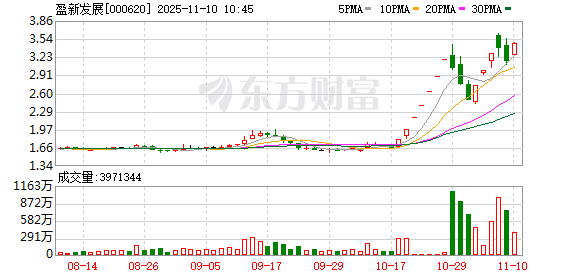
Core Viewpoint - The stock of Beijing Tongguan Yingxin Cultural Tourism Development Co., Ltd. has experienced significant volatility, achieving a cumulative increase of 40.32% over six trading days, with a notable trading volume and turnover rate [2] Trading Performance - The stock recorded four trading halts within six days, with a total turnover rate of 67.51% [2] - As of 9:40 AM, the stock's trading volume reached 215 million shares, with a transaction value of 734 million yuan, resulting in a turnover rate of 4.61% [2] - The stock has appeared on the Dragon and Tiger List twice due to a cumulative price deviation of 20% over three consecutive trading days and a daily volatility of 15% [2] Institutional Activity - Institutional investors net sold 16.54 million yuan, while the Shenzhen Stock Connect recorded a net purchase of 8.27 million yuan [2] - The total net purchase by brokerage seats amounted to 92.58 million yuan [2] Financial Performance - For the first three quarters, the company reported a revenue of 1.169 billion yuan, a year-on-year decrease of 48.38% [2] - The net profit for the same period was -486 million yuan, reflecting a year-on-year decline of 682.00% [2] - The basic earnings per share stood at -0.0828 yuan [2] Company Background - Beijing Tongguan Yingxin Cultural Tourism Development Co., Ltd. was established on June 25, 1993, with a registered capital of 587.181504 million yuan [2]

早安庆阳丨重大发现!我国探获一处超大型矿床
Sou Hu Cai Jing· 2025-11-09 05:59
Group 1 - Gansu Province has discovered a large magnesium dolomite mine with over 700 million tons of resources, marking a significant breakthrough in mineral resource exploration [2][3] - The mine is located in the Kongtong District of Pingliang City, with an average magnesium oxide grade of 20.67%, indicating high-quality ore suitable for open-pit mining [2][3] - In addition to the magnesium ore, over 300 million tons of dolomite for construction purposes have also been identified, showcasing the diverse utilization potential of dolomite resources [3] Group 2 - The establishment of the Quality Control Center for Rehabilitation Medicine in Qingyang signifies a new phase of standardized and regulated development in the field of rehabilitation medicine [4] - The "Qingyang Has Gifts · Tianjin Color Sharing" agricultural product exhibition and sales event aims to enhance cooperation between regions and promote Qingyang agricultural products in the Tianjin market [4] - The cultural exchange activity "Cutting Clouds" will showcase Qingyang paper-cutting art in Germany and France, promoting local culture internationally [6]

人文经济绘就江南新景
Su Zhou Ri Bao· 2025-11-07 00:16
Core Insights - The article emphasizes the cultural and economic integration in Changshu, particularly in the Yushan area, which is recognized as a hub for outdoor sports and cultural activities [1][5][13] Group 1: Cultural Heritage and Urban Development - Changshu has over 3,000 years of cultural heritage, with Yushan being a significant site for historical figures and cultural movements [2] - The preservation of ancient architecture alongside modern establishments fosters a harmonious coexistence of tradition and innovation [2][3] - Various projects, such as the renovation of historical residences into cultural spaces, enhance the cultural experience while promoting tourism [2][3] Group 2: Economic Growth through Cultural Tourism - The Yushan area has become a new hotspot for cultural and sports tourism, with events like cycling competitions and triathlons attracting participants from around the world [5][6] - The development of hiking trails and cultural creative industries has led to a significant increase in tourist visits, with the "Eagle Line" trail receiving approximately 2.3 million visitors from January to October, a 20% increase year-on-year [6][11] - The integration of local culture with tourism initiatives, such as themed markets and creative workshops, enhances the overall visitor experience [7][8] Group 3: Community Engagement and Economic Ecosystem - The Yushan area is fostering a community of cultural practitioners and outdoor enthusiasts, contributing to a vibrant local economy [12][13] - Initiatives like the "Lake Mountain Life Curator Plan" encourage young entrepreneurs to establish businesses that reflect local culture and lifestyle [12] - The region is building a symbiotic ecosystem that combines culture, urban development, and economic vitality, aiming for a holistic improvement in quality of life [13]
宿迁加快构建现代服务业高质量发展新体系
Xin Hua Ri Bao· 2025-11-06 21:56
Core Insights - The establishment of the Suqian Bonded Logistics Center (Type B) marks a significant step in supporting local enterprises to expand into international markets and reduce logistics costs, reflecting the city's commitment to high-quality service industry development since the 14th Five-Year Plan [1] Group 1: Service Industry Development - Suqian has prioritized service industry development as a key driver for economic transformation, implementing a three-year action plan for high-quality modern service industry development [2] - The service industry added value surpassed 200 billion yuan for the first time in 2023, reaching 206.66 billion yuan, with projections for 2024 to achieve 235.22 billion yuan, ahead of the 14th Five-Year Plan targets [2] - By the first half of 2025, the service industry's added value accounted for 51.9% of GDP, solidifying its role as a critical force in promoting synchronized development [2] Group 2: Market Vitality and Business Growth - Suqian focuses on cultivating business entities to enhance market vitality, with a significant increase in the number of scale service enterprises, reaching 756 by August 2025, a 2.6-fold increase from the end of the 13th Five-Year Plan [3] - In the first nine months of 2025, 123 new scale service enterprises were added, a year-on-year increase of 25.5%, indicating robust market activity [3] Group 3: Project Development and Investment - The city emphasizes the "project first" philosophy, attracting high-quality service industry projects that drive effective investment and enhance development momentum [4] - Notable projects include the Suqian Digital Economy Center, expected to generate annual revenues of 20 billion yuan and create 20,000 jobs upon full completion [5] - By September 2025, 47 major service industry projects had completed investments of 12.58 billion yuan, achieving 73.2% of the annual plan [5] Group 4: Policy Support and Future Outlook - Suqian's modern service industry development is supported by comprehensive policy measures and financial incentives, contributing to a 3.96-fold increase in revenue for scale service enterprises by 2024 [7] - The city aims to continue enhancing the service industry's supply-side structural reforms, focusing on improving the industrial system, expanding business entities, advancing project construction, and optimizing the development environment [7]
