
农副食品加工业

Search documents
陵水芳鑫食品贸易有限公司成立,注册资本300万人民币
Sou Hu Cai Jing· 2026-01-05 02:51
Core Viewpoint - Recently, Ling Shui Fang Xin Food Trading Co., Ltd. was established with a registered capital of 3 million RMB, fully owned by Hainan Fang Xin Meat Food Supply Chain Co., Ltd. [1] Company Information - The legal representative of Ling Shui Fang Xin Food Trading Co., Ltd. is Zhong Zhi Fang [1] - The company is classified under the manufacturing industry, specifically in the agricultural and sideline food processing sector [1] - The registered address is located at No. 1, Le Huo Avenue, Qing Shui Wan International Information Industry Park, Building 2, A Block, F1 Floor, Room 1616, Ying Zhou Town, Ling Shui Li Autonomous County, Hainan Province [1] - The company type is a limited liability company (wholly owned by a legal entity) [1] - The business term is from January 4, 2026, to an indefinite period [1] Business Scope - The business scope includes licensed operations such as animal husbandry, livestock slaughtering, pig slaughtering, poultry slaughtering, food sales, and food production (subject to licensing) [1] - General business activities include primary processing of edible agricultural products, wholesale and retail of edible agricultural products, fresh meat wholesale and retail, primary agricultural product acquisition, import and export of goods, technology import and export, trade brokerage, domestic trade agency, and import and export agency [1]
深圳旦启科技有限公司成立,注册资本1000万人民币
Sou Hu Cai Jing· 2026-01-05 00:00
Group 1 - Shenzhen Danqi Technology Co., Ltd. has been established with a registered capital of 10 million RMB, fully owned by Shenzhen Zhuanming Digital Technology Co., Ltd. [1] - The legal representative of Shenzhen Danqi Technology Co., Ltd. is Huang Lihong [1] - The company operates in various sectors including supply chain management, import and export of goods, and food processing [1] Group 2 - The business scope includes general operations such as technology services, consulting, and sales of agricultural products [1] - The company is classified under the manufacturing industry, specifically in the agricultural product processing sector [1] - The registered address of the company is located at 99 Beili North Road, Shui Bei International Jewelry Center, Luohu District, Shenzhen [1]
长贸(厦门)粮油有限公司成立,注册资本5000万人民币
Sou Hu Cai Jing· 2026-01-04 17:02
Group 1 - The core point of the article is the establishment of Changmao (Xiamen) Grain and Oil Co., Ltd., with a registered capital of 50 million RMB, fully owned by Shenzhen Xuanli Investment Co., Ltd. [1] - The legal representative of the company is Pan Li [1] - The company operates in the manufacturing industry, specifically in the agricultural and sideline food processing sector, focusing on various food production and sales activities [1] Group 2 - The business scope includes food production, feed production, and food sales, with specific activities requiring approval from relevant authorities [1] - The company is located at Room 6019, No. 2567, Binhai West Avenue, Tong'an District, Xiamen City [1] - The company is classified as a limited liability company with a business duration until January 4, 2026, with no fixed term thereafter [1]
官宣!GDP突破10万亿,北方第一强省晋级了
商业洞察· 2026-01-04 09:35
Core Viewpoint - Shandong Province is set to become the first northern province and the third overall in China to surpass a GDP of 10 trillion yuan, marking a significant milestone in its economic development [5][6][12]. Economic Milestone - On January 1, 2025, Shandong's GDP is expected to exceed 10 trillion yuan, officially announced by the provincial governor [5]. - Shandong's GDP has increased approximately 13 times since 2000, when it was 834.85 billion yuan, reaching 9.86 trillion yuan by the end of 2024 [9][30]. Comparison with Other Provinces - Shandong joins Guangdong and Jiangsu as the only provinces with a GDP over 10 trillion yuan, with Guangdong being the first in 2018 and Jiangsu in 2020 [7][8]. - In terms of global ranking, Shandong would rank 16th, below Spain and above Indonesia [8]. Economic Growth Rate - Shandong's GDP has been increasing by about 450 billion yuan annually over the past two years, indicating steady growth [17]. - The province's GDP growth has been relatively slower compared to southern provinces, which have outpaced Shandong in recent years [14][36]. Historical Data Adjustments - Shandong's GDP figures have undergone significant revisions, particularly after the 2018 economic census, which adjusted the 2018 GDP down by nearly 1 trillion yuan, reflecting a 12.8% decrease [22][19]. - The adjustments were due to the removal of non-compliant industrial enterprises and corrections in statistical data [23][24]. Industrial Structure - Shandong's industrial sector is comprehensive, with a strong presence in heavy industries, but it is criticized for being outdated and lacking in emerging industries [36][40]. - The province's heavy industry accounts for 77.3% of its industrial revenue, with the chemical manufacturing sector leading at over 1.35 trillion yuan [40]. Population Trends - Shandong is experiencing a decline in its permanent population, with a net outflow of 260,000 people projected for 2024, the second highest in the country [56][45]. - The province's birth rate has been declining, with the number of births in 2023 being only one-third of the 2016 figures [51][54]. Need for Urban Development - Shandong lacks a "super city" that can attract and retain population, unlike provinces such as Guangdong and Jiangsu, which have major cities like Shenzhen and Nanjing [60][68]. - The province's development strategy emphasizes enhancing the roles of both Jinan and Qingdao, aiming to create a synergistic effect between the two cities [70].


12月PMI点评:淡季逆势回升,结构仍趋分化
Orient Securities· 2026-01-04 05:18
Group 1: PMI Trends - December manufacturing PMI rose to 50.1%, up from 49.2% in November, indicating a return to expansion[8] - High-tech manufacturing PMI reached 52.5%, a significant increase of 2.4 percentage points from November, marking a new high for 2025[8] - Construction PMI increased to 52.8% in December from 49.6% in November, driven by favorable weather and policy support[8] Group 2: Export Dynamics - New export orders PMI rose from 47.6% to 49% in December, suggesting potential recovery in export demand[8] - Optimistic scenario indicates a rebound in U.S. consumer goods import demand, supported by textile and electronic exports[8] - Pessimistic scenario highlights potential "export rush" due to Mexico's tariff adjustments and EU carbon tariffs, impacting specific sectors[4] Group 3: Structural Disparities - Large enterprises showed significant PMI recovery, while small enterprises experienced a decline, indicating a mismatch in export capabilities[4] - Supply chain congestion in consumer goods sectors, particularly textiles and electronics, reflects urgent production demands[4] - The disparity in PMI recovery across different enterprise sizes suggests varying capacities for "export rush" activities[4]
玉山县冰溪农特产品开发有限公司成立,注册资本1000万人民币
Sou Hu Cai Jing· 2025-12-31 16:51
Group 1 - The core point of the article is the establishment of Yushan Bingxi Agricultural Special Products Development Co., Ltd., with a registered capital of 10 million RMB, fully owned by Yushan Agricultural and Cultural Tourism Development Co., Ltd. [1] Group 2 - The legal representative of the new company is Chen Ying [1] - The business scope includes construction project contracting, agricultural product sales, information consulting services, parking lot services, and various types of food sales, including fresh eggs, fruits, vegetables, and aquatic products [1] - The company is classified under the manufacturing industry, specifically in the agricultural product processing sector [1] - The registered address is located in Yushan County, Jiangxi Province, at the east side of Xinjian North Road, Ice Creek Street [1] - The company is a limited liability company with no fixed term of operation, registered until December 31, 2025 [1]
前11个月国企实现利润超2万亿元,私企1.93万亿元
Jin Rong Shi Bao· 2025-12-29 14:01
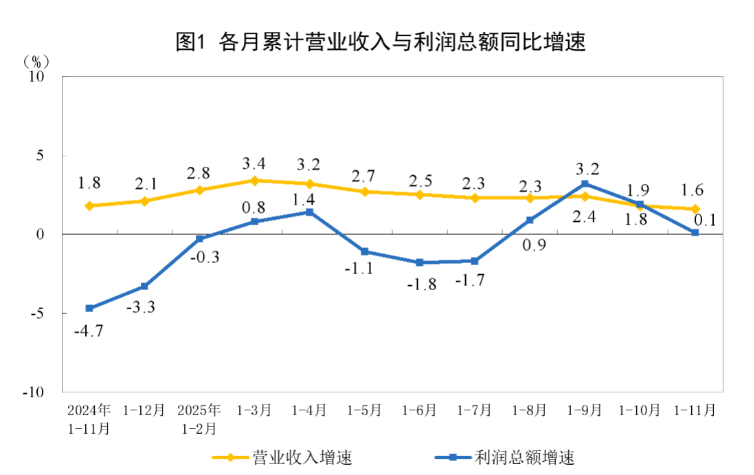
Core Insights - In the first eleven months of 2025, the total profit of large-scale industrial enterprises in China reached 66,268.6 billion yuan, reflecting a year-on-year growth of 0.1% [1] By Enterprise Type - State-owned enterprises reported a total profit of 20,083.6 billion yuan, a decrease of 1.6% year-on-year [4] - Shareholding enterprises achieved a total profit of 49,565.6 billion yuan, down by 0.4% [4] - Foreign and Hong Kong, Macao, and Taiwan-invested enterprises saw a profit of 16,355.3 billion yuan, an increase of 2.4% [4] - Private enterprises recorded a total profit of 19,319.9 billion yuan, a slight decline of 0.1% [4] By Industry Type - The manufacturing sector generated a total profit of 50,317.9 billion yuan, marking a growth of 5.0% [6] - The mining industry reported a profit of 7,896.3 billion yuan, down by 27.2% year-on-year [6] - The electricity, heat, gas, and water production and supply sector achieved a profit of 8,054.4 billion yuan, increasing by 8.4% [6] Key Industries - The computer, communication, and other electronic equipment manufacturing industry experienced a profit increase of 15.0% [7] - The automotive manufacturing sector saw a profit growth of 7.5% [7] - The agricultural and sideline food processing industry grew by 4.8% [7] - The oil and natural gas extraction industry faced a profit decline of 13.6% [7] - The coal mining and washing industry suffered a significant drop of 47.3% [7] Monthly Performance - In November, the profits of large-scale industrial enterprises fell by 13.1% year-on-year [8]
国家统计局:1—11月份计算机、通信和其他电子设备制造业利润同比增长15%
Zheng Quan Shi Bao Wang· 2025-12-27 01:44
Core Insights - The mining industry experienced a significant profit decline of 27.2% year-on-year, totaling 789.63 billion yuan [1] - The manufacturing sector saw a profit increase of 5.0%, amounting to 5,031.79 billion yuan [1] - The electricity, heat, gas, and water production and supply industry reported a profit growth of 8.4%, reaching 805.44 billion yuan [1] Industry Profit Performance - The computer, communication, and other electronic equipment manufacturing industry achieved a profit growth of 15.0% [1] - The electricity and heat production and supply industry grew by 11.8% [1] - The non-ferrous metal smelting and rolling processing industry increased profits by 11.1% [1] - The automobile manufacturing industry saw a profit rise of 7.5% [1] - The agricultural and sideline food processing industry grew by 4.8% [1] - The general equipment manufacturing industry also increased by 4.8% [1] - The specialized equipment manufacturing industry reported a profit growth of 4.6% [1] - The electrical machinery and equipment manufacturing industry grew by 4.2% [1] Declining Industries - The petroleum, coal, and other fuel processing industry reduced losses year-on-year [1] - The non-metallic mineral products industry experienced a profit decline of 4.6% [1] - The chemical raw materials and chemical products manufacturing industry saw a decrease of 6.9% [1] - The textile industry reported a profit drop of 8.2% [1] - The oil and gas extraction industry declined by 13.6% [1] - The coal mining and washing industry faced a significant profit decline of 47.3% [1]
国家统计局:1—11月份计算机、通信和其他电子设备制造业利润同比增长15.0%
Guo Jia Tong Ji Ju· 2025-12-27 01:41
Core Insights - The National Bureau of Statistics reported profit changes across various industries from January to November, highlighting significant growth in several sectors while others faced declines [1] Industry Performance Summary - The computer, communication, and other electronic equipment manufacturing industry saw a profit increase of 15.0% year-on-year [1] - The electricity and heat production and supply industry experienced a profit growth of 11.8% [1] - The non-ferrous metal smelting and rolling processing industry reported an 11.1% increase in profits [1] - The automobile manufacturing industry achieved a profit growth of 7.5% [1] - The agricultural and sideline food processing industry grew by 4.8% [1] - The general equipment manufacturing industry also saw a profit increase of 4.8% [1] - The specialized equipment manufacturing industry reported a profit growth of 4.6% [1] - The electrical machinery and equipment manufacturing industry experienced a 4.2% profit increase [1] - The petroleum, coal, and other fuel processing industry reduced its losses year-on-year [1] - The non-metallic mineral products industry faced a decline of 4.6% [1] - The chemical raw materials and chemical products manufacturing industry saw a decrease of 6.9% [1] - The textile industry reported a decline of 8.2% [1] - The oil and gas extraction industry experienced a significant decline of 13.6% [1] - The coal mining and washing industry faced a drastic decline of 47.3% [1]
江西溪望清云油脂有限公司成立,注册资本2000万人民币
Sou Hu Cai Jing· 2025-12-26 16:39
企业名称江西溪望清云油脂有限公司法定代表人王文科注册资本2000万人民币国标行业制造业>农副食 品加工业>其他农副食品加工地址江西省鹰潭市贵溪市白鹤湖农业生态科技园规划四路以北B-04-08地块 第一栋综合楼301、302室企业类型有限责任公司(非自然人投资或控股的法人独资)营业期限2025-12- 26至无固定期限登记机关贵溪市市场监督管理局 来源:市场资讯 序号股东名称持股比例1江西溪望田野粮油科技有限公司100% 经营范围含许可项目:食品生产,食品销售,食品互联网销售,道路货物运输(不含危险货物),保税 物流中心经营,食品用塑料包装容器工具制品生产(依法须经批准的项目,经相关部门批准后在许可有 效期内方可开展经营活动,具体经营项目和许可期限以相关部门批准文件或许可证件为准)技术服务、 技术开发、技术咨询、技术交流、技术转让、技术推广,饲料原料销售,饲料添加剂销售,肥料销售, 国内贸易代理,智能农业管理,物联网应用服务,供应链管理服务,休闲观光活动,普通货物仓储服务 (不含危险化学品等需许可审批的项目),食品用塑料包装容器工具制品销售(除依法须经批准的项目 外,凭营业执照依法自主开展经营活动) 天眼查显示 ...