
医疗信息化

Search documents
创业慧康:AI医疗布局覆盖五十余场景
Sou Hu Cai Jing· 2026-01-15 12:59
Core Viewpoint - The company, Chuangye Huikang, is actively developing AI applications in the healthcare sector, focusing on technology research and development, practical implementation, and ecosystem building [2] Group 1: AI Applications - The company has a comprehensive and in-depth layout in the AI medical field, focusing on technology research and development, practical implementation, and ecosystem building [2] - The company has independently developed the BsoftGPT large model service platform and is collaborating with Zhejiang University Computer Research Institute to develop the Qizhen Medical Large Model [2] - The company has launched the "Huikang·Cloud Hub" intelligent agent, which possesses reasoning and planning capabilities [2] Group 2: Practical Implementation - The company empowers over fifty intelligent scenarios, including clinical decision support, intelligent generation of electronic medical records, internet hospitals, nursing management, grassroots public services, medical insurance, and physical examinations [2] - The company has implemented products such as the Smart Medical Assistant (MedCopilot) and AI Key Patient Tracking System (APTS), which are currently being piloted in multiple hospitals [2] Group 3: Ecosystem and Solutions - The company has nearly 30 years of industry experience and has established a complete solution system, forming a core layout that deeply integrates technology and practical scenarios [2]

将现上市后年报首亏!搭上AI顺风车的卫宁健康能否改变业绩颓势
Sou Hu Cai Jing· 2026-01-15 11:45
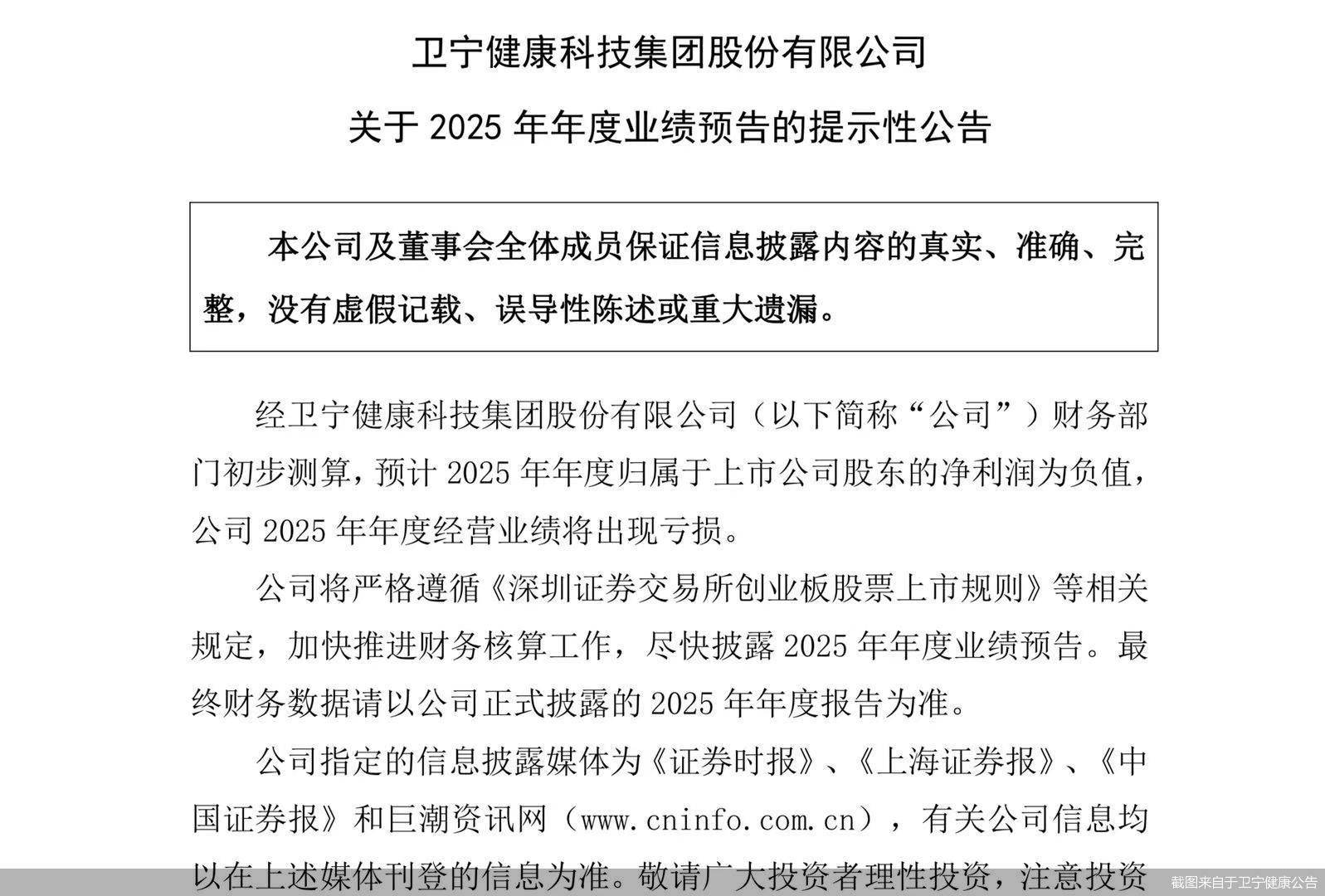
Core Viewpoint - Wining Health (300253) has announced an expected loss for the year 2025, marking the first annual loss since its listing in 2011, despite a significant stock price increase driven by AI concepts in the market [1][4]. Group 1: Financial Performance - Wining Health's preliminary estimate indicates a negative net profit for 2025, with the final figures to be confirmed in the official annual report [1]. - The company reported a revenue of 1.296 billion yuan for the first three quarters of 2025, a year-on-year decrease of 32.27%, and a net profit of -241 million yuan, a decline of 256.1% [6]. - In 2024, Wining Health's revenue was 2.782 billion yuan, down 12.05% year-on-year, with a net profit of approximately 8.8 million yuan, a decrease of 75.45% [7]. Group 2: Company Background and Leadership Changes - Wining Health is a leading enterprise in China's medical information industry and has been actively expanding into healthcare services since 2015 [4]. - Following the bribery scandal involving the former chairman, Zhou Wei, Liu Ning has taken over as chairman, bringing extensive experience from previous roles in the company and the tech industry [5]. Group 3: Market Context and Challenges - The AI concept has been a hot topic in the A-share market, contributing to a nearly 60% increase in Wining Health's stock price this year [1][4]. - Despite being an early mover in AI healthcare, the company faces challenges related to high investment costs and slow conversion rates [8]. - The urgent task for Wining Health in 2026 will be to find ways to return to profitability under new leadership [9].


肇庆封开打造广东首个县域人工智能诊疗平台
Nan Fang Ri Bao Wang Luo Ban· 2026-01-15 10:08
Core Insights - The launch of the AI-assisted diagnosis platform in Zhaoqing's Fengkai County marks the first county-level AI healthcare initiative in Guangdong Province, aimed at addressing issues of insufficient medical resources and uneven diagnostic capabilities for 500,000 residents [1][2] Group 1: Project Overview - The platform is built on the "five-in-one" digital solution from Kingmed Medical, integrating three leading county hospitals and 16 township health centers [1] - The primary application of the platform is in outpatient and inpatient disease diagnosis, serving as an auxiliary tool under the guidance of physicians [1] Group 2: Functionality and Benefits - After patient consultations, doctors input patient information into the AI system, which utilizes big data to provide standardized treatment plans for common and frequently occurring diseases [1] - For complex cases, the AI offers differential diagnosis directions and identifies additional necessary examinations [1] Group 3: Data Integration and Collaboration - Fengkai County has established a "shared hub" to integrate medical data from county and township-level institutions, facilitating real-time access to patient test reports for doctors [2] - The platform supports operational management, quality control, public health monitoring, and interconnectivity of information across medical institutions, promoting efficient collaboration among community healthcare members [2]
荣科科技:公司当前主业经营收入保持稳定
Zheng Quan Ri Bao Wang· 2026-01-15 09:47
Core Viewpoint - The company, Rongke Technology, is currently experiencing stable revenue in its main business while facing operational pressures in the medical information industry, leading to performance losses due to project delivery delays, increased R&D investments for product upgrades, and historical bad debt provisions [1] Group 1: Company Performance - The company is focused on providing products and services in smart healthcare and smart city sectors [1] - The current performance losses are attributed to industry adjustment periods affecting project delivery and payment cycles [1] - The company has no plans to divest any assets at this time [1] Group 2: Future Strategy - The company aims to concentrate on core business areas and enhance technological innovation and market expansion efforts [1] - There is a commitment to optimize operational management to improve profitability [1] - The company emphasizes the importance of protecting the rights and interests of all shareholders [1]

医疗ETF(159828)涨超2.7%,创新与国际化驱动估值重估
Mei Ri Jing Ji Xin Wen· 2026-01-15 08:18
Group 1 - The core viewpoint is that brain-computer interfaces (BCIs) are at the critical point of industrialization, with significant support from major countries like China and the U.S. [1] - The "14th Five-Year Plan" in China identifies BCIs as one of the six future industries, with goals set for technological breakthroughs by 2027 and the formation of an industrial ecosystem by 2030 [1] - The global brain market is projected to reach $7.63 billion by 2029, indicating a rapidly emerging market opportunity [1] Group 2 - The medical field is currently the most mature and largest commercial application area for BCIs, with clinical trials in China covering diseases such as stroke rehabilitation and quadriplegia [1] - Policy support, including medical insurance pricing, is expected to facilitate the deployment of related devices in the healthcare sector [1] - China is making significant progress in invasive and semi-invasive BCI technologies, with notable advancements in flexible electrode technology and Chinese language decoding [1] Group 3 - Investment in the pharmaceutical sector should focus on the intrinsic logic of clinical value, particularly in innovative medical devices, high-end equipment, and high-value consumables [1] - The medical ETF (159828) tracks the CSI Medical Index (399989), which includes listed companies in medical devices, services, and information technology, reflecting the overall performance of China's medical theme stocks [1] - The index consists of approximately 50 constituent stocks, concentrated in the healthcare sector, characterized by high growth potential and volatility [1]
中元股份(300018.SZ):目前有少量医疗信息化业务,该业务营收占比已不足5%
Ge Long Hui· 2026-01-15 07:58
Core Viewpoint - The company has strategically reduced its investment in the medical information business, which now accounts for less than 5% of its revenue, and will continue to focus on the smart grid sector [1] Group 1: Business Strategy - The company has a small amount of medical information business, with revenue contribution below 5% [1] - The company has strategically reduced investment in the medical information sector and optimized resource allocation and business structure [1] - Future efforts will concentrate on the smart grid field, targeting the development of new productive forces [1] Group 2: Key Business Areas - The company aims to actively engage in the construction of a smart grid, focusing on data collection, intelligent monitoring of power transmission and transformation, and comprehensive energy management [1]

荣科科技(300290.SZ):公司目前无剥离资产的相关计划
Ge Long Hui· 2026-01-15 07:24
Core Viewpoint - Rongke Technology (300290.SZ) is currently maintaining stable revenue from its core business, providing products and services in smart healthcare and smart city sectors. The company is facing operational pressures due to industry adjustments, which have led to project delivery and payment cycle delays, increased R&D investments for product upgrades, and historical bad debt provisions [1] Group 1: Company Performance - The company's current main business revenue remains stable [1] - The company is experiencing losses attributed to extended project delivery and payment cycles, R&D investments for product upgrades, and historical bad debt provisions [1] Group 2: Future Strategy - The company plans to focus on its core business, enhance technological innovation, and expand market development [1] - There are no plans for asset divestiture at this time [1]
AI-医疗-DeepSeek新一代大模型电话会
2026-01-15 01:06
Summary of Conference Call on AI in Healthcare - DeepSeek Industry Overview - The application of AI in the healthcare sector is increasingly widespread, particularly in areas such as image recognition, Clinical Decision Support Systems (CDSS), and intelligent triage [1][2] - Collaboration between Ruijin Hospital and Huawei has led to the development of an open-source large model that significantly enhances pathological recognition capabilities, which has been adopted by multiple hospitals to alleviate the shortage of pathologists [1][2] Key Insights and Arguments - AI technology has shown remarkable progress in medical imaging, especially in chest X-rays, CT scans, MRIs, and angiography, with significant efficiency in identifying lung nodules during the pandemic [2] - The integration of AI in rehabilitation robotics is a promising area, particularly in community hospitals, with companies like Fourier Intelligence making substantial advancements [2][3] - The current AI systems in hospitals are primarily provided by external vendors, while hospitals supply the necessary hardware, such as Haiguang CPUs and Huawei 910B integrated machines [5] - AI accounts for approximately 1% of total healthcare IT spending, with one-third of that allocated to AI solutions [6] Emerging Trends - Personal health applications, both domestically (e.g., Ant Financial's Aifuku) and internationally (e.g., OpenAI Health), are rapidly developing, focusing on managing patient data through apps in collaboration with healthcare professionals [7][8] - Future data integration efforts may focus on chronic diseases like diabetes, with third-party platforms facilitating data sharing and utilization [9] Data Management and Integration - Current efforts in hospital data management are being spearheaded by local health authorities, with projects in the planning stages to organize and potentially trade data assets [10][11] - Although no hospital has fully established a comprehensive data management system yet, pilot projects are underway to explore data asset trading [11] Competitive Dynamics - The relationship between public hospitals, third-party companies, and large enterprises is evolving, with commercial entities potentially addressing service limitations imposed by insurance reimbursement standards [12] - The demand for rehabilitation services is high in aging cities like Shanghai, where the shortage of rehabilitation physicians and expensive equipment presents challenges [3][14] Future Prospects - The acceptance of large models in hospitals has increased significantly, with AI technology becoming a standard component in various healthcare IT projects [4] - The integration of AI in hospital management is expected to enhance operational efficiency and improve service quality [4] - The market for rehabilitation robots is expected to diversify in terms of payment models, with potential for private institutions to adopt service fees or insurance payments [17] Conclusion - The healthcare industry is on the brink of a significant transformation driven by AI technologies, with ongoing developments in data management, rehabilitation robotics, and personalized health applications paving the way for improved patient care and operational efficiency [1][2][3][4][5][6][7][8][9][10][11][12][14][17]


卫宁健康上市15年年报首度预亏,前董事长获刑一年半
Shen Zhen Shang Bao· 2026-01-14 12:52
Core Viewpoint - The company, Weining Health, is expected to report a net loss for the first time in its 15-year history as a publicly listed entity, with significant declines in revenue and profit projected for 2025 [1][2]. Financial Performance - In Q1 and H1 of 2025, the company's revenue decreased by 30.24% and 31.43% year-on-year, respectively [1]. - The net profit attributable to shareholders saw a drastic decline, with a year-on-year drop of 68.18% expanding to 491.04%, resulting in a loss of -1.18 billion yuan in H1 [1]. - By Q3 2025, revenue fell by 32.27% to 1.296 billion yuan, and net profit plummeted by 256.10% to -2.41 billion yuan [1]. - The company reported a total impairment provision of 83.0458 million yuan for H1 2025 and additional tax liabilities totaling 57.3736 million yuan, impacting net profit [1]. Business Challenges - The company cited several factors contributing to the decline in performance, including deferred customer demand, delays in bidding processes, and the transition of WiNEX products not yet generating significant revenue [2]. - The company’s return on assets (ROA) was -2.90% and return on equity (ROE) was -4.10% for the first three quarters of 2025, indicating severe profitability issues [2]. - The gross margin fell from 41.68% in 2024 to 29.07% in 2025, while the net margin dropped from 1.80% to -19.12% [2]. Management Changes - The company recently underwent a leadership change, with Liu Ning appointed as the new chairman following the resignation of the previous chairman due to legal issues [3]. - Liu Ning, a co-founder of the company, holds 4.68% of the shares directly, with his spouse holding an additional 1.67%, totaling 6.35% ownership [3]. Market Performance - Despite the operational challenges, the company's stock price has shown resilience, closing at 14.73 yuan per share on January 14, with a year-to-date increase of 67.01% [4].
医疗ETF(159828)涨超2.5%,政策与新兴技术驱动行业前景
Mei Ri Jing Ji Xin Wen· 2026-01-13 06:12
Core Insights - The medical device sector is expected to gradually recover in profitability, influenced by medical anti-corruption measures, high-value consumable procurement, and the implementation of equipment replacement policies [1] - The industry faced overall profit pressure in the first three quarters of 2025, but the gradual implementation of procurement reforms is anticipated to correct market distortions, leading to valuation recovery [1] - Emerging fields such as brain-computer interfaces, AI in healthcare, and surgical robots are gaining increased attention, which may catalyze growth in related sectors [1] Industry Trends - The surgical robot industry is entering a phase of commercialization and policy acceleration, with orthopedic surgical robot sales expected to grow by 17.81% year-on-year and sales revenue by 21.62% from January to November 2025, indicating a simultaneous increase in volume and price [1] - The National Healthcare Security Administration has established a pricing management framework for robotic surgeries, which is expected to enhance clinical penetration and drive the industry's development from quantitative to qualitative changes [1] - The laparoscopic robot sector is entering a phase of intensive approvals, with projections indicating that the installation volume in tertiary hospitals could exceed 4,000 units by 2030 [1] Investment Opportunities - The Medical ETF (159828) tracks the CSI Medical Index (399989), which selects listed companies in the medical device, medical services, and medical information sectors from the A-share market to reflect the overall performance of Chinese medical-themed listed companies [1] - The CSI Medical Index comprises approximately 50 constituent stocks, concentrated in the pharmaceutical and healthcare sectors, characterized by high growth potential and volatility [1]