
可选消费

Search documents
港股本周震荡分化,科技股领跌,恒生科技ETF易方达(513010)、港股通互联网ETF(513040)受资金青睐
Sou Hu Cai Jing· 2025-12-19 10:42
Core Viewpoint - The Hong Kong stock market experienced fluctuations this week, with the consumer sector showing strength while technology and pharmaceutical sectors faced declines [1]. Index Performance - The CSI Hong Kong Stock Connect Consumer Theme Index rose by 0.6% [1]. - The CSI Hong Kong Stock Connect Pharmaceutical and Health Comprehensive Index fell by 2.0% [1]. - The Hang Seng Technology Index decreased by 2.8% [1]. - The CSI Hong Kong Stock Connect Internet Index dropped by 3.0% [1]. - The Hang Seng Hong Kong Stock Connect New Economy Index declined by 3.1% [1]. Fund Flows - The Hang Seng Technology ETF (513010) and the Hong Kong Stock Connect Internet ETF (513040) saw inflows of 920 million and 270 million respectively during the week [1]. Valuation Metrics - The rolling price-to-earnings (P/E) ratios for the indices are as follows: - Hang Seng New Economy Index: 24.5x [3]. - Hang Seng Technology Index: 22.9x [3]. - CSI Hong Kong Stock Connect Pharmaceutical and Health Comprehensive Index: 31.9x [3]. - CSI Hong Kong Stock Connect Internet Index: 24.6x [3]. - CSI Hong Kong Stock Connect Consumer Theme Index: 17.2x [3]. Historical Performance - Year-to-date performance shows: - Hang Seng New Economy Index: +29.0% [8]. - Hang Seng Technology Index: +22.6% [8]. - CSI Hong Kong Stock Connect Pharmaceutical and Health Comprehensive Index: +68.8% [8]. - CSI Hong Kong Stock Connect Internet Index: +28.2% [8]. - CSI Hong Kong Stock Connect Consumer Theme Index: +23.9% [8]. Sector Composition - The Hang Seng Technology Index consists of the largest 30 stocks related to technology, with over 90% from information technology and consumer discretionary sectors [6]. - The CSI Hong Kong Stock Connect Pharmaceutical and Health Comprehensive Index includes 50 liquid and large-cap stocks from the healthcare sector, with over 90% weight in healthcare [6]. - The CSI Hong Kong Stock Connect Internet Index comprises 30 leading internet companies, primarily from information technology and consumer discretionary sectors [6]. - The CSI Hong Kong Stock Connect Consumer Theme Index includes 50 liquid and large-cap consumer stocks, with over 55% from consumer discretionary [6].


港股震荡分化,港股通医药ETF(513200)、恒生科技ETF易方达(513010)助力布局港股资产
Sou Hu Cai Jing· 2025-12-18 10:55
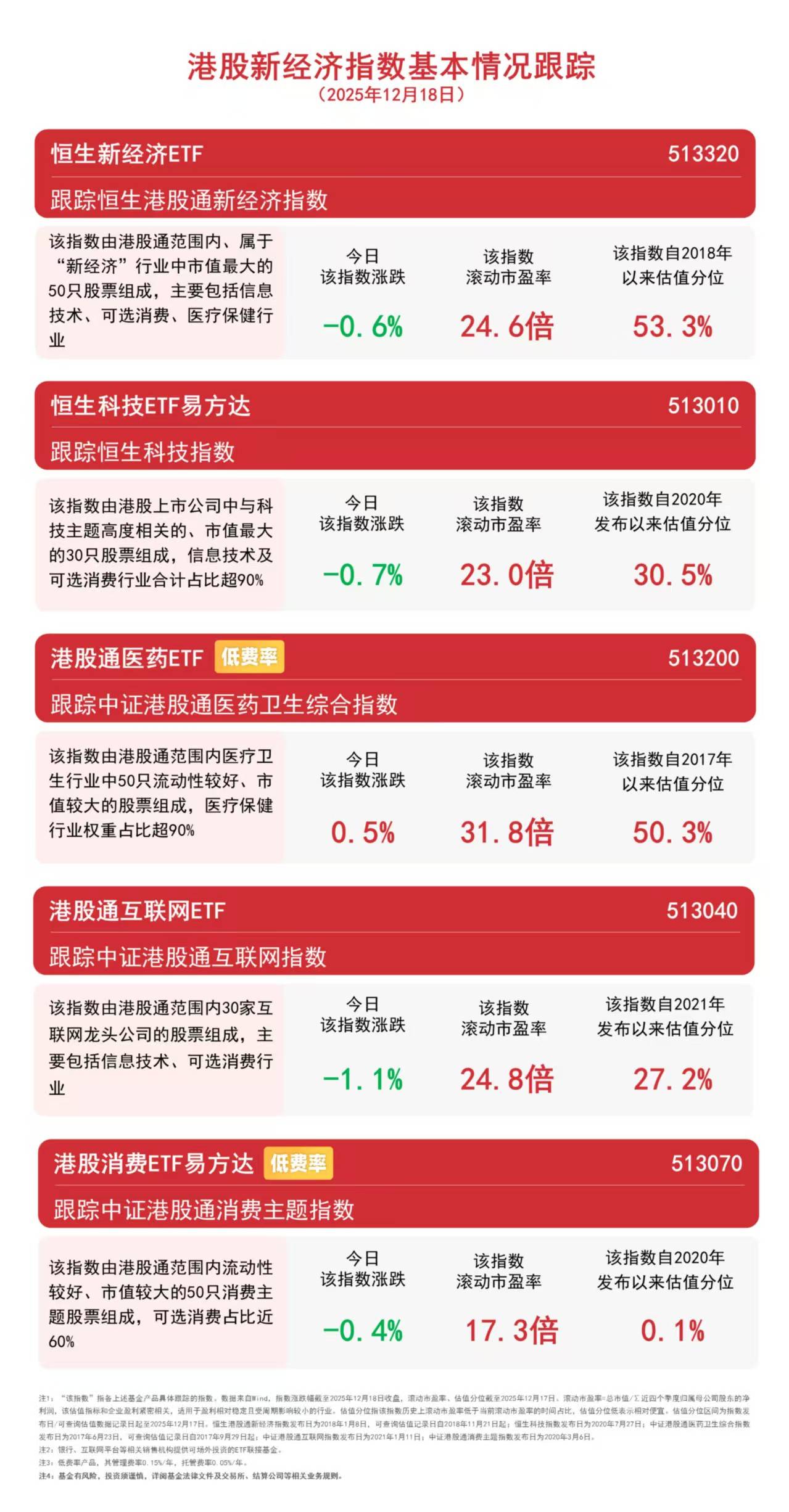
Group 1 - The Hong Kong stock market experienced fluctuations today, with a slight recovery in the afternoon, led by gains in the pharmaceutical, energy, and banking sectors, while technology stocks saw minor declines [1] - The CSI Hong Kong Stock Connect Pharmaceutical and Health Index rose by 0.5%, while the CSI Hong Kong Stock Connect Consumer Theme Index fell by 0.4%, the Hang Seng Hong Kong Stock Connect New Economy Index decreased by 0.6%, the Hang Seng Technology Index dropped by 0.7%, and the CSI Hong Kong Stock Connect Internet Index declined by 1.1% [1] - According to Wind data, as of yesterday, the net inflow of funds into the Hang Seng Technology ETP managed by Yi Fangda (513010) exceeded 2 billion yuan for the month, ranking among the top in its category [1] Group 2 - The Hang Seng New Economy Index tracks the 50 largest stocks within the "new economy" sectors listed under the Hong Kong Stock Connect, primarily including information technology, consumer discretionary, and healthcare [3] - The index decreased by 0.6% today, with a rolling price-to-earnings ratio of 24.6 times [3] - The Hang Seng Technology ETF tracks the Hang Seng Technology Index, which consists of the 30 largest stocks highly related to technology themes, with over 90% of the index comprising information technology and consumer discretionary sectors [4] - The index fell by 0.7% today, with a rolling price-to-earnings ratio of 23.0 times [4] Group 3 - The Hong Kong Stock Connect Pharmaceutical ETF tracks the CSI Hong Kong Stock Connect Pharmaceutical and Health Index, which is composed of 50 highly liquid and large-cap stocks in the healthcare sector, accounting for over 90% of the index [6] - The index rose by 0.5% today, with a rolling price-to-earnings ratio of 31.8 times [6] - The Hong Kong Stock Connect Internet ETF tracks the CSI Hong Kong Stock Connect Internet Index, which has seen a decline of 1.1% today, with a rolling price-to-earnings ratio of 24.8 times [8]
科技方向再次走强,成长ETF(159259)标的指数涨超5%
Sou Hu Cai Jing· 2025-12-17 11:28
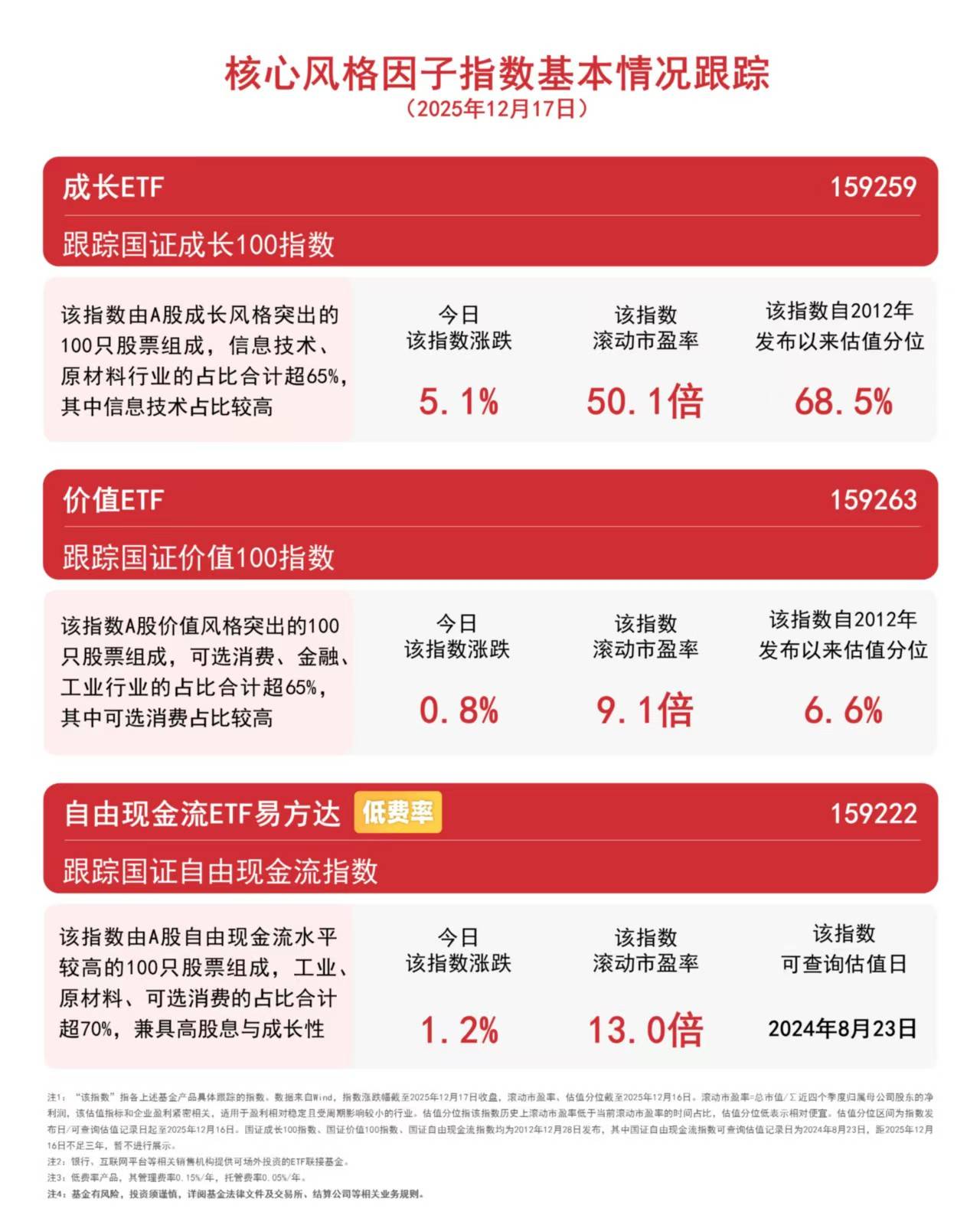
Core Viewpoint - The market showed strong performance in the afternoon, particularly in the technology sector, with the Guozheng Growth 100 Index rising by 5.1%, indicating a robust interest in growth-style investments [1]. Group 1: Market Performance - The Guozheng Growth 100 Index increased by 5.1%, while the Guozheng Free Cash Flow Index rose by 1.2%, and the Guozheng Value 100 Index went up by 0.8% [1]. - The trading volume for the Growth ETF (159259) reached approximately 130 million yuan, significantly higher than previous days, reflecting active market participation [1]. Group 2: Index Composition - The Guozheng Growth 100 Index focuses on A-share stocks with a strong growth style, with over 70% of its weight concentrated in the electronics, communications, and computer sectors, aligning with the core areas of AI computing power [1]. - The Growth ETF (159259) is the only product tracking this index, providing investors with opportunities to capitalize on growth-style investments [1]. Group 3: Sector Analysis - The Guozheng Growth 100 Index consists of 100 stocks, with the information technology and materials sectors accounting for over 65% of the index, highlighting a significant emphasis on technology [3]. - The Guozheng Value 100 Index, which tracks 100 value-style stocks, has over 65% of its weight in consumer discretionary, financial, and industrial sectors, with consumer discretionary having a high proportion [3]. - The Guozheng Free Cash Flow Index includes 100 stocks with high free cash flow levels, with industrial, materials, and consumer discretionary sectors making up over 70%, combining high dividends and growth potential [3].
科技方向集体回调,资金逆势加仓,成长ETF(159259)全天获3000万份净申购
Sou Hu Cai Jing· 2025-12-16 10:22
Core Viewpoint - The technology sector experienced a pullback today, with popular concepts such as CPO, optical chips, and optical communication collectively declining over 3%. Despite this, there was a counter trend in funding, with the Growth ETF (159259) seeing a net subscription of 30 million shares throughout the day [1]. Group 1: Index Performance - The National Securities Value 100 Index fell by 0.9% [1]. - The National Securities Free Cash Flow Index decreased by 1.2% [1]. - The National Securities Growth 100 Index dropped by 2.1% [1]. Group 2: Growth ETF Details - The Growth ETF (159259) tracks the National Securities Growth 100 Index, which focuses on A-share stocks with prominent growth styles [3]. - Over 70% of the index's weight is concentrated in the electronics, communication, and computer sectors, aligning with the core aspects of AI computing power [1][3]. - The Growth ETF is the only product that tracks this index, providing investors with opportunities to capitalize on growth-style investments [1].

港股市场估值周报:2025.12.08-2025.12.14-20251216
Zhe Shang Guo Ji Jin Rong Kong Gu· 2025-12-16 05:59
Valuation of Hong Kong Stock Market - The Hang Seng Composite Index (HSCI) and Hang Seng Index (HSI) are key indicators of market valuation[8][12] - The Hang Seng Technology Index (HSTECH) reflects the valuation trends in the tech sector[16][18] Industry Valuation Levels - The PE (TTM) valuation shows that the utilities sector is undervalued, with a percentile below 20%[23] - Consumer discretionary, consumer staples, healthcare, information technology, and utilities are below the 50th percentile in PE valuation[23] - High valuation sectors (above 50%) include energy, materials, industrials, financials, and telecommunications[23] - No sectors are currently undervalued based on PB (LF) valuation, with consumer staples, information technology, utilities, and real estate below the 50th percentile[27] - Energy, materials, industrials, consumer discretionary, healthcare, financials, and telecommunications are above the 50th percentile in PB valuation[27] AH Share Premium/Discount Levels - The Hang Seng AH Share Premium Index shows fluctuations in premium levels over time, with historical averages and standard deviations noted[33]
美联储降息平衡海外流动性,港股科技板块或仍是长期主线
Jin Rong Jie· 2025-12-16 03:16
Group 1 - The core viewpoint of the article highlights a collective decline in Hong Kong technology stocks, with the Hang Seng Technology Index dropping over 2% and major companies like Alibaba and Tencent experiencing significant losses [1] - The Federal Reserve's recent decision to cut interest rates by 25 basis points to a target range of 3.50%-3.75% is noted, which may influence global capital flows [1][19] - The liquidity environment in the Hong Kong market remains accommodative, supported by domestic policies emphasizing proactive fiscal measures and moderately loose monetary policies for the upcoming year [1][19] Group 2 - The National Index for Hong Kong Stock Connect Technology Index selects 30 leading technology companies based on market capitalization, R&D investment, and revenue growth, ensuring a focus on both scale and growth potential [4] - The index requires constituent stocks to have a compound revenue growth rate exceeding 10% over the past two years or an R&D expense ratio above 5%, with a flexible sample adjustment mechanism to maintain competitiveness [4] - The index's top five constituent stocks account for over 60% of its weight, indicating a high concentration compared to similar indices, which include major players like Alibaba, Tencent, and Xiaomi [7] Group 3 - The latest valuation of the Hong Kong Technology Index stands at 26.43 times PE, which is positioned at the 40.32 percentile since the index's inception, suggesting a relatively favorable valuation environment [10] - Recent data indicates a net outflow of 3.443 billion HKD from southbound funds, a significant decrease compared to the previous week, reflecting a shift in capital dynamics [15] - The article suggests that the technology sector may remain a long-term investment focus, with potential for rebound due to multiple favorable factors, while the consumer sector is expected to receive substantial policy support [19]

美联储降息落地,港股估值空间有望进一步打开,恒生科技ETF易方达(513010)、港股通互联网ETF(513040)受资金关注
Sou Hu Cai Jing· 2025-12-11 11:32
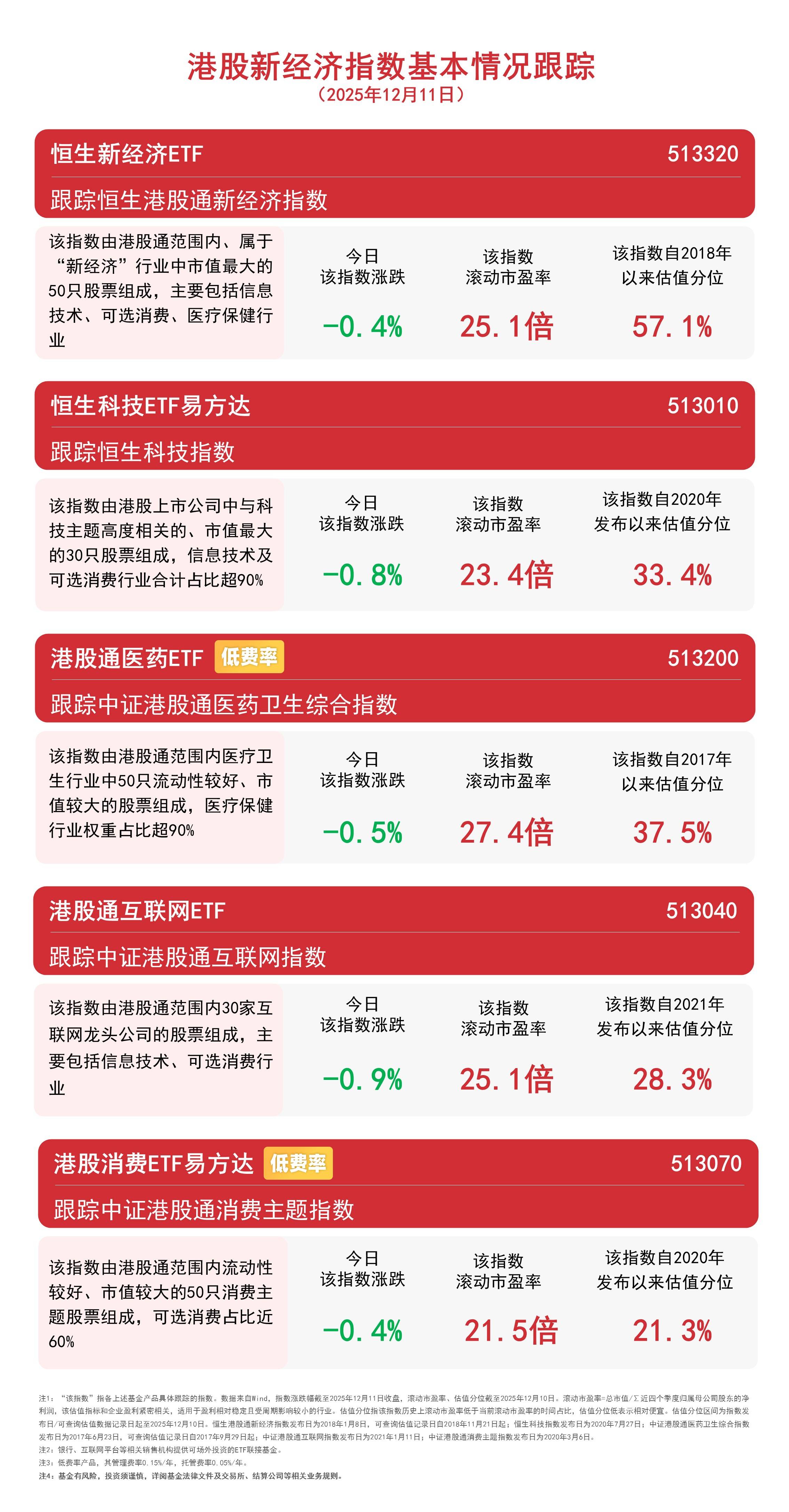
Group 1 - The Hang Seng Hong Kong Stock Connect New Economy Index and the CSI Hong Kong Stock Connect Consumer Theme Index both fell by 0.4%, while the CSI Hong Kong Stock Connect Healthcare Comprehensive Index decreased by 0.5%, the Hang Seng Technology Index dropped by 0.8%, and the CSI Hong Kong Stock Connect Internet Index declined by 0.9% [1] - As of yesterday, the net inflows for the Hang Seng Technology ETF (513010) and the Hong Kong Stock Connect Internet ETF (513040) were 1.08 billion and 700 million respectively for the month [1] - Analysts suggest that with the Federal Reserve completing its third interest rate cut of the year, the overseas liquidity environment is becoming more favorable, and external uncertainties that previously suppressed Hong Kong stocks are gradually easing [1] Group 2 - The performance of domestic and international technology leaders has been stable since the third quarter, with ongoing commercialization of AI research, cloud services, and smart applications [1] - The current valuation remains relatively reasonable, and improvements in external macro variables along with clearer industrial logic enhance the attractiveness of the Hong Kong technology sector [1] - The recent adjustment has further improved the cost-performance ratio of the Hong Kong technology sector, making technology assets one of the most certain investment themes in the medium to long term [1]
美股从AI一枝独秀到“周期群舞”! 大摩押注2026年踏向滚动式复苏 周期股领衔第二阶段牛市
智通财经网· 2025-12-08 10:30
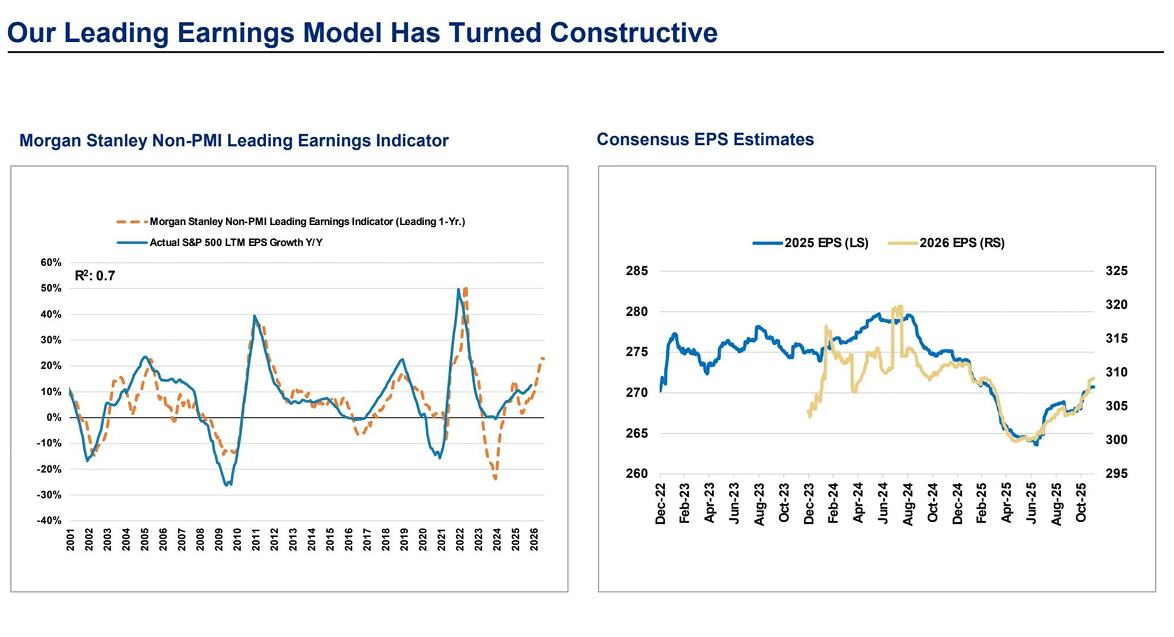
Core Viewpoint - Morgan Stanley predicts a strong economic growth effect from the "One Big Beautiful Bill" (OBBBA) passed by the Trump administration in 2025, starting in 2026, leading to a "Goldilocks" macroeconomic environment in the U.S. with moderate growth and inflation [1][8]. Economic Outlook - The U.S. stock market has transitioned from a three-year "rolling recession" to a "rolling recovery," characterized by improved cost structures, strong earnings revisions, and released pent-up demand, creating a typical early-cycle environment [2]. - The Federal Reserve's anticipated interest rate cuts are expected to initiate a new capital expenditure cycle, with corporate investments, particularly in AI and manufacturing, becoming new growth engines [2]. Market Dynamics - The "Magnificent Seven" tech giants, including Nvidia and Google, will continue to lead earnings revisions in 2025, with expectations spreading to the S&P 493 constituents, particularly in industrial and financial sectors [6]. - Morgan Stanley defines the current situation as a "second phase bull market under rolling recovery," emphasizing a return of market risk appetite and broadening investment opportunities across various sectors [6][15]. Investment Strategy - Morgan Stanley recommends an "overweight" position in cyclical sectors such as financials, industrials, healthcare, and consumer discretionary goods, while suggesting a "low weight" in staples and real estate [13][14]. - The firm anticipates that the S&P 500 index could reach 9,000 points by 2026, driven by strong corporate earnings growth and AI-related capital expenditures [11]. Broader Market Trends - The market is expected to shift focus from defensive to offensive strategies, with AI remaining a key investment theme but not the sole driver of the upcoming bull market [9]. - The anticipated "risk reboot year" in 2026 will see a significant focus on microeconomic factors, with a unique combination of fiscal, monetary, and regulatory policies providing a strong boost to risk markets [11][14].
同标的费率最低的港股通科技30ETF(159636)份额拆分完成,最新流通份额超528亿份,机构:当前港股市场估值水平仍具吸引力
2 1 Shi Ji Jing Ji Bao Dao· 2025-12-08 06:00
Core Insights - The Hong Kong stock market has seen a surge in share buybacks, with 250 companies participating and repurchasing over 7 billion shares, totaling more than 162 billion HKD as of December 4 [1] - The technology and consumer discretionary sectors are leading in buyback activities, indicating positive market sentiment [1] - The Hong Kong Stock Connect Technology 30 ETF (159636) has undergone a share split, increasing its total shares from 26.439 billion to 52.878 billion, with a net asset value adjustment from 1.3842 HKD to 0.6921 HKD per share [1] Industry Summary - The latest data shows that the Hong Kong Stock Connect Technology 30 ETF (159636) has a circulating scale of 36.597 billion HKD and an average daily trading volume exceeding 780 million HKD for the year [2] - The management and custody fees for the ETF are among the lowest in its category, at 0.45% and 0.07% respectively [2] - Market analysts from Zhongyin International express confidence in the long-term upward trend of the Hong Kong stock market, suggesting that current valuation levels remain attractive for investors [2]

港股科技等行业回购动作最为明显,港股通科技ETF(513860)飘红,机构:看好明年科技成长投资主线
2 1 Shi Ji Jing Ji Bao Dao· 2025-12-08 02:11
Group 1 - The Hang Seng Index opened with a slight decline of 0.07%, while the Hang Seng Tech Index saw a minor increase of 0.08% [1] - Notable performers in the Hong Kong stock market included Health Road, which rose over 3%, and several companies like SMIC and AAC Technologies, which increased by more than 2% [1] - The Hong Kong Stock Connect Tech ETF (513860) experienced a 0.13% rise, with a trading volume of 13.68 million yuan and a real-time premium rate of 0.01% [1] Group 2 - A significant trend in the Hong Kong stock market has been a surge in share buybacks, with 250 companies participating and repurchasing over 7 billion shares for a total amount exceeding 162 billion HKD as of December 4 [2] - The technology and consumer discretionary sectors have been the most active in terms of buybacks, driven by factors such as reasonable blue-chip valuations and companies holding ample cash [2] - The Hong Kong Stock Exchange's upcoming revision of the "treasury stock new regulations" in June 2024 will allow companies to repurchase shares without canceling them, thus lowering operational barriers for buybacks [2] Group 3 - The Hong Kong Stock Connect Tech ETF (513860) closely tracks the CSI Hong Kong Stock Connect Tech Index, which includes 50 large-cap technology companies with high R&D investment and rapid revenue growth [3] - The top ten weighted stocks in the index include major players like Alibaba, Tencent, SMIC, Xiaomi, and BYD [3] - According to CICC, the technology sector is expected to present significant investment opportunities by 2026, particularly in new infrastructure driven by technological innovation and structural opportunities arising from domestic demand recovery and high export growth [3]


