
智慧农业

Search documents
四中全会精神在基层丨中原农谷:藏在一根杆里的智慧农业
Xin Hua She· 2025-12-30 07:02
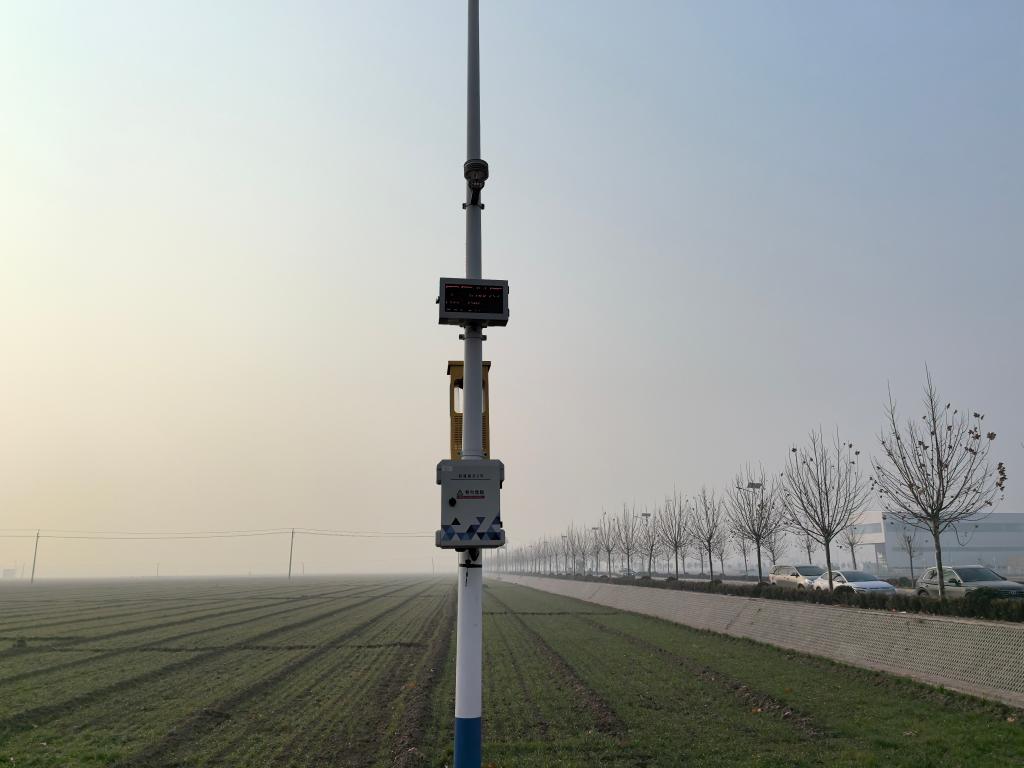
Core Insights - The article highlights the implementation of smart agricultural technology in the Central Plains Agricultural Valley, particularly through the use of "smart poles" that monitor various environmental factors such as temperature, humidity, and soil moisture [1][2][4]. Group 1: Smart Agricultural Technology - The "smart poles" equipped with solar panels, atmospheric sensors, and soil moisture monitoring devices allow farmers to receive real-time data on their crops, enabling more precise irrigation and pest management [1][2]. - In 2024, over 100 "smart poles" were installed in Huixian City, contributing to a total of more than 200 poles in the Central Plains Agricultural Valley [2]. Group 2: Data Integration and Analysis - The data collected from the "smart poles" and monitoring stations is transmitted to the "Central Plains Agricultural Valley Smart Brain," which processes this information to provide insights on weather, soil conditions, and crop health to farmers and agricultural departments [4][5]. - The "Smart Brain" currently holds over 200 million data points and utilizes four data models focused on weather, soil, fertility, and plant transpiration, although these models are still under development [5]. Group 3: Policy and Future Directions - The article references the 20th Central Committee's Fourth Plenary Session, which emphasizes enhancing agricultural production capacity and quality, promoting technological, green, quality, and brand agriculture [5][8]. - The project manager indicates a commitment to optimizing agricultural big data and training agricultural models to provide more accurate and scientific production information to farmers [8].


一套人工智能巡园系统推广超200万亩(经济新方位·新场景新动能)
Ren Min Ri Bao· 2025-12-30 00:11
Core Viewpoint - The Central Economic Work Conference emphasizes the importance of innovation-driven development and the cultivation of new growth drivers through the integration of technology and industry, particularly focusing on the application of new technologies and products in various scenarios [1] Group 1: Industry Trends - The implementation of the "Implementation Opinions on Accelerating Scene Cultivation and Open Promotion of Large-Scale Application of New Scenes" by the State Council outlines 22 key areas for scene cultivation and open promotion [1] - The agricultural sector is undergoing a transformation towards data-driven smart agriculture, with artificial intelligence (AI) playing a crucial role in enhancing production efficiency and market prediction capabilities [5] Group 2: Company Innovations - Jiejiarun Technology Group's digital orchard utilizes IoT sensors and AI to monitor and manage blueberry cultivation, significantly improving operational efficiency and crop quality [2][3] - The company has established partnerships with over ten institutions, including Zhejiang University and the Chinese Academy of Agricultural Sciences, to collect vast amounts of crop image data for AI model training [3] - The AI monitoring system has been deployed across more than 2 million acres in regions like Guangxi and Sichuan, and is expanding into international markets, particularly in Southeast Asia [4][5] Group 3: Technological Integration - The integration of data, algorithms, and scenarios forms a closed-loop system that enhances agricultural decision-making and optimizes AI models based on real-time feedback from the field [4] - The company actively collaborates with local agricultural digital transformation plans and participates in smart agriculture demonstration projects to reduce user costs through policy support [4]
智慧农业让生产“更聪明”
Jing Ji Ri Bao· 2025-12-29 22:21
Core Viewpoint - The rapid development of smart agriculture in China is transforming agricultural production methods and providing crucial support for rural revitalization and agricultural modernization [1][2]. Group 1: Smart Agriculture Innovations - Smart agriculture is enhancing production efficiency through technologies like rail transport vehicles for citrus harvesting and remote monitoring for shrimp farming, leading to improved yield and quality [1]. - Artificial intelligence (AI) is significantly improving the intelligence level of the agricultural supply chain, enabling precise demand forecasting and optimized logistics, which reduces transportation costs and delivery delays [2]. Group 2: Challenges in Smart Agriculture - There are still areas for improvement in smart agriculture, such as uneven digital infrastructure in rural areas, which limits the effectiveness of precision monitoring and automated operations [3]. - The lack of a robust mechanism for agricultural data integration and sharing hinders the training accuracy of AI models and the efficient allocation of technological resources [3]. Group 3: Recommendations for Improvement - It is recommended to optimize the layout of digital infrastructure by increasing investment in digital infrastructure in underdeveloped regions, particularly in the central and western parts of China [4]. - Strengthening the cultivation of composite talents and promoting digital skills among farmers is essential, including the establishment of interdisciplinary programs in universities and training initiatives for agricultural technicians [4].
AI+农业打造大湾区农创谷!广州天河发布智慧农业新计划
Nan Fang Du Shi Bao· 2025-12-29 14:13
Core Viewpoint - The collaboration between the Guangdong Provincial Department of Agriculture and Rural Affairs and the Tianhe District aims to promote the implementation of advanced technologies such as intelligent equipment and bio-agriculture, establishing demonstrative scenarios for learning and promotion [1][2]. Group 1: Smart Agriculture Development - Tianhe District is leveraging its unique agricultural innovation resources within the Guangdong-Hong Kong-Macao Greater Bay Area, including numerous agricultural universities, research institutes, and corporate R&D centers [1]. - The district plans to utilize artificial intelligence to drive the "AI + Agriculture" sector, enhancing efficiency and reducing costs, ultimately enriching the food supply for residents [1][2]. Group 2: Key Initiatives - Two major initiatives are outlined for the high-quality development of smart agriculture: the establishment of a modern marine ranch technology innovation center and the cultivation of a modern seed industry [2]. - The marine ranch center aims to support the development of a modern marine economy in Guangdong, expanding the "blue granary" to provide high-quality deep-sea products to the public [2]. - The seed industry initiative focuses on technological empowerment and self-reliance in seed sources, promoting high-quality development in the modern seed industry within the Greater Bay Area [2]. Group 3: Economic Impact and Goals - The development of smart agriculture is integrated into the provincial modern agriculture layout, with plans to include significant projects in national and provincial planning to foster the entire agricultural value chain [2]. - The goal is to transform Tianhe District into a hub for agricultural innovation that enhances income and ensures supply, providing tangible benefits and a sense of security for residents [2]. - By the end of 2025, the number of enterprises in Tianhe District is expected to exceed 770,000, positioning it as a leader in economic quality development within the city [3].
推进龙江人才振兴系列报道之二丨政策领航聚英才 智农创新兴龙江
Xin Hua Wang· 2025-12-29 03:47
Core Insights - The article highlights the establishment of a national key laboratory for smart farming technology and systems in Heilongjiang, emphasizing the importance of talent and innovation in modern agriculture [1][2]. Group 1: Talent Attraction and Policy Support - The laboratory, built in collaboration with major universities, aims to address talent acquisition challenges through the support of the "60 Measures for Talent Revitalization in Heilongjiang" policy [2]. - The laboratory has successfully attracted 12 national-level talents and 29 provincial-level talents, with a total of over 300 staff, including 142 PhDs and 109 master's degree holders, achieving over 80% of high-education personnel [2]. - The laboratory has secured 20 million yuan in provincial financial support to enhance its research platform and talent development [2]. Group 2: Talent Development and Training - A comprehensive talent development system has been established, including a "growth mentor" program and interdisciplinary team formation to nurture young talents [4]. - The laboratory has trained 998 students from 2022 to 2025, with students participating in significant research projects and winning national-level awards [5]. - The laboratory promotes a collaborative education model that integrates industry, education, talent, and innovation [4]. Group 3: Research Achievements and Innovations - The laboratory has made significant advancements in crop modeling, precision control, smart equipment, and large-scale applications, resulting in notable research outcomes [6]. - The BDH-Crop series crop model and AgroStudio simulation platform have been developed, leading to a 3% reduction in seed costs and a 4% increase in yield through precision planting prescriptions [6]. - The laboratory's innovations in automated farming have led to a 50.3% reduction in labor for paddy fields and a 51.5% reduction for dry fields, significantly improving operational efficiency [7]. Group 4: Industry Empowerment and Rural Revitalization - The laboratory's work aligns closely with industry needs, facilitating the rapid application of innovative results to enhance agricultural quality in Heilongjiang [8]. - The digital smart farm management system has been successfully implemented in multiple farms, projecting significant economic benefits from increased yields [8]. - The North China Agricultural Service APP has become the largest digital agricultural service platform in China, covering over 113 farms and facilitating loans exceeding 29 billion yuan [8].
第三届雄安未来之城场景汇聚焦前沿技术
Bei Jing Ri Bao Ke Hu Duan· 2025-12-27 23:45
Core Insights - The third Xiong'an Future City Scenario Conference will focus on cutting-edge technologies and future industries, launching 12 specialized competitions to promote the large-scale application and industrialization of new technologies, products, and scenarios in Xiong'an New Area and Hebei Province [1][2] Group 1: Competitions and Events - The conference will feature 12 specialized competitions, including the Xiong'an Aerospace Information Innovation Technology Competition, Xiong'an Low-altitude Transportation Innovation Technology Application Competition, and Xiong'an International Robot Competition, among others, covering a total of 35 tracks [1] - New competitions have been added, such as the Green Energy Competition and Smart Express Logistics Competition, indicating an expansion and optimization of the event compared to previous editions [1] Group 2: Project and Resource Development - The event will leverage the modern urban construction of Xiong'an and the rich resource scenarios in Hebei, identifying nearly 100 key directions for scenario development and a number of major engineering projects to support the implementation of these scenarios [2] - The competitions are scheduled to take place from April to June next year, with online registration already open for participating teams and companies through the official platform [2]

卢斌观察:农业科技驱动的长期结构趋势
Sou Hu Cai Jing· 2025-12-27 10:47
Core Insights - The modernization of agriculture in China is being driven by advancements in land resource utilization, core germplasm research capabilities, and agricultural digital infrastructure, forming a new framework for the agricultural technology system [1] - The comprehensive utilization of saline-alkali land is being promoted through collaborative innovation of new varieties, technologies, and systems, transforming "white deserts" into "high-efficiency farmland," which is crucial for food security and presents new structural opportunities in the agricultural technology industry [1] Group 1 - The Yellow River Delta Agricultural High-tech Industry Demonstration Zone is a key area gathering research forces from breeding, ecological restoration, agricultural machinery, and smart agriculture, serving as a testing ground for salt-tolerant varieties and a platform for the transformation of agricultural technology achievements [1] - Research teams have made breakthroughs in breeding, overcoming the bottleneck of achieving both high yield and quality, and have developed new varieties of soybeans, rice, and wheat suitable for saline-alkali land [1] - The trend of agricultural technology deeply integrating into production is evident, with systematic technology integration promoting soil quality improvement [1] Group 2 - Researchers have been conducting targeted experiments to enhance the stress resistance, yield, and regional adaptability of plants in saline-alkali areas, leading to significant yield increases for certain salt-tolerant soybean varieties [3] - The agricultural provinces like Shandong are leveraging smart agriculture technologies to elevate the value of traditional industries, incorporating intelligent greenhouses, water-saving irrigation, pest monitoring, and digital management across the entire production chain [3] - The application of advanced equipment and real-time feedback from big data and IoT systems in production has improved planting precision and enhanced the competitiveness of agricultural products in the market [3] Group 3 - The changes in the agricultural technology industry chain are generating increasing demand for market observation, with users seeking a systematic understanding of the structural factors, policy directions, and cyclical characteristics behind agricultural technology innovation [5] - Professional investment advisory firms are positioned to provide clearer industry insights based on public data and logical analysis of industry trends, particularly in the context of agricultural technology driving new productive forces [5] - The company, as a licensed securities advisory institution, emphasizes compliance and objective analysis in its investment advisory services, focusing on agricultural technology and other structural industries [5]
经济日报评论:发展新质生产力不是齐步走
Xin Lang Cai Jing· 2025-12-27 02:12
Core Viewpoint - The Central Economic Work Conference emphasizes the development of "new quality productivity" tailored to local conditions, indicating a direction for addressing current issues and promoting both traditional industry upgrades and emerging industry cultivation [1] Group 1: Development of New Quality Productivity - The concept of new quality productivity is not limited to emerging industries but includes the upgrading of traditional industries, as evidenced by the rapid growth in high-tech manufacturing and the stable performance of traditional sectors like coal and chemicals [1] - Data from January to November shows significant growth in high-tech manufacturing, particularly in electronic materials and integrated circuits, alongside robust performance in traditional industries that have undergone technological transformation [1] Group 2: Regional Differentiation and Innovation - Different regions are exploring unique paths for development, such as focusing on new materials or advancing quantum computing and aerospace information, demonstrating that new quality productivity is not a one-size-fits-all approach but rather a result of localized strategies [1][2] - The integration of green production into new quality productivity is highlighted by the substantial increase in clean energy generation and the rapid growth of green products like wind power equipment and electric vehicles [2] Group 3: Key Strategies for Implementation - Three key strategies are outlined for the effective development of new quality productivity: 1. Classification guidance to avoid uniform approaches, allowing regions to focus on their strengths, such as quantum technology in resource-rich areas or smart agriculture in agricultural hubs [2][3] 2. Strengthening innovation and collaboration to bridge gaps in technology transfer and enhance the role of enterprises in innovation [2][3] 3. Improving institutional support and optimizing the development ecosystem to align with new quality productivity, utilizing market mechanisms and policy tools like green finance [3] Group 4: Future Outlook - The development of new quality productivity is seen as crucial for future competitiveness, with a clear direction for the 14th Five-Year Plan emphasizing the need for efficient implementation and a focus on technological innovation and a modern industrial system [3]
2025乡村振兴与产业发展大会聚焦提升农业“智力”
Zhong Guo Xin Wen Wang· 2025-12-26 14:02
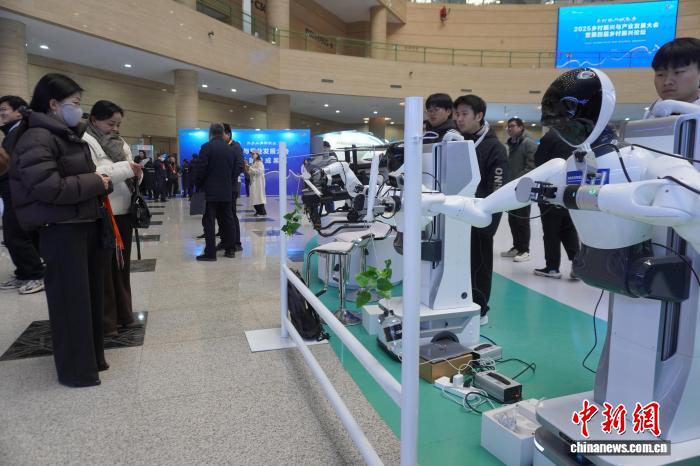
Core Insights - The 2025 Rural Revitalization and Industrial Development Conference focuses on enhancing agricultural intelligence through the application of AI and digitalization [1][3] - In 2025, Henan province achieved a total grain production of 1,350.97 billion jin, an increase of 71 million jin from the previous year, maintaining a stable output above 1,300 billion jin for nine consecutive years, attributed to the widespread use of smart agriculture [1] Group 1 - The conference showcased various smart agricultural devices, including agricultural drones, digital agriculture clouds, AI mobile control water and fertilizer robots, and smart vine-laying robots [3] - An AI mobile control water and fertilizer robot can recognize multiple local dialects, including Henan dialect, facilitating operation for frontline farmers [3] - The smart agriculture applications are particularly prevalent in rural areas of Henan, with initiatives like the "drone mountain postal route" in Anyang Linzhou improving logistics for local farmers [3]
让数字经济成为乡村振兴的新引擎
Xin Hua Ri Bao· 2025-12-24 23:23
Core Viewpoint - The integration of digital technologies such as big data, cloud computing, and artificial intelligence is crucial for advancing China's rural revitalization strategy, positioning the digital economy as a key driver for high-quality economic development and revitalizing rural economies [1] Group 1: Digital Infrastructure Development - Digital infrastructure is essential for the operation of the rural digital economy, influencing its breadth, depth, and speed of development [2] - The construction of a comprehensive digital infrastructure should adhere to principles of being appropriately advanced, efficient, and environmentally friendly [2] - There is a need to enhance network coverage in rural areas through the deployment of high-speed fiber networks and mobile communication technologies [2] Group 2: Integration and Empowerment of New Digital Business Models - The deep integration of the digital economy with rural industries is vital for stimulating internal motivation and enhancing development capabilities [3] - Emphasis on smart agriculture through the application of IoT, big data, and AI in agricultural production processes is necessary to improve productivity and resource utilization [3] - The promotion of e-commerce models and the development of diverse marketing strategies such as live streaming and social e-commerce are essential for expanding rural market access [3] Group 3: Innovation-Driven Ecosystem Development - A supportive development ecosystem is crucial for the sustainable growth of the rural digital economy, requiring the removal of institutional barriers and optimization of policy frameworks [4] - The cultivation of local digital talent through training programs for rural stakeholders is necessary to enhance digital skills and knowledge [4] - The advancement of digital governance through integrated online government service platforms can improve rural management and public service delivery [4]