
农村电商

Search documents
尺素金声|农村网络销售首破3万亿元,电商平台加速“下沉”
Sou Hu Cai Jing· 2026-02-13 05:50
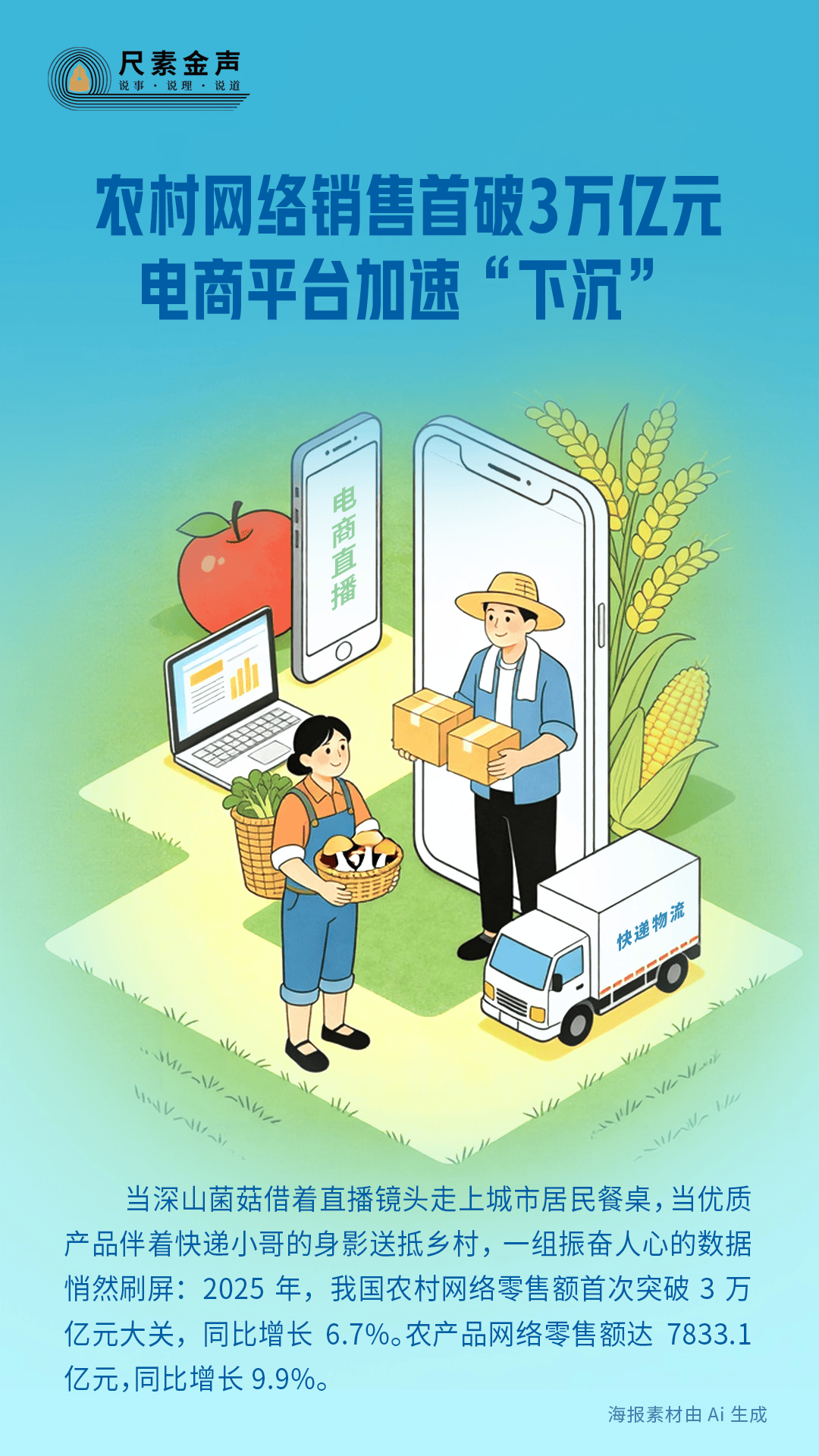
Core Insights - The rural e-commerce sector in China is projected to surpass 3 trillion yuan in retail sales by 2025, marking a year-on-year growth of 6.7%, with agricultural product online sales reaching 783.31 billion yuan, a 9.9% increase [1][4]. Group 1: Policy Support - The significant growth in rural e-commerce is attributed to precise policy support, including initiatives from 17 government departments aimed at enhancing county-level commercial systems and ensuring logistics accessibility [4][5]. - Policies such as "Digital Commerce Promotes Agriculture" have been implemented to cultivate new rural business leaders and strengthen agricultural brand development, creating a conducive environment for rural online retail [4][5]. Group 2: Infrastructure Development - Continuous improvement in rural infrastructure has been crucial for e-commerce growth, with logistics challenges being addressed through upgraded commercial service centers and widespread coverage of village-level express delivery points [5]. - The application of digital technologies like 5G and big data in rural areas has facilitated skills training for farmers, enabling them to engage in live streaming sales and online store management [5]. Group 3: Market Dynamics - The vibrant activity of various market players, including e-commerce platforms and traditional stores, has enriched the rural online retail landscape, enhancing product quality and diversity [5][6]. - High-quality agricultural products from different regions are now reaching urban consumers through e-commerce, fulfilling the demand for premium goods while providing farmers with local employment opportunities and increased income [5][6]. Group 4: Future Outlook - The achievement of surpassing 3 trillion yuan in rural online retail sales is seen as a new starting point, with ongoing challenges in e-commerce talent and brand influence in rural areas [6]. - Continued policy guidance and market-driven approaches are expected to further enhance rural circulation networks and support the growth of market entities, unlocking new potential in rural online retail [6].

做深做细做实县域富民产业大文章
Xin Lang Cai Jing· 2026-02-09 22:25
Core Viewpoint - The development of county-level industries aimed at increasing farmers' income is crucial for promoting rural revitalization and achieving common prosperity, as emphasized in the 2026 Central Document No. 1 [2] Group 1: Importance of County-Level Industries - Cultivating and strengthening county-level industries is essential for addressing urban-rural development imbalances and enhancing local employment opportunities for farmers [3] - County-level industries represent a systematic upgrade and spatial restructuring of traditional rural industry development models, focusing on integrated development and leveraging local resources [3] Group 2: Current Achievements and Challenges - Recent efforts in implementing rural revitalization strategies have led to significant advancements in modern agricultural systems and the emergence of new industries such as rural e-commerce and leisure tourism [4] - Despite progress, challenges remain, including short industrial chains, low efficiency, and severe homogenization, necessitating focused efforts to deepen and solidify county-level industries [4] Group 3: Strategies for Development - Emphasizing local characteristics and adhering to a place-based approach is vital for the development of county-level industries, avoiding homogenization and fostering unique competitive advantages [5] - Understanding industry dynamics and maintaining a market-driven approach are crucial for enhancing efficiency and innovation within county-level industries [6] Group 4: Focus on Wealth Creation - The primary goal of developing county-level industries is to enrich farmers, which requires establishing diverse and close-knit benefit-sharing mechanisms to ensure stable income for rural communities [7] - Investing in human capital through training and skill development is essential for creating a new generation of professional farmers, thereby stimulating local consumption and driving further industrial growth [7]
中国打造农业现代化大产业 八方面举措筑牢乡村全面振兴根基
Chang Jiang Shang Bao· 2026-02-09 01:55
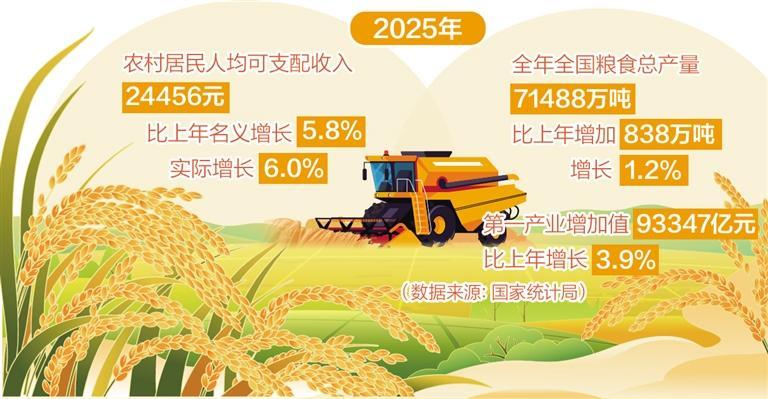
Core Insights - The modernization of agriculture and rural areas is crucial for China's overall modernization, with 2026 marking the beginning of the "14th Five-Year Plan" and emphasizing the importance of "three rural issues" [2][3] Group 1: Policy Implementation - The Ministry of Agriculture and Rural Affairs has released the "Implementation Opinions" to execute the Central Document No. 1 for 2026, outlining 40 specific measures across eight key areas to promote new development in agriculture [2][3] - The 2026 Central Document No. 1 aims to establish agriculture as a modernized major industry, focusing on rural revitalization and leveraging the "Ten Thousand Projects" experience [2][3] Group 2: Agricultural Technology and Innovation - The implementation plan emphasizes enhancing agricultural technology and equipment support, proposing five specific measures to boost agricultural innovation and productivity [3][4] - The contribution rate of agricultural technology to production has increased from 54.5% in 2012 to over 64% in 2025, while the comprehensive mechanization rate of crop farming has risen from 57% to 76.7% in the same period [4] Group 3: Rural Industry Development - The document highlights the importance of cultivating and expanding county-level industries to promote rural prosperity, integrating technology, green practices, quality, and branding in agriculture [6][7] - The goal is to enhance the agricultural product processing and circulation industry, creating modern agricultural processing parks and improving the efficiency of agricultural value chains [6][7] Group 4: Enhancing Rural Livelihoods - The plan aims to increase farmers' income through stable employment opportunities and the development of new industries such as rural tourism and e-commerce, with rural residents' disposable income reaching 24,456 yuan in 2025, a 6% increase from the previous year [6][7] - The focus is on creating a fair mechanism for sharing the benefits of industrial development with farmers, ensuring a positive cycle of industry growth and income increase [7]
靠一根网线领跑全国?粤北瑶乡书写电商逆袭故事
Xin Lang Cai Jing· 2026-02-08 04:04
Core Viewpoint - The article highlights the successful development of e-commerce in Liyuan Yao Autonomous County, showcasing how the region has leveraged e-commerce to boost local products and stimulate economic growth, with significant increases in online retail and agricultural product sales [3][4][15]. E-commerce Development - Liyuan has implemented the "Hundred Million Thousand Project" to promote rural e-commerce, resulting in a network retail sales of 490 million yuan in 2024, a 75% year-on-year increase, and a 140.8% surge in agricultural product online sales, the highest growth rate among counties in the province [3][4]. - The county was recognized as a "National Rural E-commerce Leading County" in 2025, the only county in Guangdong to receive this honor, and its live e-commerce center was selected as a typical case for county-level live e-commerce centers [3][4]. Policy Support and Innovation - To support e-commerce, Liyuan introduced policies providing land supply, tax incentives, and low-interest loans exceeding 15 million yuan to over 50 e-commerce entities, addressing financing challenges [4][6]. - The Liyuan E-commerce Public Service Center has integrated e-commerce services with government services, offering comprehensive support for e-commerce entrepreneurs and traditional businesses transitioning to online sales [4][6]. Local Product Promotion - The county has established a public brand area for local products, showcasing items like Yao bath bags and specialty oils, and has created a "cloud supermarket" system to ensure product quality and traceability [6][12]. - Notable brands such as Huayao and Yunmen Gan have emerged, benefiting from the county's branding and standardization efforts [6][12]. Live Streaming and Talent Development - Local talents like Huang Lingyun have successfully utilized live streaming to promote traditional crafts, gaining significant online followings and expanding their market reach [7][10][12]. - The county has nurtured over 30 local live streamers, with three achieving annual sales exceeding 10 million yuan, supported by the "Yao Township E-commerce Talent Program" [12]. Integration of E-commerce and Tourism - Liyuan has innovated the "E-commerce + Rural Tourism" model, promoting cultural brands and developing digital agricultural tourism products, attracting 32,000 visitors and generating 180 million yuan in tourism revenue in 2024 [13]. - Collaborations with platforms like Hema Fresh and Meituan have established a digital supply chain for agricultural products, enhancing market access for local farmers [13]. Logistics Infrastructure - The county invested 80 million yuan to build a comprehensive logistics network, improving delivery efficiency by 6 hours and reducing costs for small e-commerce businesses [15]. - The logistics system supports the vibrant e-commerce environment, facilitating the connection between rural producers and national markets [15].
农村电商加快发展—— 希望田野更有活力
Ren Min Ri Bao· 2026-02-08 02:54
Core Viewpoint - The rapid development of rural e-commerce in China is significantly enhancing farmers' income and promoting rural consumption, with projected growth rates of 6.7% for overall rural online retail and 9.9% for agricultural products by 2025 [2] Group 1: E-commerce Development - Rural e-commerce has established a three-tier service and logistics system at the county, township, and village levels, facilitating better access to goods and services for rural residents [2] - The integration of logistics and e-commerce is creating new opportunities for rural areas, making products more accessible and enhancing the quality of life for residents [2] Group 2: Logistics Innovations - A new model combining passenger and freight transport is being piloted in the Inner Mongolia region, allowing public transport to carry parcels, thus reducing delivery costs for courier companies [4] - The collaboration between public transport and postal services is leading to a win-win situation, where costs are lowered for courier companies while providing additional income for bus drivers [4][5] Group 3: Impact on Local Businesses - Rural supermarkets are evolving into package collection points, increasing foot traffic and sales as more residents engage in online shopping [6][7] - Local farmers are benefiting from improved logistics, allowing them to sell their products directly to consumers, thus increasing their profit margins [7] Group 4: E-commerce and Livestreaming - Livestreaming e-commerce is thriving, with local farmers using platforms to sell their products directly to consumers, significantly boosting their sales [8][9] - The county of Linyi has seen a substantial increase in e-commerce activity, with over 1,000 companies contributing to local employment and economic growth [10][11] Group 5: Government Support - Local governments are providing financial support for logistics costs, which is crucial for the sustainability of e-commerce businesses in rural areas [10][11] - Training programs for e-commerce skills are being implemented, enhancing the capabilities of local entrepreneurs and contributing to the growth of the sector [11]
2025年农村网络零售额同比增长6.7%
Ren Min Ri Bao· 2026-02-07 22:28
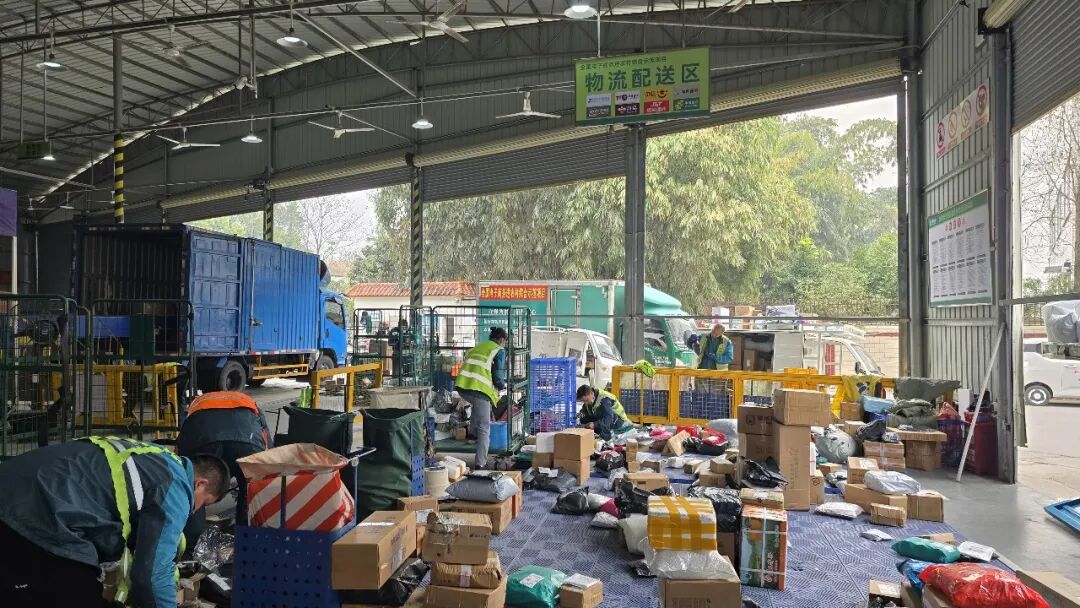
Core Insights - The Ministry of Commerce reports that by 2025, rural online retail sales will reach 3 trillion yuan, and agricultural product online retail sales will reach 783.31 billion yuan, representing year-on-year growth of 6.7% and 9.9% respectively [1] Group 1: Consumer Trends - Continuous growth in goods and services consumption is expected, with county-level home appliance trade-in and new mobile phone subsidies achieving sales of 48.23 million units and revenue of 158.6 billion yuan [1] - County-level service sales are projected to reach 9.1 trillion yuan, reflecting a year-on-year increase of 5.9% [1] Group 2: E-commerce Development - Rapid development of rural e-commerce is highlighted, with leading e-commerce platforms expected to conduct over 4 million agricultural livestreams, resulting in agricultural specialty product sales exceeding 10 billion units and daily shipments surpassing 20 million units [1] Group 3: Logistics Infrastructure - The logistics network is improving, with plans to establish 348 county-level logistics distribution centers and 562 township express logistics stations by 2025 [1] - Currently, the coverage rate of county-level logistics distribution centers across the country has reached 100% [1]
农村电商带来哪些乡村新变?人民日报记者探访
Sou Hu Cai Jing· 2026-02-07 11:10
Core Viewpoint - The rapid development of rural e-commerce in China is significantly enhancing farmers' income and promoting rural consumption, with projections indicating a 6.7% year-on-year growth in rural online retail sales and a 9.9% growth in agricultural product online retail sales by 2025 [7]. Group 1: Rural E-commerce Development - The establishment of a three-tier e-commerce service and logistics distribution system at the county, township, and village levels is crucial for rural e-commerce growth [7]. - The integration of passenger and freight services in rural areas is being explored to improve logistics efficiency and reduce costs for delivery companies [9]. Group 2: Case Studies of Rural E-commerce - In Inner Mongolia, a new model combining passenger transport and parcel delivery is being implemented, allowing for efficient delivery of packages to remote villages [9][10]. - In Liaoning, a village supermarket has become a postal service point, facilitating easier access to e-commerce for local residents and increasing the number of elderly individuals engaging in online shopping [11][12]. - In Shanxi, live-streaming e-commerce is thriving, with local farmers directly selling their products online, significantly increasing their income by eliminating middlemen [14][15]. Group 3: Economic Impact and Future Prospects - The logistics improvements are not only enhancing consumer convenience but also expanding market access for local agricultural products, leading to increased sales and profitability for farmers [12][16]. - Policies supporting logistics cost reductions and e-commerce training are fostering a more vibrant rural economy, with expectations of significant growth in agricultural e-commerce sales by 2025 [16].

农村电商加快发展—— 希望田野更有活力(视线)
Xin Lang Cai Jing· 2026-02-07 04:17
Core Insights - The rapid development of rural e-commerce in China has established a three-tier electronic commerce service and logistics distribution system at the county, township, and village levels, significantly contributing to farmers' income and rural consumption [2] Group 1: Rural E-commerce Development - By 2025, the national rural online retail sales are expected to grow by 6.7% year-on-year, while agricultural product online retail sales are projected to increase by 9.9% year-on-year [2] - The integration of logistics and e-commerce has made rural life more convenient, allowing for better quality of life and increased economic activity in rural areas [2] Group 2: Integration of Delivery Services - In Inner Mongolia, a new model combining passenger and freight transport has been implemented, allowing rural residents to receive packages directly in their villages, thus reducing delivery costs for courier companies [4] - The collaboration between postal services and local bus companies has created a win-win situation, where postal companies manage distribution centers, and bus companies earn additional income from delivery services [4][6] Group 3: Impact on Local Businesses - Rural supermarkets are increasingly serving as package collection points, enhancing convenience for local residents and boosting sales for these businesses [6][7] - The integration of delivery services has led to a 30% increase in income for local supermarkets that also function as delivery hubs [7] Group 4: Agricultural Product Sales - Live streaming e-commerce has significantly increased sales for local farmers, with one farm reporting over 30,000 yuan in sales within half a day of live streaming [8][10] - The county of Linyi has seen a transformation in its agricultural sector, with e-commerce contributing to a significant portion of farmers' income and attracting young entrepreneurs back to rural areas [10][11] Group 5: Government Support and Future Prospects - The local government has implemented logistics cost subsidies to support agricultural product sales, with one farm receiving 260,000 yuan in subsidies to reduce operational costs [10] - By 2025, Linyi County aims for agricultural e-commerce sales to reach 2.5 billion yuan, with live streaming expected to account for 25% of this figure [11]
希望田野更有活力(视线)
Ren Min Ri Bao· 2026-02-07 01:34
Core Viewpoint - The rapid development of rural e-commerce in China has established a three-tier electronic commerce service and logistics distribution system at the county, township, and village levels, significantly contributing to farmers' income and rural consumption. By 2025, the national rural online retail sales are expected to grow by 6.7% year-on-year, with agricultural product online retail sales increasing by 9.9% [7]. Group 1: Integration of Delivery and Public Transport - The integration of public transport and delivery services addresses the challenges faced by both sectors, with rural public transport companies like Xiangyu Bus Company in Inner Mongolia collaborating with private courier companies to deliver packages to remote areas [8][10]. - The new model allows for cost savings in delivery for courier companies and provides additional revenue streams for public transport, creating a win-win situation for all parties involved [10]. - By the end of 2025, the new delivery model is expected to handle an average of 4,000 packages daily across seven townships and 94 villages in the region [11]. Group 2: Rural E-commerce and Consumer Behavior - The establishment of village-level courier stations has made it easier for residents to receive and send packages, leading to an increase in online shopping among older villagers [12][13]. - Local farmers are benefiting from improved logistics, allowing them to sell their products directly to consumers, which increases their profit margins significantly [13][14]. - The integration of e-commerce with local businesses has resulted in a 30% increase in revenue for village supermarkets that also serve as courier stations [14]. Group 3: Agricultural E-commerce Growth - The rise of live-streaming e-commerce has significantly boosted sales for local farmers, with one farm reporting over 30,000 yuan in sales within half a day of live streaming [15][16]. - The county of Linyi has seen a transformation in its agricultural sector, with e-commerce contributing to a substantial increase in farmer incomes and attracting young entrepreneurs back to rural areas [16][17]. - By 2025, Linyi County aims to achieve 2.5 billion yuan in agricultural e-commerce sales, with live-streaming sales accounting for a quarter of that total [17].

农村电商加快发展——希望田野更有活力(视线)
Ren Min Ri Bao· 2026-02-07 00:44
Core Insights - The rapid development of rural e-commerce in China has established a three-tier electronic commerce service and logistics distribution system at the county, township, and village levels, significantly contributing to farmers' income and rural consumption growth. By 2025, the national rural online retail sales are expected to grow by 6.7%, with agricultural product online retail sales increasing by 9.9% [1]. Group 1: Rural E-commerce Development - Rural e-commerce has transformed the accessibility of goods, allowing for direct delivery to villages, enhancing the quality of life for residents [1][4]. - The integration of logistics services, such as the collaboration between public transport and courier services, has improved delivery efficiency and reduced costs for both courier companies and local transport services [3][6]. Group 2: Case Studies in Rural Areas - In Inner Mongolia, a new model combining passenger and freight services has been implemented, allowing for the delivery of parcels to remote areas, which has increased the income of local postal workers [3][4]. - In Liaoning, the establishment of village-level courier stations has facilitated the last-mile delivery of goods, encouraging more residents, including the elderly, to engage in online shopping [6][7]. - In Shanxi, the rise of live-streaming e-commerce has significantly boosted local farmers' incomes, with one farmer reporting sales exceeding 30,000 yuan in a single day through live broadcasts [8][9]. Group 3: Economic Impact and Future Prospects - The e-commerce sector in Shanxi has evolved, with over 1,000 e-commerce companies established, creating employment for over 60,000 people, and contributing to a projected 25 billion yuan in agricultural e-commerce sales by 2025 [10][11]. - Policies supporting logistics cost reductions, such as subsidies for local shipments, have been instrumental in enhancing the competitiveness of local agricultural products in broader markets [10][11].