算力产业

Search documents
“国补”激活消费市场 福嫂温暖京津万家
Xin Lang Cai Jing· 2026-01-16 23:11
Group 1 - The new round of national subsidies for replacing old consumer goods in Hebei has been implemented, covering various sectors including automobiles, home appliances, and digital products, effectively stimulating consumer activity [6] - From January 1 to 9, the subsidy for replacing old home appliances in Hebei exceeded 130 million yuan, driving sales over 920 million yuan [6] - The "Hebei Fusa" brand has significantly impacted labor output and public services, with 153,000 workers employed in the Beijing-Tianjin area, enhancing local labor force income and meeting family needs [7] Group 2 - The construction of a "waste-free city" in Xiong'an New Area has shown significant results, with a waste treatment facility capable of processing over 3,000 tons of waste daily, utilizing advanced incineration technology [5] - The Xiong-Xin high-speed railway's key project, the Beitai Mountain Tunnel, has been completed, facilitating the railway's timely operation and enhancing regional economic development [5] - The market recognition of drought-resistant alkali wheat products is increasing, with unique flavors and nutritional benefits leading to expanded production and processing [8] Group 3 - Langfang is developing a "computing power highland" to drive intelligent upgrades across various industries, leveraging its geographical and industrial advantages [9] - The city has established a robust computing power application ecosystem, integrating AI technologies into sectors such as transportation and project matching [9]

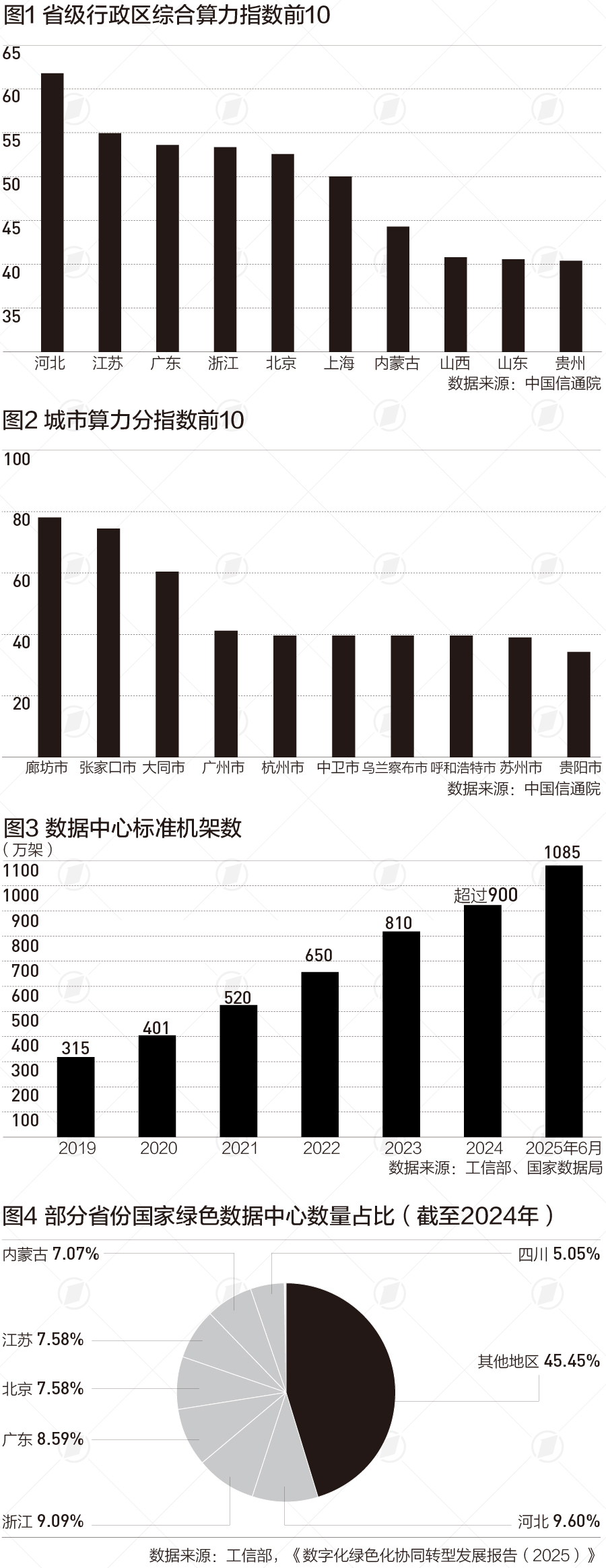
综合算力大数据:河北江苏广东居前三
Di Yi Cai Jing· 2026-01-15 12:20
Group 1 - The core viewpoint of the articles highlights the rapid growth of China's artificial intelligence (AI) computing power market, which is expected to reach $25.9 billion by 2025, reflecting a year-on-year increase of 36.2% [3][1] - The Ministry of Industry and Information Technology and other departments have issued guidelines to strengthen AI computing power supply and promote the construction of a national integrated computing power network [1][22] - The "Blue Book" on comprehensive computing power index indicates that while progress has been made in China's computing power ecosystem, challenges such as uneven infrastructure and insufficient application depth remain [1][2] Group 2 - As of mid-2025, China has released 1,509 large models, accounting for approximately 40.2% of the global total of 3,755 [2] - The number of standard racks in data centers in China has increased from 3.15 million in 2019 to over 9 million by 2024, with a total of 10.85 million racks in use by mid-2025 [2][9] - The top provinces for standard racks in use are Hebei, Guangdong, and Jiangsu, each exceeding 600,000 racks [2] Group 3 - The global AI server market is projected to grow from $125.1 billion in 2024 to $158.7 billion in 2025, with generative AI servers expected to increase their market share from 29.6% in 2025 to 37.7% by 2028 [3] - The comprehensive computing power index ranks Hebei, Jiangsu, and Guangdong as the top three provinces, while cities like Langfang, Zhangjiakou, and Dalian lead in computing power sub-index [14][21] Group 4 - The national strategy to accelerate the construction of an integrated computing power network is leading to a more extensive distribution of computing resources beyond core regions [21] - The average Power Usage Effectiveness (PUE) of computing centers in China is 1.46, indicating progress in energy efficiency, although there is still significant room for improvement [21] - The implementation of the "Opinions" encourages the use of cloud computing services to quickly build intelligent infrastructure capabilities, reducing technology investment costs [22]
智算服务市场规模突破1300亿元
Jing Ji Ri Bao· 2026-01-14 22:10
Core Insights - The recent 2025 Computing Power Internet Conference marked a significant advancement in China's computing power development, entering a new phase of collaborative interconnectivity [1] - By December 2025, the scale of consumer-level users in China's computing power internet is expected to approach 10 million, with public intelligent computing service usage reaching 1.407 billion card hours and the market size for intelligent computing services exceeding 130 billion yuan [1] Group 1: Development and Infrastructure - The Ministry of Industry and Information Technology emphasizes the importance of accelerating the construction of computing power infrastructure as a crucial support for AI development [1][2] - Current challenges include a fragmented service landscape, uneven facility distribution, and significant differences in cluster architecture, necessitating a national-level push for coordinated computing power interconnectivity [2] - The establishment of a national computing power internet service platform, supported by key regions and telecom operators, aims to provide diverse public services and facilitate unified access to computing resources [3] Group 2: Technological Advancements - The computing power industry is undergoing rapid technological iteration, with standardization being essential for high-quality development and innovation [5][6] - There is a pressing need to enhance the efficiency of computing resource scheduling and address barriers in cross-domain data flow, which currently hinder the industry's growth [6] - Accelerating core technology breakthroughs and fostering collaborative innovation among academia, industry, and users is vital for building a secure and advanced computing power system [7] Group 3: Application and Integration - Significant breakthroughs have been achieved in computing power facility interconnectivity, with ongoing efforts to promote large-scale applications in enterprise-level scenarios such as scientific computing and industrial simulation [8] - Companies are leveraging deep digitalization of complex scenarios to enhance the infrastructure and application ecosystem for computing power [8] - The integration of computing power resources is being exemplified by companies like Dassault Systèmes, which is building a global cloud-based R&D platform to support high-intensity tasks [9] Group 4: Future Directions - The focus for 2023 is to transition from pilot breakthroughs to deeper application phases in computing power internet construction, emphasizing coordination, rule standardization, technological advancement, and scenario empowerment [9]
西宁开发区谋划“十五五”重大项目287项
Xin Lang Cai Jing· 2026-01-12 19:03
Core Viewpoint - Xining Economic and Technological Development Zone aims to establish five key areas: new quality productivity, technological innovation, green low-carbon demonstration, industrial transfer, and open economy, with a total investment of 277.7 billion yuan for 287 major projects [1][2]. Group 1: Development Strategy - The development strategy focuses on stabilizing silicon, expanding energy storage, deepening non-ferrous metals, coordinating computing power, and nurturing new quality [1]. - The dual-driven approach of "emerging industry cultivation + traditional industry upgrading" is emphasized to activate the industrial upgrade engine [2]. Group 2: Project Implementation - A special leadership group has been established to ensure the implementation of the five key areas, with responsibilities and annual targets clearly defined [1]. - The "one project, one special team" mechanism is introduced to address challenges in project initiation, land use, and financing [1]. Group 3: Industry Focus - The development zone will leverage Qinghai's green electricity advantages to focus on green computing power, artificial intelligence, and hydrogen energy [2]. - Key industries such as photovoltaics, lithium batteries, and non-ferrous metals will undergo special technical transformation actions to advance the value chain towards high-end [2]. Group 4: Investment and Resource Allocation - A focus on chain extension and strengthening will be implemented, with a targeted industrial chain investment map developed to attract projects from key regions like the Yangtze River Delta and the Pearl River Delta [2]. - The operational model of "management committee + company" will be promoted to streamline project initiation and approval processes, reducing project landing cycles by over 30% [2].
让算力像水和电一样方便取用
Ren Min Ri Bao· 2026-01-12 07:43
Core Insights - The article highlights the successful implementation of a mixed-rate network trial in China's core computing power regions, specifically the 400G and 800G dual-rate network, which enhances the efficient interconnection and collaborative development of computing resources [1] - The "East Data West Computing" project has positioned Guizhou as a national hub for integrated computing networks, transitioning from a "data warehouse" to a "computing factory" [1] - Guizhou's digital economy is projected to exceed 100 billion yuan in software and information technology services by 2024, with continuous growth rates among the highest in the country [4] Group 1: Computing Power Development - Guizhou has accelerated the establishment of a green data center that integrates general computing, supercomputing, and intelligent computing, increasing its computing capacity from 2P to over 10,000P [1] - The region has improved data transmission efficiency by establishing direct connections to 24 cities, reducing latency by 33% and cutting costs by over 30% for data transfers [2] - The "Xirang" computing scheduling platform has been launched to enhance the efficiency of computing resource allocation across various sectors [2] Group 2: Technological Advancements - The development of a 5G smart factory platform with 2,000 intelligent terminals has enabled full-process digitalization of production and sales [3] - The implementation of a "5G + digital twin factory" has led to a 40% reduction in accident rates and a 30% increase in management efficiency [3] - Guizhou is establishing an artificial intelligence laboratory to attract more companies in the computing industry, supporting high-quality development of the digital economy [3] Group 3: Industry Ecosystem - Guizhou has built a comprehensive digital economy framework, including cloud services, data storage, data processing, and application, attracting multiple enterprises to the region [4] - The province currently operates 50 data centers with a computing power scale of 150 billion billion calculations per second, with over 90% in intelligent computing and domestic production rates [4] - Guizhou is pioneering market-oriented reforms for data elements, promoting the development of a data trading market and facilitating nationwide data circulation [4]
让算力像水和电一样方便取用(创新故事)
Ren Min Wang· 2026-01-11 22:43
Core Insights - The article highlights the successful implementation of a dual-rate mixed network trial with 400G and 800G speeds in key computing power regions of China, particularly in the Guizhou-Guangzhou corridor, enhancing efficient interconnection and collaborative development of computing resources [1] - The "East Data West Computing" initiative has positioned Guizhou as a national hub for integrated computing networks, transitioning from a "data warehouse" to a "computing factory" [1][4] - Guizhou's digital economy is projected to exceed 100 billion yuan in software and information technology services revenue by 2024, with continuous growth rates among the highest in the country [4] Group 1: Computing Power Infrastructure - Guizhou has established a direct connection to 24 cities through a low-loss optical cable network, significantly reducing data transmission time by 33% and lowering costs by over 30% for businesses in the Guangdong-Hong Kong-Macau Greater Bay Area [2] - The computing power capacity in Guizhou has reached 150 billion billion calculations per second, with over 90% of intelligent computing being domestically sourced and regionally concentrated [4] Group 2: Efficient Computing Power Scheduling - The "Xirang" computing power scheduling platform has been launched in Guizhou, enabling nationwide coordination and scheduling of computing resources, akin to utilities like water and electricity [3] - Collaborations with local meteorological agencies have led to improved weather prediction accuracy and efficiency through the application of lightweight meteorological diffusion models [3] Group 3: Future Development and Industry Focus - Guizhou aims to further develop its computing power, data, applications, and industries, with a focus on intelligent computing, high-quality data aggregation, and artificial intelligence [5] - The establishment of an artificial intelligence laboratory in Guizhou is expected to attract more enterprises along the computing power industry chain, contributing to high-quality digital economic development [3][5]
数字化建设取得新进展
Xin Lang Cai Jing· 2026-01-10 17:26
Group 1 - The core viewpoint of the article highlights the systematic progress in the "Digital Golmud" initiative, which is expected to inject new momentum into the development of the highland city by the end of 2025 [1] Group 2 - Government service efficiency has improved, with 95% of government service items available online and a 100% satisfaction rate among the public. The number of services offered at the municipal service center has significantly increased, with over 10,000 "one-stop" services completed [1] Group 3 - The public resource trading system has undergone a smart transformation, establishing a fully electronic trading system. This has released over 400 million yuan in liquidity for enterprises through measures such as replacing guarantees with letters of credit and remote evaluation across provinces. During the 14th Five-Year Plan period, the total trading volume reached 13 billion yuan, saving nearly 580 million yuan in fiscal funds [1] Group 4 - The green computing industry has achieved breakthrough development, leveraging clean energy advantages. Golmud is actively integrating into the national "East Data West Computing" project layout, with over 5 billion yuan invested in computing power projects, marking a significant shift from non-existence to establishment, and defining a development path based on green electricity and core computing power [1]
赞!新疆算力给重庆科技上大分
Xin Lang Cai Jing· 2026-01-10 00:54
Core Insights - The "East Data West Calculation" project has been fully launched, positioning the northwest region as a key hub for the national computing power network due to its favorable climate and abundant green electricity [1] - A technology company in Chongqing has submitted computing power demands that are efficiently transmitted via a "data expressway" to Yiwuzhen, Xinjiang, significantly reducing computation time from 100 hours to just 10 hours [1] - The computing power from the northwest is quietly supporting various data applications in the internet era, such as investment reports in Shanghai and autonomous driving tests in Guangdong [1] Group 1 - The northwest region is becoming an important area for computing power due to its climate and renewable energy resources [1] - The efficiency of data transmission has drastically improved, with computation tasks being completed ten times faster than before [1] - The infrastructure supports a wide range of applications, highlighting the growing importance of computing power in various industries [1]
浙江嘉善唱响“双示范”建设与民营经济发展协奏曲
Xin Lang Cai Jing· 2026-01-08 23:08
Core Viewpoint - Jiaxing's Jiashan County has achieved significant economic growth and development through its dual demonstration status, focusing on high-quality development and ecological integration, with the private economy contributing approximately 75% of the county's total economic output [1] Group 1: Economic Development - The private economy in Jiashan accounts for about 75% of the total economic output and nearly 60% of private investment, with industrial output value increasing from 118.5 billion yuan in 2019 to 225 billion yuan in 2024, reflecting an annual growth rate of 13% [1] - Jiashan aims to enhance its industrial strength through a three-year action plan, prioritizing high-quality development in manufacturing and establishing a modern industrial system [2] Group 2: Industry and Innovation - Jiashan is focusing on developing industrial clusters, particularly in telecommunications electronics and new energy, with significant investments from major companies, positioning itself as a leading production base for Apple products [2] - The share of emerging industries in Jiashan has increased from 21.5% in 2019 to 60.7%, indicating a strong shift towards high-tech sectors [2][3] Group 3: Talent and Education - Jiashan has established high-level innovation platforms in collaboration with top universities, resulting in significant research and development partnerships and a doubling of doctoral talent in the region [6] - The county has implemented a comprehensive talent policy, leading to a notable increase in the number of doctoral graduates and research institutions, enhancing the local innovation ecosystem [6] Group 4: Investment and Infrastructure - Jiashan has adopted an innovative "fund + equity + project" investment model, successfully attracting over 10 billion yuan in social capital and signing 130 manufacturing projects with a total output value exceeding 160 billion yuan [4] - The county is enhancing its transportation infrastructure to support industrial growth, aiming for improved connectivity with major urban centers [7] Group 5: Urban-Rural Integration - Jiashan is promoting urban-rural integration by improving living environments and attracting talent, with plans to increase the coverage of beautiful courtyards and tourist villages to over 75% by 2025 [8] - The county is developing urban amenities and educational institutions in collaboration with prestigious universities, enhancing its attractiveness for businesses and residents [8]
热点思考 | “新”新基建,地方如何适度超前?(申万宏观·赵伟团队)
赵伟宏观探索· 2026-01-08 16:03
Core Viewpoint - The "15th Five-Year Plan" suggests "moderate advanced new infrastructure construction," emphasizing the need for local governments to implement this requirement through tailored approaches based on regional characteristics [1][59]. Group 1: Understanding "Moderate Advanced New Infrastructure" - The "15th Five-Year Plan" emphasizes "moderate advanced construction," focusing on the development of information communication networks, integrated computing networks, and major technological infrastructure, while also promoting the digital transformation of traditional infrastructure [2][60]. - The scope of new infrastructure has significantly expanded compared to the "14th Five-Year Plan," now covering communication networks, data, and computing fields, driven by the digital transformation of the economy [2][9]. - From 2019 to November 2025, investments in electricity, heat, internet software, and logistics have increased by 10.4%, 5.0%, and 4.1% respectively, indicating the core investment attributes of new infrastructure [12][61]. Group 2: Commonalities and Differences in Local Infrastructure Layout - Local governments focus on integrating infrastructure and enhancing information infrastructure, with 28 regions proposing the digital transformation of traditional infrastructure [3][15]. - In the North China region, the focus is on building national data hubs and integrating energy transformation, with Beijing leading in data management and resource centers [3][29]. - The East and South China regions leverage their advantages in low-altitude economies and water transport systems, emphasizing low-altitude infrastructure and smart upgrades to water transport [3][35]. Group 3: Policy Support for New Infrastructure in 2026 - Fiscal policies have increased support for new infrastructure through policy financial tools, with the China Development Bank providing 98.02 billion yuan for digital economy and AI projects [5][43]. - Monetary policies have introduced tools like technology innovation loans to support new infrastructure, with green loans and loans for infrastructure upgrades showing growth rates of 17.5%, 25.1%, and 22.3% respectively [6][49]. - Regulatory measures will optimize spatial layouts, control hidden debts, and prevent redundant construction, aiming to enhance the overall effectiveness of new infrastructure development [6][52].