
支付

Search documents
降价303万元!圣亚云鼎支付20%股权再登拍卖台,牌照续展仍在中止状态
Bei Jing Shang Bao· 2025-09-04 14:13
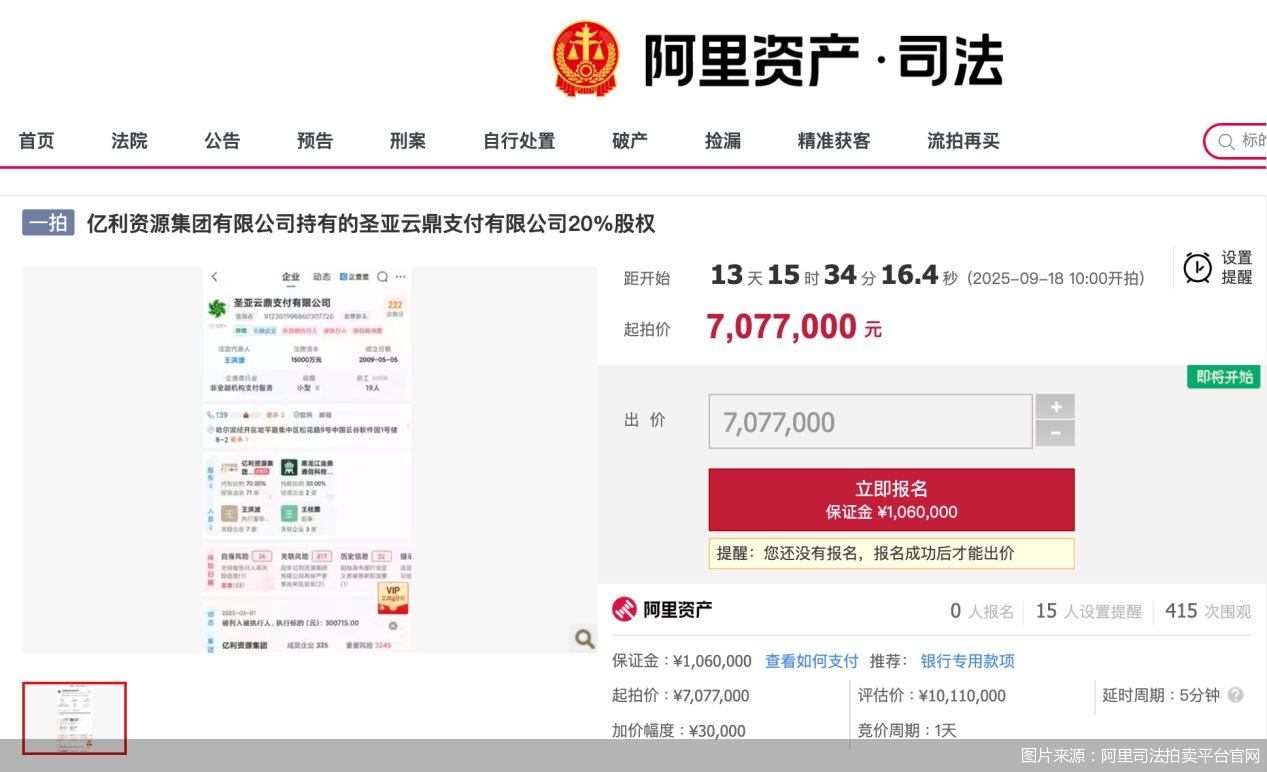
Core Viewpoint - The auction of a 20% stake in Shengya Yunding Payment Co., Ltd. is set to take place on September 18, with a starting price significantly lower than its previous valuation, reflecting the company's financial struggles and regulatory challenges [1][2]. Company Summary - Shengya Yunding Payment was established in May 2009 with a registered capital of 150 million yuan. The largest shareholder, Yili Resources Group, holds a 70% stake, while Heilongjiang Jinding Communication Technology Group owns 30% [1]. - The company has faced financial difficulties, reporting a revenue of 23,000 yuan and a net loss of 595,300 yuan for the first quarter of 2025. As of March 31, 2025, total assets were valued at 201 million yuan, with total liabilities of 97.93 million yuan, resulting in a net asset value of 103 million yuan [1]. Industry Summary - The payment license transfer prices have been declining, with regulatory scrutiny increasing, leading to significant valuation reductions for payment institutions facing compliance risks and uncertainties regarding license renewals [3]. - The auction of Shengya Yunding Payment's stake is seen as an exception due to the lack of absolute control for new shareholders, ongoing financial losses, and the major shareholder's debt crisis, alongside the suspension of license renewal by the People's Bank of China [3]. - Moving forward, payment institutions with clear core businesses, good compliance records, and strong technical capabilities are expected to attract more investor interest, while those with ongoing losses or complex ownership structures may face increased transaction difficulties [3].

361度与“最快女护士”马拉松跑者已解约;苹果首款折叠iPhone明年出货量或达千万台;传字节对大模型方向加码期权激励丨邦早报
创业邦· 2025-09-04 00:12
Group 1 - 361 Degrees has terminated its partnership with marathon runner Zhang Shuihua due to adjustments in both parties' development paths, emphasizing a long-term collaboration philosophy [3] - Anthropic has raised $13 billion in a new funding round, bringing its valuation to $183 billion, nearly tripling since the beginning of the year [5] - Gu Ming, an analyst, predicts that Apple's first foldable iPhone will sell between 8 to 10 million units in 2026, with potential growth to 25 million units in 2027 [14] Group 2 - Zero Run Auto has completed a domestic stock issuance, raising a total of 2.6 billion yuan [12] - Starbucks plans to launch an AI inventory management system in over 11,000 stores in North America by the end of September [12] - SAP intends to invest over 20 billion euros in a "sovereign cloud" to support AI development in Europe over the next decade [12] Group 3 - Tesla's sales in major European electric vehicle markets have continued to decline, with an August registration drop of 39% and a year-to-date decrease of 56% [12] - The global smart home cleaning robot market saw a 33% year-on-year increase in shipments in the first half of the year, totaling 15.35 million units [20] - The Chinese passenger car new energy market retail sales reached 1.079 million units in August, a 5% year-on-year increase [21]



全国首个离境退税“一键退税”在浙江杭州试点落地
Hang Zhou Ri Bao· 2025-09-03 00:45
Core Insights - The "One-Click Tax Refund" service in Hangzhou has significantly improved efficiency, reducing the refund time from at least 20 minutes to as fast as 2 minutes [1][2] - The service is expected to cover 124 stores by the end of the year, enhancing the shopping experience for international tourists [1][2] Group 1: Service Implementation - The "One-Click Tax Refund" service was launched on August 29, with initial support from six stores, and aims for full coverage by the end of the year [1] - The process involves automatic generation of shopping invoices through Alipay, allowing tourists to initiate refunds with a simple tap on their phones [1][2] Group 2: Digital Transformation - The service underwent two rounds of process simplification, including automatic invoice entry and integration of tax refund applications with payment systems [2] - The system supports various payment methods, including credit cards, cash, Alipay, and WeChat, making it more convenient for tourists and reducing manual workload for merchants [2] Group 3: Market Impact - From January to July, Hangzhou received 719,800 overnight international visitors, marking a 19.8% year-on-year increase, with the city leading in Zhejiang province [3] - The number of tax refund stores in Hangzhou has increased by 126.3% compared to last year, with tax refund sales reaching 2.23 times that of the same period last year [3] Group 4: Future Developments - Hangzhou is developing integrated sightseeing and shopping routes that include clusters of tax refund stores, enhancing the overall tourist experience [3] - Additional self-service tax refund devices will be installed in popular shopping areas to further optimize the shopping and refund process for international visitors [3]
上市支付机构半年考:逾半营收下滑,境内承压出海寻“新蓝海”
Guan Cha Zhe Wang· 2025-09-02 05:28
Core Insights - The overall performance of listed payment institutions in China during the first half of 2025 shows significant divergence, with over half experiencing revenue declines due to intensified domestic market competition and regulatory pressures [1][2][8] - Many institutions are seeking new growth opportunities through overseas expansion and technological transformation, particularly in "payment + technology" models [1][4][8] Domestic Market Challenges - The domestic third-party payment market is facing saturation, with several institutions reporting revenue declines, including major players like Lakala and JiaLian Payment, which saw revenue drops of 11.1% and 12.9% respectively [2][8] - Factors contributing to the revenue decline include stricter cash-out regulations, increased competition leading to price wars, and rising operational costs [2][8] - The overall payment transaction volume has shrunk, with Lakala reporting a 9.2% decrease in payment transaction amounts [2] Growth Amidst Adversity - Despite the overall downturn, some institutions like Yika, Lianlian Digital, and Guotong Xingyi achieved revenue and profit growth, with Lianlian Digital's revenue increasing by 26.8% [3][8] - These companies have maintained growth in transaction volumes, with Lianlian Digital reporting a 27.6% increase in total payment volume [3] Technological Innovations - Many payment institutions are exploring "payment + SaaS" and "payment + AI" strategies to enhance service capabilities and create new revenue streams [4][8] - Lakala has introduced AI-driven services to improve merchant interactions, indicating a trend towards integrating advanced technologies into payment solutions [4] Cross-Border Business Expansion - Cross-border payment services have shown significant growth, with Lakala reporting a 73.5% increase in cross-border payment transaction amounts [6][8] - The demand for digital payment solutions in emerging markets is driving this growth, with institutions like Lianlian Digital achieving a 94% increase in global payment transaction volumes [6] Challenges in Overseas Expansion - Despite the potential for growth in overseas markets, institutions face challenges such as regulatory differences, localization difficulties, and compliance risks [7][8] - The competitive landscape in cross-border e-commerce is dominated by established players, making it difficult for new entrants to gain market share [7][8] Conclusion - The first half of 2025 presents a challenging environment for listed payment institutions in China, prompting them to embrace technological advancements and seek new growth avenues in cross-border markets, while navigating the complexities of international expansion [8]

跨境业务成上市系支付机构扩张要点
Bei Jing Shang Bao· 2025-09-01 16:42
Core Viewpoint - The performance of listed payment institutions in the first half of 2025 shows significant divergence, with some companies experiencing revenue and profit growth while others face declines, reflecting the intense competition and evolving market dynamics in the domestic payment industry [1][4][5]. Group 1: Performance Overview - Eight payment institutions reported a cumulative revenue of approximately 9.268 billion yuan in the first half of 2025, with three companies achieving both revenue and net profit growth, while five companies experienced varying degrees of revenue decline [1][3]. - Among the companies, Yika achieved a revenue of 1.642 billion yuan, a year-on-year increase of 4%, and a net profit of 41.37 million yuan, up 27% [3]. - Lakala, despite maintaining its leading position, reported a revenue of 2.65 billion yuan and a net profit of 230 million yuan, representing declines of 11.1% and 45.3% respectively [3][4]. Group 2: Market Dynamics - The payment industry is facing saturation in the domestic market, leading to intensified competition and price wars, which have compressed profit margins for many institutions [5][6]. - The overall decline in transaction volumes has been a significant factor affecting revenue performance, with Lakala's payment transaction amount decreasing by 9.2% to 19.6 trillion yuan [6]. - Companies are increasingly focusing on technology investments and innovative solutions to enhance competitiveness, with many exploring "payment + SaaS" and "payment + AI" strategies [7][8]. Group 3: Cross-Border Business Growth - In contrast to the domestic market, cross-border payment businesses are experiencing robust growth, with Lakala serving over 160,000 clients and achieving a transaction amount of 37.1 billion yuan, a year-on-year increase of 73.5% [9][10]. - Companies like Lianlian Digital reported a total payment transaction volume of 198.5 billion yuan in global payments, reflecting a 94% year-on-year growth [10]. - The potential for profitability in cross-border payments is significantly higher than in domestic transactions, driven by increasing digital payment demands in emerging markets [10][11].

8家上市系支付机构上半年营收超90亿元!出海赛道渐拥挤
Bei Jing Shang Bao· 2025-09-01 13:18
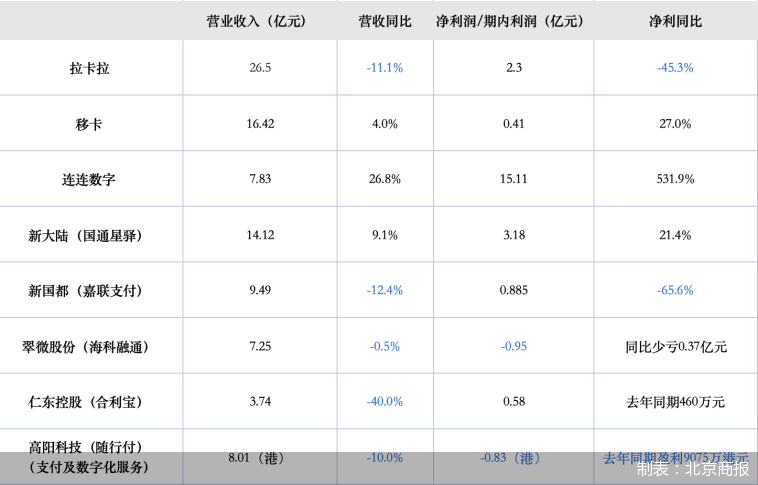
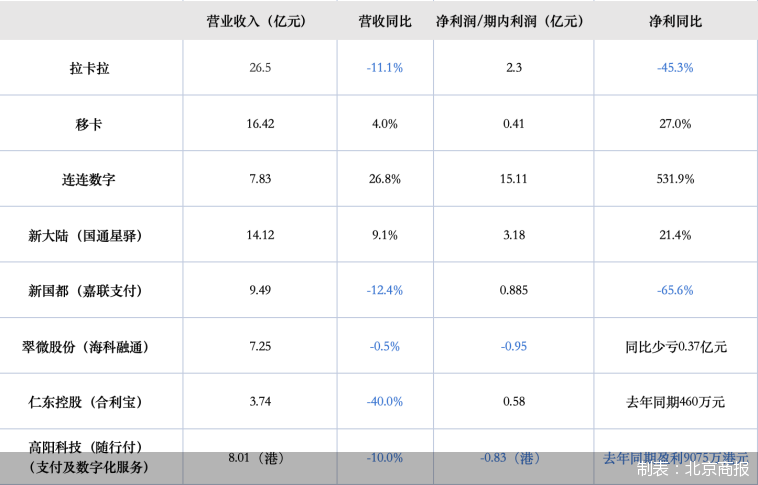
Core Insights - The third-party payment industry in China is facing intense competition, leading to a stagnation in transaction growth and a compression of profit margins for many companies [1][5] - Among the eight listed payment institutions, total revenue for the first half of 2025 reached approximately 9.268 billion yuan, with three companies reporting both revenue and net profit growth, while five experienced revenue declines [1][3] Revenue and Profit Performance - Lakala reported revenue of 2.65 billion yuan, down 11.1% year-on-year, with net profit of 230 million yuan, down 45.3% [2][3] - Yika achieved revenue of 1.642 billion yuan, up 4.0%, and net profit of 41 million yuan, up 27.0% [2][3] - Lianlian Digital saw significant growth, with revenue of 783 million yuan, up 26.8%, and net profit of 1.511 billion yuan, a 531.9% increase [2][3] - Guotong Xingyu reported revenue of 1.412 billion yuan, up 9.1%, and net profit of 318 million yuan, up 21.4% [2][3] - Other companies like Jialian Payment and Suixing Pay experienced revenue declines of 12.4% and 10.0%, respectively, with significant drops in net profit [2][3][4] Market Dynamics and Challenges - The payment industry is experiencing a saturation in the domestic market, leading to increased price competition and reduced profit margins [5][6] - The overall decline in transaction volumes is a key factor affecting revenue performance, with Lakala's transaction amount dropping by 9.2% year-on-year [6] - Companies are increasingly investing in technology and innovation to enhance competitiveness, despite short-term profit pressures [5][8] Cross-Border Business Growth - Cross-border payment services are showing robust growth, with Lakala serving over 160,000 clients, a 70.4% increase, and cross-border transaction amounts reaching 37.1 billion yuan, up 73.5% [9][10] - Lianlian Digital's global payment transaction volume reached 198.5 billion yuan, a 94% increase, indicating a strong expansion in cross-border services [10][11] - The potential for higher profit margins in cross-border payments is attracting companies to explore international markets, despite challenges such as regulatory differences and local operational difficulties [11][12]


金融中报观|8家上市系支付机构上半年营收超90亿元!出海赛道渐拥挤
Bei Jing Shang Bao· 2025-09-01 13:12
Core Viewpoint - The performance of listed payment institutions in the first half of 2025 shows a mixed picture, with some companies experiencing revenue and profit growth while others face declines due to intense competition and market saturation in the domestic payment sector [1][5]. Group 1: Financial Performance - Eight payment institutions reported a cumulative revenue of approximately 9.268 billion yuan in the first half of 2025, with three companies achieving both revenue and net profit growth, while five experienced varying degrees of revenue decline [1][3]. - Lakala, despite maintaining its leading position, reported a revenue of 2.65 billion yuan, down 11.1% year-on-year, and a net profit of 230 million yuan, down 45.3% [2][3]. - Lianlian Digital saw significant growth, with revenue of 783 million yuan, up 26.8%, and a net profit of 1.511 billion yuan, a remarkable increase of 531.9% [2][3]. Group 2: Market Dynamics - The payment industry is facing a "involution" phenomenon, characterized by fierce competition and a saturated domestic market, leading to reduced profit margins for many institutions [1][5]. - The overall decline in transaction volumes is a key factor affecting revenue performance, with Lakala's payment transaction amount decreasing by 9.2% to 19.6 trillion yuan [6][12]. - Companies are increasingly focusing on cross-border payment services, which are showing robust growth, with Lakala's cross-border payment transaction amount reaching 37.1 billion yuan, up 73.5% [9][10]. Group 3: Strategic Shifts - Payment institutions are exploring new growth avenues through technology integration, such as AI and SaaS solutions, to enhance service quality and operational efficiency [7][8]. - The trend of "payment + technology" is becoming prominent, with companies aiming to transform into comprehensive service providers by leveraging blockchain and AI technologies [8][11]. - Cross-border payment services are seen as a new growth path, driven by higher fee rates compared to domestic services and the rising demand for digital payments in emerging markets [11][12].
牌照价值缩水?支付机构股权频遭转让
Guo Ji Jin Rong Bao· 2025-09-01 02:59
Core Viewpoint - The trend of equity transfer among payment institutions is increasing, driven by regulatory changes, market competition, and strategic adjustments by shareholders [2][5][6] Group 1: Equity Transfers - Dongfang Electronic Payment Co., Ltd. plans to transfer a total of 9.505% of its equity at a base price of 14.0674 million yuan [1] - Yili Resources Group Co., Ltd. will auction 20% of its stake in Shengya Yunding Payment Co., Ltd. starting from a base price of 7.077 million yuan [1] - Several payment institutions, including Shenzhen Kuaitong Payment Co., Ltd. and Wuhan Urban Card Payment Co., Ltd., have also listed their equity for sale this year [1][4] Group 2: Market Dynamics - The value of payment licenses is expected to decline, prompting shareholders to cash out at current prices [2] - The implementation of stricter regulations since May last year has increased compliance costs for payment institutions [2][5] - The market is experiencing intensified competition, with diminishing growth opportunities for the industry [2][5] Group 3: Industry Trends - The overall trend in the payment industry is shifting from scale expansion to high-quality development, leading to increased market concentration [5][6] - Analysts suggest that the value of payment licenses has significantly decreased from peak levels due to stricter regulatory environments and limited external buyers [6] - Payment institutions are encouraged to innovate and focus on core business areas to adapt to the changing market landscape [6]
央行拟修改电子支付及信用卡规范:单笔不超1000、日付不超5000将删除
Guan Cha Zhe Wang· 2025-09-01 02:41
Core Viewpoint - The People's Bank of China has released a draft for public consultation to amend four regulatory documents, including the "Electronic Payment Guidelines," to adapt to the rapid development of digital payments and market maturity, aiming to enhance the flexibility of financial institutions in pricing and to transition the payment system from "small-scale convenience" to "full-scenario coverage" [1][6]. Group 1: Adjustments in Electronic Payment - The amendments include the removal of transaction limit regulations, allowing financial institutions to set their own limits based on risk management, which previously restricted individual online payments to a maximum of 1,000 yuan and daily accumulations to 5,000 yuan [3][4]. - The guidelines emphasize the need for banks to handle customer disputes promptly and responsibly, encouraging resolution through mediation and arbitration to better protect user rights [3][6]. Group 2: Changes in Credit Card Business - The removal of upper and lower limits on overdraft interest rates allows issuing institutions to determine their own pricing based on customer credit status, enhancing pricing flexibility [4][8]. - The requirement for issuing institutions to publicly disclose credit card application conditions and fees has been eliminated, along with the obligation to report interest rate changes to the central bank, reducing administrative burdens [4][9]. Group 3: Implications for Consumers and Financial Institutions - The adjustments are expected to enhance payment convenience and personalized services for consumers, particularly benefiting large transactions such as real estate purchases and cross-border e-commerce [6][9]. - Financial institutions will gain greater operational flexibility and innovation opportunities, allowing them to develop customized payment products and adjust pricing strategies based on customer risk profiles [8][9]. - The changes are aligned with the government's goal to stimulate consumption and expand domestic demand, potentially invigorating the digital finance sector, although the ultimate impact will depend on the implementation details and market feedback [9].
移卡(9923.HK)2025年半年报点评:营收稳健利润修复 海外收单是亮点
Ge Long Hui· 2025-08-31 19:13
Core Viewpoint - The company has experienced a 27% year-on-year profit growth driven by an increase in payment service fees, aligning with expectations. The overseas payment business shows promising growth potential [1][2]. Group 1: Financial Performance - The company reported a revenue of 1.642 billion RMB for the first half of 2025, a 4% increase year-on-year, with net profit reaching 41 million RMB, reflecting a 27% growth [1]. - Payment business revenue was 1.429 billion RMB, up 6% year-on-year, contributing significantly to overall revenue growth, despite a slight decline in GPV by 1.9% to 11.4 trillion RMB due to macroeconomic fluctuations [1]. - The payment service fee rate increased to 0.125% in the first half of 2025 from 0.115% in the same period of 2024 [1]. Group 2: Business Segments - The merchant solutions business saw a revenue decline of 7.8% to 187 million RMB, although the number of active merchants grew by 5.8% [1]. - The gross profit margin for merchant solutions improved from 90.9% in 2024 to 91.3% in 2025 due to a shift towards higher-margin services [1]. - The in-store e-commerce business reported a revenue of 26 million RMB, down 13.5% year-on-year, primarily due to a strategic shift away from less profitable merchants [1]. Group 3: Overseas Payment Business - The overseas payment business has shown rapid growth, with transaction volume reaching 1.5 billion RMB in the first half of 2025, surpassing the total for the entire year of 2024 [2]. - The overseas payment fee rate stands at 0.67%, significantly higher than domestic rates, with a gross profit margin of 50%, well above the overall payment margin of 13.7% [2]. - Continued expansion in overseas payment services is expected to enhance profitability and better serve local merchants and consumers [2].