
无人机

Search documents
美方将大疆无人机列入“受管制清单” 中方:坚决反对无理打压中国企业
Zhong Guo Xin Wen Wang· 2025-12-23 07:44
广告等商务合作,请点击这里 本文为转载内容,授权事宜请联系原著作权人 林剑表示,中方坚决反对美方泛化国家安全概念,划设歧视性清单,无理打压中国企业。美方应纠正错 误做法,为中国企业经营提供公平公正、非歧视的环境。(完) 来源:中国新闻网 编辑:王永乐 美方将大疆无人机列入"受管制清单" 中方:坚决反对无理打压中国企业 中新网北京12月23日电 (记者 郭超凯)中国外交部发言人林剑23日主持例行记者会。有记者就美国联邦 通信委员会将包括大疆公司在内的无人机列入"受管制清单"一事提问。 中新经纬版权所有,未经书面授权,任何单位及个人不得转载、摘编或以其它方式使用。 关注中新经纬微信公众号(微信搜索"中新经纬"或"jwview"),看更多精彩财经资讯。 ...
美方将大疆无人机列入“受管制清单”,外交部回应
Xin Jing Bao· 2025-12-23 07:38
Core Viewpoint - The Chinese government firmly opposes the U.S. Federal Communications Commission's inclusion of all non-U.S. manufactured drones, including DJI, on a "regulated list," arguing that it represents an unjust suppression of Chinese companies and a broadening of the national security concept [1] Group 1 - The Chinese Ministry of Foreign Affairs spokesperson Lin Jian stated that the U.S. should correct its erroneous practices [1] - The Chinese government demands a fair, just, and non-discriminatory environment for Chinese companies to operate in [1]
美国将大疆列入受控清单,中方回应
财联社· 2025-12-23 07:35
Core Viewpoint - The article discusses the U.S. Federal Communications Commission's decision to include all non-U.S. manufactured drones, including those from DJI, on a "regulated list," which is viewed as an unjustified suppression of Chinese companies by the U.S. government [1] Group 1 - The Chinese government firmly opposes the U.S. approach of broadly defining national security and creating discriminatory lists against Chinese enterprises [1] - The Chinese Foreign Ministry spokesperson, Lin Jian, emphasized the need for the U.S. to correct its erroneous practices [1] - The article highlights the call for a fair, just, and non-discriminatory environment for Chinese companies to operate in [1]


外交部回应美国将大疆无人机列入“受管制清单”
Yang Shi Xin Wen· 2025-12-23 07:30
Core Viewpoint - The U.S. Federal Communications Commission has added DJI, a Chinese drone manufacturer, to a list of companies deemed to pose an "unacceptable risk" to U.S. national security, leading to a ban on the approval of new drone models for import or sale in the U.S. [1] Group 1 - The Chinese government firmly opposes the U.S. for broadening the concept of national security and creating a discriminatory blacklist that unjustly suppresses Chinese companies [1] - The U.S. is urged to correct its erroneous practices and provide a fair, just, and non-discriminatory environment for Chinese enterprises to operate [1]
美政府封禁外国无人机引发愤怒 飞手:中国无人机无法替代
Feng Huang Wang· 2025-12-23 05:21
凤凰网科技讯 北京时间12月23日,据《华尔街日报》报道,美国政府周一宣布,将禁止进口和销售大 多数外国制造的新无人机。该决定引发了美国无人机飞手群体的愤怒,因为这会影响他们的生计。在无 人机飞手看来,美国无人机没有竞争力,无法取代中国无人机。 "人们购买大疆无人机,并非因为它是中国无人机,而是因为它容易获得、价格实惠,而且性能出 色。"雷韦迪欧说。 杰森·科利普(Jason Colip)与大约300名房地产经纪人合作,为房产拍摄航拍照片和视频。"对于我这样在 密西西比州南部的松林和房屋上空飞无人机的小人物,为什么要限制这些事情?"他说,"对我这个小企 业主来说,我们还能有什么替代选择?眼下我们真的没有答案。"(作者/箫雨) "我是彻头彻尾的美国制造拥护者,开的都是雪佛兰皮卡,"印第安纳州戴尔市建筑工地监测公司Falcon Unmanned Systems老板埃里克·埃伯特(Eric Ebert)表示,"但美国无人机实在缺乏竞争力。" 眼下,无人机飞手们正在掀起一轮采购潮,疯狂购买无人机、电池和备用零部件,试图延长现有机队的 使用寿命。埃伯特拥有一支由7名无人机飞手组成的团队,负责监测遍布数千英亩的太阳能和风 ...

金融靶向发力低空经济新蓝海
Jin Rong Shi Bao· 2025-12-23 05:16
"天命玄鸟,降而生商。"2025年9月,由河南首家低空经济领域省级实验室——蓝天实验室研发的"玄 鸟"无人机在安阳无人机产业园正式发布。这一创新成果,正是安阳低空经济蓬勃发展的生动缩影。近 年来,依托4420平方公里报备空域的得天独厚优势,安阳低空经济方兴未艾,以蓝天实验室为龙头,已 牵头制定并输出全国性规范性标准14项。 安阳弘安航空科技公司是一家专注于无人机配件研发的小微企业,曾一度面临研发资金紧张的难题。中 国人民银行安阳市分行获悉情况后,主动牵线搭桥,推动工行安阳分行创新推出"无人机产业贷"专项金 融产品,为该企业投放300万元优惠利率贷款,精准破解了资金瓶颈。在金融活水的精准滴灌下,该企 业发展势头迅猛,目前已与国内1200余家无人机企业建立了合作关系,其产品在国内工业无人机配件领 域的市场占有率超过80%。公司负责人由衷感慨:"得益于科技金融政策的大力支持,我们的研发创新 之路才走得如此顺畅!" 当前,安阳市低空经济领域集聚企业160余家,随着产业规模持续扩大,企业多元化融资需求日益增 长。中国人民银行安阳市分行立足本地产业实情与区位优势,创新打造"制度机制为土壤、政策资金引 活水、创新举措输养分 ...
美限无人机避险升温黄金T+D破千
Jin Tou Wang· 2025-12-23 04:39
摘要今日周二(12月23日)亚盘时段,黄金T+D目前交投于1011元附近,截至发稿,黄金T+D暂报1009.91 元/克,涨幅2.47%,最高触及1011.65元/克,最低下探989.99元/克。目前来看,黄金T+D短线偏向看涨 走势。 今日周二(12月23日)亚盘时段,黄金t+d目前交投于1011元附近,截至发稿,黄金t+d暂报1009.91元/克, 涨幅2.47%,最高触及1011.65元/克,最低下探989.99元/克。目前来看,黄金t+d短线偏向看涨走势。 黄金T+D价格今日早盘强势反弹,突破1010元/克关键阻力,最高触及1011元/克,涨幅超2.5%,技术面 呈现突破性上涨。日线级别,价格站稳短期均线上方,MACD指标金叉延续,多头动能占优,RSI进入 超买区,显示市场情绪偏强。上方阻力关注1020元/克,下方支撑在1000元/克整数关口。 【要闻速递】 中国无人机制造商大疆创新23日发表声明,对美国联邦通信委员会(FCC)将全部非美国制造无人机列 入"受管制清单"深表遗憾。此举不仅限制美国消费者与商业用户的选择权,也违背开放、公平竞争的市 场原则。 此前,FCC于22日宣布将大疆及所有外国制无人 ...
美国全面禁售外国无人机,还污蔑“中方会测绘美国每一寸土地”
Xin Lang Cai Jing· 2025-12-23 04:37
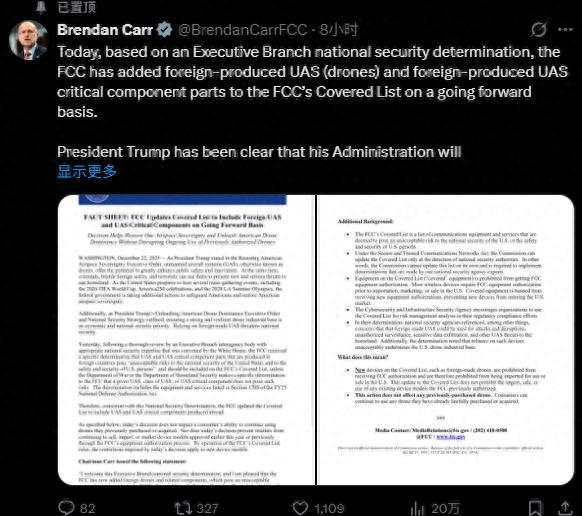
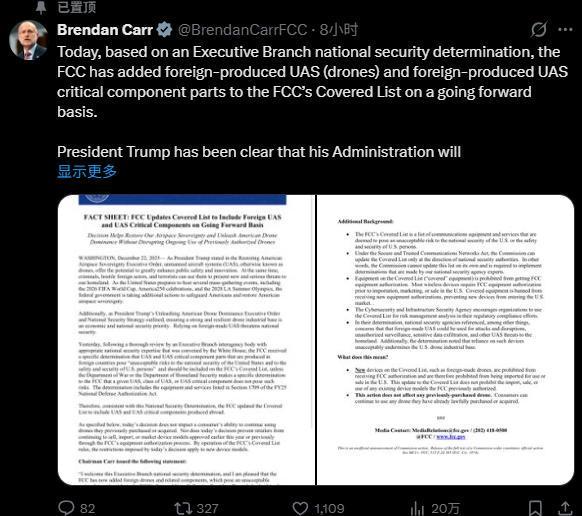
Core Viewpoint - The U.S. government has officially blacklisted all foreign-manufactured drones and their components, citing "unacceptable national security threats," which significantly escalates efforts to curb Chinese drone manufacturers like DJI and Daotong [1][2]. Group 1: Regulatory Actions - The Federal Communications Commission (FCC) has placed all foreign-made drones, including those from DJI, on a regulated "Covered List," prohibiting the approval of new drone models for sale in the U.S. [2] - This decision does not affect existing drone models that have already received FCC approval, meaning previously deployed drones will not be grounded [2]. Group 2: Industry Impact - DJI, a leading global drone manufacturer, expressed regret over the FCC's decision, stating it limits consumer choice and undermines fair market competition [6]. - The U.S. accounts for a significant portion of the global drone market, with Chinese manufacturers producing 70% to 80% of commercial drones, and DJI holding a 90% market share in the U.S. commercial sector [9]. Group 3: Political Reactions - U.S. lawmakers, particularly from the Republican Party, have celebrated the ban, framing it as a move to protect national security and bolster American drone manufacturers [5]. - The Chinese government has condemned the U.S. for misusing the concept of national security, arguing that such actions disrupt normal economic trade and harm global supply chain stability [5]. Group 4: Historical Context - The U.S. has a history of targeting Chinese drone manufacturers, with DJI previously placed on a sanctions list by the Department of Defense in 2017, alleging potential data sharing with the Chinese government [9]. - The Trump administration intensified these efforts, aiming to promote the U.S. drone industry and ensure supply chain independence from foreign control [9].
全面禁售,还污蔑“中方会测绘美国每一寸土地”
Guan Cha Zhe Wang· 2025-12-23 04:08
Core Viewpoint - The U.S. government has officially blacklisted all foreign-manufactured drones and their components, citing "unacceptable national security threats," which significantly escalates efforts to curb Chinese drone manufacturers like DJI and Daotong [1][2]. Group 1: Regulatory Actions - The Federal Communications Commission (FCC) has placed all foreign-made drones, including those from DJI, on a regulated "blacklist," prohibiting the approval of new drone models for import and sale in the U.S. [2] - This decision does not affect previously authorized drone models, meaning existing drones in the U.S. will not be grounded [2]. Group 2: Industry Impact - DJI and other Chinese drone manufacturers will face significant restrictions, limiting U.S. consumer choices and undermining principles of open and fair competition [6]. - The U.S. currently relies heavily on Chinese drones, with DJI holding a 90% market share in the commercial drone sector in the U.S. [9]. Group 3: Political Reactions - U.S. lawmakers, particularly from the Republican Party, have expressed support for the ban, framing it as a measure to protect national security and bolster American drone manufacturing [5]. - The Chinese government has condemned the U.S. actions as an abuse of the "national security" concept, arguing that it disrupts normal economic trade and harms global supply chain stability [5]. Group 4: Market Dynamics - China dominates the commercial drone market, producing 70% to 80% of global commercial drones, with significant implications for U.S. manufacturers who may struggle to match this production level [9][10]. - The ongoing demand for drones in agriculture, construction, maritime, and industrial sectors is expected to sustain DJI's market presence despite regulatory challenges [9].
大疆回应被美列入“受管制清单”:将评估可行路径维护公司合法权益
Xin Lang Cai Jing· 2025-12-23 03:18
Core Viewpoint - DJI expresses regret over the FCC's decision to include all non-U.S. manufactured drones in the "Covered List," which limits consumer choice and undermines market competition principles [1][4]. Group 1: Company Response - DJI emphasizes its role as a pioneer in civil drone and aerial photography technology, providing innovative tools for creators globally and contributing significantly to various critical sectors such as agriculture, inspection, surveying, firefighting, and natural resource protection [1][4]. - The company asserts that its products have been validated for safety and reliability by global markets and independent third-party organizations, and it will explore all possible avenues to protect its and its users' legal rights [1][4]. Group 2: Regulatory Context - The FCC's new regulations, effective from November 25, 2022, state that foreign drone manufacturers on the "Covered List" cannot obtain FCC approval to sell new drone models in the U.S., which is a prerequisite for market entry [1][5]. - However, the regulations do not prohibit the import, sale, or use of existing models that have already received FCC authorization, nor do they affect previously purchased drones [5]. Group 3: Market Impact - The U.S. Department of Defense had previously placed DJI on the "Chinese Military Companies List" in 2022 without explanation, leading to legal actions by DJI against the Department [2][5]. - A report from the Center for Strategic and International Studies (CSIS) indicates that DJI holds a 90% market share in the U.S. commercial drone market, suggesting that regulatory restrictions could significantly impact local supply [3][6]. - Data from Drone Industry Insights shows that Chinese-manufactured drones account for 70% to 80% of the global commercial drone market, with China dominating the production of key components like sensors and speed controllers [2][5].