核电

Search documents
梅安森(300275.SZ):参股子公司伟岸测器深度参与核电业务
Ge Long Hui· 2025-12-09 07:31
格隆汇12月9日丨梅安森(300275.SZ)在投资者互动平台表示,公司参股子公司伟岸测器深度参与核电业 务。 ...

好评中国|真抓实干,持续巩固增强经济回升向好态势
Huan Qiu Wang· 2025-12-09 07:10
Group 1 - The core viewpoint emphasizes the importance of major projects in stabilizing the macroeconomic environment and achieving the goals set for the "14th Five-Year Plan" [1] - Guangdong has established nearly 2,100 technology enterprise incubators and innovation spaces to promote the transformation of scientific and technological achievements [1] - The successful grid connection of the world's largest "Hualong One" nuclear power base in Fujian is expected to generate 20 billion kilowatt-hours annually, showcasing significant progress in major engineering projects [1] Group 2 - The new development philosophy is crucial for addressing development challenges and enhancing competitive advantages, with a focus on innovation, coordination, green development, openness, and sharing [2] - Anhui is leading industrial innovation through technological advancements in cutting-edge fields such as quantum information and artificial intelligence, contributing to the formation of future industries [2] - The promotion of ecological corridors in Hubei through the transformation of chemical enterprises reflects a commitment to green development [2] Group 3 - The achievements during the "14th Five-Year Plan" period lay a solid foundation for the upcoming "15th Five-Year Plan," with various regions proactively planning for future development [3] - Jiangxi's finance department is collecting suggestions for 2026's livelihood projects, indicating a focus on targeted measures to enhance public welfare [3] - Zhejiang is innovating in the integration of basic public services, demonstrating a commitment to improving the quality of life for its citizens [3]
日本东部深夜强震,福岛第一核电站暂停核污水排海,区域内核电站暂无异常
Di Yi Cai Jing· 2025-12-09 00:18
Core Viewpoint - A significant earthquake of magnitude 7.5 struck off the eastern coast of Honshu, Japan, prompting tsunami warnings and the suspension of operations at the Fukushima Daiichi Nuclear Power Plant due to safety precautions [1][2][3] Group 1: Earthquake and Tsunami Alerts - The earthquake occurred on December 8 at 22:15 local time, with a depth of 50 kilometers, affecting areas including Aomori and Hokkaido [1][2] - The Japan Meteorological Agency issued tsunami warnings for the coastal areas of Fukushima Prefecture [1][3] - The Natural Resources Department's tsunami warning center assessed that the earthquake could trigger localized tsunamis but would not impact the Chinese coastline [2] Group 2: Nuclear Power Plant Status - Tokyo Electric Power Company reported no abnormalities at the Fukushima Daiichi and Fukushima Daini Nuclear Power Plants following the earthquake [3] - The Onagawa Nuclear Power Plant and the Tōkai Nuclear Power Plant also reported no anomalies, with radiation levels remaining unchanged [2] - The Fukushima Daiichi Nuclear Power Plant had been engaged in the discharge of treated radioactive water, which was temporarily halted due to the tsunami warning [3] Group 3: Nuclear Water Discharge Operations - The discharge of approximately 7,800 tons of treated radioactive water was scheduled to continue until December 22, 2023, but was paused on December 8 [3] - Cumulative discharges have exceeded 125,000 tons since the process began in August 2023, despite international concerns [3] - The next round of discharges is anticipated to occur around March 2026 [3]
日本青森地震影响区域内未收到核电站异常报告
Xin Hua She· 2025-12-08 16:27
新华社快讯:日本共同社报道,日本青森县附近海域地震影响区域内的北海道泊核电站、青森县东通核 电站、宫城县女川核电站、福岛县福岛第二核电站现阶段未收到异常报告。 ...
重大资产重组新进展!A股将添“国字号”核电巨头
Zheng Quan Ri Bao Wang· 2025-12-08 14:06
业绩承诺方面,国家核电承诺,若交易于2025年实施完毕,业绩承诺资产2025年至2027年归母净利润分 别不低于33.75亿元、30.00亿元、35.87亿元;若2026年完成交割,则承诺期顺延至2026年至2028年,对 应承诺净利润分别为30.00亿元、35.87亿元、49.08亿元。同时约定,若实际净利润未达承诺,国家核电 将以股份或现金方式进行补偿,且业绩承诺期届满后需进行减值测试,确保上市公司及中小股东利益。 "此次重组是国企改革与能源结构转型的双重典型案例。"中国企业联合会特约研究员胡麒牧在接受《证 券日报》记者采访时表示,"电投产融通过剥离金融业务、聚焦核电主业,既响应了国家'双碳'目标下 清洁能源发展的战略导向,也解决了原有'能源+金融'双主业协同不足的问题。国家电投将优质核电资 产注入上市公司,不仅提升了国有资产证券化率,也为资本市场提供了稀缺的核电运营标的,有助于优 化能源类上市公司估值体系。" 12月8日晚间,国家电投集团产融控股股份有限公司(下称"电投产融(000958)")披露重大资产置换 及发行股份购买资产并募集配套资金暨关联交易报告书(草案),拟通过资产置换、发行股份购买资产 及 ...


政策汇编(12.1-12.7)
Xin Lang Cai Jing· 2025-12-08 12:25
Group 1 - The core viewpoint of the article is the launch of a new "Policy Compilation" section on the "Shanghai Nuclear Power" WeChat public account to better serve nuclear-related enterprises in Shanghai by providing timely updates on relevant business policies [1] Group 2 - The "Policy Compilation" section will regularly summarize and compile significant industrial policies and special funding project application guidelines issued by the national government, Shanghai municipal government, and various districts within the past week [1] - This initiative aims to provide relevant policy references to nuclear-related enterprises in Shanghai [1]
法国核能复兴,离不开中国制造
Sou Hu Cai Jing· 2025-12-08 09:43
Core Viewpoint - The recent joint statement on nuclear energy cooperation between France and China indicates a complex evolution in their relationship, moving from a close partnership to a more mature and pragmatic collaboration, reflecting a shift in roles and capabilities in the nuclear sector [1]. Historical Context - The cooperation between France and China in nuclear energy began in 1982 with the signing of the first agreement for peaceful nuclear energy use, where France acted as the teacher and China as the student, leading to the establishment of the Daya Bay Nuclear Power Plant, China's first large commercial nuclear power station [3]. - The Daya Bay project symbolized a typical exchange of market access for technology, benefiting both parties in a straightforward manner [3]. Turning Point - The pinnacle of this teacher-student model was the Taishan Nuclear Power Plant, which utilized France's latest EPR technology. However, this project highlighted a turning point as the EPR technology faced significant delays and budget overruns in France and Finland, damaging its reputation [6]. - While France struggled with EPR projects, China advanced independently, developing its own third-generation nuclear technology, the Hualong One, indicating a reduced reliance on French technology [8]. Current Challenges and Changes - France is now facing challenges in its nuclear sector, with President Macron's ambitious plan to build six new EPR2 reactors hindered by a weakened domestic supply chain and loss of expertise [10]. - The signing of a strategic consulting agreement between EDF and China National Nuclear Corporation for the EPR2 project marks a role reversal, where China now provides management and technical consulting to France [10]. Future Cooperation Areas - The joint statement outlines new areas for cooperation, including decommissioning and nuclear waste management, where France's experience and China's engineering capabilities can be mutually beneficial [12]. - Another area of collaboration is nuclear fusion, with both countries participating in the ITER project, focusing on long-term exploration rather than immediate commercial benefits [12]. - The potential for third-party market collaboration has diminished due to geopolitical tensions, leading to a shift from strategic partnership to functional cooperation, where both countries now rely on each other's strengths in various aspects of nuclear energy [13].


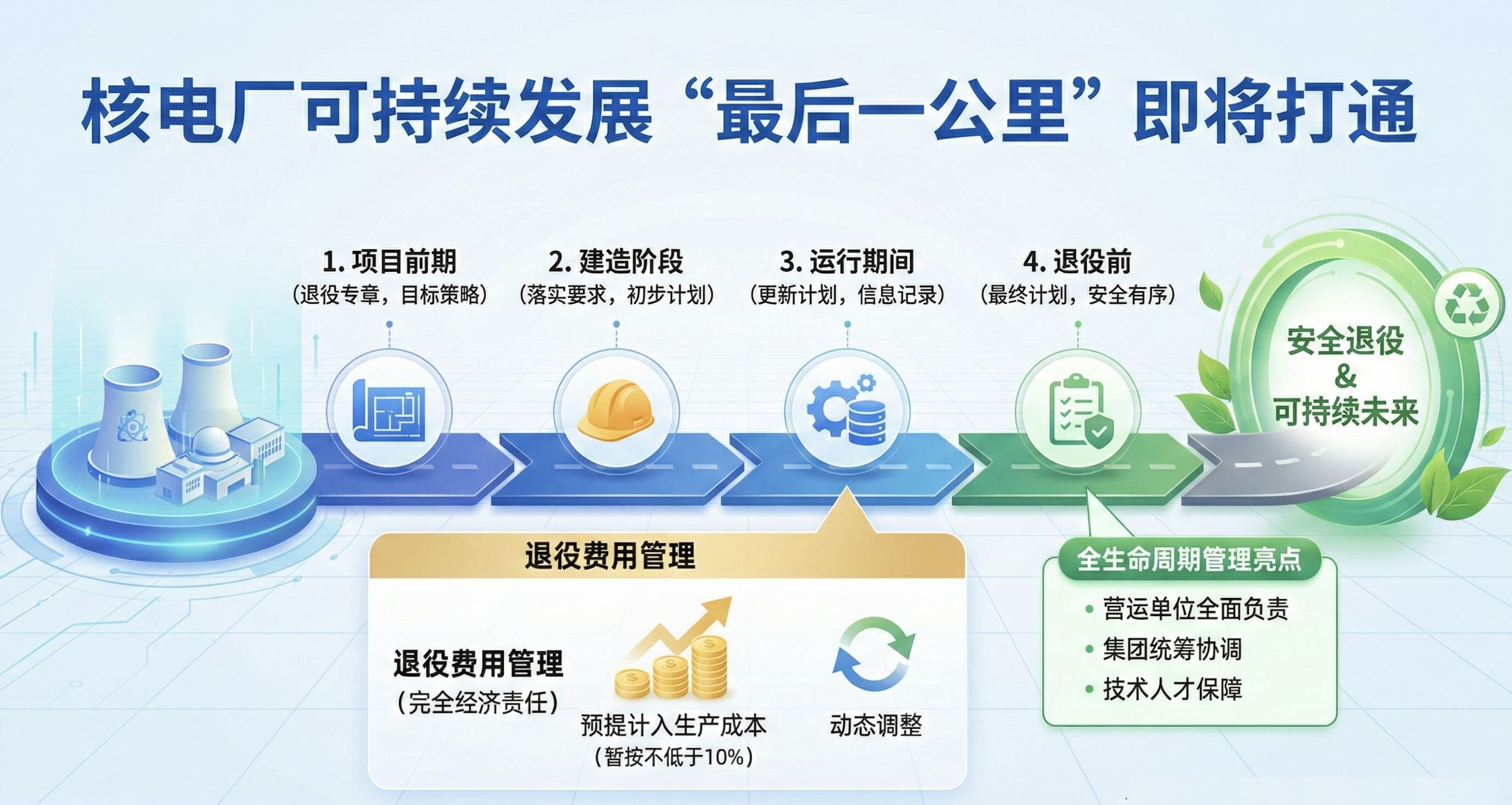
核电厂可持续发展“最后一公里”即将打通
Zhong Guo Jing Ying Bao· 2025-12-08 09:24
中经记者索寒雪北京报道 为指导核电企业规范开展核电厂退役准备工作,保障核电行业长远发展,国家发展改革委结合行业实际研究起草了《核电厂退役准备管理暂行办法》(征求 意见稿)。12月7日为本次征求意见的截止日期。 业内对《核电厂退役准备管理暂行办法》(以下简称"《暂行办法》")普遍期待。 "中国核电站的发展已有较长历史。"中国核学会相关工作人员在接受《中国经营报》记者采访时表示,"此前虽有一些关于核电厂退役的规定,但多为企业 内部制度。《暂行办法》的出台将对行业统一开展退役管理起到积极推动作用。" 该人士介绍,中国目前尚无核电站进入正式退役阶段,一些核电站则可根据相关技术条件和监管要求申请延寿。 《暂行办法》的一大亮点是将退役准备融入核电厂全生命周期管理。 文件提出,营运单位需在项目前期就提前考虑"便于退役"的措施,在项目申请报告中设置"退役专章",明确退役目标、策略和初步方案;建造阶段需落实设 计中的退役要求,编制初步退役计划;在运行期间,需根据监管变化、技术进步及机组改造情况及时更新退役计划,并做好受污染或活化设备的信息记录, 与机组档案一并妥善保管;在退役前,营运单位需在机组运行期满前编制最终退役计划,确保 ...
确保我国经济航船乘风破浪、行稳致远
Ren Min Ri Bao· 2025-12-07 20:39
回望2021年—2025年,开启全面建设社会主义现代化国家新征程的第一个五年,"极不寻常、极不平 凡"—— 在以习近平同志为核心的党中央坚强领导下,在习近平新时代中国特色社会主义思想科学指引下,"十 四五"我国经济实力、科技实力、综合国力跃上新台阶,中国式现代化迈出新的坚实步伐,第二个百年 奋斗目标新征程实现良好开局。 "实现社会主义现代化是一个阶梯式递进、不断发展进步的历史过程,需要不懈努力、接续奋斗。"习近 平总书记的重要讲话,蕴含着深邃的历史观和辩证法。 党的二十届四中全会审议通过"十五五"规划建议,擘画了未来五年宏伟发展蓝图,新时代中国作出乘势 而上、接续推进中国式现代化建设的又一次总动员、总部署。 踔厉奋发,勇毅前行。用新的伟大奋斗创造出新的历史伟业,在人类的伟大时间历史中创造中华民族的 伟大历史时间。 领航—— "党中央集中统一领导是做好经济工作的根本保证" 高质量发展,"十四五"乃至更长时期我国经济社会发展的主题。 中华民族伟大复兴的征程,以势不可挡的姿态向前推进。 长江流域,尽显高质量发展新气象。 上游青海,保护冰川、治理黑土滩、恢复湿地,"中华水塔"水源涵养量持续提升,发展绿意盎然。 中游湖 ...
公用事业行业周报(2025.12.01-2025.12.05):煤价加速回落,风电开发积极性优于光伏-20251207
Orient Securities· 2025-12-07 09:46
Investment Rating - The report maintains a "Positive" investment rating for the utility sector [4]. Core Insights - Coal prices are rapidly declining, and the enthusiasm for wind power development is higher than that for photovoltaic (PV) projects [2][7]. - The utility sector is expected to continue to be a valuable dividend asset, with low-priced utility assets worth attention [7]. - The report suggests that the profitability of the thermal power industry is expected to continue to grow, with improved commercial models [7]. Summary by Sections Coal Market - Coal prices have decreased across the board, with the Qinhuangdao port Shanxi Q5500 thermal coal price at 785 RMB/ton as of December 5, 2025, down 31 RMB/ton (3.8%) week-on-week [7][13]. - Coal inventories at ports and power plants are rising, leading to increased pressure on coal traders to lower prices [7][23]. Renewable Energy - The report anticipates a slowdown in new PV installations in 2026, while wind power investment enthusiasm is expected to be stronger due to higher project profitability [7]. - The report highlights that the current stage of wind power projects has higher returns compared to PV, leading to greater investment interest in wind energy [7]. Utility Sector Performance - The utility sector index rose by 0.1% but underperformed compared to the CSI 300 index, which increased by 1.3% [38]. - The report indicates that the utility sector is still a favorable long-term investment option, particularly in a low-interest-rate environment [7]. Investment Recommendations - The report recommends several stocks within the thermal power sector, including Huadian International, Guodian Power, and Huaneng International, among others [7]. - For hydropower, it suggests focusing on high-quality river basin projects, with specific stocks mentioned [7]. - The report also notes the long-term growth certainty in nuclear power and suggests companies like China General Nuclear Power [7].