
餐饮服务

Search documents
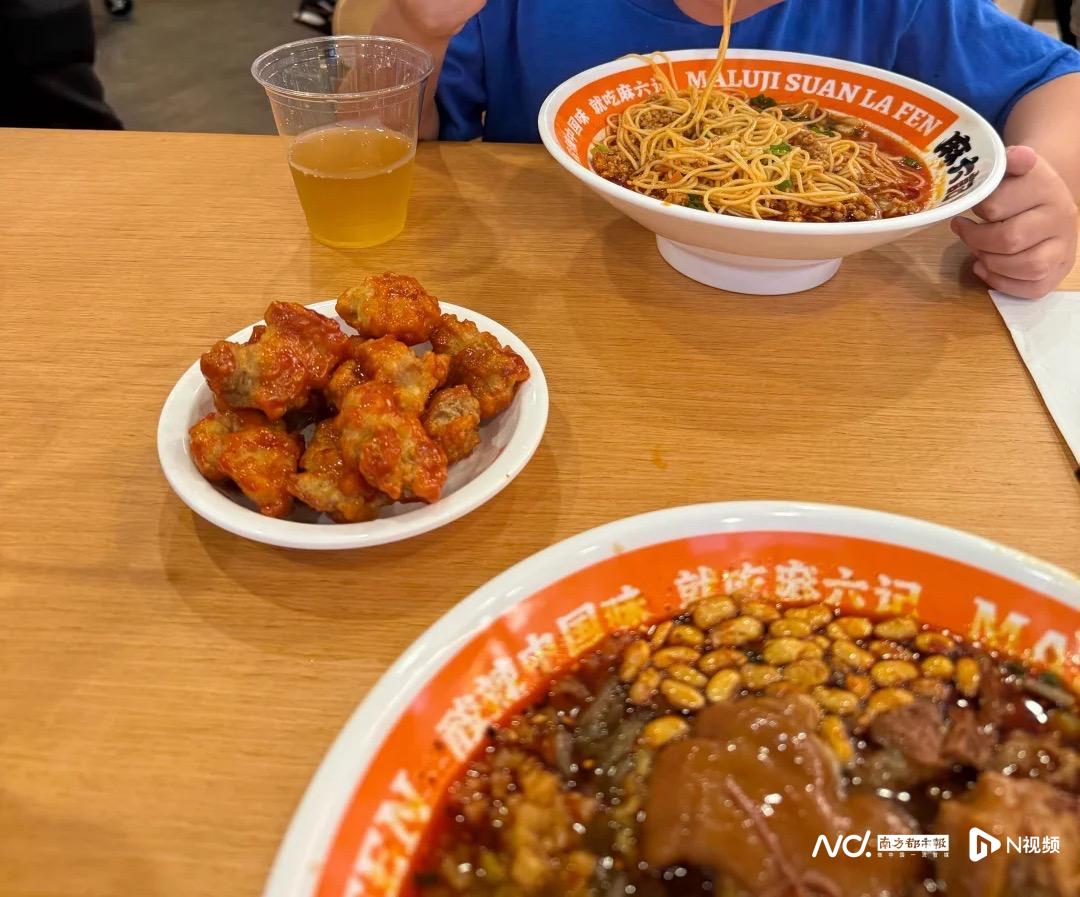
卫生部门已介入!麻六记美国门店被多位消费者投诉就餐后腹泻
Nan Fang Du Shi Bao· 2025-11-11 15:45
Core Viewpoint - The newly opened restaurant "Ma Liu Ji Spicy Noodles" in Los Angeles, founded by Wang Xiaofei, has faced multiple consumer complaints regarding food safety issues, leading to reports of food poisoning symptoms among patrons [1][2][4]. Group 1: Consumer Complaints - Multiple consumers reported experiencing symptoms of vomiting and diarrhea after dining at the restaurant shortly after its opening on October 28 [2][4]. - One consumer, Ms. Chen, and her son experienced severe gastrointestinal issues after dining on November 1, leading her to seek emergency medical attention [4]. - Another consumer, Ms. Li, also reported similar symptoms after dining on the same day, prompting her to file a complaint with the Los Angeles Public Safety Bureau [4]. Group 2: Restaurant Response - The restaurant's official account acknowledged the complaints and expressed regret, offering refunds to customers who dined between November 1 and November 3 [5]. - The restaurant stated that inspections revealed temperature fluctuations in their refrigeration equipment, which have since been addressed to ensure compliance with health standards [5]. - The establishment is reportedly working on improving food storage and service processes to enhance dining quality [5]. Group 3: Health Department Involvement - The Los Angeles Public Health Department is actively investigating the complaints but has not disclosed specific details regarding the situation [6]. - As of November 11, some consumers reported receiving refunds, while others indicated they had not yet communicated with the restaurant regarding their complaints [7].

百胜中国11月10日斥资626.81万港元回购1.82万股
Zhi Tong Cai Jing· 2025-11-11 12:13
Core Viewpoint - Yum China (09987) announced a share buyback plan, indicating confidence in its financial position and commitment to returning value to shareholders [1] Group 1: Share Buyback Details - The company will repurchase 18,200 shares at a total cost of HKD 6.2681 million, with a price range of HKD 340.4 to HKD 348.6 per share [1] - Additionally, the company spent USD 320,000 to buy back 70,900 shares, with a price range of USD 44.89 to USD 45.49 per share [1] - The company also issued 1,798 shares under its long-term incentive plan and canceled 73,700 shares that had been repurchased [1]
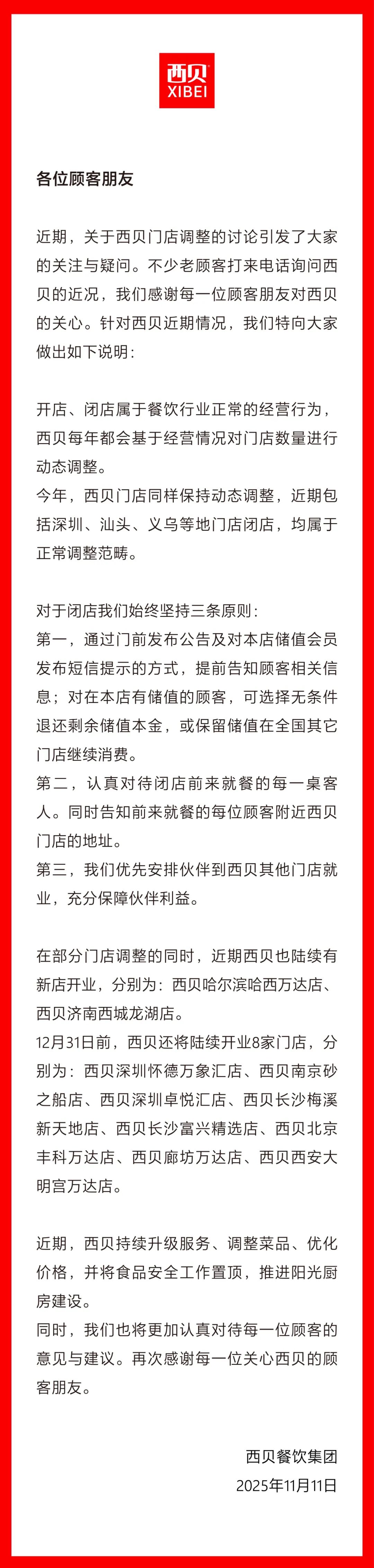
西贝的现状到底是什么?
Mei Ri Jing Ji Xin Wen· 2025-11-11 11:07
Core Viewpoint - The recent public discourse surrounding Xibei has shifted dramatically, with concerns about store closures contrasting sharply with reports of long queues at other locations, indicating a complex operational adjustment strategy by the company [1][7]. Store Operations - Xibei has been closing some stores in cities like Shenzhen and Shantou as part of normal operational adjustments, while simultaneously planning to open eight new locations by the end of the year [3][5]. - The company has implemented a policy to inform customers about store closures through announcements and SMS notifications, offering options for refunds or transfers of stored value to other locations [4]. Management Response - Founder Jia Guolong has taken a hands-on approach during a challenging period, focusing on improving product quality and customer service rather than engaging in public disputes [8][11]. - The company has emphasized transparency in food preparation processes to enhance customer trust, showcasing the cooking methods in-store [10][18]. Pricing Strategy - In response to consumer concerns about pricing, Xibei has reduced menu prices and issued substantial discount coupons, effectively doubling the value for customers [12][15]. - The strategy has successfully attracted both returning and new customers, with reports indicating a 20% increase in weekend traffic at some locations [15]. Customer Engagement - Xibei is focusing on rebuilding trust through a "scene revolution" in its stores, where cooking processes are made visible to customers, reinforcing the brand's commitment to quality and authenticity [16][18]. - The company aims to reconnect with its customer base by demonstrating improvements in service and product offerings, encouraging patrons to return and experience the changes firsthand [18].
上海:在机关、学校、医院、企业食堂等领域,全面推进“智慧食堂”模式
Xin Lang Cai Jing· 2025-11-11 10:13
Core Viewpoint - The Shanghai Municipal Commission of Commerce and four other departments have issued the "Shanghai Action Plan for Promoting Intelligent Layout in the Catering Industry (2026-2028)", aiming to enhance the efficiency and sustainability of the catering sector through smart technologies [1] Group 1: Smart Dining Initiatives - The plan promotes the "smart canteen" model across various sectors including government agencies, schools, hospitals, and corporate cafeterias [1] - It supports the establishment of online reservation platforms that utilize system reservation data to guide precise meal preparation, thereby reducing waste from the source [1] Group 2: Technological Advancements - The initiative encourages the widespread use of smart self-service meal cabinets and AI visual recognition payment systems to improve dining efficiency [1] - It promotes the adoption of automated cooking equipment such as smart cooking robots and automatic rice production lines to ensure standardized and stable meal output [1] Group 3: Nutritional Optimization - The plan encourages the introduction of AI nutrition analysts that can automatically generate balanced weekly meal plans based on the characteristics of the dining group [1]
尝高美集团(08371) - 自愿性公告 - 在香港开设一间新 San Roku Roku Pan ...
2025-11-11 08:31
香港交易及結算所有限公司及香港聯合交易所有限公司對本公布的內容概不負責,對其準確 性或完整性亦不發表任何聲明,並明確表示概不就因本公布全部或任何部分內容而產生或因 倚賴該等內容而引致的任何損失承擔任何責任。 業主為香港主要物業發展商及高級購物中心營運商。據董事經作出一切合理查詢後所知、所 悉及所信,於本公告日期,業主為獨立於本公司的第三方(定義見香港聯合交易所有限公司 (「港交所」)GEM證券上市規則(「GEM上市規則」))。 新餐廳:San Roku Roku Pan 餐廳,The Southside,黃竹坑 (於開曼群島註冊成立之有限公司) (股份代號: 8371) 自願性公告 在香港開設一間新 San Roku Roku Pan 餐廳 所訂立之租賃協議 本公告乃由嚐‧高美集團有限公司(「本公司」)自願作出,旨在向本公司股東及潛在投資者提 供本公司及其附屬公司(「本集團」)最新業務計劃及發展的最新資料。 本公司之董事會(「董事會」或「董事」)欣然宣布,本集團已透過其全資附屬公司簽訂了一 份新的租賃協議(「新租賃協議」),在香港開設一間新的 San Roku Roku Pan 餐廳(「新餐廳」)。 這家新餐 ...
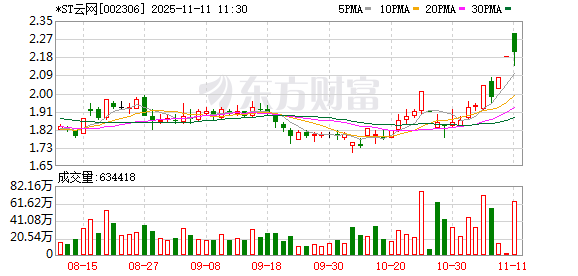
*ST云网录得5天4板
Zheng Quan Shi Bao Wang· 2025-11-11 04:00
*ST云网再度涨停,5个交易日内录得4个涨停,累计涨幅为18.04%,累计换手率为17.93%。截至9:25, 该股今日成交量129.68万股,成交金额296.97万元,换手率0.16%。最新A股总市值达19.92亿元,A股流 通市值18.64亿元。 | 日期 | 当日涨跌幅(%) | 换手率(%) | 主力资金净流入(万元) | | --- | --- | --- | --- | | 2025.11.10 | 4.81 | 0.40 | 363.99 | | 2025.11.07 | 5.05 | 1.81 | 1102.45 | | 2025.11.06 | -2.94 | 6.81 | -1344.44 | | 2025.11.05 | 5.15 | 8.75 | 707.73 | | 2025.11.04 | 0.52 | 4.04 | -799.85 | | 2025.11.03 | 3.21 | 5.55 | 233.54 | | 2025.10.31 | 0.54 | 2.88 | 81.50 | | 2025.10.30 | 1.09 | 4.13 | 244.58 | | 2025.10.2 ...
淮南楚禾牛肉汤有限公司成立 注册资本100万人民币
Sou Hu Cai Jing· 2025-11-11 03:40
天眼查App显示,近日,淮南楚禾牛肉汤有限公司成立,法定代表人为闪晶晶,注册资本100万人民 币,经营范围为许可项目:餐饮服务;食品销售(依法须经批准的项目,经相关部门批准后方可开展经 营活动,具体经营项目以相关部门批准文件或许可证件为准)一般项目:餐饮管理;外卖递送服务;农 副产品销售;商务代理代办服务;食用农产品批发;农产品的生产、销售、加工、运输、贮藏及其他相 关服务;谷物销售;食品销售(仅销售预包装食品)(除许可业务外,可自主依法经营法律法规非禁止 或限制的项目)。 ...
早报|下代iPhone Air将延期发布/闪迪价格暴涨50%/摩根大通CEO:未来发达国家每周只需上班三天半
Sou Hu Cai Jing· 2025-11-11 00:45
Group 1: Apple and iPhone Air - Apple has decided to postpone the release of the next-generation iPhone Air due to poor sales performance since its launch in September 2025, with no new timeline provided for its release [5][6] - The iPhone Air, which features a slim design with a thickness of only 5.6mm, compromises on battery capacity and camera configuration, offering only a single rear camera at a price of $999 [5] - The iPhone 17 Pro offers a better value proposition with a triple-camera system and longer battery life, highlighting the challenges Apple faces in positioning a fourth model beyond the standard and Pro series [5] Group 2: NAND Flash Market - SanDisk has announced a 50% increase in NAND flash contract prices due to supply constraints, with expectations of a continued upward trend in the market [21] - The NAND flash market is experiencing a supply-demand imbalance, which is anticipated to persist until at least the end of 2026 [21] Group 3: AI and Business Trends - According to McKinsey's report, 88% of companies have adopted AI, but only 39% have seen an increase in earnings before interest and taxes (EBIT), indicating a gap between efficiency gains and profitability [45][46] - High-performing companies are more likely to benefit from AI, with 50% planning transformative changes driven by AI, compared to only 14% of average companies [46] - The demand for AI-related roles is increasing, while traditional roles face replacement pressures, with 32% of companies expecting a decrease in total workforce in the next year [46] Group 4: Robotics and AI Developments - The first international robot debate competition concluded with Songyan Power winning the championship, showcasing the potential of robots in both physical and intellectual domains [34] - A new AI framework called "Cambrian-S" has been proposed by researchers to enhance spatial perception and long-term memory in AI systems, indicating a shift towards more advanced AI capabilities [40]


伦敦股市10日上涨
Xin Hua Wang· 2025-11-10 18:59
Core Points - The London Stock Exchange's FTSE 100 index closed at 9787.15 points on November 10, marking an increase of 104.58 points, or 1.08% from the previous trading day [1] - All major European stock indices experienced gains on the same day [1] Top Gainers - Fresnillo, a precious metals producer, saw its stock price rise by 5.38% [1] - Diageo, a beverage company, increased by 5.21% [1] - Endeavour Mining's stock rose by 4.45% [1] - Polar Capital Technology Trust's shares went up by 4.42% [1] - Scottish and Southern Energy's stock increased by 3.99% [1] Top Losers - London Stock Exchange Group's stock fell by 2.14% [1] - Rightmove, a UK real estate company, decreased by 1.78% [1] - Hikma Pharmaceuticals' shares dropped by 1.71% [1] - BT Group's stock declined by 1.25% [1] - Compass Group, a catering services company, saw a decrease of 1.04% [1] Other European Indices - The CAC 40 index in Paris closed at 8055.51 points, up by 105.33 points, or 1.32% [1] - The DAX index in Frankfurt closed at 23959.99 points, increasing by 390.03 points, or 1.65% [1]
【环球财经】伦敦股市10日上涨
Xin Hua Cai Jing· 2025-11-10 18:36
Core Points - The London Stock Exchange's FTSE 100 index closed at 9787.15 points on November 10, marking an increase of 104.58 points, or 1.08% from the previous trading day [1] - All major European stock indices experienced gains on the same day [1] Top Gainers - Fresnillo, a precious metals producer, saw its stock price rise by 5.38% [1] - Diageo, a beverage company, increased by 5.21% [1] - Endeavour Mining's stock rose by 4.45% [1] - Polar Capital Technology Trust's shares went up by 4.42% [1] - SSE, an energy supplier, experienced a 3.39% increase [1] Top Losers - London Stock Exchange Group's stock fell by 2.14% [1] - Rightmove, a UK real estate network, decreased by 1.78% [1] - Hikma Pharmaceuticals saw a decline of 1.71% [1] - BT Group's shares dropped by 1.25% [1] - Compass Group, a food service company, fell by 1.04% [1] Other European Indices - The CAC 40 index in Paris closed at 8055.51 points, up by 105.33 points, or 1.32% [1] - The DAX index in Frankfurt closed at 23959.99 points, increasing by 390.03 points, or 1.65% [1]