生物医药

Search documents
上海给未来五年加了什么buff?5个指标提前剧透
第一财经· 2026-02-06 00:49
Core Viewpoint - Shanghai aims for an average GDP growth rate of 5% over the next five years, a slight increase from the previous 4.9% during the "14th Five-Year Plan" period, indicating significant potential for growth despite a challenging external environment [3][4]. Group 1: Economic Growth Targets - The GDP is projected to exceed 7 trillion yuan by 2030, positioning Shanghai among the top three global cities, following New York and Los Angeles [4]. - Key indicators for the "15th Five-Year Plan" include an average annual growth rate of 10% for the three leading industries, a labor productivity exceeding 520,000 yuan per person, and a digital economy's core industry value-added accounting for over 20% of GDP by 2030 [4][5]. Group 2: Strategic Development Plans - Shanghai's "15th Five-Year Plan" outlines a modern industrial system characterized by "2+3+6+6," focusing on advanced manufacturing and the development of world-class high-end industrial clusters [5][6]. - The three leading industries—integrated circuits, biomedicine, and artificial intelligence—are expected to drive significant economic growth, with a focus on enhancing equipment capabilities and fostering innovation [6][11]. Group 3: Innovation and R&D - In 2025, R&D expenditure as a percentage of GDP reached approximately 4.5%, with a target of 12% for basic research investment intensity [6][13]. - The plan emphasizes the importance of enhancing labor productivity through talent development, technological innovation, and systemic reforms to create a conducive business environment [15][16]. Group 4: Future Industry Focus - The "15th Five-Year Plan" identifies six emerging pillar industries, including new-generation electronic information and intelligent connected vehicles, alongside six future industries such as quantum technology and brain-computer interfaces [11]. - The strategy aims to establish a dynamic adjustment mechanism to accelerate the development of future industries and ensure alignment with global technological advancements [11].

四川干部群众热议政府工作报告 以奋勇争先之姿,乘势而为
Si Chuan Ri Bao· 2026-02-06 00:23
Group 1 - The government work report highlights significant achievements during the "14th Five-Year Plan" period, including crossing two trillion yuan thresholds and exceeding 6 trillion yuan in economic output, marking a historic milestone for Sichuan [2] - The report emphasizes the importance of high-quality development and outlines key tasks for 2026, focusing on expanding domestic demand and promoting consumption and investment [2][3] - The report mentions the inclusion of Chengdu in the national pilot for market-oriented allocation of factors, which is expected to enhance the city's development in key sectors such as biomedicine and low-altitude economy [2] Group 2 - The report stresses the need for technological innovation and the integration of technology with industry, with a focus on fostering new growth drivers [3] - It highlights the importance of improving the quality of life for citizens, particularly in the area of elderly care, with a call for enhanced community-based services [3][4] - The report introduces the "Network Chain Sharing Plan," aimed at transforming educational resources into a collaborative and innovative teaching model, promoting balanced educational development across the region [4]
三十而立再出发 真抓实干开新局
Xin Hua Ri Bao· 2026-02-05 22:52
Core Viewpoint - The Jiangsu provincial government report highlights significant achievements over the past five years, emphasizing a commitment to high-quality development and modernization in Taizhou, aligning with Xi Jinping's directives [1] Group 1: Industrial Development - The focus is on enhancing competitiveness through tailored strategies for eight advanced manufacturing clusters, aiming for a total output value exceeding 800 billion yuan this year [2] - The integration of production and innovation is prioritized, fostering a dual pyramid system that encourages interaction between enterprise innovation and platform development [2] - A project-driven approach is adopted, enhancing leadership engagement with key industrial chains, parks, enterprises, and major projects to build strong momentum for future growth [2] Group 2: Open Economy - Significant progress has been made in integrating with Shanghai and southern Jiangsu, attracting high-quality resources for Taizhou's development [2] - The strategy includes establishing innovation and industry hubs, as well as talent centers, to deepen cross-river development initiatives [2] Group 3: Workforce and Culture - There is a strong emphasis on improving work culture and team effectiveness, promoting a mindset of competitiveness and resilience among all team members [3]
三大先导产业规模突破2万亿元上海加快培育发展新质生产力
Zhong Guo Zheng Quan Bao· 2026-02-05 20:27
上海市第十六届人大四次会议于2月3日上午开幕,上海市市长龚正作《政府工作报告》。根据报告,一 年来,上海市经济社会发展稳中有进、进中提质,经济持续回升向好。2025年,上海市生产总值达到 5.67万亿元、增长5.4%,好于预期。地方一般公共预算收入达到8500亿元、增长1.5%。 产业发展方面,报告显示,2025年,上海新质生产力加快发展,集成电路、生物医药、人工智能三大先 导产业规模突破2万亿元。今年上海将聚焦建设现代化产业体系,持续巩固壮大实体经济根基,在石 化、钢铁等行业持续开展数智技术、绿色技术改造和产线升级,在集成电路、生物医药、人工智能等领 域加快实施一批重大产业项目,积极支持智能网联新能源汽车、海洋经济、低空经济、航空航天、卫星 互联网等产业发展,培育特色数字产业集群,大力推动服务业扩能提质、集聚发展。 ● 本报记者 李梦扬 加快构建现代化产业体系 报告表示,2025年,上海聚力落实国家重大战略任务,"五个中心"建设扎实推进。加快构建现代化产业 体系,有力推进集成电路装备、零部件、材料、EDA软件等全产业链攻关,深入实施"模塑申城"工程, 完善高端医疗器械、智能终端、智算云、具身智能、商业航天等 ...
三大先导产业规模突破2万亿元 上海加快培育发展新质生产力
Zhong Guo Zheng Quan Bao· 2026-02-05 20:27
● 本报记者李梦扬 加快构建现代化产业体系 产业发展方面,报告显示,2025年,上海新质生产力加快发展,集成电路、生物医药、人工智能三大先 导产业规模突破2万亿元。今年上海将聚焦建设现代化产业体系,持续巩固壮大实体经济根基,在石 化、钢铁等行业持续开展数智技术、绿色技术改造和产线升级,在集成电路、生物医药、人工智能等领 域加快实施一批重大产业项目,积极支持智能网联新能源汽车、海洋经济、低空经济、航空航天、卫星 互联网等产业发展,培育特色数字产业集群,大力推动服务业扩能提质、集聚发展。 报告表示,2025年,上海聚力落实国家重大战略任务,"五个中心"建设扎实推进。加快构建现代化产业 体系,有力推进集成电路装备、零部件、材料、EDA软件等全产业链攻关,深入实施"模塑申城"工程, 完善高端医疗器械、智能终端、智算云、具身智能、商业航天等产业发展政策,推进大飞机规模化系列 化发展,制定实施脑机接口、量子计算、硅光、6G等领域未来产业培育方案,多措并举促进服务业创 新发展,产业基础高级化、产业链现代化水平进一步提升。 从数据来看,2025年,上海全社会研发经费支出相当于全市生产总值的比例达到4.5%左右;工业战略 性新 ...
国家药监局:“十五五”大力支持生物制造产业创新发展
Xin Lang Cai Jing· 2026-02-05 20:14
Core Insights - The National Medical Products Administration (NMPA) is focusing on supporting the innovative development of the biomanufacturing industry during the 14th Five-Year Plan period, transitioning from "follow-up innovation" to "systematic innovation" and from "scale-speed growth" to "quality-efficiency growth" [1] - In 2025, China approved 76 innovative drugs, showcasing its leading position in global R&D applications, with a trend towards complex frontier technologies, diversified innovation entities, and internationalized regulatory standards [1] - The medical device sector is also experiencing strong innovation, with 76 innovative medical devices approved in 2025, a 17% year-on-year increase, and a significant rise in priority approvals [1] Industry Developments - In 2026, the NMPA plans to strengthen drug safety risk management by enhancing risk prevention mechanisms and regulatory oversight across the entire drug clinical trial chain [2] - The focus will be on encouraging innovation while managing risks, particularly in the development of urgently needed drugs and the implementation of drug trial data protection systems [2] - The NMPA aims to improve the quality and efficiency of generic drug evaluations and strengthen post-marketing management of generic drugs [2] Regulatory Enhancements - The NMPA will enhance supervision of online drug sales and improve the drug information traceability system to increase risk management efficiency [2] - Specific attention will be given to new drug targets, AI-driven drug development, and cell and gene therapies, with expedited approval channels to accelerate the market entry of new and effective drugs [2]
上海给未来五年 加了什么“燃料”? 5个指标提前剧透
Xin Lang Cai Jing· 2026-02-05 17:13
Group 1 - Shanghai's GDP is projected to grow at an average annual rate of 5% over the next five years, up from 4.9% during the "14th Five-Year Plan" period, indicating significant progress despite a seemingly small increase [1][3] - The achievement of this growth target relies on three key factors: stronger support from new drivers, greater release of core functions from five centers, and substantial backing from major projects, particularly in emerging industries [1][4] - By 2030, if the 5% growth rate is maintained, Shanghai's GDP is expected to exceed 7 trillion yuan, positioning it among the top three global cities, following New York and Los Angeles [1] Group 2 - The three leading industries in Shanghai are expected to maintain an average annual growth rate of over 10% during the "15th Five-Year Plan" period [2][3] - Key indicators for Shanghai's economic development include labor productivity exceeding 520,000 yuan per person, digital economy core industries accounting for over 20% of GDP, and R&D expenditure reaching over 5% of GDP by 2030 [2] Group 3 - The "15th Five-Year Plan" outlines a modern industrial system characterized by "2+3+6+6," focusing on advanced manufacturing and the establishment of world-class high-end industrial clusters [3][5] - The plan emphasizes the digital and green transformation of traditional industries and the acceleration of the three leading industries, which include integrated circuits, biomedicine, and artificial intelligence [4][5] Group 4 - The three leading industries have a significant driving effect on Shanghai's economy, with their combined scale surpassing 2 trillion yuan [4] - Specific strategies for the three leading industries include enhancing the capabilities of the integrated circuit sector, accelerating drug development in biomedicine, and advancing AI technologies [4][6] Group 5 - Shanghai aims to maintain a reasonable industrial proportion while focusing on enhancing quality and competitiveness in manufacturing, which is crucial for supporting technological innovation and the construction of five centers [5][6] - The city plans to solidify its industrial system and leverage existing industrial foundations to foster new growth engines and optimize resource allocation [5][6] Group 6 - The "15th Five-Year Plan" proposes the development of six emerging pillar industry clusters and anticipates six future industries, including advanced materials and quantum technology [7] - The focus on future industries includes areas such as brain-computer interfaces, controlled nuclear fusion, and biomanufacturing, which are expected to have high growth potential [7] Group 7 - Labor productivity is a key indicator for economic and social development, with a continued emphasis on improving productivity during the "15th Five-Year Plan" [9][10] - Enhancing labor productivity will depend on talent development, technological innovation, and systemic reforms to create a favorable business environment [10]
北京市大学生创业板企业累计达447家
Xin Lang Cai Jing· 2026-02-05 17:12
Core Insights - The Beijing University Student Entrepreneurship Board (Dachuang Board) recently held a collective listing ceremony for 53 new companies, marking their official entry into the board and enabling them to benefit from various policies and capital market services [1][2] - Over the past decade, the Dachuang Board has seen a total of 447 companies, with a registered capital exceeding 3.2 billion and cumulative financing surpassing 14 billion, creating over 8,000 job opportunities [1] Group 1 - The Dachuang Board was established in 2016 as a pioneering regional equity market segment, focusing on high-tech industries such as biomedicine, artificial intelligence, and new materials [1] - Beijing has provided over 20.95 million in support funds, ensuring a free process for companies to get listed and reducing operational costs for startups [1] Group 2 - To address the challenges of "difficult and expensive financing" for student entrepreneurship, Beijing has developed a diversified financing system that includes equity, debt, and special funds, launching the "Qingteng Plan" to support projects from inception to realization [2] - A demonstration service base of 1,100 square meters has been established to incubate and promote Dachuang Board companies, facilitating tangible and visible operations for student entrepreneurship [2]

北京协和医学院携手东城打造“协和创新港”
Xin Lang Cai Jing· 2026-02-05 17:12
Core Viewpoint - The "Xiehe Innovation Port" project aims to create a comprehensive ecosystem for innovation in the medical field, focusing on drug development, vaccines, high-end medical devices, and AI in healthcare, with a target investment of 4 billion yuan [1][2] Group 1: Project Overview - The "Xiehe Innovation Port" is initiated by the Chinese Academy of Medical Sciences and Peking Union Medical College in collaboration with the Dongcheng District government [1] - A cooperation agreement was signed to establish a transformation fund with a target scale of 4 billion yuan [1] - Nine partners, including major health and pharmaceutical companies, have expressed intent to collaborate on the project [1] Group 2: Development Goals - The project focuses on creating a closed-loop ecosystem that encompasses "original innovation - clinical validation - results transformation - industrial landing" [2] - It aims to cultivate dozens of high-tech enterprises by 2030 and form a biopharmaceutical industry cluster [2] - The Dongcheng District will provide comprehensive support, including space and policy resources, to facilitate the project's development [2]
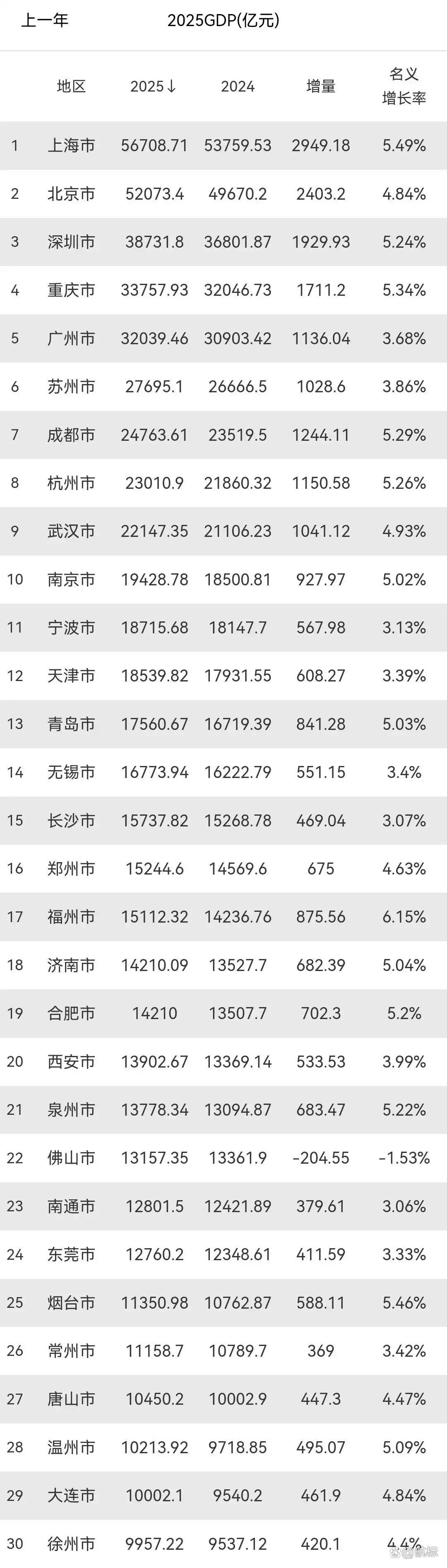
2025年GDP30强城市洗牌,成都远超杭州,郑州突破1.5万亿,泉州逆袭佛山,徐州入围!
Sou Hu Cai Jing· 2026-02-05 17:11
Core Insights - The annual city GDP rankings reflect a competitive landscape, showcasing both expected leaders and surprising "dark horses" in 2025, illustrating the distribution of economic vitality across different cities in China [1] Group 1: GDP Rankings and Growth Rates - Shanghai leads with a GDP of 56,708.71 billion yuan, showing a growth rate of 5.49% from the previous year [2] - Beijing follows with a GDP of 52,073.4 billion yuan and a growth rate of 4.84% [2] - Shenzhen ranks third with a GDP of 38,731.8 billion yuan, growing by 5.24% [2] - Chongqing and Guangzhou round out the top five, with GDPs of 33,757.93 billion yuan (5.34% growth) and 32,039.46 billion yuan (3.68% growth) respectively [2][3] Group 2: Economic Drivers and Trends - Shanghai's economic leadership is attributed to its strong focus on technology innovation, particularly in integrated circuits, biomedicine, and artificial intelligence, which together exceed 20 trillion yuan and account for nearly half of the city's industrial output [5] - Chengdu's GDP surpasses 24.7 trillion yuan, driven by a dual focus on consumption and industry, with retail sales exceeding 1.14 trillion yuan, contributing over half to its economic growth [7][8] - The transformation of traditional cities like Xuzhou into modern economic hubs, exemplified by its solar energy production, highlights successful industrial transitions [5] Group 3: Competitive Dynamics - The competition between Chengdu and Hangzhou illustrates different growth strategies, with Chengdu focusing on comprehensive development and Hangzhou emphasizing service industries, which constitute 73.8% of its GDP [7][8] - Zhengzhou's GDP surpassing 1.5 trillion yuan showcases its strategic advantage as a national central city, leveraging its transportation network to boost manufacturing and electronic information sectors [8] - The notable shift in rankings between Quanzhou and Foshan, with Quanzhou's diverse industrial base leading to a GDP of 13,778.34 billion yuan, emphasizes the importance of economic resilience and adaptability [8]